Europe: Uncontrollable hiccups
Niall Ferguson expects euro area headline inflation, measured by the harmonised index of consumer prices, to peak near 3.5% in late 2026 or early 2027 and to return to 2% in 2H2027. This is a higher peak than consensus and a longer return to target than in the European Central Bank’s adverse scenario. The return to 2% inflation was never sustainable. Imported disinflation from Chinese manufactured goods had been masking broad but shallow inflation in domestic services, and the current shock now arrives with no disinflationary buffer. Accordingly, Niall expects the ECB to hike rates by 50 bps by year-end. His views on US and EU rates and inflation translate to a minimally stronger euro than the market is pricing; Niall sees the EURUSD spot price at 1.178 and the one-year forward at 1.193. Europe’s second inflation shock in four years will prove less acute than the first but harder to shake.
Copper: Lack of supply growth vs rising inventories
David Radclyffe's copper coverage totals ~63% of global mine production. Copper supply continues to wrestle with many legacy headaches from 2025, mixed with the Iran conflict and its implications for diesel and sulphuric acid supply. There is therefore downside supply risk. However, the current oil disruption has implications for global growth and copper demand. Worryingly, David points out that copper inventories are rising rapidly. His coverage universe implies 0.9% annual contraction in refined copper supply in 2026, following a strong 2025. Weak supply growth for 2026, even with moderate demand growth, is at odds with strongly rising terminal market inventories, now at 1,267kt, adding to price risk. Copper is a crowded long trade, with caution warranted. The sector is not particularly cheap at spot 1.6x P/NPV10 and 9x EV/EBITDA. Antofagasta PLC is cut to HOLD. Preferred stocks include Lundin Mining Corp, KGHM Polska Miedz SA, Ivanhoe Mines Ltd, Grupo Mexico SAB de CV, Hudbay Minerals Inc and Teck Resources Ltd.
Senegal: Ongoing talks but as yet no IMF programme
Maximilian Hess observes that Senegal is in the throes of a financial crisis caused by the revelations of large amounts of ‘hidden’ debt contracted by the previous government, that has seen an additional 20-30% of borrowing as a percentage of GDP uncovered. The government has leaned on its monetary union, WAEMU, to meet its debt service with local currency issuance. While the WAEMU market has demonstrated surprising liquidity, Senegalese and regional banks are approaching (or have met) their regulatory limits for state debt. Senegal is negotiating with the IMF for the resumption of a USD 1.8 billion facility suspended in October 2024. The Fund noted strong GDP growth, better-than-expected primary and current account performance, and moderate inflation, in 2025, though it expects Senegal’s fiscal and macroeconomic picture to materially deteriorate in 2026. The IMF said that ongoing talks are “complementary to a programme” but are primarily on structural reforms and capacity development.
Japan: Yen under the cosh
The yen breached Y/$1.60 on Thursday and JGBs are under pressure again after Trump signalled that a prolonged blockade on the Strait of Hormuz may be necessary. Ironically, Graham Turner points out that it may not be the inflation numbers that undo the Japanese bond market: the data had been benign in recent months and the BoJ has time on its side and can wait. The problem is the Japanese Government’s insistence that it can hike defence spending, without compromising on other areas of spending. Markets had been persuaded by the new prime minister’s claim that a "responsible expansionary fiscal policy" could work. Ironically, the trade and manufacturing data in Japan suggests that the Takaichi Government can be more prudent: it can afford to accommodate higher defence spending without resorting to more borrowing. It just chooses not to. The long end of the JGB market will react before too long.
Financials
Anas Abuzaakouk (CEO since Aug 2017, joined 2012) bought 30,000 shares at €149, spending €4.5m. He has a great track record based on his 21 prior purchases. This is his single largest purchase and the highest price he has paid. He last bought in Oct 2025 at €108. Smart Insider has ranked the stock several times based on his prior activity, with the majority of those signals proving to be very timely. They are ranking the stock +1 (highest rating).
Technology
JNK’s analysis suggests LSCC is tracking ahead of guidance, with Q1 supported by strong bookings extending into 1H27 and a book-to-bill above 1.2. However, this strength is partly driven by Greater China customers pulling forward demand ahead of a ~15% price increase implemented in March 2026, with regional shipments running ~25% above Q4 levels. Lead times remain elevated at over 26 weeks, constrained by substrate and packaging rather than wafer capacity. With servers accounting for ~60% of revenue and exposure to Intel and AMD platforms, the company also benefits indirectly from AI-related demand. JNK's analysis suggests pricing can support growth even if volumes soften.
Materials
GMR cuts FCX to Sell following further production downgrades at Grasberg, with the ongoing impact of the 2025 “Mud Rush” now expected to persist through 2027. They estimate cumulative production losses of 952kt of copper, 1.5Moz of gold and 6.6Moz silver over 2025-2029, equating to $19.2bn of lost revenue at spot prices (or $15.4bn on GMR’s base case price forecasts). GMR has cut 2026/27 EBITDA forecasts by 15-21% and reduced its valuation by 27%, arguing the recent share price reaction underestimates the severity and duration of the impact. With risks of further downgrades and rising capex, downside remains.
Identifying stock swaps within your portfolio
Mill Street's Swap Shop report reflects frequent interest from equity portfolio managers in using their MAER model (the Monitor of Analysts’ Earnings Revisions) to identify problematic low-ranked holdings and provide high-ranked substitutes that preserve overall portfolio allocations. The screens take advantage of MAER’s strong intra-sector or intra-industry ranking performance to allow managers to stay not only within a benchmark universe but also identify stocks within specific industries as potential swaps to keep sector / industry weightings consistent. This month they include swap screens for Global Technology / Communication Services stocks and Global Energy / Materials sectors stocks to capture the key topical themes of Tech / AI and commodity prices. Also included are the regular screens for the S&P 500 universe and their European stock universe. Click here to access the report.
Global liquidity will not bottom before 2027
Michael Howell points out that the global liquidity cycle peaked in Q3/2025 and is not slated to bottom before 2027. He has pared back risk exposure as the underlying currents driving liquidity lower will ultimately dominate geopolitical twists and turns. Economic activity is still slated to recover through 2026, even if the Iran conflict extends. Global liquidity looks more vulnerable than the broader economy. It was already falling pre-conflict, and higher oil prices, bond volatility (MOVE), and a stronger USD have further dented it, with the Global Liquidity Index (GLI™) falling to 44.1 in March from a December peak of 56.1. Bond market moves confirm this deterioration in global liquidity. Yield curves are inflecting lower and falling term premia highlight a demand for safety. Gold, meanwhile, is underpinned by China’s ongoing ‘monetisation’. Higher gold must translate into higher oil and other commodity prices.
The best 3 space exploration stocks to buy in 2026
Technology
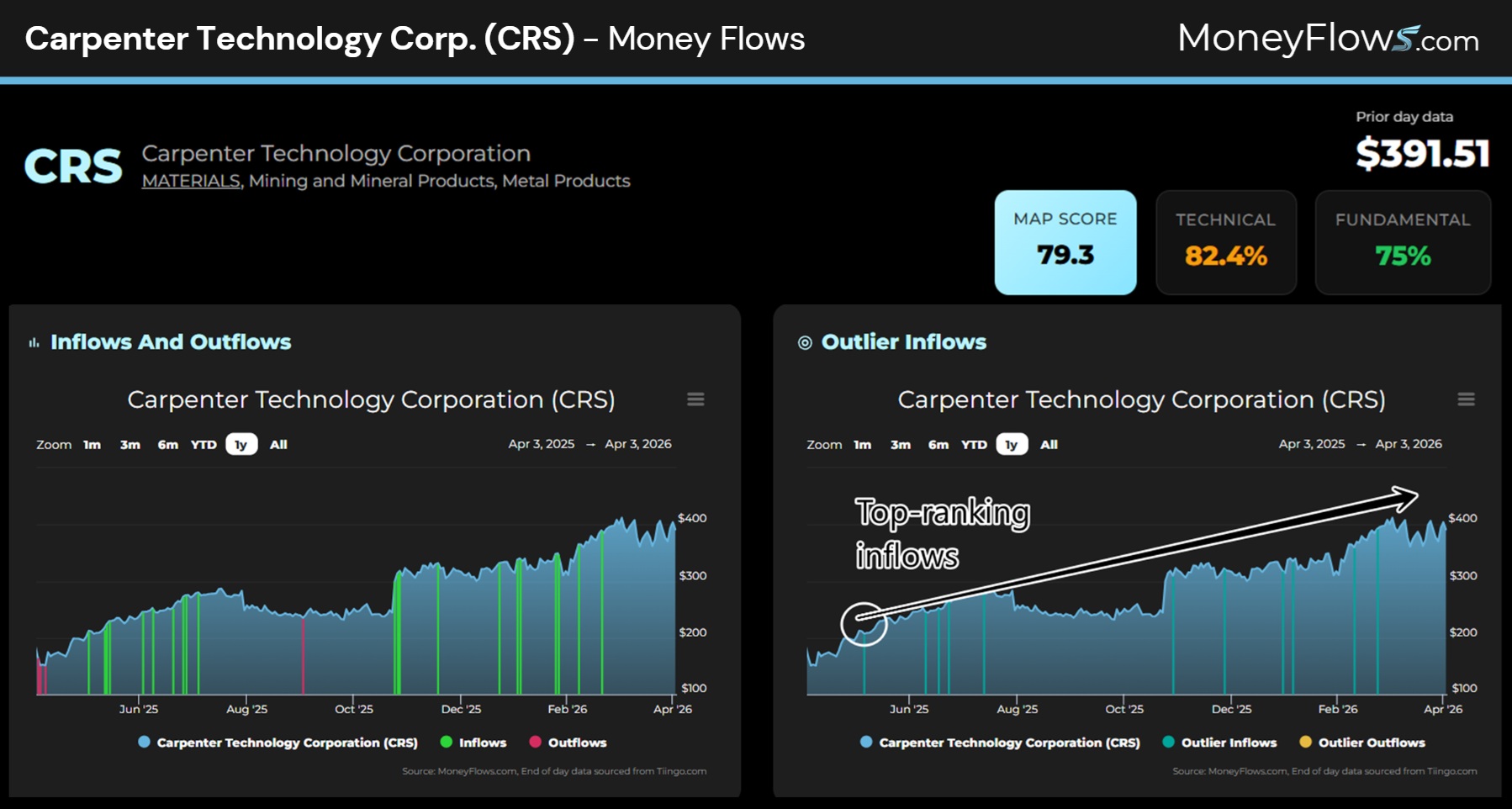
The space economy is a major structural growth theme, expected to expand from ~$614bn in 2024 to >$1.8tn over the next decade, with opportunities extending beyond rockets into the broader infrastructure stack. MAPsignals’ edge lies in identifying institutional inflows before the narrative becomes consensus, using its “Big Money” framework to find winners early. For example, Teradyne was flagged at ~$90 last June and has since surged to ~$342 on sustained inflows, with further upside anticipated. Applying the same process, they also highlight Carpenter Technology and Palantir as beneficiaries of the space buildout, supported by persistent institutional buying - including “non-stop” inflows into Carpenter. Tomorrow’s leaders are found by following the flows, not the headlines.
Consumer Staples
Following publication of its FY25 annual report Iron Blue lifts their RKT score +2pts to 28/60 (top quartile / fertile grounds for shorting). This reflects 1) 7-year high stripped out restructuring charge; 2) another spike lower in balance sheet trade spend accruals; 3) reduced inventory and bad debtor impairment provisions; 4) various additional risks related to NEC litigation, HS compensation changes and UK Suboxone civil proceedings within RKT’s contingent liabilities disclosures; 5) another increase in KPMG’s non-audit fees; and 6) the 14% discretionary upward adjustment to the CEO’s annual bonus to reflect strong share price performance (which compares with shares -14% FY26 YTD).
Mining equities in turbulent markets
The US-Israeli war with Iran and oil shock has resulted in some of the most volatile markets of recent times. Higher oil prices are clearly inflationary; however, the larger short-term risk for the miners is arguably the supply of liquid fuel. Slowing global growth could erode copper demand; the copper sector P/NPV10 and +1 year P/CF is trading close to previous tough levels with a spot FCF yield of 5.2% being attractive. Gold equities are still attractive with the market imputing lower spot prices today. The shares are cheap on a cash flow basis with a 6.9% spot FCF yield. Gold sector margins are still robust with better balance sheets compared to peers. Copper and gold equities have corrected, and value opportunities have emerged. Preferred coppers are Antofagasta PLC, Lundin Mining Corp and Ivanhoe Mines Ltd, whilst least preferred are First Quantum Minerals Ltd and Southern Copper Corp. Preferred golds are Barrick Gold Corp, Agnico Eagle Mines Ltd and Kinross Gold Corp.
China: Tapping SOE profits
Dinny McMahon notes that in a recent explainer, the finance ministry (MoF) revealed that last year it hiked up SOE profit remittance ratios, as he anticipated. In China wholly owned SOEs are obliged to remit a portion of their profits to the government. Most non-financial, centrally-owned SOEs are classified into one of five categories depending on their business line, subjecting them to profit remittance rates ranging from 0%-25%. In 2025, MoF merged Tier-1 and 2 SOEs into one group and raised their remittance ratio to 35%. This covers China Tobacco, the three major telecommunication and petroleum firms, and electricity utilities and grid firms. MoF also raised the profit remittance ratio for what had previously been Tier-3 firms – which cover SOEs operating in competitive sectors like mining, transportation, and trade – from 15% to 30%. It raised the ratio for Tier-4 firms from 10% to 20%. Dinny wonders if local governments will follow suit and ramp up profit remittance ratios for locally-owned SOEs?
Technology
The semiconductor distribution channel is posting ~40% Q/Q revenue growth in 1Q26, but the composition tells a more nuanced story than the headline suggests. JNK's supply chain checks show 800G optical module demand at a 2-year high, with all global Tier 1 makers pulling orders and Broadcom Tomahawk 6 extending the cycle into 2H26; simultaneously, the ASIC-to-GPU semi revenue mix is shifting from 80/20 towards 60-70/30-40, positioning MRVL as the most direct beneficiary. On the consumer side, Apple/iOS is outperforming seasonal patterns (+10% Q/Q vs. flat expected in Q4), though component buyers stocking ahead of tariff increases are raising H2 inventory correction flags. The divergence between data centre acceleration and consumer pull-in risk shapes the setup for H2.
Financials
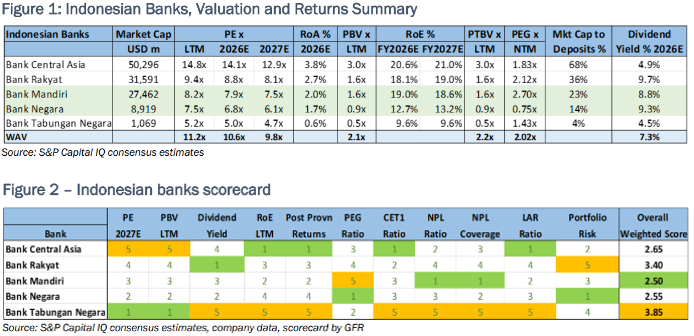
Victor Galliano upgrades Bank Mandiri and Bank Negara to Buy on better-than-expected credit quality, attractive valuations and signs the government is reining in market-unfriendly policies. Both banks screen well on fundamentals (fig 1) and in his proprietary scorecard (fig 2). Mandiri is his top pick, driven by strong credit quality and solid returns, supported by mid-ranking valuations. Low NPLs underpin a declining cost of risk and improving post-provision returns, while returns relative to valuation are very attractive. With PBV near a three-year low and bond yields elevated, he sees scope for a valuation uplift if yields ease. Negara’s valuations are close to deep value and, although return trends remain uninspiring, it has the lowest MSME exposure of the peer group and second best NPL coverage.
Technology
The group's competitive moat is anchored by three mutually reinforcing advantages: 1) a proprietary, cloud‑native payments infrastructure with direct integrations into 50+ national payment systems across the world, creating a durable cost leadership position that compounds with scale; 2) a Mission Zero pricing philosophy, that continuously reinvests operational efficiencies and scale benefits into lower prices, driving organic volume growth and deepening customer stickiness; and 3) a growing platform business, which is transforming potential competitors into distribution partners, expanding the company's netting pool and lowering unit costs across the entire network. 2Xideas forecasts 14.7% revenue CAGR and 15.9% underlying income CAGR to FY32E. Assuming a conservative 20x exit NTM P/E, this supports ~17.5% annualised TSR.
Europe: Uncontrollable hiccups
Niall Ferguson expects euro area headline inflation, measured by the harmonised index of consumer prices, to peak near 3.5% in late 2026 or early 2027 and to return to 2% in 2H2027. This is a higher peak than consensus and a longer return to target than in the European Central Bank’s adverse scenario. The return to 2% inflation was never sustainable. Imported disinflation from Chinese manufactured goods had been masking broad but shallow inflation in domestic services, and the current shock now arrives with no disinflationary buffer. Accordingly, Niall expects the ECB to hike rates by 50 bps by year-end. His views on US and EU rates and inflation translate to a minimally stronger euro than the market is pricing; Niall sees the EURUSD spot price at 1.178 and the one-year forward at 1.193. Europe’s second inflation shock in four years will prove less acute than the first but harder to shake.
Technology
Electronic-grade solvent allocation stopped for non-contract customers across Asia as of early Mar 26. No spot supply is available at any price in Taiwan, South Korea or Singapore. Force majeure from Formosa Petrochemical and PCS, combined with cracker cuts at LG Chem and Lotte Chemical to 54-73% utilisation, pushed naphtha-derived feedstock prices ~30% higher. The disruption spans legacy analog, DRAM, NAND and leading-edge logic with no node insulated. Conductive carbon black, a separate petroleum-derived passive component input, is developing a parallel shortfall into a supply chain already running at near-80% utilisation. China based foundries serving MPWR and STM are the base case for 2Q26 impact. Click here to access JNK’s note.
Real Estate
MRL sees a double upgrade from Smart Insider, moving to +1 (highest rating) following two notable insider purchases. The initial upgrade was driven by Senior Officer Fernando Ramírez Baeza (€152k at €14.05), a larger-than-usual buy into strength from an insider with a strong track record. This was followed by a €1m purchase from long-serving Non-Executive Fernando Ortiz Vaamonde - the largest of his 5 buys, at the highest price he has paid and his first since 2020.
Consumer Discretionary
John Zolidis’ investment case is based on a positive inflection in same-store sales producing valuation expansion as investors give more credit to unit growth and the longer-term opportunity. He believes this thesis remains intact as comps improved to -1.4% in FY25 (vs. -5.1% in FY24) and have turned positive in early FY26, with Q1 likely >2%. While the recent >10% share price drop reflects macro concerns and weak transaction trends (-6.4% in Q4), John views this as partly intentional, driven by ~10% price increases and a shift towards higher-income customers. This mix shift should support higher gross profit per ticket despite lower traffic. With the shares trading at 8x P/E and 5x EV/EBITDA (FY26 estimates) and a 9% FCF yield, ASO is a “bargain”, with an eye towards the upcoming analyst day as a near-term positive catalyst.
Nickel may yet surprise
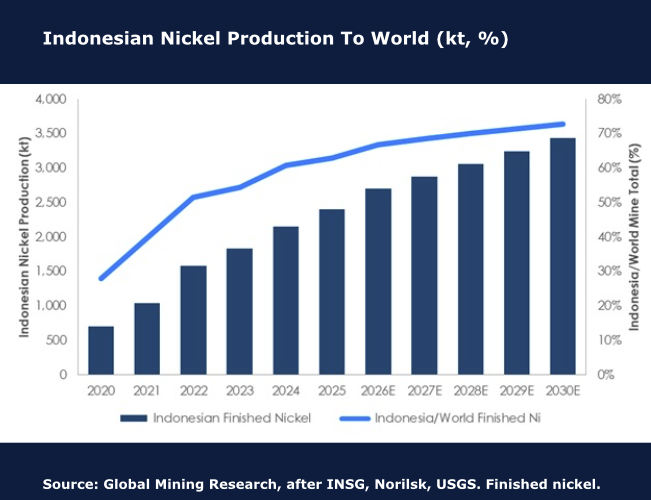
Recent events brought spot nickel up to ~US7.80/lbafterabriefreturnto US8.00/lb. The three major developments that led to this are the Iran war, a decision by the Indonesian government to dramatically cut thermal coal mining permits from 790Mt to 600Mt, and another decision to cut laterite nickel mining permits to 260-270Mt versus 2025 at 379Mt. GMR has calculated an annual nickel demand growth rate at 6.2% CAGR over the last decade, but the unceasing volumes from Indonesia (see chart) have been the issue. New changes may see parts of the global nickel cash cost curve move by ~US$1.50/lb. If laterite ore is really cut back heavily, then the price impact should add to that, but very large inventories could limit substantive price moves for some time. This is all potential; good news for producers like Vale SA, Glencore PLC or MMG Ltd. It’s too late for the Cuban producers where the lack of fuel is triggering closures.
US: The case for 10% unemployment
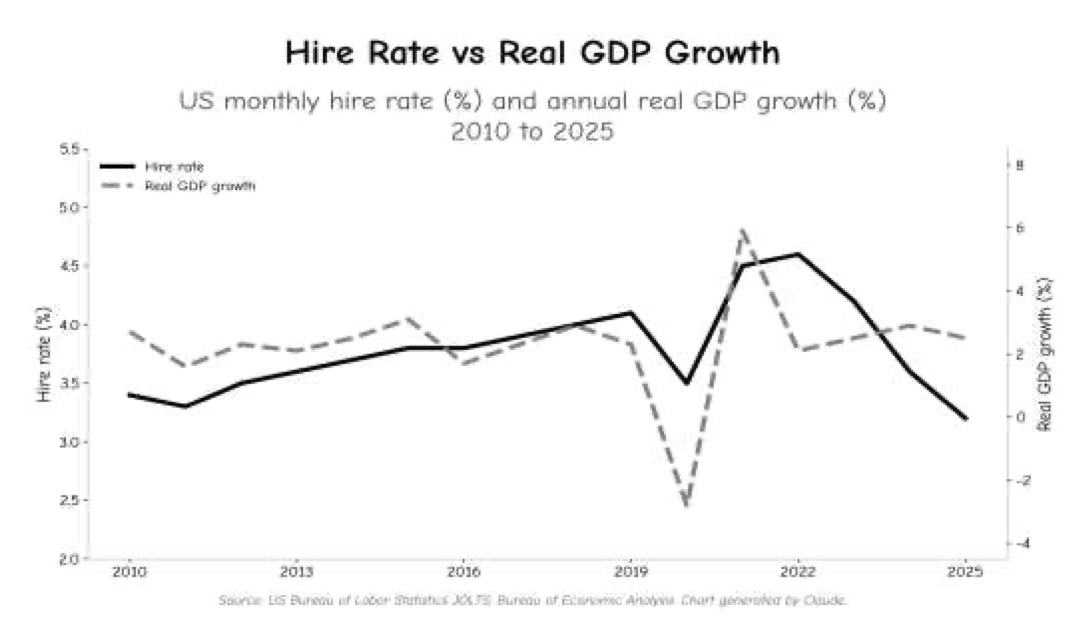
Paul Krake’s latest report rebukes the argument that AI-driven job displacement will be absorbed by new industries generating new work. It is an argument that Paul claims is taken seriously in policy circles, investment committees, and corporate boardrooms, yet it is deeply flawed. The hiring data already shows this, with the hire rate having falling 29% since the post-pandemic peak yet GDP has grown by 8% (see chart). AI is amplifying the pattern that labour is not required for growth. Just a 1 in 10 displacement of knowledge workers, which represent 45% of the US labour force, is enough to push unemployment towards 9% without a recession. Paul claims that the frameworks used to detect labour market stress are not built for an economy where growth and hiring decouple permanently. By the time the unemployment rate confirms what the hire rate has been signalling since 2022, the adjustment will have been compounding for a decade. 10% unemployment in the years ahead is not a tail risk, it is the base case.
The Euro’s extremely important juncture
The Euro’s (€1.1416) monthly chart shows a breakout from a 17-year Down-channel, with the currency trading as high as €1.2083 in January this year, up 27% from the Sep 2022 low. Chris Roberts comments how a sustained breakout from the channel, following the 14-year, 40%+ fall in 2008-22, could potentially be very bullish. The near 6% fall from the recent high has taken the Euro back to the rising 20-month WMA and the 9-month RSI back to Neutral 50. Chris is 40% long from €1.1572 and would look to add on a break above the Jan high. His stop stays at a daily close below €1.0954.
Space: A slow burn for investors
Industrials
Japan’s space sector remains in transition: technically ambitious, strategically important and increasingly commercial, but still fundamentally dependent on launch reliability and policy execution, with recent progress overshadowed by several high-profile setbacks. Looking ahead, Neil Newman highlights 3 developments which would signal meaningful acceleration in the sector and potentially justify thematic investment consideration: 1) improving the reliability and cadence of H3 launches; 2) continued deployment and monetisation of Earth-observation and SAR constellations; and 3) stronger government procurement as space capabilities become embedded in national infrastructure and security policy. Companies flagged in Neil’s report include Mitsubishi Heavy Industries, Mitsubishi Electric, NEC, IHI, iSpace, Astroscale, Synspective and Axelspace.
Financials
Victor Galliano upgrades the stock to Buy, arguing that the recent partial disposal of its stake in Nintendo could mark the start of a broader unwind of the bank’s large strategic equity portfolio - its primary source of potential shareholder value creation. The sale generated a ¥75.1bn gain (c.¥90bn proceeds) and reduced Kyoto’s stake from 4.2% to 3.3%, though the remaining holding still represents more than 30% of the bank’s market value. With ¥160bn in gains on stock sales, Kyoto has also been able to crystallise roughly ¥90bn of losses on government bonds, bringing its unrealised losses on the domestic government bonds still on its balance sheet close to zero. Kyoto trades at the lowest PBV among Japan’s top ten banks, while its 4.1% dividend yield also has scope to rise.
Regulated Utilities: No place to hide - compressing equity risk premiums
Utilities
Canadian regulated utilities are up ~10% YTD, outperforming the TSX, as rising geopolitical risk has driven a flight to safety and multiple expansion across defensive sectors. The re-rating has pushed equity risk premiums to levels that are difficult to justify against the prevailing rate backdrop and Veritas believes risk-adjusted returns have become materially less compelling at current valuations and recommends underweighting the sector. Their report covers Canadian-listed regulated utilities in their coverage (Emera, Fortis, Hydro One, Canadian Utilities, ATCO). Veritas’ analysis is structured around 3 analytical pillars: 1) current sector valuations relative to a yield-implied terminal capitalisation framework; 2) the macro backdrop governing utility equity performance; and 3) the company-level funding dynamics that determine whether rate base growth translates into per-share value creation.
Bear’s Den Idea Forum
Short-focused events consistently rank among MYST’s best-performing Idea Forums with their last one yielding a ~70% hit rate and ~8.7% average positive alpha. The dominant theme at this meeting centred on companies confronting new competition driving share loss and margin compression, while other high-level topics included businesses facing AI-related challenges; “fading” cyclical recoveries; and GLP-1-driven demand destruction. MYST felt Calix (BEAD subsidy unwind favours lower-cost solutions + forensic red flags) and TransMedics (organ transplant tech leader facing share loss amid new competition) were “unique” and worth investigating, while convincing bearish arguments were also presented on A.O. Smith, Dollar General, Old Dominion Freight Line and Uber.
Consumer Discretionary
the IDEA! remains constructive on the stock following FY25 results, highlighting strong ecosystem monetisation, robust cash generation and disciplined capital returns as key pillars of the investment case. The Polish marketplace continues to fund international expansion while sustaining attractive incremental margins, with ~63% drop-through. Management reiterated its leverage framework centred around ~1x net debt/EBITDA and announced a further PLN 1.6bn FY26 buyback, which the IDEA! sees as offering downside support. However, they caution that management may be underestimating the competitive trajectory of Chinese cross-border platforms such as Temu and Shein. While EU parcel duties from July could slow growth, the competitive threat is unlikely to disappear and could pressure domestic GMV growth over time.
Buy the dip on China tech
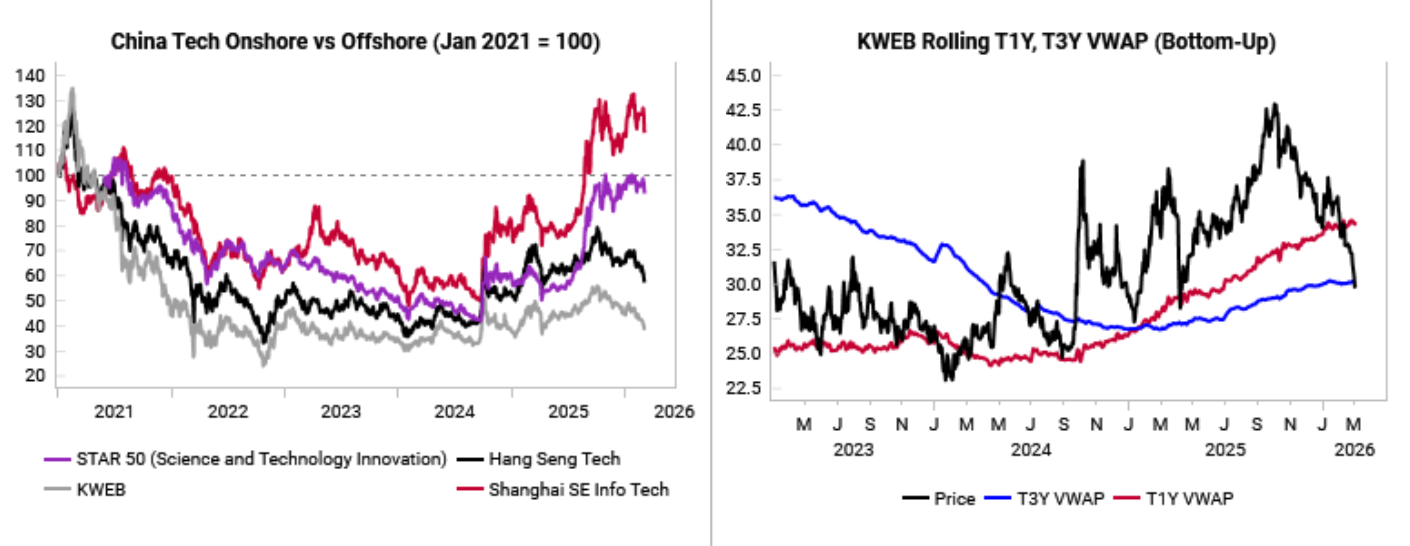
Offshore Chinese tech equities have materially lagged onshore equities over the past 6 months, suffering big drawdowns even as onshore equities make new highs. The KWEB China Tech ETF has now fallen down major support levels at the T3Y VWAP (see charts). The Variant Perception team are starting to see more LPPL crash exhaustions signals for Chinese tech stocks, while their fast money speculative flow proxy shows that they are approaching contrarian buy levels for KWEB. MSCI China is now underperforming the MSCI EM index by a wide margin, with the trailing 1-year relative performance below -2 standard deviations. Despite this, Chinese small caps have been outperforming large caps, a positive divergence that bodes well for future Chinese equity returns. There is a chance the Iran situation will worsen, and Chinese assets will be further caught up in the energy shock, but there is already a decent amount of dislocation priced into Chinese tech equities. Ultimately, this is an attractive entry point for investors.
Brazil: Stagnation ahead
In the fourth quarter of 2025 Brazil’s GDP rose 0.1% QoQ s.a., broadly in line with the market median (0.1%) and BuySideBrazil’s projection (0.0%). Compared to 4Q/2024, GDP increased 1.8%. In Q4/2025 Brazil’s economic growth relative to 3Q/2025 was mainly driven by stronger exports and services. Services, slightly above expectations, posted a positive performance in the quarter, supported by higher consumer income amid a still-robust labour market. However, Andrea Damico says this momentum already shows signs of exhaustion, with a potential turning point in H1/2026. The key highlight is the sharp slowdown in domestic demand, with the weakest marginal performance in domestic absorption and private consumption since the end of the pandemic in 2021. The clearest sign of this fragility was the sharp decline in imports. Overall, this data reinforces Andrea’s view of cooling economic activity and stagnation in the first half of 2026. BSB’s projection for 1Q/2026 is 1.1% QoQ s.a.
Consumer Discretionary
Hedgeye provides updates on 3 of their top Retail shorts. For GIII, they expect the next guide for the year to be an absolute disaster; forecasting a 20%+ cash flow hit from the the loss of major Calvin Klein and Tommy Hilfiger licenses back to PVH, while prior channel stuffing and tougher retail conditions could force the company to increase markdown support to key partners. Meanwhile, VFC is caught between a heavy debt burden and weakening brand momentum; Hedgeye believes a massively dilutive equity raise will ultimately be required. And finally, DDS remains a mispriced security, trading at ~12x EBITDA despite a sharply decelerating model and the company overearning by 800-1,000bp. That suggests that the real earnings power is between $10-20 per share. 5x earnings, is an appropriate department store multiple, suggesting 80-90% downside.
Online travel & AI
Consumer Discretionary
Robert Mollins examines how OTAs are adapting to a rapidly changing environment driven by rising AI adoption. He focuses on 4 key themes: 1) AI as an emerging traffic channel; 2) structural advantages limiting disintermediation risk; 3) consumer-facing AI development across travel platforms; and 4) internal AI initiatives driving monetisation and cost-saving opportunities. AI companies have rapidly integrated tools into their assistants, raising concern over the technology’s ability to replicate functionality and reduce dependency on established platforms. Investor concern has extended beyond software into sectors with significant digital exposure, including online travel. While Robert acknowledges these risks, he believes AI assistants are more likely to evolve into a paid traffic channel rather than a vertically integrated travel marketplace capable of displacing Booking, Expedia and Airbnb.
China: Channel checks on leading coffee & tea brands
Consumer Discretionary
The competitive environment across the country's leading beverage chains appears to be shifting from aggressive subsidy-led share grabs towards more rational pricing and product-led differentiation. For global investors, this suggests: 1) margin recovery potential after a prolonged discount cycle; 2) strengthened positioning for category leaders with innovation capabilities; and 3) continued consolidation towards scaled operators with diversified product offerings. Luckin’s near-term fundamentals look resilient with Jan SSSG likely >10% and pricing/ASP recovering sequentially. Mixue was modestly softer due to the CNY timing shift, while Guming was a clear relative winner among tea chains with SSSG/GMV +10-15% (still HSD even ex delivery fees) and momentum likely improved further in Feb on holiday & platform campaign effects.
Industrials
With a market cap of $3.6bn, Nichias is an industrial insulation company that Asymmetric has followed for over 20 years. While the shares have outperformed the TOPIX over the long term, the performance gap has widened materially in recent periods, a trend Asymmetric believes can continue, highlighting the group’s: 1) cash-rich balance sheet and strong FCF, supporting rising shareholder returns; 2) ability to raise margins across its business segments; 3) exposure to maintenance work related to nuclear restarts in Japan; and 4) earnings gearing to the slower than initially expected SPE cyclical pick up.
Technology
Rosenblatt reiterates their Buy rating and Top Pick status on AAOI. The company invested $209m in capex in 2026 with a focus on increasing laser and transceiver capacity in Texas. This ongoing investment is poised to drive a tripling of Data Centre revenues in 2026 and even faster growth in 2027. Amazon and Oracle 800G demand are the primary revenue drivers in 2026 along with Microsoft's solid 100G and recently renewed 400G demand. By 2027, all these customers should also be buying 1.6T. Rosenblatt’s 2026 revenues/EPS estimates increase to $1.02bn/$1.18. For 2027 their respective figures are $3.3bn/$6.25. Their new TP of $125 is based on 20x CY27 EPS forecast - a conservative multiple to account for execution risk.
AI driven 10Q / 10K text analysis
Since there are always reasons when companies change the wording in their financial filings, being alerted to these changes allows investors to realise potential risk factors and opportunities before they are reflected in the market. Recent alerts include: 1) AvalonBay Communities - bylaws last amended in Oct 23; is the added wording to its 2025 10K, prompted by takeover interest? 2) Diamondback Energy - loss of customers; Endeavor equityholders planning on selling shares? 3) GoDaddy - Microsoft partnership in trouble? 4) Align - more benign competitive environment. Caution on OSOs, DSOs and other large group practices. 5) Armstrong World Industries - better demand expectations. 6) Cigna - clients terminating / modifying contract terms?
Not made in India
According to Jonathan Anderson, India has little chance of catapulting itself into middle-income levels without seriously raising its game on exports, in particular light manufacturing exports which would maximise employment, income and dollar earnings gains. Jonathan points out that there are no examples of sustained rapid services-led growth in any but the smallest emerging market economies – and certainly not in a case like India with a population of 1.4 billion. In practice, the only proven model that leverages on underlying comparative advantage for the populous low-income world is labour-intensive manufacturing. And until India jumps on the bandwagon, it will not be a breakout. This doesn't stop Jonathan from investing in India's domestic growth cycle on a cyclical basis, but it does very much inform how he sees the country's structural prospects.
The best FX trade for 2026
In Stephen Jen’s view, USDJPY may be the best (i.e., with the highest Sharpe ratio) FX trade for 2026. With the dominant election victory, Stephen points out that the LDP has enough popular support for PM Takaichi to go through with her 3%-GDP worth of fiscal stimulus. With inflation still above the BOJ’s target (headline CPI is down to 2.1%, but core-core is still hovering around 3.0%), this prospective fiscal stimulus will likely be met with accelerated or earlier rate hikes by the BOJ. Stephen says that the US Fed and the BOJ will continue to converge in 2026, with the former cutting while the latter is hiking. Stephen argues that the US dollar itself is in a structural descent, and the particular policy mix in Japan should lead to a stronger JPY. He still views 125 as a very reasonable target for USDJPY this year.
Consumer Staples
OWS reiterates their short on COCO following 4Q25 results, arguing the print reinforces their original thesis that the company’s perceived supply chain “moat” is overstated. Management disclosed ongoing US market share losses and flagged heavier promotions, distributor incentives and stepped-up SG&A to defend growth. Private label competition is intensifying, pricing benefits are set to fade through FY26 and inventory has surged to 106 days, increasing the risk of further discounting. Meanwhile, ~96% of revenue still comes from coconut water, underscoring limited platform diversification. With insiders adopting new 10b5-1 selling plans and shares still trading at ~3.9x FY26 sales, OWS sees meaningful downside with a TP of $31 (35% downside).
Insider buying in beaten-down Tech stocks
Technology
Smart Insider flags a number of insider buys at Hexagon, Sage and ATOSS following recent share price weakness, ranking all 3 stocks +1 (highest rating). At HEXA, the new CEO, Chief Strategy Officer and Vice Chair made their first purchases, buying a combined €3.4m of stock, shortly after results and the announced spin-off of Octave Intelligence. At SGE, 2 long-serving non-execs bought stock, including one director tripling his holding in a rare purchase and at a higher price than his last buy 5 years ago. At AOF, the CEO invested €11.6m (adding 4% to his stake) and the long-tenured CFO made his first-ever purchase - a notable shift from a series of smaller sales.
Industrials
Robert Crimes updates its long-term forecasts for the stock and increases his TP to €192 (40% upside). The company boasts a high-quality mix of French autoroutes, international airport concessions, while Energies benefits from global megatrends driven by energy transition and digital transformation. In 2026-30E, Robert estimates DG will generate >€30bn of cumulative FCF pre-dividends. He assumes ~€20bn is returned to shareholders including €17bn of dividends, supporting a DPS CAGR of +10% over the period, plus €3bn of net share buybacks, while still leaving c.€8bn of additional capital available for debt reduction (yet Group ND/EBITDA is already low at 1.3x in 2026E), long-duration acquisitions (most likely airports) to increase the company's weighted average Concession duration or enhanced shareholder distributions.
Consumer Discretionary
Iii conducted channel checks across the 3 companies to assess demand, competition and store economics. Footfall is flat to modestly down, growth is increasingly promotion- or online-led and store-level productivity appears constrained - pointing to normalisation rather than reacceleration in discretionary demand. On FirstCry, consensus expects multichannel growth to reaccelerate to mid-to-high teens via RocketBees and FC Quick, however, Iii believes execution delays and intense competition will keep growth in low single digits. For Bluestone, the Street assumes Q3’s operating leverage and ~12% pre-IndAS EBITDA margin are sustainable, but Iii expects margins to deteriorate within 1-3 quarters as seasonally weaker revenues expose a high fixed-cost base. At AVL, incremental store expansion appears supported by discounting and channel inventory build rather than productivity-led leverage.
Technology
Contrary to Street expectations, JNK supply chain research indicates AMBA's near-term strength masks structural headwinds. Book-to-bill remains above 1.0x, channel inventory is lean and pricing is stable. However, the underlying trajectory is weaker: FY27 revenue is tracking roughly flat Y/Y, reflecting rising customer and geographic concentration risk. Two customers account for more than one-third of China revenue, while Qualcomm design activity is increasing across AMBA accounts. In addition, Samsung remains AMBA's only foundry partner for leading-edge 3nm and 5nm nodes; whereas competitors source from multiple fabs. Limited consumer exposure further constrains diversification. Recent order strength does not mitigate the single-foundry dependency or competitive encroachment now visible in JNK's tracker data.
Apollo: Data that changes the game
Libra’s flagship platform enables investors to observe, rank and act on fundamental market shifts across stocks, sectors and themes. Apollo highlights re-ratings, de-ratings and forecast changes - supporting timely, data-driven decision-making. Access to Apollo data allows investors to map changes in valuation, identify entry points and exit points, and the evolution of the (dynamic) investment cycle in real time. This ability to detect inflection points as they develop provided early evidence to build and maintain exposure to gold stocks while avoiding the subsequent de-rating in LVMH.
Delivering alpha in 2025; positioning for 2026
Healthcare
In 2025, Bios published 12 short ideas and 2 longs, delivering a 78% absolute hit rate, with 7 of 14 positions closed intra-year. Notable winners included Anavex Life Sciences (~77% absolute return to short sellers), Butterfly Network (~49%) and Arcellx (~30%), while 89bio returned ~115% on the long side. Looking ahead, top short ideas for 2026 include a ~$40bn medtech facing reimbursement pressure, new competition and GLP-1 headwinds; a ~$20bn biotech exposed to excessive hype, competitive threats and clinical trial failure; and a ~$10bn commercial pharma/biotech likely to see material y/y sales declines and poor regulatory environment. On the long side, Bios highlights a $1.5bn development biotech with strong data and potential for FDA approval in 2H26 and a ~$600m biotech with multiple assets in development and 3+ years of cash, where material licensing / M&A potential exists.
Accounting red flags emerge across multiple names
SMCI moves to Forensic Alpha's maximum ‘10’ risk rating after its 10Q revealed extreme working-capital swings: receivables surged from $2.5bn to $11bn in one quarter, heavily concentrated in a single customer, while payables ballooned to $13.8bn, masking weak cash conversion. Bloom Energy also remains a top concern, with a widening gap between adjusted and statutory earnings, rising contract assets and growing reliance on off-balance-sheet JVs. NiSource’s score rose on higher DSO and advances to unconsolidated VIEs, while Cummins saw a jump in sales to equity investees to $1.70bn, with receivables outstanding from these investees of $523m, suggesting extended credit terms. Other stocks flagged last week include Amentum, Atlassian, Becton Dickinson, Ford and Impinj.
Industrials
Following publication of its FY25 annual report, Iron Blue increases their DSV score by 4 points to 33/60 (top decile and fertile grounds for shorting), reflecting 1) more cost strip outs; 2) increased use of provisions accounting; 3) Schenker acquisition accounting (principally around general and bad debtor provisions fair value adjustments and possible future PPE sale & leasebacks); 4) increased pension deficit (including when adjusting for a high liabilities discount rate); 5) another doubling of whistleblower cases and deteriorated health & safety performance & target; and 6) a rise in the rate of employee unionisation to 41% from 30%.
Ethiopia: Rising risk of full-scale conflict
According to Hugo Brennan, a resumption of full-scale armed conflict between government troops and Tigrayan forces is becoming increasingly plausible. The region is heavily militarised, tensions between federal and regional groups have been brewing for a while and now look at risk of boiling over. This matters to sovereign investors because a resumption of armed conflict in Tigray would pose both political and economic challenges for the government as well as potentially triggering another humanitarian crisis. Federal elections scheduled for June would be at risk of postponement, while ongoing efforts to restructure the country’s debt would likely be derailed. In addition, Ethiopia’s restructuring of its sole USD$1 billion Eurobond, one of the last outstanding under the G20 Common Framework, is at risk of tipping into litigation amid a disagreement over the terms between the bondholders and official bilateral creditors (led by France and China).
Materials
Forensic Alpha raises their risk score sharply after Dow’s 10-K highlights balance-sheet concerns tied to the Sadara JV with Aramco. Their report highlights a $901m negative investment balance linked to sustained losses at Sadara, reflecting Dow’s exposure through guarantees on ~$1.3bn of debt and a $500m revolving credit facility. Despite these losses, Dow’s net debt has risen only modestly and no new loans to Sadara have been disclosed. Forensic Alpha suggests the company has instead supported Sadara via favourable working capital movements, helping explain weak OCF over the past two years. Notably, 10-K language now indicates performance under guarantees is “no longer remote” ahead of Sadara’s 2026 refinancing. With negative FCF, restructuring costs and rising minority cash leakage, investors should question dividend sustainability and the growing gap between EBITDA and true cash flow.
An early, data-driven read on MedTech trends
Healthcare
Medmine analyses purchase order data from 3,500+ US healthcare providers, providing investors with an early, differentiated read on demand and revenue drivers. Last year, they captured several trends including tariff impact & pricing resilience, supply chain disruptions, Pulsed Field Ablation (PFA) adoption in EP labs, TAVR market resurgence and a robotics supercycle. Crucially, Medmine’s models provide a more accurate read on company performance than comparable market estimates. They averaged a 1.5% error rate, compared to 4.1% for consensus through the first three quarters of 2025. Additionally, their models tracked within 1% of reported actuals in 68% of cases, while consensus estimates met that threshold in only 13% of instances. Their Q4 models, incorporating Dec data, are now available. Contact us below for further information.