Japan: Yen under pressure, but data is encouraging
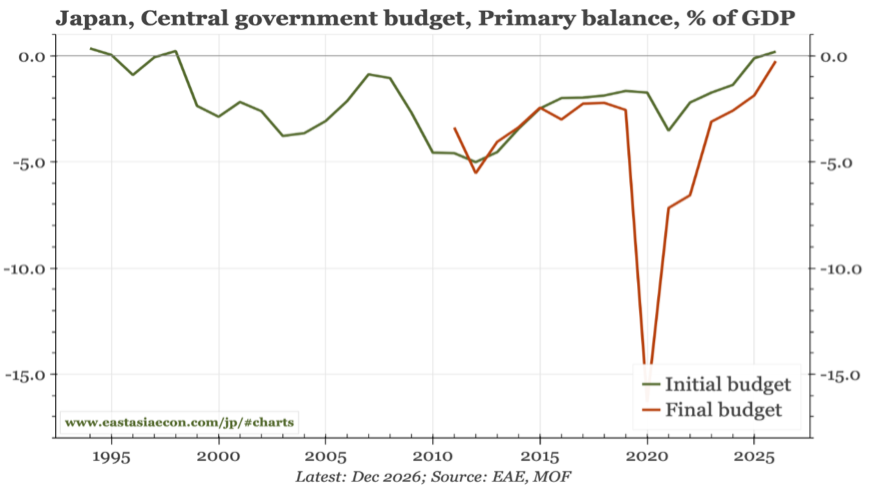
Graham Turner says that the prospect of a rate hike at the FOMC meeting in June casts a harsh spotlight on the Bank of Japan: the BoJ will meet earlier next week, and unless it agrees to tighten policy too, the yen is likely to plumb new lows against the US$. For the Bank of Japan, there is no obvious pressure to hike, as inflation has been well-behaved. The y/y for the Nationwide CPI eased to 1.38% in April. The CPI excluding food, alcohol & energy dipped to 1.06% y/y. Real wages are rising sharply, in part, because of the drop of core inflation as well as fuel subsidies. The labour market in Japan is tight. The unemployment rate fell to 2.5% in April. Total employment jumped to 68.76m, a new high, despite a shrinking population. These are encouraging trends that bode well for Japan’s response to an ageing population, particularly against the backdrop of high government debt.
US: The populist backlash against AI
Report by
BCA Research
BC
Matt Gertken and Marko Papic say that the populist backlash against AI could result in bipartisan regulation in 2027, but is especially likely to prompt tax hikes from 2029. Public criticism of the new technology is growing and politicians in the US and abroad are proposing measures such as AI regulation, taxation, redistribution, and restrictions on data centres. Job displacement is the core concern, with opposition to AI strongest in service-oriented economies where workers fear automation. Americans increasingly view AI as developing too quickly, oppose data-centre construction in their backyard, and are becoming less optimistic about the benefits of technology, particularly among younger generations. The investment risk is political, not technological: a recession, AI-driven mass layoffs, inflation, or a major AI-related accident could mobilise voters and lead to aggressive regulation or higher taxes on technology firms as early as next year – and especially after the 2028 election.
Stock Picking: #1 ranking for 60 straight months
New Constructs highlights a milestone 60 consecutive months of #1 rankings across multiple SumZero categories, underlining the consistency of their stock selection record. They are currently top in Consumer Discretionary and Industrials, alongside strong showings in Value, Large Cap, Micro Cap and Healthcare. New Constructs attributes this track record to their proprietary Robo-Analyst AI, which analyses financial statement footnotes and MD&A disclosures to calculate Core Earnings, a proven superior measure of earnings. Their performance evidence also extends beyond the rankings: since Jan 2021, New Constructs’ Focus List Long portfolio has outperformed the S&P 500 by 20%, while their Short portfolio has outperformed shorting the index by 60%. The three indices that they have developed with Bloomberg’s Index Licensing Group have also all outperformed the S&P 500 over the past five years.
Korea: Everything but a hike
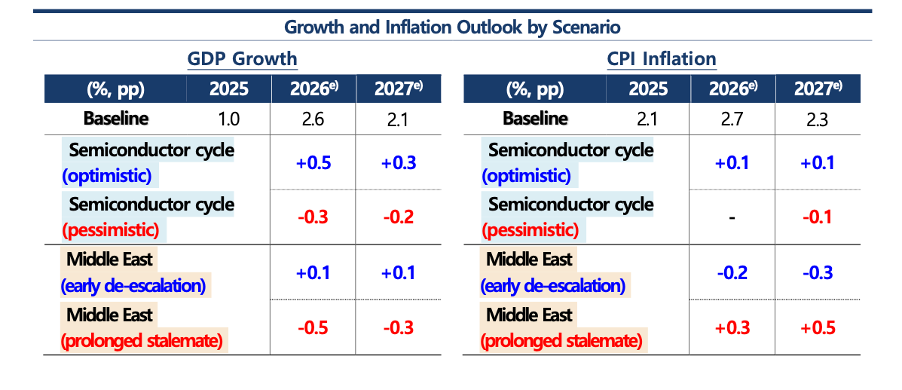
The BOK didn't hike today, but reading through the materials, Paul Cavey comments that it was a surprise that it stayed on hold. The governor made it clear that rate hikes were coming. Three aspects of the forecast stand out for markets. The BOK now thinks the current account surplus will be $250bn in 2026, up from a $72bn forecast just months ago. The bank also thinks core inflation will be 2.4% in 2026. That feels low, given core was at 2% before either of the shocks from Iran and semiconductors, and with the BOK itself flagging that big tech profits will lift nominal wages. If the semiconductor cycle and the Middle East situation were to evolve simultaneously in the pessimistic direction (see chart), adverse feedback loops between financial conditions and the real economy would emerge, further amplifying the growth slowdown.
US: Warsh’s natural bias
In the last week markets have moved to peg the Fed for about 28bps of hikes in the next year, a substantial shift from the 1-2 cuts priced in late February. Warsh assumes the Chair with a challenge to his natural bias – higher productivity via AI implying stronger GDP growth potential (but less inflation and hence need to hike), weak jobs markets but immigration arguably keeping the U/E rate down (which should point to rate cuts), a tighter and smaller Fed balance sheet (that implies rate cuts to offset) and different measures of inflation (trimmed mean over core PCE which conveniently is lower and implies rate cuts). This set of biases imples that Warsh is more of a cutter than a hiker. While the markets peg the first Fed hike in March 2027, Craig Ferguson thinks that the Fed will get an inflation shock in the next 3-4 months that leads to them hiking in Q3.
Technology
CORZ moves sharply higher in Arete’s AI infrastructure rankings following a major expansion in its long-term power roadmap, with them now modelling 3.6GW of IT load and $6.3bn of NOI by 2032 - up from prior estimates of 1.9GW and $3.7bn, respectively. Arete argues demand for AI compute remains “off-the-charts”, while CORZ is becoming increasingly attractive to hyperscalers through the expansion of its Pecos and Muskogee campuses into gigawatt-scale AI data centre sites. Importantly, the company has leveraged its existing CoreWeave contract into $3.3bn of financing, giving it sufficient capital to begin pre-building new facilities before signing additional leases, which Arete views as a key competitive advantage. With leasable power expected to nearly triple over the next few years, Arete raises their TP to $55 (100% upside) and now ranks CORZ alongside Applied Digital as a top pick in colocation infrastructure.
Industrials
Hamed Khorsand’s bearish call on KRMN is already playing out with the shares down ~40% since his Sell initiation earlier this year, yet he continues to see material downside with a 12-month target price of $37. Acquisitions masked underlying weakness in the company’s core business during Q1. Excluding newly acquired maritime defence assets, revenue would have declined sequentially, despite a strong defence spending environment. Hamed also flags KRMN’s rising contract assets (unbilled receivables), which now exceed 32% of the company’s 12-month trailing revenue, alongside weak FCF generation. Valuation remains elevated at ~42x EV/EBITDA, while comps begin to look tougher as the year progresses.
Materials
APAM is evolving from a cyclical European stainless-steel producer into a more diversified materials platform, supported by its integrated recycling activities and higher-value product mix, which VRS believes should improve long-term margin resilience and sustainability alignment. Recent performance reflects a challenging market backdrop rather than a deterioration in core fundamentals, with VRS highlighting operational efficiency improvements, the strategic importance of ELG recycling and the acquisition of Universal Stainless, which expands APAM’s aerospace footprint in the US. Europe’s increasingly protective stance on steel imports could also add ~€200m to EBITDA from 2027 onwards while improving utilisation rates. Their analysis incorporates a valuation framework combining six different methodologies spanning intrinsic, peer-based and probabilistic approaches.
Roche - SERD: Is lidERA being over-extrapolated?
Healthcare
Foveal published on adjuvant SERDS and sees a mispricing emerging between Roche and AstraZeneca, with the market potentially extrapolating lidERA into a broader commercial opportunity than is warranted, while underappreciating a more practice-aligned pathway elsewhere. The core debate is whether investors should be underwriting a broad SERD backbone in early breast cancer today, or positioning for a narrower outcome with a different catalyst path into 2027 that could shift relative value across the group.
Communications
CEO Johan Svanstrom is the wrong leader for RMV’s critical transformation. Despite bringing a background as a “digital native” who scaled Expedia’s Hotels.com to over $3bn in revenue, more recent roles at BIMobject and RMV reveal a polarising leader who is disinterested in operational details and relies on a closed circle of advisors. Svanstrom will continue to champion an AI strategy with high-level, buzzword-driven directives while delegating core business oversight, creating significant execution risk and key-person dependency on a team he has already begun to alienate. His chaotic leadership and lack of operational discipline are a direct mismatch for the rigorous execution and financial control the company desperately needs. Paragon’s research includes interviews with former senior executives who worked with Svanstrom for more than 32 years combined.
Consumer Discretionary
Stellantis’ latest results reinforce concerns that its finance arm is masking weakness in the core car business. While the market is focused on the potential for a recovery in earnings, the report argues that rapid growth in leased vehicles and heavy use of off-balance-sheet JVs is helping support sales and industrial free cash flow. With credit ratings now close to junk, higher funding costs could undermine this support and create further pressure.
Consumer Discretionary
Lululemon shares are trading at both 52-week and five-year lows after a difficult period marked by product challenges and pressure on the brand’s core offering. The source notes that the company had strayed too far from its brand DNA, with limited colour in parts of the range and the departure of its senior merchant. However, early signs of improvement are emerging, including a tighter product offering, more colour and the appointment of a former Nike executive as CEO. While a full turnaround is likely to take time, The Retail Tracker sees potential for the stock to reach $175 over the next 12 months.
Consumer Discretionary
Paragon’s executive diligence memo was originally published when Heidi O’Neill was being discussed as a potential CEO successor at Nike and they viewed her as a poor fit for that role. At LULU, she is somewhat better matched to the brief, but their core reservations remain. She has tended to look stronger as an operator and internal brand steward than as a true strategic architect. That matters at LULU, where the challenge requires a sharper product vision, stronger innovation instincts and a willingness to make harder calls on strategy and talent. So, while the fit is better than it would have been at NKE, Paragon still views her as more of a stabiliser than an obvious answer to LULU’s deeper issues.
US: Underlying inflation trends are cooling
Report by
Ironsides Macroeconomics
Barry Knapp argues that recent geopolitical shocks—particularly the Iran conflict—have not meaningfully altered the medium term economic or inflation outlook. By focusing on stated policy objectives rather than speculative geopolitical outcomes, Barry concludes that escalation risk remains limited and that markets largely share this view. Inflation expectations normalised quickly, equity markets avoided a sustained dislocation and the anticipated “fat pitch” equity market overreaction never materialised. Inflation remains the central macro issue, but underlying trends are cooling. March CPI was elevated due to an energy price spike, yet the key components - core goods, rent of shelter, and non housing services - continue to moderate. Barry stresses that post pandemic seasonal adjustment distortions are overstating inflation pressure and risk repeating policy mistakes made after the Global Financial Crisis. He views the Fed’s rigid 2% inflation target as poorly conceived and expects trend inflation to settle nearer 2.5% over time.
US: The AI boom continues
Graham Turner comments that there is plenty of inflation stuck in the pipeline despite some respite for energy prices. The headline CPI was up 0.87% m/m in March but the core CPI was well behaved. The key will be broader, second-round effects from the higher headline numbers. That will depend on consumer resistance: slower wage growth and uncertainty over job prospects due to AI could limit the ability of companies to push prices up more generally. The oil price shock has not yet had much impact on services demand, if the non-manufacturing ISM is any guide. The new orders index rose in March to its highest level since February 2023. There could be a delayed reaction to the Iran conflict, but Graham sees this as a potential sign that the US economy is indeed quite resilient. Low core inflation and no clear evidence that the energy shock or AI are damaging the economy would represent a big buying opportunity for equity investors.
Industrials
Grid constraints threaten to slow data centre construction growth, potentially disrupting STRL’s key revenue growth and margin expansion engine. Early signs are already visible, with decelerating construction data, softer backlog and margin pressure in its core E-Infrastructure segment. The CEC acquisition is a desperate move by management to mask a plateau in its site prep business and expand into Texas ahead of increasing competition. With cash flow moderating (and diverging meaningfully from adjusted earnings), insider selling rising and valuation elevated (~22x EV/EBITDA), OWS is targeting more than 30% downside.
OpenClaw drives AI shift, but disruption risk overstated
Communications
Report by
Blue Lotus Research Institute
Blue Lotus argues the rise of OpenClaw and AI agents is reshaping China’s internet ecosystem but believes market concerns are overstated. While agent frameworks could emerge as new traffic gateways and LLM platforms have already captured 8-10ppt of global traffic share, they see disruption as more incremental than structural in core consumer use cases. China’s low software penetration supports rapid AI adoption but also limits near-term cannibalisation. Despite execution premiums being assigned to startups and ByteDance, Blue Lotus believes incumbents such as Tencent and Alibaba retain strong underlying advantages and sufficient time to adapt. Recent share price weakness is therefore seen as a buying opportunity. However, they turn more cautious on Kuaishou, removing it from their Top Buy list amid intensifying competitive pressures.
US Producer Price Index
For the January PPI report, John Ryding wrote the report "ought to be a blow to hopes of a quick return to 2% and further suggests that monetary policy is accommodative". The report for February adds to this assessment ahead of the oil shock adding to price pressures. Final demand PPI inflation rose to 3.4% from 2.9% on a 12-month basis with all major categories adding to the upward pressure (core goods, food, energy, and services--see table for details). On the old methodology basis for goods, the pipeline pressures were rising strongly even before the oil price shock. Not only is it too soon to say that PPI inflation is moving in a way that it is consistent with a gradual return to 2%, but it is also too soon to say if the upward move in inflation is levelling off.
Consumer Discretionary
The Retail Tracker sees improving momentum at AEO, driven by a rebound in Aerie, which returned to growth in late 2025 following assortment resets and a renewed focus on its younger customer. They expect this momentum to continue, supported by a positive contribution from Offline despite some lingering assortment inconsistency. By contrast, the core Eagle brand remains mixed: denim is "solid" with exposure to emerging trends such as ripped jeans and bootcut styles, but tops lack impact (the online range is much better than in store). Increased marketing spend - including partnerships with high-profile celebrities and country music events - is driving traffic and sales. With the stock down ~30% amid recent market volatility, AEO is an attractive opportunity at current levels.
Consumer Staples
Scott Mushkin remains cautious on TGT despite management acknowledging some operational challenges flagged in his field research. Recent store visits continue to reveal poor endcap execution, high levels of discarded items, long checkout lines, out-of-stocks and even extreme messiness. These nagging store operating challenges are likely to take more effort to overcome than management currently believes. He also sees several structural pressures ahead. TGT may need to sacrifice gross margin to improve price competitiveness, while everyday essentials could face deflation in 2026 amid heightened competition. Meanwhile, Walmart and Amazon are unlikely to cede share and TGT’s core demographic offers limited growth. Scott believes the recent swing to positive sales reflects easy comps and short-term consumer spending variability rather than a structural improvement in demand.
Why (some) EM Telcos’ multiples could double
Communications
The resumption of pricing power is one of the key drivers of the rally in EM Telcos and perhaps the area where consensus is most sceptical. In this note New Street analyses which markets have the greatest potential for sustained pricing power, looking at key issues: affordability and regulatory and competitive structure. Where these come together they see the potential for a multi-year period of above-inflation revenue growth from the core telco business. They also show that where pricing power is sustained, EM Telco multiples have doubled. As this plays out across the industry the scope for above market returns are high, and New Street remains (very) bullish on EM Telcos.
Consumer Discretionary
The shift from puffer-only to broader fashion outerwear (wool, shearling, fur) has expanded consumers’ wardrobes, with MONC well positioned at the intersection of function and luxury. Its core styles are not overly trend-led, supporting their status as long-term investment pieces with resale value. Pricing sits above Canada Goose and Herno, but below Prada and Loro Piana, sustaining an attractive premium tier. Beyond outerwear, The Retail Tracker sees opportunity in functional yet fashionable handbags (e.g., a travel line between Rimowa and Away). Footwear remains strong but still lacks a viral breakout moment. Meanwhile, early signs of a streetwear revival could lift visibility for Stone Island and help the brand extend beyond its core. Under new leadership, renewed energy in the stock could support a move back towards the 52-week high.
The best FX trade for 2026
In Stephen Jen’s view, USDJPY may be the best (i.e., with the highest Sharpe ratio) FX trade for 2026. With the dominant election victory, Stephen points out that the LDP has enough popular support for PM Takaichi to go through with her 3%-GDP worth of fiscal stimulus. With inflation still above the BOJ’s target (headline CPI is down to 2.1%, but core-core is still hovering around 3.0%), this prospective fiscal stimulus will likely be met with accelerated or earlier rate hikes by the BOJ. Stephen says that the US Fed and the BOJ will continue to converge in 2026, with the former cutting while the latter is hiking. Stephen argues that the US dollar itself is in a structural descent, and the particular policy mix in Japan should lead to a stronger JPY. He still views 125 as a very reasonable target for USDJPY this year.
US: Fall in short-dated Treasury yields needs to be quicker
Graham Turner points out that US core inflation is trending just above 2.0%. The ex-food, energy & shelter CPI was up 2.20% in the 6-months to January, annualised. Meanwhile unemployment is falling, despite a rise in the labour market participation rate to new highs. The rapid adoption of AI suggests that the growth-inflation trade-off for the economy should improve. Therefore, the noninflationary growth path of the US economy is notching higher. Graham comments that how the Treasury market views the jobs and inflation data has been interesting. The two-year Treasury yield fell to 3.40% on Friday, the lowest since October 27th, 2022. This is pulling longer-dated yields down: break-even inflation rates are falling across the curve. The Treasury market has rightly concluded that stronger labour market data does not preclude lower interest rates when AI shifts the NAIRU lower. However, to prevent stock markets falling, the decline in short-dated Treasury yields is going to need to be quicker.
Financials
The investment thesis is straightforward: EG's market cap is $13.7bn, its book value is $15.5bn and it generates >$2bn per year from investment income alone. In other words, EG could make no money at all through its core reinsurance and insurance businesses every year, and still be undervalued. It is an incredibly low bar for positive returns. The core risks would be heavy insurance losses going forward or significant deterioration in the investment portfolio. The losses required would need to be much more serious than simply a ‘bad catastrophe’ year, it would require multiple years of dreadfully written business. Ben Jones thinks this is highly unlikely, especially as the group is moving in the correct direction by limiting casualty business and purchasing additional cover for previously written long-tail business.
Special Sits Idea Forum
MYST’s buyside events continue to draw impressive attendance while consistently delivering strong results. This Forum was notable for highlighting several foreign companies with imminent US listings (Ashtead, Guardian Metal Resources, SK Square) as well as Healthcare stocks (Cigna, Qiagen). Other ideas presented include:
Boise Cascade (BCC) - trough multiple at cycle bottom with potential business split under new CEO. TP $207 (145% upside).
Core Scientific (CORZ) - robust HPC pipeline not reflected despite buildout running ahead of schedule. TP $34 (95% upside).
Ralliant (RAL) - cyclical inflection masked by “one-time” cost headwinds. TP $60 (35% upside).
VSE (VSEC) - compelling entry point for “transformational” aerospace story. TP $300 (35% upside).
Energy
Vista announced the acquisition of Equinor’s non-operating interests in Bandurria Sur and Bajo del Toro, reinforcing its scale in the core of Vaca Muerta with low-cost, oil-weighted, cash-generative production. EM Spreads views the transaction as credit supportive, adding immediate EBITDA at implied multiples well below Vista’s own trading levels, while limiting execution risk through producing assets and established infrastructure, despite YPF remaining operator. The earn-out structure further improves downside protection by linking additional payments to higher oil prices. At current levels, EM Spreads maintains their Overweight view on Vista, preferring the 2033s for their better risk-adjusted balance of carry, duration and Argentina exposure.
Healthcare
RDNT’s AI narrative is materially overhyped relative to fundamentals. The AI business remains nascent, loss-making and largely unreimbursed, with equipment vendors increasingly bundling AI into imaging hardware, eroding RDNT’s perceived edge. Meanwhile, the core business remains highly capital intensive: imaging equipment is costly and capex has consumed ~50% of EBITDA for several years. Lately, that is 10% of sales in a mid-teens margin business, more than twice that of Two Rivers’ selected comp group. Operating leverage is limited as labour, equipment and supply costs continue to rise. While RDNT has reduced its leverage, it is still a concern at 4.4x forward EBITDA. The stock is priced to perfection, trading at all-time high EV/Sales, EV/EBITDA and earnings multiples. It has historically traded at a 40-50% EBITDA multiple discount to the comps - now it trades on par with them.
UK: Weak employment trumps noisy inflation
Report by
BCA Research
BC
Year-end employment data was weak, confirming the recent labour market slowdown, with the payroll fall of 53k exacerbating the 33k decline in November. December CPI data was mixed but on the cool side. Headline inflation printed hotter than expected at 3.4% y/y, but core inflation held steady at 3.2% when economists expected it to accelerate. Tight financial conditions will cap growth upside and further dampen inflation, while recent strength in hard activity data partly reflects pent-up industrial activity rather than broad-based momentum. BCA’s UK growth diffusion index appears to have bottomed, but at a very low level. More BoE cuts will be required, with barely two 25 bps cuts priced by year-end. Further weak data could bring an April cut into focus. BCA’s Global Fixed Income strategists’ highest-conviction view for 2026 remains an overweight in UK gilts, alongside GBP 2-year/10-year steepeners. Sterling remains mispriced versus the USD: UK equities have priced in weakness, but the currency has not, and BCA remain underweight GBP on a 12-month horizon.
South Africa: Sparking the transition
According to Peter Attard Montalto, South Africa’s climate transition is set to reach a pivotal moment of action in 2026. Peter says that carbon budgets, a tighter carbon tax and trade measures such as the Carbon Border Adjustment Mechanism move climate risk from disclosure into core business and financial decisions. At the same time, sustainability reporting will gain momentum to shift from voluntary practice to mandatory, investor-focused standards aligned with IFRS S1 and IFRS S2. However, Peter points out that most companies are not ready. Disclosures still focus on non-financial metrics and remain weakly linked to earnings, asset values and capital allocation. Data quality and systems lag, raising costs, limiting access to capital and increasing greenwashing. Clear ownership is now essential. Policy, regulation and market expectations must align. Companies and banks must embed reporting into strategy and risk management so it supports the transition to net zero rather than becoming another compliance exercise.
Technology
Arete upgrades SAP to Buy, citing improving demand visibility as the ECC end-of-support deadline drives renewed urgency around S/4 and cloud migrations. Based on their CIO and partner checks, sentiment towards SAP has improved in 2025 vs. 2024, especially in the last few months, with more customers accelerating or restarting migration plans. While large-enterprise resistance persists, RISE adoption has shown clear signs of improvement. Arete sees limited displacement risk from GenAI, which CIOs view as years away from impacting core enterprise platforms; instead, GenAI may act as an indirect catalyst, easing migrations via automation and code clean-up. Applying a ~30x P/E multiple to their higher FY27E EPS yields a new €270 FY26 TP, implying 30% upside.
Industrials
Judy Marks is a poor fit for the CEO role. Her tenure has been marked by share-price underperformance, repeated guidance cuts, underinvestment in innovation and purging experienced internal talent to make way for inferior DEI placements. Facing a weak China market, Marks has relied on repeated restructurings that have further hurt morale and credibility. Paragon’s research draws on interviews with former senior executives from OTIS, Siemens and Dresser-Rand, revealing a sharp contrast between her stronger reputation at Siemens and overwhelmingly negative feedback from OTIS insiders. Sources cite a fear-based culture, weak grasp of the core service model and poor capital allocation. Paragon argues Marks’ leadership style is misaligned with the company's need for stability, operational discipline and reinvestment.
Shorts continue to deliver outstanding returns
In 2025, MYST’s short ideas delivered an +11.3% average LTD alpha and 73.5% hit rate. Having reviewed all the shorts presented across their buyside events, several shorts remain compelling including:
Adobe - churn to accelerate due to new click to cancel laws + FTC scrutiny. TP $245 (30% downside).
Coca-Cola Consolidated - KO stake sale a red flag amid structural volume decline + MAHA / SNAP headwinds. This idea was highlighted at MYST’s Consumer Ideas event last month and the shares have already fallen 10%. TP $110 (25% downside).
Flutter - structural challenge from prediction markets jeopardises core online sports betting economics. TP $150 (30% downside).
Oklo - fuel supply constraints + regulatory hurdles create multi-year execution risk. TP $20 (80% downside).
South Africa: One notch down, guard up
The SARB delivered the unanimous 25bp cut that Peter Montalto expected, but this was no dovish pivot: the CPI path was only nudged slightly lower and the language stayed cautious. The MPC is now comfortable moving into “less restrictive territory”. It means that the country now sits a little above the new neutral range around 6.50%. Looking ahead, Peter remains more conservative than the QPM on both inflation and the policy path. He still sees a stickier non-core wedge and slower expectations pass-through than the model assumes, given the fixed public-sector wage agreement, Nersa’s tariff pipeline and unusual food CPI seasonality, even though the de jure shift to a 3% target pulls the expectations profile down. That keeps Peter above the SARB’s inflation and repo projections: his baseline is no further change for roughly six months, and a clearer next leg down only in H2 2026 to 6.00% end 2026.
Materials
A 2026 copper turnaround story - IVN is now producing from all 3 of its core and globally significant mining assets. However, this has not been reflected in the share price following the seismicity event at Kakula in May 25. The market is focused on short term risks, but Kakula’s recovery is being managed and 3Q25 volumes (annualised at 285kt/yr) likely marks the bottom. With the 3 operating assets contributing in 2026 and a new smelter set to lower costs, GMR sees next year as the inflection point. IVN also offers major exploration upside - its 100%-owned Makoko district alone has 9.2Mt of copper identified, with additional drilling across Angola, Zambia and Kazakhstan providing further optionality not priced in. Trading at 1.4x P/NPV10, IVN’s growth, scalability and asset quality make the risk/reward compelling.
Payment Companies: 1H26 high conviction ideas
Technology
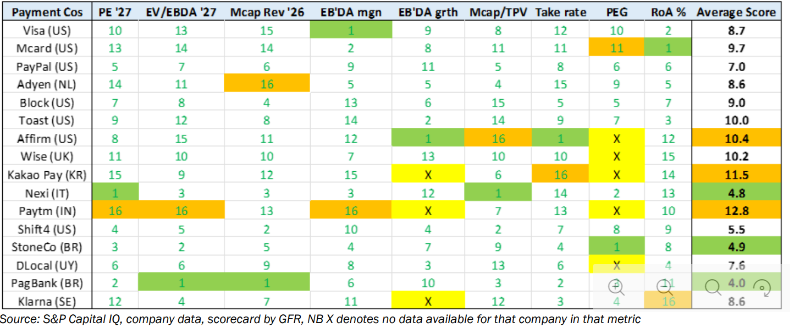
Nexi is Victor Galliano’s top pick - it screens as one of the cheapest global payments names on market cap to revenue and market cap to TPV, with expanding EBITDA margins, rising take rate and improving cash opex discipline, all supported by increasing digital-payments penetration in Italy. PagSeguro remains his core LatAm Buy, despite strong YTD performance, valuations are still compelling and it ranks highly on Victor’s proprietary scorecard (see above), with a high net take rate relative to market cap to TPV. Affirm is the key Sell: Klarna’s IPO erodes scarcity value; valuation looks stretched on market cap to TPV and credit quality in its interest-bearing receivables is worsening. Klarna is one to watch - cheaper post-IPO, but BNPL competition and credit risks keep Victor on the sidelines pending a clear catalyst.
September US retail sales up modestly but Q3 still strong
John Ryding points out that while the increase in retail sales was modest in September, for the quarter as a whole, sales were relatively solid with the control group measure of retail sales rising at the fastest rate (6.3%) since the first quarter of 2023. Core producer price inflation held steady in September at 2.9% but the increase over the last three months was a more rapid 4.7%. Jumping ahead to November, however, consumer confidence fell more sharply than expected as the median one-year inflation rate edged up to 4.8% from 4.7%, households’ perceptions of the labor market declined, and plans to buy autos and cars fell. John doesn’t see this report materially shifting the debate at the FOMC meeting on December 9-10 with the cut camp finding comfort in the inflation readings holding steady and the hold camp seeing potential faster price pressures in input costs and higher frequency inflation rates as well as the strength in retail sales for the quarter as a whole.
Healthcare
Tom Tobin thinks there are several secular trends, including AI tailwinds, which makes RDNT a compelling idea even after its share price has rebounded in recent months. Core to Tom’s thesis is his ability to track Diagnostic Radiology staffing at RDNT, monitor turnover, and forecast volume and revenue per clinician. While the current valuation against consensus estimates appears stretched, he can model upside well into 2027 with a number of simultaneous secular tailwinds that justify the premium: 1) continued inpatient-to-outpatient imaging migration; 2) mix shift towards high-margin advanced imaging where demand is being driven by Alzheimer's, Oncology and Cardiology; and 3) AI tailwinds driving incremental revenue and operating leverage.
Consumer Discretionary
Alibaba’s stepped-up AI investment is pressuring margins, but RFM argues it has now hit critical mass in open-source AI, making it the leading contender in China’s artificial intelligence race. Headline revenue growth in Q2 was only +5% Y/Y, but was +15% adjusting for disposals. The standout was Cloud Intelligence, +34% Y/Y, powered by surging demand for AI services. Qwen now has 180,000+ models on Hugging Face, more than double the No.2 player, giving Alibaba the network-effect scale needed to dominate China’s AI ecosystem. With core e-commerce stabilising and shares far cheaper than Amazon (17x FY26 P/E vs. 29x), RFM sees sentiment turning decisively positive.
Technology
ZM delivered a "clean sweep" Q3 that should silence the sceptics. This was not just a beat-and-raise quarter; it was a validation of the company’s structural pivot from a meeting app to an AI-first work platform. With revenue and EPS ahead of forecasts, a raise in FY26 guide and a fresh $1bn buyback authorisation, management is demonstrating immense confidence in the company's capital allocation and operational execution. The real story for investors, however, is the tangible monetisation of AI: usage is up 4x Y/Y and paid AI features are now anchoring 9 out of 10 large CX deals. With the core business stabilising and the AI/CX growth engines firing on all cylinders, ZM offers a rare combination of deep value (trading at ~3.2x EV/Sales vs. peers at 3.7x) and highly profitable growth.
How to beat the S&P500 - the Q&A that matter
Trivariate examines six core issues for long-only managers benchmarked to the S&P500: 1) Beta: despite long-term data favouring sub-1.0 beta portfolios, this is currently nearly impossible given the high-beta “Great 8”. 2) Alpha vs. Risk: ~75% of holdings should be for risk management. 3) Diversification: run both a broad risk book and a concentrated alpha book - essentially two portfolios in one; holding a higher number of stocks vs. history. 4) Position Sizing: take large, conviction-weighted bets in names with high company-specific risk / hard to replicate (e.g. Healthcare). 5) Blow-up Avoidance: avoid large exposures to bottom-decile FCF converters, large increases in inventory-to-sales, large intangible accruals and extreme valuations. 6) Macro: portfolio managers must consider what set of macro conditions are best for their portfolio performance.
Consumer Discretionary
Breaking the value trap - 86Research’s report presents a focused analysis of GenAI-powered commerce, a strategic frontier they believe investors have overlooked. Market attention has remained concentrated on AliCloud’s reacceleration, while continuing to dismiss core commerce as a “value asset” trapped in macro drag. By spotlighting conversational interfaces and AI-enhanced ad tech as emerging structural advantages, 86Research sees a window of opportunity opening. A wave of initiatives has already unfolded in 2H25 and they expect Alibaba to further escalate its efforts in 2026, catalysing a period of positive news flow and re-rating potential.
Industrials
Reno Bianchi argues that AAL’s core operating problem is management’s inability to control costs as effectively as competitors. Q3 was poor with a significantly deteriorating cash conversion rate and a substantial increase in the group's leverage metrics. He continues to recommend staying away from the risker parts of the group’s capital structure (equity and unsecureds) and also from the longer dated secured securities. He does not believe the fixed income market fully appreciates how speculative this credit really is.
Consumer Discretionary
A story riddled with risk - Brian McGough argues DKS is priced for perfection despite mounting structural and cyclical headwinds. Core growth is tapped out and the House of Sport concept – its only unit growth driver - is not working; comping down 20% in year 2 and down again in year 3. Inventory issues, including a Critical Audit Matter on carrying value, and gross margin risks from tariffs on private-label apparel add further pressure. Apparel (40% of sales) has turned deflationary and the Foot Locker merger is seen as immediately margin-destructive, with no strategic merits and likely to strengthen competitors such as Academy and JD Sports. Brian is incrementally of the view that the 5-year CAGR for athletic footwear in the US is -300bp below pandemic-era trends and warns that at 10x EBITDA, a historical peak, DKS is over-owned, over-earning and due for a correction.
Consumer Discretionary
The Retail Tracker notes continued improvement in URBN’s product assortments, describing the current offering as focused, confident and well-positioned for the holidays with stronger gifting and better alignment to its customer. New leadership is credited with sharper merchandising and more responsive assortments visible across stores, online and social media. Anthropologie and Free People remain strong, attracting younger shoppers while maintaining core customers, with standout accessories, home and active lines. Nuuly, the rental platform, continues to expand rapidly, offering tariff resilience and appealing to younger, price-sensitive consumers. The Retail Tracker has been positive on the name since early in the year and remains so.
Eurozone: Consensus too optimistic on disinflation
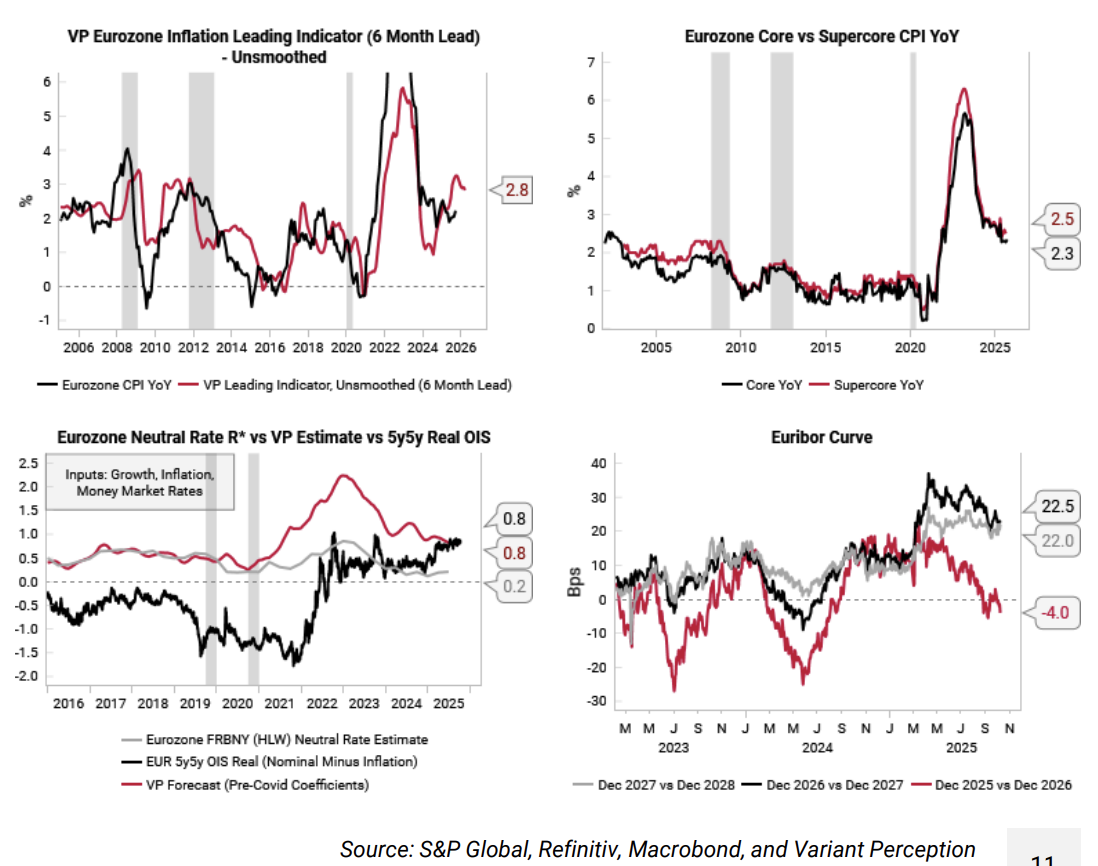
Consensus expectations see 2026 eurozone headline CPI at 1.8% and core CPI at 2%. The Variant Perception team suspects that inflation risks are tilted to the upside from here given the recovery in their eurozone growth leading indicators and the ECB rate cuts so far this year. Their main inflation leading indicator is rolling over from a high level, but the point estimate remains elevated at 2.8% (top left chart). Core and supercore CPI have also been slower to fall, still at 2.3 to 2.5% YoY (top right). The team put the real neutral rate (R*) for the eurozone at 0.8%, which is also where the 5y5y EUR real OIS is trading (bottom left). With headline CPI at 2%, there is good chance that ECB policy is already stimulatory, potentially creating inflation upside in 2026. The team take profits on their SOFR vs Euribor Dec 25/26 convergence trade established last month.
Deutsche Boerse integrates social media intelligence in market surveillance software
While Deutsche Boerse has been an early adopter of social media monitoring for years, they have now taken the critical step of integrating Stockpulse's social analytics directly into their core Scila surveillance system. This integration provides comprehensive monitoring of 70,000+ global equities and cryptocurrencies with real-time social sentiment analysis, buzz metrics and seamless workflow integration within their mission-critical market oversight platform. This signals a broader trend toward holistic market surveillance encompassing trading data, news feeds and social sentiment. As social media increasingly shapes market dynamics, similar integrations are likely to follow globally. For investors, Stockpulse's insights into social sentiment, help spot emerging risks and opportunities before they hit the market. Contact us for a free trial / demo.
China: The illusion of growth in China’s trust sector
Given the extreme financial stress in China, some may be surprised by the near record y/y growth in trust AUM to RMB29.6trn in 2024. However, Jonathan Anderson points out that nearly all of the growth came from passive products; true investment and financing trust AUM were essentially flat. Over a third of trust companies are technically insolvent or on the brink, and Jonathan doubts their long-term viability. Looking at the core active trust products, one will see them weighed down by unresolved defaults in the real estate and local government financial vehicle sectors, with freeze clauses on repayments placing a lot of active AUM into limbo. The impending collapse of many companies in the sector is unlikely to be a catalyst for broader financial contagion, but Jonathan mentions that its loss as a credit channel will still have wide implications.
Healthcare
While GALD shares have performed well since the company’s IPO, the stock remains in a "discovery phase", in which its valuation appears expensive amid consensus estimates that do not fully appreciate the underlying fundamental opportunity. Over 50% of cash flows are derived from Botox and dermal fillers, positioning GALD in a duopoly market with a wider moat and longer growth runway than traditional beauty peers. GALD's core skincare business is growing ~10% annually (relative to L’Oreal’s sub-5% revenue growth), driven by exposure to higher value, nascent life cycle segments. The investment case is further supported by the company’s new eczema treatment, Nemluvio, which could generate $5bn+ in sales vs. management’s $2bn guidance. TP CHF230 (60% upside).
Industrials
FAN stands out as a high quality (29% FY24 FCF RoE) mid-cap building products and business services company that has bucked the trend of sluggishness across its core markets. The business has had a very successful buy-and-build strategy, using excess FCF and modest leverage to undertake earnings accretive M&A. The recent acquisition of Fantech exemplifies this and Fighting Financials thinks consensus estimates underestimate the full benefits of this deal. Beyond fundamentals, FAN also fits the profile of UK SMID-caps attracting takeover interest with 1) geographically diversified revenues; 2) high returns on capital; 3) modest leverage; and 4) suffering a discount due to trading on the troubled UK market.