Fortnightly Publication Highlighting Latest Insights From IRF Providers
Company Research
2026 risks being overstimulated
Developed economies enter 2026 with inflation above target, labour markets tight, wage growth solid and governments running gargantuan budget deficits. Yet Gerard Minack points out how markets expect most central banks to ease or keep policy rates steady, Japan (and Canada & Australia) excepted. There are many hard-to-calibrate risks – such as the war in Europe, US trade policy, Fed independence – but the base-case macro-outlook is for at-or-above trend growth that threatens higher inflation and undermines the case for easier monetary policy. Gerard will discuss the implications of this for markets next week. Spoiler alert: two of the biggest issues for investors – the AI equity trade and risks around developed economy sovereign bonds – don’t hinge on the near-term cycle forecast.
Edition: 226
- 12 December, 2025
The next financial crisis
That we live in a hyper-financialised world is not in dispute, but James Aitken cannot see the net benefits to society from changes like Kalshi, which monetise differences in opinion. He argues that over the long run, monetising any difference in opinion will create negative utility due to the externalities of normalising the idea of betting on everything. And one would think that these betting markets are enormously susceptible to manipulation by state actors; yet such is the path we are on. So what? James says he isn’t tilting against the windmill of the ongoing, hyper-financialisation of everything. Instead, he suggests that the path to the next financial crisis won’t run through (e.g.) private credit, geopolitics or whatever, but instead it will run directly through market structure, period. What happens when, for any period of time from minutes to hours to days, all the machines that intermediate 1x, 2x, or 3x levered ETFs, prediction markets, 0DTE, bonds, stocks etc. decide ‘computer says no’?
Edition: 226
- 12 December, 2025
Industrials
Results will not live up to the enormous expectations surrounding this story, as the company shows almost no customer traction beyond Walmart. While SYM is rolling out systems across 42 WMT distribution centres through 2029, new wins have been minimal, leaving a massive revenue gap ahead. In contrast, competitors Knapp and Witron have announced dozens of new customers since 2022 including new business with WMT. Half of the company’s touted $22bn backlog sits in a stalled SoftBank JV (GreenBox), with little evidence of progress. With heavy insider selling, a recent revenue restatement, TAM overstated and the stock trading at ~10x 2027 sales, the bear case sees estimates beginning to be revised down next year and SYM’s valuation potentially halving.
Edition: 226
- 12 December, 2025
South Africa: One notch down, guard up
Krutham (formerly known as Intellidex)
The SARB delivered the unanimous 25bp cut that Peter Montalto expected, but this was no dovish pivot: the CPI path was only nudged slightly lower and the language stayed cautious. The MPC is now comfortable moving into “less restrictive territory”. It means that the country now sits a little above the new neutral range around 6.50%. Looking ahead, Peter remains more conservative than the QPM on both inflation and the policy path. He still sees a stickier non-core wedge and slower expectations pass-through than the model assumes, given the fixed public-sector wage agreement, Nersa’s tariff pipeline and unusual food CPI seasonality, even though the de jure shift to a 3% target pulls the expectations profile down. That keeps Peter above the SARB’s inflation and repo projections: his baseline is no further change for roughly six months, and a clearer next leg down only in H2 2026 to 6.00% end 2026.
Edition: 226
- 12 December, 2025
Aluminium in transition: The neglected materials play?
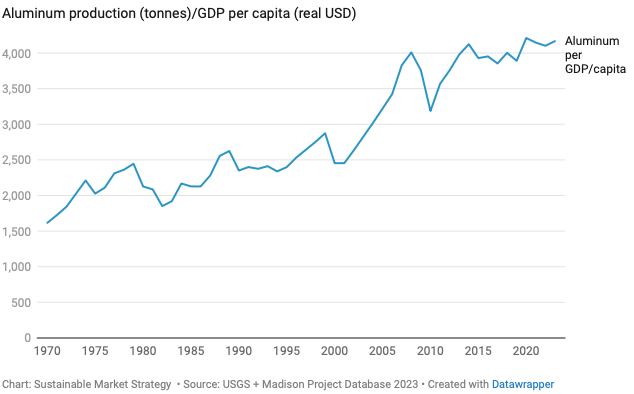
Fossil fuel demand may be falling in the future, but aluminium certainly won’t, driven by demand for EV and solar adoption, the great grid buildout and more aggressive lightweighting. There are no physical constraints to aluminium supply, with bauxite a plentiful resource that can be found near the earth’s surface, yet supply is expected to tighten relative to demand beyond the next three years. China is the main reason, having imposed a national ceiling of 45m tons per year on primary aluminium production. The next big reason lies in electricity constraints; given the amount of electricity required to produce aluminium, the economics of the metal are essentially the economics of power. Competitive advantages are available for producers with sizeable recycling operations, which the team expects to outperform over the next few years. Expect the likes of Constellium, UACJ Corp and Norsk Hydro ASA to be the biggest relative winners.
Edition: 226
- 12 December, 2025
Technology
2Xideas argues OS is tapping into a large, visible market opportunity as enterprises replace outdated software applications and tools. The company continues to gain market share, strengthening its position relative to peers and is on a "winner‑take‑most" path. Furthermore, OS is well‑positioned to integrate emerging AI technologies, benefitting from its role as a trusted governance and compliance layer, which largely insulates it from disruption. 2Xideas forecasts 19% revenue CAGR, driven by new customer wins, strong cross-/up-sell opportunities and international expansion. Over the next 5 years, they expect a total shareholder return of 20.8% p.a., based on an exit NTM EV/Sales multiple of 8.0x.
Edition: 226
- 12 December, 2025
Ivanhoe Mines (IVN CN) Canada
Materials
A 2026 copper turnaround story - IVN is now producing from all 3 of its core and globally significant mining assets. However, this has not been reflected in the share price following the seismicity event at Kakula in May 25. The market is focused on short term risks, but Kakula’s recovery is being managed and 3Q25 volumes (annualised at 285kt/yr) likely marks the bottom. With the 3 operating assets contributing in 2026 and a new smelter set to lower costs, GMR sees next year as the inflection point. IVN also offers major exploration upside - its 100%-owned Makoko district alone has 9.2Mt of copper identified, with additional drilling across Angola, Zambia and Kazakhstan providing further optionality not priced in. Trading at 1.4x P/NPV10, IVN’s growth, scalability and asset quality make the risk/reward compelling.
Edition: 226
- 12 December, 2025
Don’t fall asleep at the wheel, this is a secular bull market
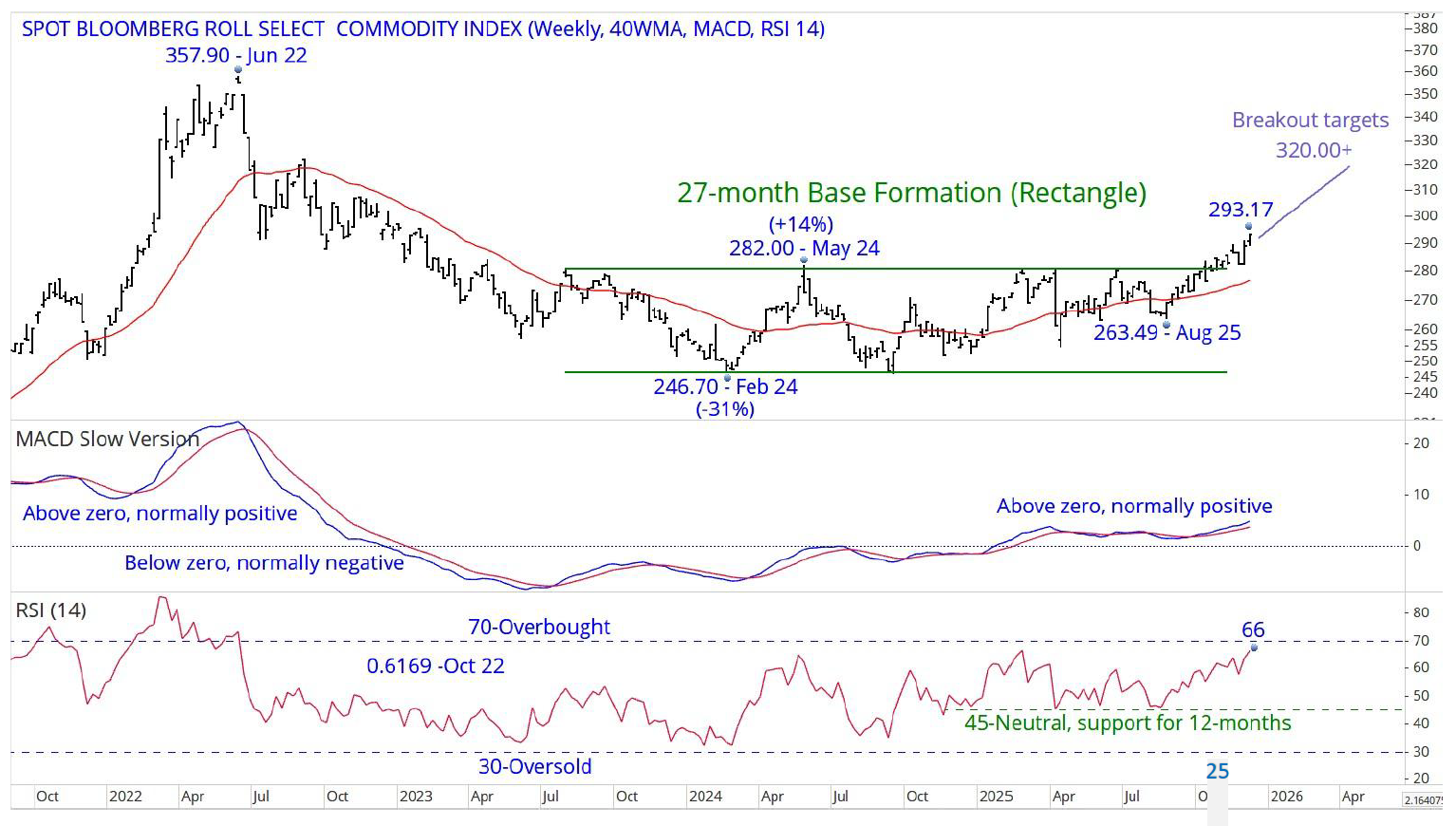
The Spot Bloomberg Roll Select Commodity Index (293.17) is the instrument that Chris Roberts’ newest data provider has, that is just about identical in shape to the Bloomberg Commodity Index that he used to feature. The breakout from the 27-month base formation targets a move to 320.00+, but Chris’s target is a new high above 2022’s 357.90. A secular bear market ended in April 2020 (see next page). The 1st leg of a secular bull market ended in 2022, and following a 30%+ decline and a distracting, time consuming sideways movement, the 2nd leg up is now underway. Indicators have room for further gains.
Edition: 226
- 12 December, 2025
Fears of lower oil prices may be too pessimistic
While market participants await to see what, if any, peace accord emerges from the current Russia-Ukraine talks, William Brown notes that Wall Street analysts appear to be leapfrogging over one another in terms of how bad the global oil “surplus’ will be next year and beyond, and in turn how low oil prices could go. Once again, as William has discussed over the years, analysts always qualify their either extreme bullish or bearish price forecasts with “could” and not “will”. Be that as it may, he notes that one bank he has now heard from is JP Morgan, who suggests that Brent, again “could”, plummet into the $30s due to an “overwhelming” market oversupply. Meanwhile Goldman Sachs are reiterating their bearish view, estimating an average 2.0 MMB/D surplus in 2026, leading to a Brent average of $53.00 per barrel. In contrast, William’s view is the opposite, given what he estimates to be the substantial net short position investors and funds have already amassed.
Edition: 225
- 28 November, 2025
Gold and silver to remain volatile with underlying strength
Jeffrey Christian of CPM Group discusses the increasingly unstable economic and political environment and what it means for gold, silver, and broader precious metals markets. He compares today’s conditions with the late 1970s, noting both the similarities and critical differences to that period, and what those differences may mean for gold and silver prices. Jeff looks at the volatility across gold, silver, platinum, and palladium, explaining the factors influencing investor anxieties. He also discusses economic shifts, including weakening U.S. influence on the global stage. The video concludes with a look at inflation data, consumer behavior, policy risks, and why CPM Group expects a recession within the next 12–24 months.
Click here here to watch
Edition: 225
- 28 November, 2025
UK Budget is negative for economic growth
Mark Bathgate's initial thoughts on the overall shape of the UK Budget is welfare spending and taxes up a lot, borrowing up in the first two years of the budget period, with most tax hikes coming years 4 and 5. He points out that the Budget looks to be negative for growth – primarily via the further decline in household real after tax income, and likely impacts on confidence from the messy process of recent weeks and prospects of many years of rising taxes. Moreover, three key expenditure areas have not been addressed which questions the sustainability of the current budget:
* defence spending (no funding for NATO commitments entered into at June summit);
* Ukraine 2026 & 2027 budget which UK is publicly committing to contribute significantly to;
* local government financing crisis.
Overall, Mark says this looks to maintain the trend we’ve seen over the last 15 months: higher borrowing; lower economic growth; steeper gilt yield curve/higher long gilt yields; and more speculation about next round of tax hikes. However, Mark also says that one positive is that there are less inflationary risks relative to the previous budget.
Edition: 225
- 28 November, 2025
Anglo Asian Mining (AAZ LN) UK
Materials
Ben Jones reiterates his bullish view with the stock up ~200% since initiation in July 23. AAZ is set to enjoy a dramatic increase in net income as well as FCF which is expected to swing from -$2m (2024) to c.$126m (2026) - a 45% FCF yield on today’s m/cap. He expects AAZ to develop 3 new mines (without raising equity) over the next 5 years which will boost copper production from 2.1kt in 2023 to around 40kt per year from 2028. Ben increases his base case price target from £3.70 to £5.59 (150% upside), assuming long-term copper prices at $4.50/lb, but with optionality to £8.00+ if long-run copper averages $5.50/lb, as forecast by Citi and BAML. Since publication of Ben’s report, AAZ has disclosed it is in preliminary takeover talks - unsurprising given his view that the market continues to undervalue the company’s asset base and growth profile.
Edition: 225
- 28 November, 2025
Consumer Discretionary
Hesham Shaaban argues that EXPE’s strong 3Q25 may be a head fake, with the apparent re-acceleration simply reflecting a return to pre-Covid travel seasonality rather than any revival of “Revenge Travel”. TSA passenger volumes are flat YTD and EXPE’s room-night growth is tracking 2024 levels, suggesting travel demand is merely normalising, not strengthening. Hesham sees EXPE as a useful beta offset to his long ideas, while noting the post-print rally looked like a short squeeze. The key catalyst is 4Q25, where he expects a light 2026 guide - EXPE often sets high Q4 targets only to lower them the next quarter, while consensus estimates leave little room for upside and nothing in the traffic data signals a demand resurgence.
Edition: 225
- 28 November, 2025
Financials
Abacus revisits BN after a 70%+ rise since their Jan 24 write-up, arguing the fundamentals remain as compelling as ever. They still see a 22% IRR over the next 2 years - even assuming a persistent ~30% SOTP discount. BN’s thesis is simple despite its perceived complexity: a longstanding focus on infrastructure positions it as a major beneficiary of US on-shoring and increased infrastructure spending, while structural growth tailwinds support its insurance and wealth platforms (Brookfield Wealth Solutions is highly attractive at ~1x book, given 15% ROE). Although BN is improving its communication, Abacus argues few investors appreciate the value, leaving ~35% upside to their TP of $63.
Edition: 225
- 28 November, 2025
Why investors keep buying silver
In his latest video, Jeffrey Christian of CPM Group discusses recent developments in gold, silver, platinum, and palladium prices, and their consolidation following October’s sharp rise. He also looks at the factors that could determine the next breakout for the metals, and whether the next price move might be higher or lower. Jeff takes an in-depth look at the physical silver market and addresses several misconceptions about physical supply, fabrication demand, investment demand, and inventories. He looks at mine production, secondary recovery, fabrication demand, inventory levels, and investor activity, explaining how the market remains well supplied even as investment demand has risen sharply in recent months. Jeff also discusses ETF flows, coin sales, premiums for 1,000-ounce bars, and why talk of a “silver shortage” is misleading.
Click here to watch.
Edition: 224
- 14 November, 2025
Bharti Airtel (BHARTI IN) India
Communications
New Street turns more positive on Bharti, arguing that focus is likely to shift back to the company itself after Airtel Africa and Singtel materially outperformed over the past year. Bharti has historically rallied ahead of tariff hikes and with price increases expected in H1 next year, momentum should build. Growth is accelerating across Home and Enterprise, AAF continues to perform strongly and capital intensity is now falling, supporting margin expansion and rising ROIC. With fixed wireless access (FWA) adoption gaining traction and scope for meaningful EBITDA beats through FY26-27, New Street raises their TP to INR 2,750 and sees a strong case for re-rating as earnings expectations climb.
Edition: 224
- 14 November, 2025
Short-Term Rates-1 Model
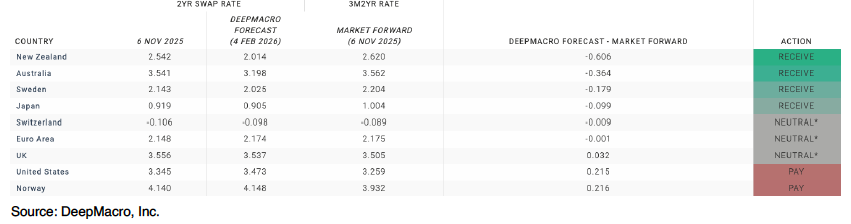
DeepMacro’s STR-1 is a short-term rates model, providing forecasts of 2yr swap rates for the G10 countries over the next three months. The team choose 2yr swap rates because they are an estimate of the market's expectation for monetary policy over the medium term, which they recognise as a function of economic growth and inflation. STR-1 generates receive/pay recommendations based on the difference between model forecasts, and market forward interest rates. The inputs to the model are the DeepMacro growth and inflation factors, including "Big Data", and DeepMacro's automated, machine-driven analysis of central banks. Currently, the model expects rates to rise in the US, but the market forwards expect rates to decline. In Europe the model forecasts rates to rise but by less than market forwards, and in UK it expects rates to decline but by less than market forwards, but both gaps are not large enough to recommend a trade. Please get in touch to find out more.
Edition: 224
- 14 November, 2025
Varonis: Impact of growing competition
Technology
The company’s latest stumble stems from a weakening Federal pipeline and sluggish on-prem renewals, but channel feedback points to deeper challenges from nimble DSPM rivals like Cyera and Concentric.ai to mounting pushback on costly cloud migrations that offer less functionality. With competitive share shifts and customer dissatisfaction surfacing in SPR’s 10/12 panel, it’s clear the DSPM market is heating up fast, fuelled by AI-driven data priorities and VRNS may be losing its footing. SPR’s full note unpacks which vendors are gaining ground, why end users are rethinking their data protection stack and where this market is headed next.
Edition: 224
- 14 November, 2025
Russia: Close to recession
Christopher Weafer notes that the Russian economy is close to recession. Economic growth has accelerated on the back of big fiscal stimulus and an upswing in the domestic demand – but GDP growth could fall into a negative territory in 4Q25. Industrial output is expected to be near zero, while other segments, such as retail sales and agriculture, could help the economy escape a contraction. However, the growth dynamic will become far less certain in early 2026 with the introduction of higher VAT and inflationary pressures. In 9M25, GDP increased by just 1% YoY (0.9% YoY in September), which puts Christopher’s 2025 growth forecast of 1.2% more on the optimistic side. Over the next 2-3 quarters, the economy will balance at close to zero. Christopher expects that it will be no earlier than mid-2026 when credit conditions could start to improve, thus offering support to a gradual rise in consumer demand and corporate investments.
Edition: 224
- 14 November, 2025
Gold and silver update
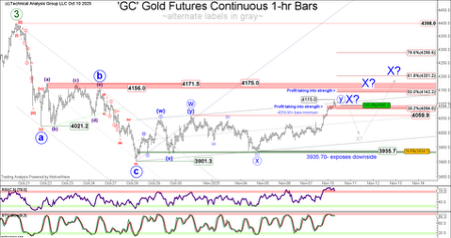
Andrew Egan Baptiste notes that both gold and silver have rallied up to his listed attraction zones. With the attainment of the new rebound highs, he has closed his tactical long positions into strength as recently discussed. Moving forward, given the overall shallow depth of the correction off the 3901.30 selloff low, Andrew expects a corrective pullback in a wave ‘x’ position, that can then lead higher towards the 50% retracement at 4142.00, and potentially up the highs of the prior triangle wave ‘b’ consolidation at 4156.00, 4171.50, and 4175.00. Above that is 61.8% Fibo. retracement at 4201, although he doesn’t believe we can get there without a pullback. If we see evidence of a corrective pullback, Andrew will consider another tactical long. He is now looking for the next opportunity, which he says will likely be on the short side in silver.
Edition: 224
- 14 November, 2025
The rise of China’s intelligent economy
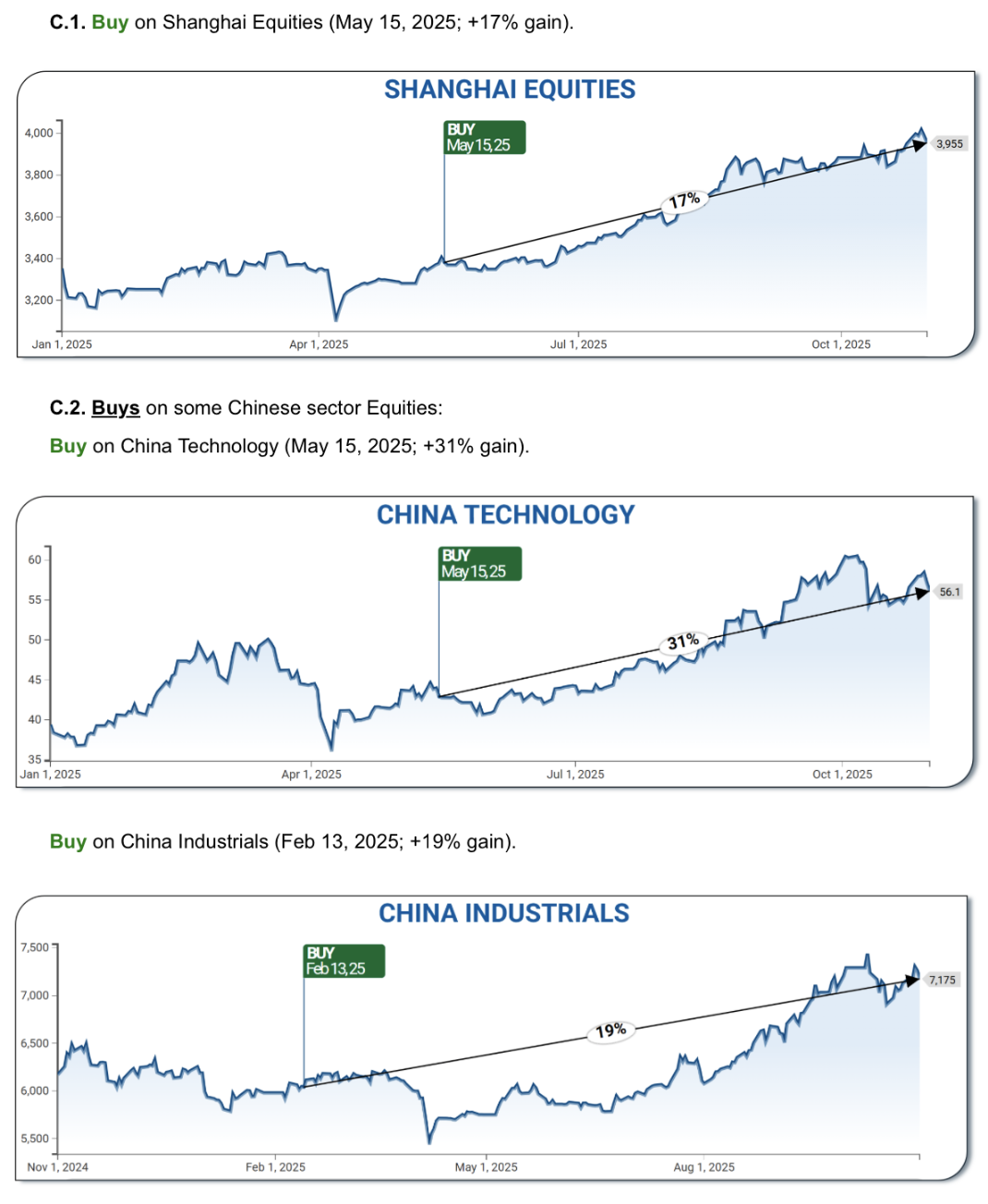
Konstantin Fominykh comments on the breathtaking structural rise of China’s intelligent economy, powered by technology and automation, which is advanced at a scale and speed that far surpasses global peers. It is overtaking the US in key next-gen industries, and over the next few years its main strengths will be EVs, green tech, 5G, high-speed rail, and defence. Currently, we might be witnessing a cyclical recovery, with manufacturing production up 7.3% YoY, service activity expanding again, exports up 3.3% YoY, and consumer confidence finally stabilising. Konstantin’s predictive tools predict further inflows into Chinese stocks, and he recommends a buy on Chinese sector equities, financials, tech, industrials and healthcare.
Edition: 224
- 14 November, 2025
US equities: The case for value
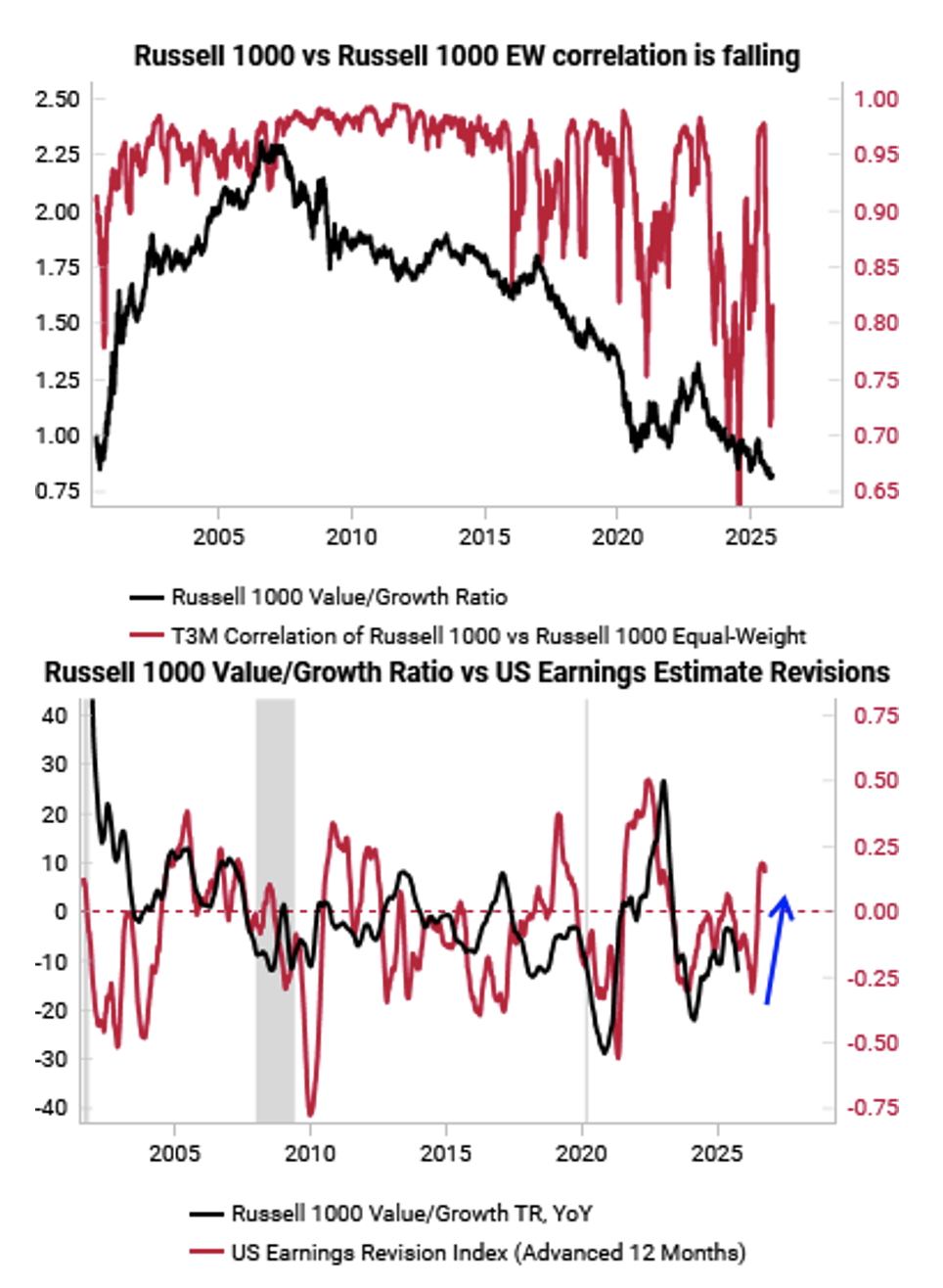
Tian Yang is changing his long-held bias against value stocks and recommending a shift to overweight value vs growth. He points out that he is finally seeing alignment across A) market behaviour, B) the macro-outlook, and C) bottom-up fundamentals. On his indicators, today's set up is as good as it has been since the GFC for value to outperform. US earnings estimate revisions have broadened since Liberation Day, which has historically been indicative of value vs growth outperformance over the next 12 months (first chart below). At the same time, he notes a sharp fall in the correlation of the Russell 1000 market cap weighted index vs the equal weighted index. As the second chart shows, this correlation collapse has often marked a low in the value-to-growth ratio historically. Tian is also seeing evidence of a rotation into value stocks over the past couple of months.
Edition: 223
- 31 October, 2025
Ready for the contrarian gold trade?
Cam Hui has been bullish on gold, but point-and-figure charts of gold and gold miners now show that they are either very near or have outrun their measured price objectives. Tactically, the contrarian trade would be to sell gold and buy bonds. However, a cycle analysis leads Cam to conclude that the market is undergoing a shift to a hard asset price leadership cycle. Cam’s base case calls for a multi-month correction and consolidation in the manner of the 2004–2006 experience, followed by a second rally to an ultimate top at much higher gold prices. It is within this context that a long-term point and figure objective of 9,800 is achievable in the next 3–5 years.
Edition: 223
- 31 October, 2025
Consumer Discretionary
PLNT is well positioned in the growing high‑value‑low‑price gym segment with scale and ample runway for growth. New CEO Colleen Keating brings relevant hospitality franchise experience to drive the next phase of growth in the US and internationally. Gen Z is the fastest‑growing membership cohort for the company, supported by initiatives like the “High School Summer Pass”. PLNT continues to refine club formats and contractual terms to improve efficiency and unit economics. 2Xideas expects 2024-31E system‑wide sales CAGR of 11.7%, driven by 6.6% annual net unit growth and 5.0% same‑club sales growth. They forecast an 11.1% EBITDA CAGR and a 44.6% margin in 2031E. European expansion remains an upside not reflected in their forecasts. They see 17.2% annualised total returns based on an exit NTM P/E of 28.0x (17.7x EV/EBITDA).
Edition: 223
- 31 October, 2025
Healthcare
Leveraging purchase order data from 450 US facilities, MedMine is closely tracking the rollout of Pulse Field Ablation (PFA), the key driver of BSX’s Electrophysiology growth. The US ablation catheter market for AFib is estimated to be growing about 12% Y/Y. BSX has been growing faster in part due to mix shifting from lower-priced Cryo and RF products to its premium FARAPULSE PFA system. However, BSX is facing increasing competition with its PFA market share now at 80%, 10 percentage points lower than its peak. This raises a key question: will BSX’s next growth phase come from converting the larger RF market or expanding the total patient base estimated at 60m globally? MedMine’s near real-time data helps investors track these shifts in market share, pricing and technology adoption as they unfold.
Edition: 223
- 31 October, 2025
Financials
Abacus sees FIGR as a highly disruptive leader in real-world asset tokenisation - a theme they expect to define the next decade. The company has found a real-world use for blockchain, proving it can reduce the cost and time in HELOC origination by 90% (current 3% market share), with an average production cost per loan of just $730 vs. an industry average of $11,000. Beyond its low-cost origination engine, FIGR operates a marketplace for pooled credit, creating liquidity and transparency in traditionally illiquid markets. Abacus expects this model to scale into other asset classes, underpinned by ~30% operating margins and 80%+ incremental margins, with potential upside of 150% to $115.
Edition: 223
- 31 October, 2025
Is Argentina the next big thing?
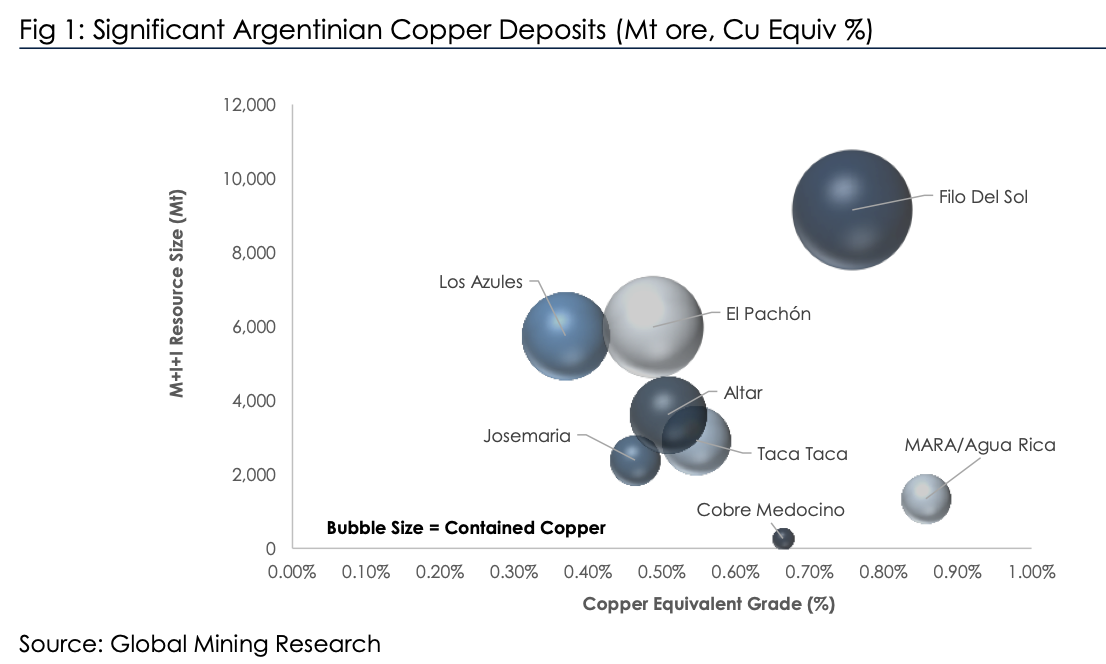
Argentina has significant copper reserves yet produces no material copper (see chart). The new investment climate (RIGI) in Argentina, spearheaded by libertarian President Milei, is hoping to reverse this. Other volatile countries including DRC have achieved significant growth, so it’s possible. In his latest report, David Radclyffe examines the potential of Argentina copper. He sees potential for the nation to become a 1.0–1.5 Mt per year copper producer (top 10 globally), but comments on the aspirational timelines, with first copper unlikely on this side of 2029. Issues also cannot be discounted, with ESG concerns bubbling alongside a lack of infrastructure and skilled workers. David estimates the total capex at USD $40–50 billion. Lundin Mining has the most leveraged exposure to Argentina in partnership with BHP and is the preferred exposure. There are a few exploration plays, of which NGEx Minerals (non-rated) and its Lunahuasi discovery is the largest.
Edition: 222
- 17 October, 2025
A compelling growth story
AIR highlights Spain as the Eurozone’s standout growth opportunity, further supported by US immigration tightening redirecting talent and labour. The country is benefitting from its strong position in the EU’s €750bn Next Generation EU program, minimal exposure to US tariffs and insulation from Chinese industrial competition. A rapid transition to renewables has driven a 40% decline in wholesale electricity prices over five years, while lower structural taxes and spending continue to support competitiveness. Preferred sector calls include Infrastructure (Acciona, Ferrovial, Sacyr) with robust project pipelines supported by public and private investment; Banking & Insurance (CaixaBank) benefitting from SME exposure and high household savings rates; Real Estate (Merlin, Metrovacesa) poised for catch-up gains vs. other European countries amid supply constraints; and Defence, where Indra Sistemas is well positioned for M&A.
Edition: 222
- 17 October, 2025
China: Xi-Trump summit still possible despite tariff threats
William Hess comments that the tumultuous week for US-China highlights the latter’s position: China is happy to drag out negotiations for as long as possible. The backdrop to successive negotiations is a situation of fundamental distrust and geopolitical realignment that Beijing is in no hurry to slow down. These developments set the stage for markets to blow off some steam after recent rallies appear overextended. In terms of activity levels, William’s proprietary indicator for China is showing activity that is moderating but in line with cyclical expectations and far from collapsing. This is consistent with his expectations for Q3 GDP growth that is a tick above the consensus of 4.7%. More important for market expectations will be the Fourth Plenum next week, which should be Beijing’s attempt to improve the macro narrative with structural reform plans.
Edition: 222
- 17 October, 2025
Chile: Policy rate should stabilise at ~4.5%
Igal Magendzo points out that the market — which in recent weeks had been converging toward a scenario with a policy rate somewhat higher than the Central Bank’s baseline projection — has slightly adjusted the timing of the final cuts expected in this cycle. Specifically, the highest probability of a rate cut shifted from next January to this December, in line with the medians of both the Economic Expectations Survey and the Financial Operators Survey, and consistent with Igal’s baseline scenario. Regarding the final cut, although the probability of a 25-basis-point move remains only around 50%, the market brought its expectation forward from October to June (compared with last week). Igal continues to maintain his view that the policy rate is close to neutral and should stabilise around 4.5%.
Edition: 222
- 17 October, 2025
Siemens Energy (ENR GR) Germany
Industrials
A “backdoor” AI infrastructure play amid growing power bottlenecks from new data centre construction. As data centres cannot rely on intermittent renewables, natural gas turbines are seen as the only viable near-term solution. The market is extremely tight, with projected demand of 80-100GW vs. supply of only ~70GW and consensus likely underestimating both pricing and volume potential. ENR’s Gas business is positioned to deliver 20%+ long-term margins, while its Grid Technologies division should benefit from global electrification and grid modernisation, with revenue expected to exceed €20bn by 2030. Shares could double over the next 3 years, driven by earnings beats and a profit inflection in the Wind segment. The upcoming November Analyst Day is viewed as a major catalyst.
Edition: 222
- 17 October, 2025
China: A fragile improvement in PPI
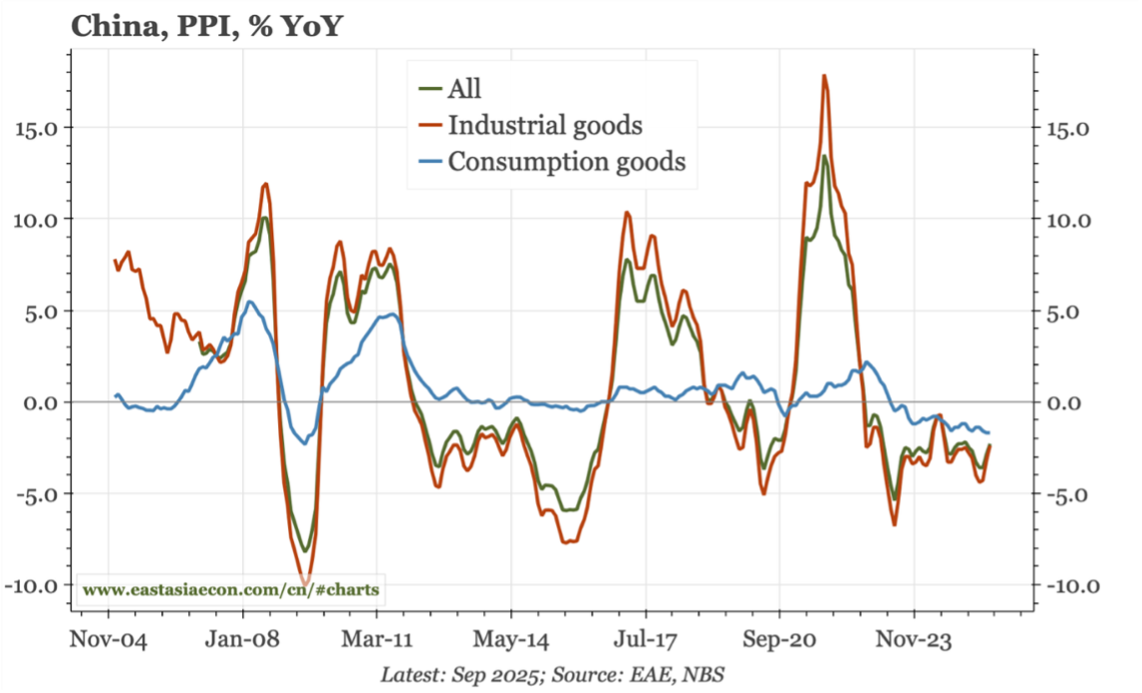
For the first time in more than a year, in level terms, the producer price index (PPI) has stopped falling; however, in year-on-year terms it was down 2.3%y-o-y (versus -2.9% y-o-y in August). That is an improvement, but one that looks fragile. Prices in auto manufacturing – one of the sectors targeted by the anti-involution drive – are falling more quickly than ever, and the "consumption" sector of the PPI in general shows no turnaround. Building material prices continue to be dragged down by the problems in the property market. The stabilisation in PPI is being driven by prices for "industrial" products, namely mining and energy. The short-term leads don't suggest much change in PPI in the next couple of months. But there is some upside risk coming from the YoY rise in global commodity prices (in CNY terms). Paul Cavey remarks that this would be more powerful for China if the construction cycle really finds a floor, allowing building materials prices to do the same.
Edition: 222
- 17 October, 2025
Germany: Angela Merz
Four months in and Chancellor Merz’s government has a mixed record, and Niall Ferguson says that doubts over the coalition lasting until 2029 are justified. However, media forecasts for a near term breakdown are unlikely to be founded, and Niall expects the coalition to survive beyond November of next year. Even if the AfD secures victories in state-level elections, Merz and Vice-Chancellor Klingbeil will be able to use the argument that time must be given for economic recovery before the electorate rushes to the polls for another party. Russia’s antics in testing NATO should bolster the coalition’s cohesion. Niall is positive on German equities and continues to be constructive on German growth, which will in turn boost Europe as a whole.
Edition: 221
- 03 October, 2025
Japan: Give me capex
The quality of Japan’s growth is outstanding, Manoj Pradhan comments on how capex is the dominant trend alongside base pay growth. Additionally, the composition of inflation is not convincing, with goods and rice prices forming the biggest component. Thankfully, the combination of labour shortages and services producer price inflation suggests that capex may be playing a critical role. Pulled together, these point to productivity creating the virtuous cycle of income-spending, a more sustainable likelihood of the wage-services price drift that the BoJ desires, and an economy that can handle any rate rises as the underlying rate of return in the economy is rising. The productivity dynamic points to equity upside not just today but for the next 2-3 years. Balassa-Samuelson should mean medium-term Yen upside, with Manoj claiming EUR/JPY as the better choice for Yen bulls whilst USD improves.
Edition: 221
- 03 October, 2025
Further misery for beleaguered Canadian lumber producers
Materials
ERA continues to urge caution on all lumber-leveraged names and sees risk as downside-weighted in the near-term from sluggish demand. While the timber REITs are better positioned over the long-term, weak wood products markets will be a headwind for them too. Q3 earnings will be terrible and with an incremental 10% tariff being introduced shortly, prospects for Q4 remain extremely bleak. Lumber names are generally beaten up and there will be plenty of upside runway for survivors when markets eventually begin their next upcycle. However, ERA recommends waiting a quarter or two before building long positions.
Edition: 221
- 03 October, 2025
Healthcare
GH has two new liquid biopsy products that are ramping quickly and are well positioned. There is a massive TAM to go after: $100bn vs. current industry revenues of ~$3-5bn. Abacus believes Shield, one of the new products, could transform GH, with revenues growing from $60m this year to $700m in 2028, with further upside if Shield evolves into a multi-cancer screening platform. GH’s first-mover advantage is significant, provided the company demonstrates strong commercial execution. Abacus does not anticipate the need for additional capital, though a modest equity raise in 2026/27 to support growth would not be surprising. They target ~150% upside over the next 3-4 years.
Edition: 221
- 03 October, 2025
Bios scores big on 89bio, rotates to new opportunities
Healthcare
Bios Research’s long call on 89bio has paid off handsomely: since turning bullish in Apr 25, the shares have climbed ~120%, culminating in Roche’s announced takeover at $14.50/share plus a $6 CVR. With conviction now removed, Bios suggests rotating into SMID-cap biotech to capture what they see as the early stages of a new bull cycle. On the short side, the team has just launched a new idea with 30-50% expected downside over the next 6 months. Their track record is strong: 15 of 22 shorts over the past 18 months have generated absolute returns (~72% alpha-adjusted hit rate), with notable successful conviction removals including Apellis, Butterfly Network, Geron and Inspire Medical.
Edition: 221
- 03 October, 2025
The ailing world
The global economy is weakening and looks recession-bound, claims Andrew Hunt, who expects markets to be surprised by the extent of the economic weakness over the coming weeks. The bond sell off may have run its course for now. US equities are in a bubble that has been fuelled by continued aggressive debt monetisation in the G7 and China. Many are worried that the bubble could end as global economic growth slows, but Andrew suspects that the World has already entered an easing cycle – particularly in quantity terms which he regards as very much more important than simple rates. Andrew expects that easier monetary conditions will sustain markets in Q4. Next year, Andrew expects to see the inflationary consequences of the current easing cycle and for that reason he expects that higher inflation and the prospect of higher rates will then represent a clear threat to the system’s ability to sustain the bubble next year.
Edition: 220
- 19 September, 2025
France: Rising debt, rising instability
According to Brunello Rosa, the resignation of PM Bayrou after a no-confidence vote makes the approval of restrictive fiscal measures even less likely. Once again President Macron chose a loyalist, Sébastien Lecornu, as the replacement. But the likelihood of forming a coalition that could vote through the next budget is very slim, and so Macron may be forced to dissolve parliament. However, the result of new elections may be as inconclusive as the previous two, with three blocks of similar size unwilling to compromise and coalesce amongst themselves. France needs a serious and prolonged period of fiscal consolidation and reform, but this will make Macron even more unpopular, in turn favouring the rise of extreme parties on the far right and the left. If Macron dissolves parliament, he may end up in a cohabitation with an extreme party, which may pave the way for the RN’s victory in the next election.
Edition: 220
- 19 September, 2025
Europe: The Art of War
It’s been a rough summer for Europeans. The EU-US trade deal is highly unpopular, yet European leaders had little choice if they wanted to keep President Trump on their side in Ukraine. Niall Ferguson expects the European Parliament to ratify the deal. At the same time, EC President von der Leyen is looking to diversify trade deals, and Niall expects one with Mercosur countries to be ratified by year’s end. The EC will also walk back commitments under the Green Deal, including softening emissions targets for the auto industry, which will provide businesses with much needed breathing room. Niall expects frozen Russian assets and higher bilateral support from member states to support Ukraine, with defence-only EU bonds materialising next year. He remains bullish on European defence and dual-use tech.
Edition: 220
- 19 September, 2025
South Africa: Duller and calmer, with eyes on the prize
Krutham (formerly known as Intellidex)
The SARB kept rates unchanged in a 4-2 vote – which Peter Montalto expected would be a close call – but it remains a bit of a surprise given that this week’s CPI and expectations data could have opened a sliver of space. The QPM model moved up the repo path by removing one cut at the end of this year and the coming two, while the inflation track was marked up. Growth for 2025 was revised up to 1.2%, now in line with Peter’s view. Overall, the statement largely sidestepped this week’s CPI and gave inflation expectations only a passing nod; a signal possibly that the MPC wants a broader medium-run, firmer, re-anchoring before moving again. Peter’s baseline is an extended hold of ~10 months, with the next leg down only after a formal target change by Budget 2026, trending towards 5.50% terminal rates into 2028. There is a small risk of one more cut in November, but the bar is high.
Edition: 220
- 19 September, 2025
TKH Group (TWEKA NA) Netherlands
Technology
At its upcoming CMD, TKH is expected to set new mid-term targets to 2029: turnover >€2bn, EBITA margin >18%, ROCE 22-25% and net debt to EBITDA / leverage ratio <2x. While broadly consistent with prior goals, the updated plan is likely to emphasise organic growth. Crucially, with its investment cycle complete and working capital set to normalise, TKH is forecast to generate €600-650m in FCF in the next couple of years. This underpins scope for materially larger share buybacks - potentially €300m, or ~20% of current m/cap - alongside dividends and bolt-on M&A. the IDEA!’s DCF points to fair value of €51.30/share, implying ~50% upside.
Edition: 220
- 19 September, 2025
China: A new drive
William Hess notes that this past week saw the proliferation of annual industry “stable growth plans”. These are consistent with the objectives outlined recently which themselves are consistent with expected top-down emphasis on optimising the economic layout and capacity in the next batch of five-year plans. According to comments from MIIT, the weight of stable growth plans will focus on ten industries: the steel, non-ferrous, petrochemical, chemical, building materials, machinery, automobiles, power equipment, light industry, and electronic information manufacturing industries. These are cited as key forces to stabilize the industrial and national economy. As is the case for the steel sector, William sees the latest annual stable work plans as outlines for pending five-year plans to be released in 2026, focusing on improving high-quality supply capacity, optimizing the industry’s development environment, and promoting the effective improvement of quality and reasonable growth of the industry. It’s all part of Xi’s quality productivity drive.
Edition: 220
- 19 September, 2025
Technology
TWLO is positioned as a leader in the expanding CXaaS market, fuelled by its unique integration of communications, data and AI capabilities, which no competitor matches. The company’s disciplined shift to a unified platform is unlocking deep cross-sell opportunities among its vast customer base (63% of 349k+ customers still use only one product) and driving margin expansion, while accelerating revenue growth and robust FCF ($3bn+ cumulative by 2027) support an explicit capital return strategy (50% payout target via buybacks). Anchored by strong partnerships in the AI ecosystem and a proven go-to-market overhaul, TWLO’s compelling risk/reward profile is underpinned by durable profitability targets and margin stability, making it highly attractive for those seeking exposure to next-generation customer engagement infrastructure. TP $140 (35% upside).
Edition: 220
- 19 September, 2025
Iron ore is too big to ignore, but headwinds prevail
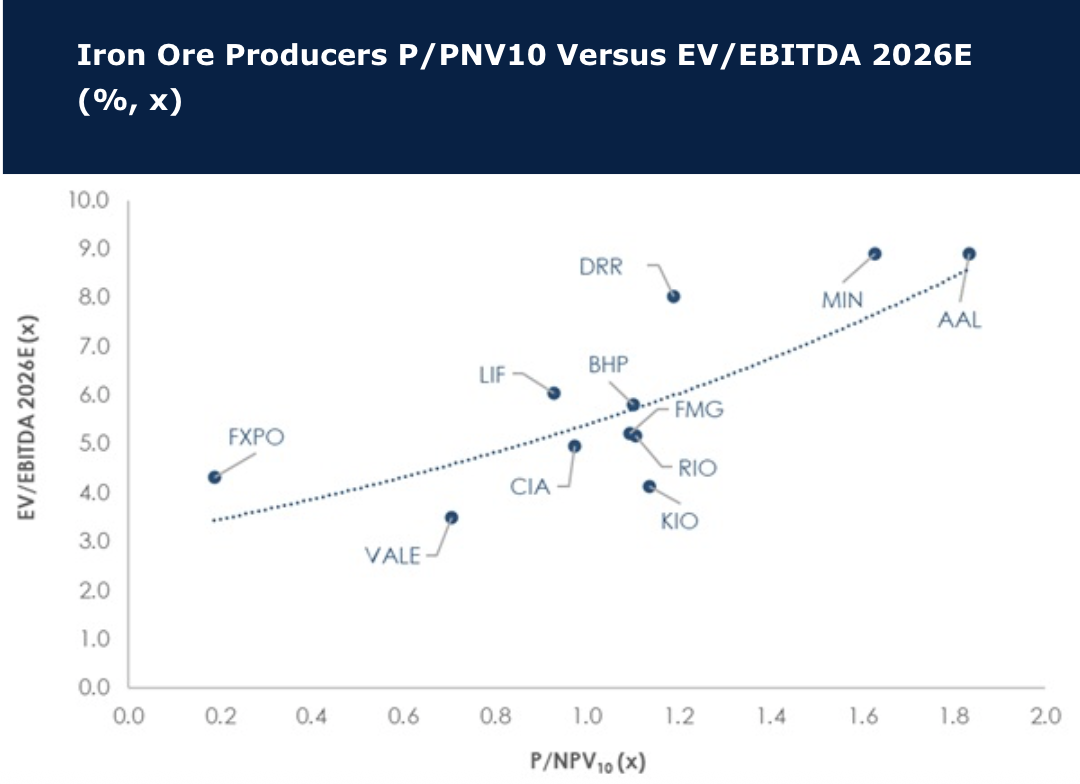
Iron ore seaborne supply is increasing at a time when steel demand is ailing, and David Radclyffe points out that this rightly makes investors nervous. However, the spot iron ore price has proven to be quite resilient this year at ~US$100/t. The headwinds may have dissuaded some investors, but at $378bn the iron ore market is simply too big to ignore in mining. As demand rolls the cost curve is key to sustaining volumes, and David assesses the LT price at US$95/t (US$101/t). Iron ore pure plays and diversified miners trade at 1.1x P/NPV10, and a prospective next two years average EV/EBITDA of ~5.8x and dividend yield of ~4.4%. Relative to other sectors this is reasonable, but high compared to historic levels. In the diversified iron ore-rich miners David prefers buy-rated BHP, then Vale, while in the pure plays it is Labrador Iron Ore Royalty. Overall, he remains underweight iron ore, with sells on key pure plays. Herein, Champion Iron is upgraded from sell to hold.
Edition: 219
- 05 September, 2025
How do you Identify Compounders?
In a market where investors increasingly seek long-term “compounders” to ride out volatility, Trivariate’s research shows that out of the four factors tested (revenue, gross margin, net margin, and price momentum), consistent gross margin expansion has been the most reliable signal of future stock outperformance. This is a rare but powerful cohort with only 39 companies having expanded gross margins for 12 consecutive quarters; 22 are expected to continue doing so next quarter. Actionable names include AMZN, T, ETN, APH, and TDG, among others.
Edition: 219
- 05 September, 2025
France: Instability ahead
The country is entering another period of political turbulence over next year’s budget. Niall Ferguson sees Beyrou’s days as prime minister as numbered, expecting him to lose the confidence vote on September 8th. This will put President Macron back into the driver’s seat, and Niall expects him to nominate another minority government that can secure a 2026 budget with PS cooperation. Yet such a budget would reduce the deficit only marginally. The other scenario is parliamentary snap elections in autumn, which would raise the risk of a victory for RN. In any case, Niall expects the risk premium on French sovereign bonds to rise in the coming weeks, with Frech political instability a major European theme for 2H/2025.
Edition: 219
- 05 September, 2025
ECB: Expect the circumspect
In line with Dimitris Valatsas’s expectations, the European consumer is showing signs of life: June retail sales came in at 3.1% y-o-y. But across the EU, growth remains slow and non-mortgage lending subdued. Demand for mortgages and consumer credit fell in Q2 and credit to EA companies stays very low. Spain remains Europe’s economic steamroller—2Q25 consumption grew by 3.5% y-o-y, while GFCF grew by 5.6% y-o-y. Dimitris views the trade truce with the US as a derisking factor—though he expects some of the deflationary effects of the global trade war to remain. Dimitris says the ECB has settled here; policymakers are too scared to get ahead of the economy, so he now expects them to hold for at least the next two meetings. 2Q26 forward rate expectations still seem too hawkish. The French and Spanish governments are increasingly fragile, though only the French situation presents a major threat to policy continuity.
Edition: 218
- 22 August, 2025
Technology
According to Systems Integrators who work with SNOW, they saw strong 2Q25 momentum driven by rapid partner expansion and AI innovation. The company now has over 10,000 partners worldwide reflecting heavy investment in programs that broaden global reach. New AI-driven tools, including Cortex AI, Iceberg tables, and adaptive compute capabilities, enable enterprises to interact with data in natural language and automate pipelines, and are driving revenue. Strategic acquisitions, such as Crunchy Data, further enhance Postgres capabilities and enterprise appeal. To sustain momentum, SNOW is leaning heavily on system integrators, hyperscalers and resellers to drive adoption of next-gen AI offerings.
Edition: 218
- 22 August, 2025
Financials
The Genius Act has changed America’s relationship with crypto, making it the most attractive country in the world for stablecoins. Abacus’ latest report notes that while the pace of adoption is still unclear, long-term disruption of financial incumbents appears inevitable. CRCL’s model is attractive if USDC can scale, though Abacus estimates ~10x growth is needed to deliver a reasonable IRR - a challenging hurdle. Blockchains are expected to replace legacy infrastructure, with SWIFT the first casualty. Visa and Mastercard face limited near-term risk, but crypto is the primary long-term threat to their duopoly. Stablecoins have the potential to reach >$2trn m/cap in the next few years vs. $260bn today. Abacus sees CRCL as a compelling risk/reward play, with upside potential of 195% outweighing downside risk of 50%.
Edition: 218
- 22 August, 2025