Fortnightly Publication Highlighting Latest Insights From IRF Providers
Company Research
US monetary policy: QE by another name?
Andrew Hunt says the FRB has U-turned on QT and that other central banks will surely follow as their governments’ fiscal / debt issuance arithmetic bites in a world in which the PBoC now seems less inclined to fund “everyone else’s” deficits. As expected, the Fed has gone down the path of YCC. This is QE-by-another-name, but the “certainty” provided by the Fed’s shift towards guaranteeing stable yields out to three months may have been slightly undermined by the divisions shown in the dot plots and a degree of risk aversion within the banking system. Andrew expects some positive quantity reaction vis-à-vis monetary conditions but perhaps not a large one. The Fed’s move does however confirm that there is little stomach for hard budget constraints in Washington despite the economy’s positive output gap. As such, this will undermine the USD’s internal and external values over the medium term, likely starting with the FX rate.
Edition: 226
- 12 December, 2025
Markets are misreading the China steel story
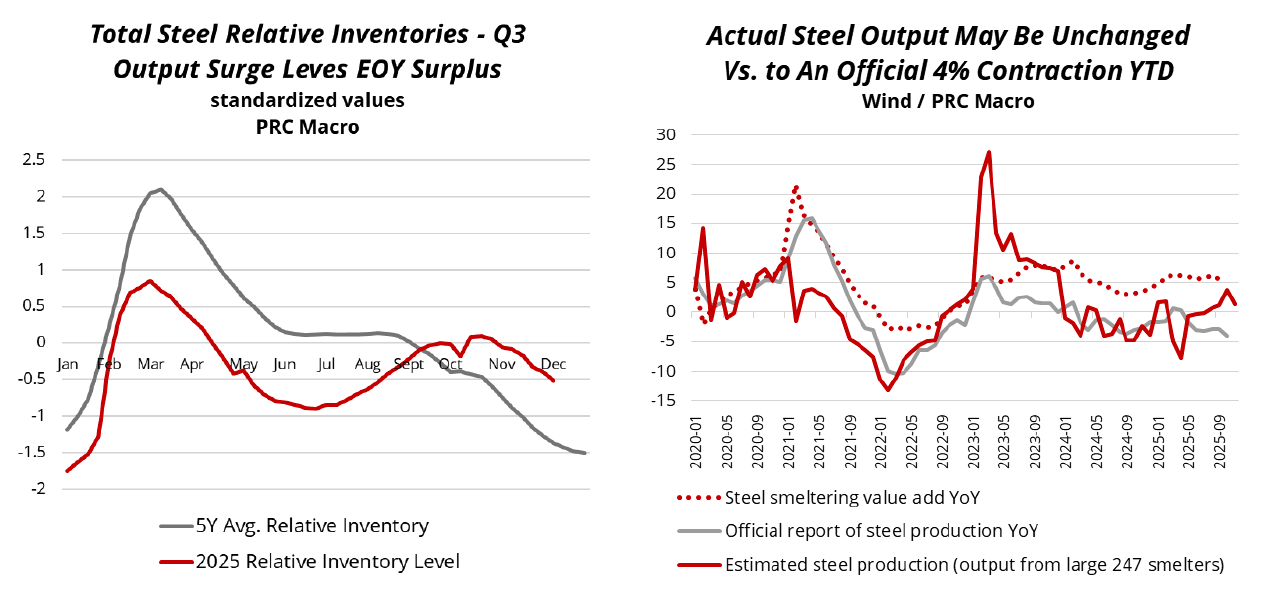
Beijing’s latest Five-Year Plan signals a shift from volume growth to productivity, profitability and price stability. William Hess notes that headline production cuts are likely smaller than consensus; actual 2025 output appears underreported, and Beijing is taking care not to deindustrialise too quickly. Contrary to what some investors think, capacity adjustments will focus on improving operating rates and margins, not aggressive output suppression, which should be supportive of better than consensus iron ore demand – the current institutional outlook of average prices drifting to low $90s by Q2/2026 is too bearish. On the demand side, expect a better year in 2026 supported by multiple factors including a moderate recovery to infrastructure investment, manufacturing capex and machinery upgrades, as well as a tailwind from ODI. William also notes that capacity reductions could stem from carbon costs, which could wipe out 10-15% of inefficient producers if set at RMB 150-200/ton.
Edition: 226
- 12 December, 2025
Taiwan: Lai’s big bet
Whilst the country rides the AI boom, political risk is mounting. The opposition KMT party is divided, with a controversial new pro-Beijing leader, and President Lai is looking to split the opposition in the legislature by simultaneously pushing a bold defence spending plan and closing a trade deal with Washington. The potential market and geopolitical upside are significant if Lai’s gamble pays off, with the Taiwan dollar strengthening and a likely announcement of big new TSMC investments in the US. However, Lai still needs opposition votes from a party spoiling for a fight, and should he fail to secure suitable support, the Trump administration may sour on Taipei just as it steps up détente with China in Q1/2026. Niall Ferguson expects Lai to get the support for both a defence spending hike and trade deal, but he will lack support for every line item, and his plan could easily go off the rails.
Edition: 226
- 12 December, 2025
China: Shifting the focus
China’s leaders discussed their economic priorities for 2026 at the recent Politburo meeting. According to Andrew Polk, the short readout largely signals policy continuity, calling for:“Continued implementation of a more proactive fiscal policy and a moderately accommodative monetary policy”. This mirrors the Politburo’s prescription for 2025 macro policy one year ago. However, there was a nod to “cross-cyclical policy” (which was absent from last year’s readout), which indicates that macro policy will not be as supportive in 2026. Specifically, the readout calls to: “Strengthen counter-cyclical and cross-cyclical policy adjustments”. For reference: Cross-cyclical policies are more long-term in nature, targeting structural challenges – such as demographics and innovation – to raise potential growth. Andrew says senior policymakers appear less worried about short-term growth in 2026 than they were a year ago, and are once again shifting focus toward longer-term structural issues.
Edition: 226
- 12 December, 2025
Hungary: Another good year for the forint?
2025 was a good year for the forint, in light of weak demand, lower inflation and a supportive external balance. Jonathan Anderson remarks that 2026 will likely be the same. The MNB is in no hurry to resume easing, real interest rates are solidly in positive territory and there's no sign of credit or demand pressures going into the new year. Jonathan was on the sidelines with HUF in 2025, but is now taking up the carry trade for a while. There’s still no end to the equity rally. CEE stock indices continue to "blow the doors off" the rest of EM, in Hungary's case led by main listed name OTP Bank. As before, however, this is not a reflection of Hungarian macro trends at home.
Edition: 226
- 12 December, 2025
China: Back to 1994
Andrew Hunt examines China’s deteriorating economy. Households, companies and the public sector are spending less. Liquidity trends are weakening. The country’s external trade surplus is being pushed higher. The practical mechanism for this is a fall in PRC export prices and a reduction in imports. China is therefore exporting (intense) deflation in global goods markets. Previously, capital outflows were providing an inflationary counterbalance to global capital markets, and even (implicitly) non-traded goods sectors. Over recent weeks there are signs that not only have China’s private sector capital outflows decelerated, but so too have public sector flows. The slowdown on private sector outflows is the result of declining domestic liquidity but the reduction in PBoC-sourced outflows may have a political dimension. If the PBoC continues to hold back vis-à-vis its intervention, and instead allows the CNY to appreciate, Andrew Hunt warns that global bond markets will come under more pressure in what could amount to a repeat of 1994.
Edition: 226
- 12 December, 2025
US: Rumble in the market jungle
The bull may have danced like a butterfly, but the bear has once again shown its ability to sting like a bee. US equities recently triggered a 5% drawdown alert from their 52-week highs, with S&P500 key support at 6500. Only a weekly close above psych level at 7000 would neutralise the mean-reversion signal. Ron Williams points out that late-cycle signals are flashing: broad market weakness, crowded mega-caps under pressure despite strong earnings, shifts in investor psychology towards balance-sheet strength, and macro uncertainty. As risk appetites fade, gold remains a resilience diversification play while it’s LT trend holds above $3,930. Multiple timing models suggest a potential high-risk cyclical inflection heading into Q1 2026, with tightening conditions, slowing growth, margin pressures and crowded trades converging. Ron advises investors to stay flexible, patient and diversified, to emphasise balance-sheet quality over speculative growth, and to follow RWA tactical strategies to enhance trade setups and market timing.
Edition: 226
- 12 December, 2025
Italy: Industrial Devolution
Italy’s industrial production undershot expectations in October, with production falling 1.0% month-on-month, a sharper contraction than the expected 0.3% decline. The pullback was broad-based across key categories: consumer goods output dropped 1.8%, capital goods declined 1.0% and intermediate goods slipped 0.3%. Energy production provided only a modest offset, rising 0.7%. On an annual basis, industrial output fell 0.3%. John Fagan points out that the year-on-year breakdown highlighted persistent structural weaknesses, with significant declines in chemical manufacturing (-6.6%), textiles and apparel (-5.0%), and refined petroleum products (-4.6%). The data reinforce the fragile momentum across Italy’s industrial base, which continues to face a combination of soft external demand, elevated input costs, and sector-specific pressures in chemicals and textiles. The sharp monthly swing also signals that September’s strength was not sustained, raising concerns about the durability of Italy’s manufacturing recovery.
Edition: 226
- 12 December, 2025
Ukraine: The litmus test of European determination
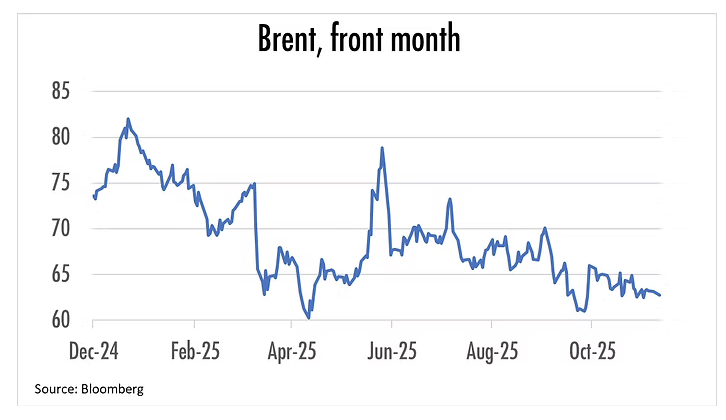
Zelensky rejected the latest US peace plan this week, but this does not change David Woo’s view that the war will be winding down in Q1. He remains of the view that, with dwindling US financial and military support, Ukraine has no way of sustaining its war effort much beyond this winter. The recent proposed plan is as good as Ukraine is ever going to get. The biggest risk to David’s view is if Europe decides to step up, with the debacle of convincing Belgium to turn over frozen Russian assets to Ukraine a litmus test of European determination. David has established a short position in the Dec26 Brent future on the view that a peace deal will be accompanied by a lifting of sanctions on Russia. He will double it should the US invade Venezuela, given the likelihood that the conflict will be short and sanctions will be lifted post-Maduro. If Europeans turn over the frozen assets to Ukraine, sell the euro.
Edition: 226
- 12 December, 2025
The US-China AI war
The White House will allow Nvidia to sell its H200 chips to China, but the 25% tariff presents a disincentive to sell at a time where demand is so high money can be made elsewhere instead. Xi remains the biggest hurdle, who maintains that technological independence takes priority over economics. China’s chips are much less capable, with Richard Windsor calculating that Huawei’s SuperPod system is 32x less efficient than Nvidia’s equivalent. Although Chinese AI models are performing well, the country simply cannot compete when it comes to the tech. It’ll be a long while before Nvidia and AMD truly re-enter the Chinese market, and the country will continue to stay behind with little scope for it to catch up due to its lack of cutting-edge hardware. For now, the West has the advantage.
Edition: 226
- 12 December, 2025
Communications
Craig Huber downgrades NFLX to Underweight following its $82.7bn agreement to acquire Warner Bros Discovery’s studios, HBO and HBO Max streaming assets - a major strategic shift he views as unnecessarily risky. He argues the deal brings significant regulatory hurdles, adds heavy leverage and could slow NFLX’s organic revenue growth while pressuring margins. Large US media acquisitions rarely succeed and NFLX had excelled for 15+ years without pursuing major M&A. With the deal likely taking 12-18 months to close, Craig expects a prolonged stock overhang. Re. Paramount’s hostile bid, he believes PSKY would need to raise its offer to $32/share to fully entice shareholders away from NFLX’s attractive proposal.
Edition: 226
- 12 December, 2025
Cisco's 800G just hit the same wall GPUs did
Technology
JNK Research indicates CSCO's Silicon One networking roadmap faces the same thermal management bottleneck that constrained Nvidia and AMD GPU production. CSCO is ramping wafer starts 8x - from 1k to 8k annually - at TSMC in 1H26. However, heat spreader suppliers already operate at 85%+ utilisation with capacity concentrated among few Taiwan suppliers. The company is proactively qualifying secondary thermal suppliers and paying for tooling upfront to secure allocation. This mirrors the CoWoS packaging constraints that limited GPU shipments in 2024. Networking ASIC thermal requirements are approaching GPU-level complexity as data centre switches migrate from 400G to 1.6T.
Edition: 226
- 12 December, 2025
Ferrari (RACE IM) Italy
Consumer Discretionary
AlphaValue sees the recent share price correction as a compelling entry point, arguing that RACE’s equity story is unchanged: a scarcity-driven model, limited volume to protect residual values and earnings growth driven by mix, personalisation and pricing. The market’s disappointment with the 2030 targets is misplaced - management has a long track record of beating guidance and the new goals look intentionally conservative. Demand remains exceptionally resilient, supported by a growing collector base, rising UHNW populations and consistently oversubscribed limited series. The stock trades at a discount relative to its historical performance and direct peers, providing a safe haven in the automotive and luxury space, insulated from macroeconomic headwinds, trade disputes and China-related risks. TP offers >40% upside.
Edition: 226
- 12 December, 2025
Communications
Hesham Shaaban argues the Street is underestimating the durability of RBLX’s monetisation surge. Historically sceptical of its Robux-driven model, he now sees clear evidence that incremental traffic is highly monetisable: mid-2025 saw a material surge in traffic (DAUs and Hours) with limited slippage in bookings efficiency, which isn’t typical of a freemium model. Engagement is also “snowballing”: the fact that average hours are even up Y/Y - especially double digits - on a 70% surge in DAU growth suggests engagement is now viral. Hesham sees 4Q25 earnings as the key catalyst - he expects RBLX to produce booking growth more comparable to Q3 results than management's muted guidance triggering a short squeeze.
Edition: 226
- 12 December, 2025
Industrials
Results will not live up to the enormous expectations surrounding this story, as the company shows almost no customer traction beyond Walmart. While SYM is rolling out systems across 42 WMT distribution centres through 2029, new wins have been minimal, leaving a massive revenue gap ahead. In contrast, competitors Knapp and Witron have announced dozens of new customers since 2022 including new business with WMT. Half of the company’s touted $22bn backlog sits in a stalled SoftBank JV (GreenBox), with little evidence of progress. With heavy insider selling, a recent revenue restatement, TAM overstated and the stock trading at ~10x 2027 sales, the bear case sees estimates beginning to be revised down next year and SYM’s valuation potentially halving.
Edition: 226
- 12 December, 2025
The Fed’s upcoming productivity bet
According to Cam Hui, a Trump-dominated Fed is on the verge of a rate cutting cycle based on a probable Greenspan-style bet on AI-driven productivity. If AI does significantly boost productivity, the economy could be in for a period of non-inflationary growth and prosperity. The risk is a policy error, rising inflation and a falling USD. Much depends on the usefulness of AI across different applications and industries. From the market’s perspective, the preliminary verdict is that the Fed will undertake an inflationary outcome. Yield curve spreads are undergoing mild steepening reactions, which is discounting higher inflationary expectations in the future. Regardless of the outcome of the productivity debate, Cam believes strength in the gold price is consistent with his long-term observation of a relative breakout in gold against both the S&P 500 and 60/40 portfolio, which is a signal that the market is undergoing a shift from paper to hard asset leadership.
Edition: 226
- 12 December, 2025
South Africa: One notch down, guard up
Krutham (formerly known as Intellidex)
The SARB delivered the unanimous 25bp cut that Peter Montalto expected, but this was no dovish pivot: the CPI path was only nudged slightly lower and the language stayed cautious. The MPC is now comfortable moving into “less restrictive territory”. It means that the country now sits a little above the new neutral range around 6.50%. Looking ahead, Peter remains more conservative than the QPM on both inflation and the policy path. He still sees a stickier non-core wedge and slower expectations pass-through than the model assumes, given the fixed public-sector wage agreement, Nersa’s tariff pipeline and unusual food CPI seasonality, even though the de jure shift to a 3% target pulls the expectations profile down. That keeps Peter above the SARB’s inflation and repo projections: his baseline is no further change for roughly six months, and a clearer next leg down only in H2 2026 to 6.00% end 2026.
Edition: 226
- 12 December, 2025
Materials
Yuka Marosek examines whether ISK can narrow its sizable profitability gap with Nissan Chemical, whose operating margins are more than triple ISK’s. She attributes the gap to ISK’s heavier reliance on lower-margin TiO₂ and inorganic chemicals, while Nissan benefits from higher-value agrochemicals and semiconductor materials. ISK’s mid-term plan aims to shift its portfolio towards higher-value TiO₂, consolidate production under the chloride process, upgrade its functional materials mix and continue disciplined R&D investment. Early signs are constructive: ISK’s Q2 FY3/26 margins have already begun to recover, helped by improving TiO₂ pricing and mix. With further optimisation, new capacity through the MF Material JV and a strengthening agrochemical/vet-pharma pipeline, Yuka sees credible scope for margin expansion and valuation catch-up.
Edition: 226
- 12 December, 2025
Financials
MCAP is emerging with the strongest momentum in Japan’s once-tainted M&A consulting sector. Unlike scandal-hit peers, MCAP avoided reputational damage and is now growing faster than Nihon M&A, generating higher margins and trading on just ~15x FY9/26 earnings despite forecasting >30% Y/Y profit growth (which may well prove conservative). Deal sizes are rising, consultant numbers are compounding 20-25% annually and MCAP’s high-incentive pay model draws top sales talent, keeping churn low. The company’s Recof subsidiary remains a drag, but restructuring should push it towards profitability. With improving industry governance, fears of a “kabarai-style” crackdown fading and cash piling up from strong FCF, the shares are attracting renewed investor interest.
Edition: 226
- 12 December, 2025
Aluminium in transition: The neglected materials play?
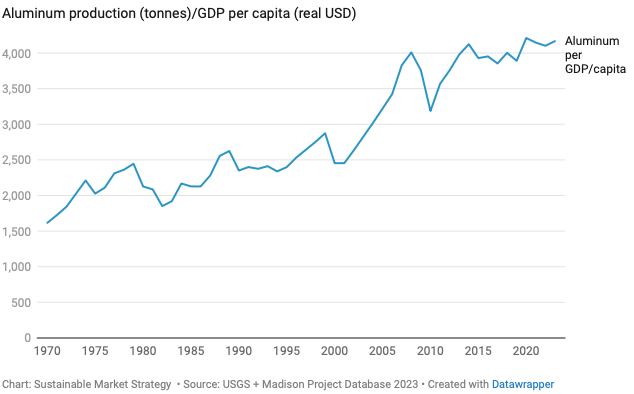
Fossil fuel demand may be falling in the future, but aluminium certainly won’t, driven by demand for EV and solar adoption, the great grid buildout and more aggressive lightweighting. There are no physical constraints to aluminium supply, with bauxite a plentiful resource that can be found near the earth’s surface, yet supply is expected to tighten relative to demand beyond the next three years. China is the main reason, having imposed a national ceiling of 45m tons per year on primary aluminium production. The next big reason lies in electricity constraints; given the amount of electricity required to produce aluminium, the economics of the metal are essentially the economics of power. Competitive advantages are available for producers with sizeable recycling operations, which the team expects to outperform over the next few years. Expect the likes of Constellium, UACJ Corp and Norsk Hydro ASA to be the biggest relative winners.
Edition: 226
- 12 December, 2025
Memory pricing dynamics & new monthly tracker
Technology
The rally in memory prices shows no signs of abating - a burden for buyers but a windfall for suppliers, especially late entrants and firms focused on legacy products. Yet the upside may carry unintended outcomes: elevated prices could slow AI innovation, trigger cyclical downturns despite structural demand growth and most critically, accelerate China’s push for semiconductor self-sufficiency. DRAM prices are expected to jump 40-60% in 4Q25 and another 15-20% in 1Q26, forcing buyers to either secure expensive inventory early or cut memory content. Counterpoint is launching a Monthly Memory Pricing Tracker with monthly contract-price updates and market commentary. Meanwhile, supply is ramping fast, with their 2026 bit supply growth forecasts raised from 16% to 25% for DRAM and from 14% to 16% for NAND. China remains a key variable in pricing and Counterpoint is formalising its tracking of Chinese supply.
Edition: 226
- 12 December, 2025
Ivanhoe Mines (IVN CN) Canada
Materials
A 2026 copper turnaround story - IVN is now producing from all 3 of its core and globally significant mining assets. However, this has not been reflected in the share price following the seismicity event at Kakula in May 25. The market is focused on short term risks, but Kakula’s recovery is being managed and 3Q25 volumes (annualised at 285kt/yr) likely marks the bottom. With the 3 operating assets contributing in 2026 and a new smelter set to lower costs, GMR sees next year as the inflection point. IVN also offers major exploration upside - its 100%-owned Makoko district alone has 9.2Mt of copper identified, with additional drilling across Angola, Zambia and Kazakhstan providing further optionality not priced in. Trading at 1.4x P/NPV10, IVN’s growth, scalability and asset quality make the risk/reward compelling.
Edition: 226
- 12 December, 2025
Industrials
BTN views AAON as exhibiting some of the most aggressive revenue-recognition practices in its peer group. The degree to which revenue is pulled forward makes it difficult for the company to sustain momentum from quarter to quarter, resulting in pronounced volatility in reported results and limited visibility into the underlying run rate. Unbilled contract assets remain elevated at 50 days of sales (vs. 27 days a year ago), reflecting AAON’s practice of booking revenue upfront when parts are ordered. Receivables increased $96m sequentially, reaching a new high of 64 days of sales and was the primary driver of the revenue beat. Falling inventory days suggest Q3 was backloaded, consistent with the jump in accounts receivable. OCF remains negative, with BTN sceptical of management’s claims of a swing to positive cashflow in 2025. The company is borrowing and stretching payables to plug the gap.
Edition: 226
- 12 December, 2025
Consumer Staples
John Zolidis sees DG’s Q3 results as strengthening both the near- and long-term bull case, with traffic growth and gross margin expansion reinforcing that estimates remain too low. The long-term opportunity is margin recovery: FY24 EBIT margins were 4.7% vs. a 10-yr average of 8.9%, yet DG is targeting 6-7%, far above what the Street has modelled for FY26/27. Near term, analysts were expecting a H2 slowdown, but Q3 comps and margins instead accelerated, suggesting upside - especially as consensus Q4 GM (30%) looks far too conservative vs. 31.2% in H1 and a long history of Q4 outperformance. With execution improving under returning CEO Todd Vasos and profitability still well below historical levels, John sees room for further re-rating.
Edition: 226
- 12 December, 2025
Earnings manipulation, anyone?
Two Rivers has recreated the Beneish model showing the highest potential manipulators and highlighting stocks such as QXO (due to M&A-driven sales spikes for AI supply chain plans), Joby Aviation (high growth amid declining margins), Rivian (rising accruals suggesting expense capitalisation), Alpha Metallurgical Resources (falling gross margins) and Pinterest (rising balance sheet accruals and sales growth). The model's inputs are similar to some that Two Rivers use in their own Stock at Risk's Earnings Quality model - albeit with some additional proprietary “secret sauce”.
Edition: 226
- 12 December, 2025
Payment Companies: 1H26 high conviction ideas
Technology
Galliano's Financials Research
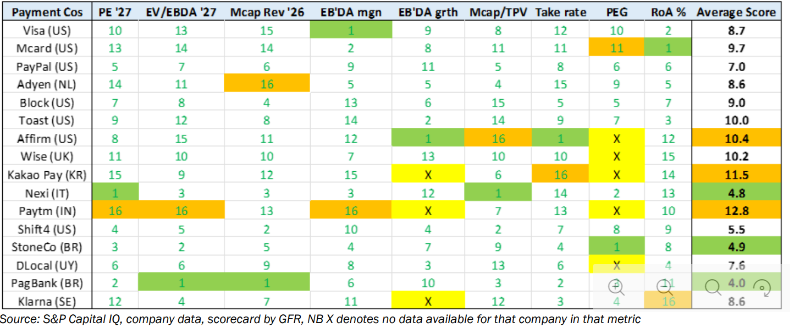
Nexi is Victor Galliano’s top pick - it screens as one of the cheapest global payments names on market cap to revenue and market cap to TPV, with expanding EBITDA margins, rising take rate and improving cash opex discipline, all supported by increasing digital-payments penetration in Italy. PagSeguro remains his core LatAm Buy, despite strong YTD performance, valuations are still compelling and it ranks highly on Victor’s proprietary scorecard (see above), with a high net take rate relative to market cap to TPV. Affirm is the key Sell: Klarna’s IPO erodes scarcity value; valuation looks stretched on market cap to TPV and credit quality in its interest-bearing receivables is worsening. Klarna is one to watch - cheaper post-IPO, but BNPL competition and credit risks keep Victor on the sidelines pending a clear catalyst.
Edition: 226
- 12 December, 2025
Wolters Kluwer (WKL NA) Netherlands
Industrials
Concerns that AI threatens WKL are significantly overstated; in reality, AI is reinforcing its competitive position. WKL’s AI-focused analyst teach-in underscored how rapidly the company is evolving into an AI-first, cloud-native software and content provider. Recurring, AI-enabled digital revenues continue to grow strongly, supported by deeply entrenched platforms in tax, legal and healthcare that deliver high customer stickiness and expanding scale efficiencies. Management also highlighted the rising financial burden of US clinical errors (USD 38.5bn in payouts from 2009-18), emphasising the value of WKL’s proprietary evidence-based, longitudinal data in reducing risk and liability. With solutions that deliver far more savings than they cost, the IDEA! maintains a positive stance on the stock.
Edition: 226
- 12 December, 2025
FLSmidth (FLS DC) Denmark
Industrials
Iron Blue initiates coverage on FLS with a score of 29/60, which is top decile and fertile grounds for shorting. They highlight 1) reliance on percentage of completion revenue recognition with an associated rise in FY24 balance sheet contract assets; 2) elevated stripped out restructuring and software/R&D amortisation costs; 3) evidence of deteriorated client payment behaviour; 4) FY24 headline margins supported by Y/Y reductions in inventory and bad debtor impairment expense; 5) DKK1bn headline net debt adjustments from reverse factoring and restricted cash; and 6) many disclosure gaps.
Edition: 226
- 12 December, 2025
Don’t fall asleep at the wheel, this is a secular bull market
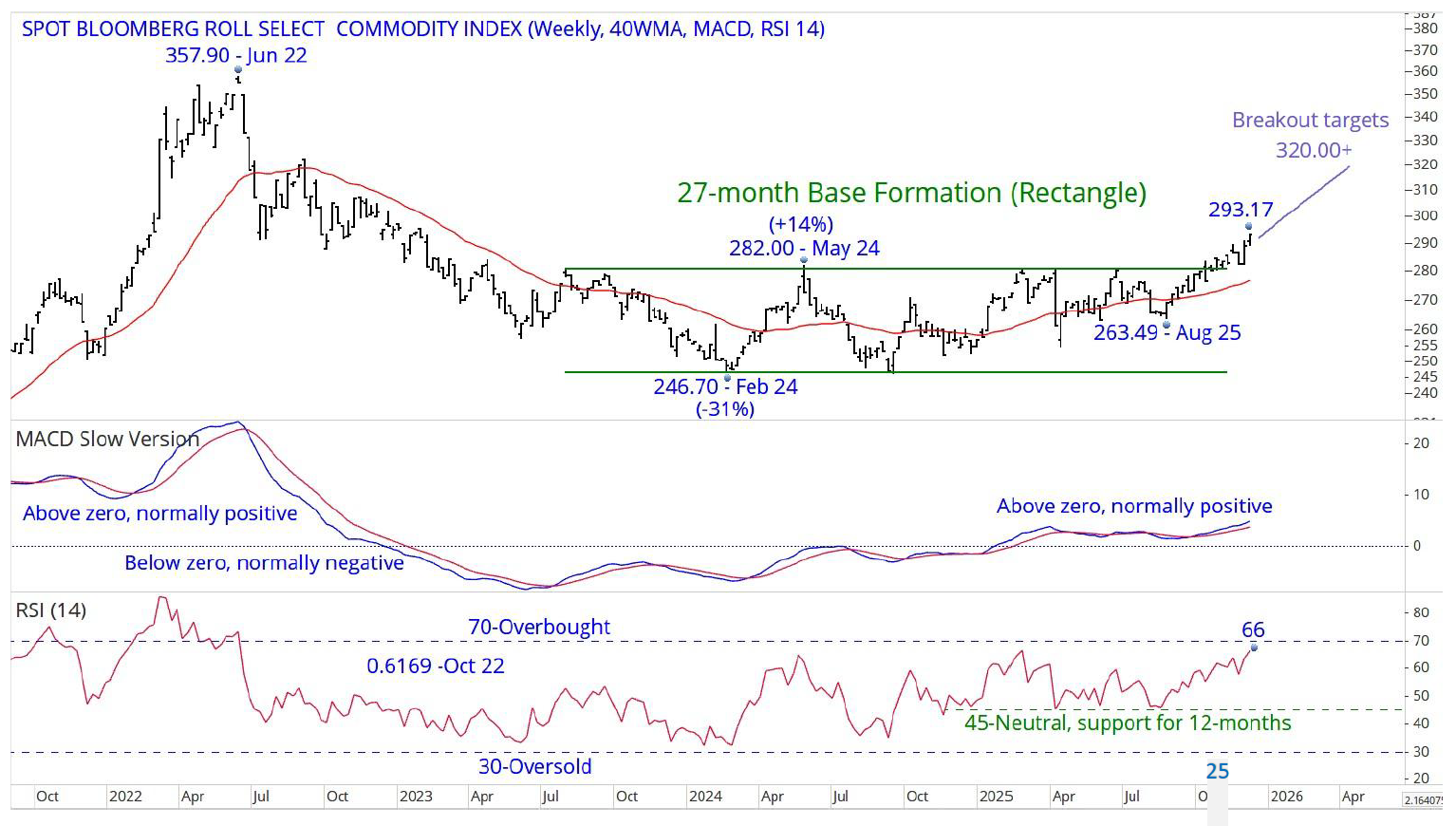
The Spot Bloomberg Roll Select Commodity Index (293.17) is the instrument that Chris Roberts’ newest data provider has, that is just about identical in shape to the Bloomberg Commodity Index that he used to feature. The breakout from the 27-month base formation targets a move to 320.00+, but Chris’s target is a new high above 2022’s 357.90. A secular bear market ended in April 2020 (see next page). The 1st leg of a secular bull market ended in 2022, and following a 30%+ decline and a distracting, time consuming sideways movement, the 2nd leg up is now underway. Indicators have room for further gains.
Edition: 226
- 12 December, 2025
US consumer confidence fell 1% in October
Carl Weinberg notes US consumer confidence was down again in October, with the Conference Board’s headline index continuing its jagged course toward the southeast corner of the chart. Expectations declined, too, and so did the index of current conditions. These confidence indices are very low, well below levels seen just before the Covid lockdowns. Carl says consumers are rattled. The survey indicates that the labour market is tight but jobs have become harder to find in recent months. The inflation expectations index for one year rose, seems to have steadied, but is still extraordinarily high! Carl believes consumer confidence this low will add to the arguments in favour of a rate cut at the FOMC… not a lot, but they do imply a slowdown of consumer spending. Whether or not that might not be a good thing—since the economy is at full employment anyway and cannot produce much more goods or services near term—is a question the FOMC should be debating.
Edition: 225
- 28 November, 2025
Apple: HBM reallocation adds $4bn to iPhone memory bill
Technology
JNK Supply Chain Research reveals AAPL's iPhone memory costs have doubled as a share of BOM - from 5% to 10% - driven by structural HBM reallocation, not cyclical shortage. iPhone 17 Pro Max memory runs $41-$43 per unit vs. $22 in iPhone 15 Pro Max. Across 225m annual shipments, that is $4bn in incremental cost AAPL absorbs through margin compression, not price increases. HBM production for AI accelerators consumes 3x normal wafer capacity. SK Hynix and Samsung control 95% of DRAM supply with all capacity sold through 2026. AAPL negotiates from a position of weakness and there will no relief until late 2027 when new NAND lines come online. For timing of the resulting GM impact, contact us below. AAPL and other smartphone makers are covered in JNK's Consumer Tracker.
Edition: 225
- 28 November, 2025
Real Estate
JSB is defying Japan’s demographics. Despite the shrinking pool of 18-year-olds, Yuka Marosek argues the student-housing leader continues to compound growth thanks to rising university enrolment, a structural shift away from general rentals toward purpose-built student housing and JSB’s unmatched operational moat. While foreign-student demand adds another tailwind. The company runs ~99,300 units with 18 years of 98%+ occupancy and 11 consecutive years of revenue/profit growth. Valuation-wise, JSB trades at an EV/EBITDA of 8.3x and a P/E of 14.4x - levels that appear low given the group’s ability to deliver steady growth.
Edition: 225
- 28 November, 2025
Fears of lower oil prices may be too pessimistic
While market participants await to see what, if any, peace accord emerges from the current Russia-Ukraine talks, William Brown notes that Wall Street analysts appear to be leapfrogging over one another in terms of how bad the global oil “surplus’ will be next year and beyond, and in turn how low oil prices could go. Once again, as William has discussed over the years, analysts always qualify their either extreme bullish or bearish price forecasts with “could” and not “will”. Be that as it may, he notes that one bank he has now heard from is JP Morgan, who suggests that Brent, again “could”, plummet into the $30s due to an “overwhelming” market oversupply. Meanwhile Goldman Sachs are reiterating their bearish view, estimating an average 2.0 MMB/D surplus in 2026, leading to a Brent average of $53.00 per barrel. In contrast, William’s view is the opposite, given what he estimates to be the substantial net short position investors and funds have already amassed.
Edition: 225
- 28 November, 2025
The Philippines – Protests will not confront Marcos, but the president remains at risk
Major anti-corruption rallies are scheduled throughout the country for 30 November. Civil society groups primarily associated with the middle class — such as the Catholic Church, private universities, professional groups and the business community — are taking the lead. The loose coalition leading this weekend’s protest is critical to political stability, given its prominent role in shaping the broader media narrative and eventually mobilizing the broader population. The consensus view in Manila is that while the broader coalition is calling for accountability and reform, it is still not yet aiming to target President Ferdinand Marcos Jr. directly. Instead, protesters are expected to apply indirect pressure by calling for the president to allow for investigations to continue unimpeded and for the prosecution of high-ranking lower house, senate and executive officials. One key reason for the coalition’s less confrontational stance toward Marcos is that they are less certain that the president himself participated. Driving this consideration is the coalition’s deep unease over the prospect of Vice President Sara Duterte succeeding to the presidency.
Edition: 225
- 28 November, 2025
Lumber price decline continues
Lumber price declines continued unabated in S-P-F last week, with 2x4s off by a further $15 at just $395. More S-P-F supply is coming out of the market this quarter, but with little excitement about H1/26 demand prospects, buyers appear to have shrugged off recent mill curtailment announcements and remain happy to operate on a hand-to-mouth basis. In SYP, 2x4 prices were flat at $326 as upcoming holidays (and disruptions to production schedules) had very little impact on trading. ERA expect that prices across North America will be flat-to-down through year-end, and Q1/26 pricing will be driven by changes to supply—clearly, more sawmill downtime is needed.
Edition: 225
- 28 November, 2025
Chile – Market signals scope for further interest rate cuts
In terms of interest rates, declines continued, albeit modestly, in line with the recent trend. In particular, nominal swap rates fell by an average of 3 basis points since the previous report, although this time Igal Magendzo observed some shifts in trend compared with recent weeks. Igal notes that the market continues to assign a high probability to a reduction of the Monetary Policy Rate (MPR) to 4.5% at the December Monetary Policy Meeting (MPM), consistent with his base case. It also now prices in a second additional 25bp cut during the first half of 2026. However, it still does not fully incorporate the idea of a 4% terminal rate, which the Central Bank has been signalling for quite some time. Regarding Igal’s base case, the latest macroeconomic data continue to indicate that the economy is operating close to equilibrium, and therefore near the neutral rate. As such, it would take evidence of a meaningful weakening in activity or more persistent downward pressure on inflation to justify taking the TPM below 4.5%.
Edition: 225
- 28 November, 2025
China’s slump deepens
China’s domestic economy is deteriorating. Andrew Hunt asks if this could lead to a degree of angst within the population? Domestic policy conditions look to have tightened: fiscal policy is notably less expansionary, and liquidity growth has cooled as a result. Equities appear less well bid and the rally may have stalled. Andrew also points out that the corporate sector’s weak financial situation has led to a reduction in China’s once aggressive rate of exportation of private sector capital. China is now a deflationary force within the global economy. The PBoC has acted to suppress the rise in the CNY via hefty FX intervention. Presumably, the weakness in the domestic economy will lead to another round of easing within China’s fiscal policy at some point, although concerns over fiscal sustainability could delay this action. Andrew says global investors should pay close attention to China’s fiscal stance and the nature & quantum of its capital outflows. These may yet hold the key to determining “the top” in global risk markets.
Edition: 225
- 28 November, 2025
Argentina – Economy grew 5.0% year-on-year in September
The Argentine economy expanded 0.5% month-on-month in September, much better than Jorge Morgenstern’s expectations, according to the GDP proxy EMAE. Activity grew 5.0% year-over-year. There were significant upward revisions of previous data, with August now 0.9% higher than previous data release and monthly expansions since July. While the economy expanded 5.2% yoy in January-September (5.4% using the seasonally adjusted series), activity in September was 0.2% above February’s peak. As a result, GDP expanded at a seasonally adjusted annual rate of 1.9% in 3Q-2025 following a 0.2% contraction in 2Q-2025, dodging a technical recession.
Edition: 225
- 28 November, 2025
Brazil Central Bank waiting for clear signal on inflation
The BCB Director of Monetary Policy and Deputy Governor, Nilton David, opened his remarks at the Brazil Treasury Summit by highlighting that the rate-hiking cycle is over and that raising the Selic is not part of the baseline scenario. He stated that the priority now is understanding when the cutting process may begin, something fully conditioned on data convergence. He stressed that the Central Bank is waiting for clear signs of inflation and expectations easing before moving forward, and that forward guidance is not appropriate in a highly uncertain environment. According to Andrea Damico, David’s remarks reinforced the sense of a technical Central Bank highly focused on keeping expectations anchored, aligned with recent speeches by President Gabriel Galípolo. The communication emphasized the priority of preserving credibility, avoiding unnecessary volatility, and consolidating the disinflation process. The messages indicate confidence in the effectiveness of monetary policy, while acknowledging that full convergence still depends on a lower-uncertainty environment and disciplined communication. Overall, the tone reinforces prudence, mandate focus, and continuity in strategy.
Edition: 225
- 28 November, 2025
Gold and silver to remain volatile with underlying strength
Jeffrey Christian of CPM Group discusses the increasingly unstable economic and political environment and what it means for gold, silver, and broader precious metals markets. He compares today’s conditions with the late 1970s, noting both the similarities and critical differences to that period, and what those differences may mean for gold and silver prices. Jeff looks at the volatility across gold, silver, platinum, and palladium, explaining the factors influencing investor anxieties. He also discusses economic shifts, including weakening U.S. influence on the global stage. The video concludes with a look at inflation data, consumer behavior, policy risks, and why CPM Group expects a recession within the next 12–24 months.
Click here here to watch
Edition: 225
- 28 November, 2025
UK Budget is negative for economic growth
Mark Bathgate's initial thoughts on the overall shape of the UK Budget is welfare spending and taxes up a lot, borrowing up in the first two years of the budget period, with most tax hikes coming years 4 and 5. He points out that the Budget looks to be negative for growth – primarily via the further decline in household real after tax income, and likely impacts on confidence from the messy process of recent weeks and prospects of many years of rising taxes. Moreover, three key expenditure areas have not been addressed which questions the sustainability of the current budget:
* defence spending (no funding for NATO commitments entered into at June summit);
* Ukraine 2026 & 2027 budget which UK is publicly committing to contribute significantly to;
* local government financing crisis.
Overall, Mark says this looks to maintain the trend we’ve seen over the last 15 months: higher borrowing; lower economic growth; steeper gilt yield curve/higher long gilt yields; and more speculation about next round of tax hikes. However, Mark also says that one positive is that there are less inflationary risks relative to the previous budget.
Edition: 225
- 28 November, 2025
Global Equities Tactical Asset Allocation – Germany moves into late-cycle Stage 3
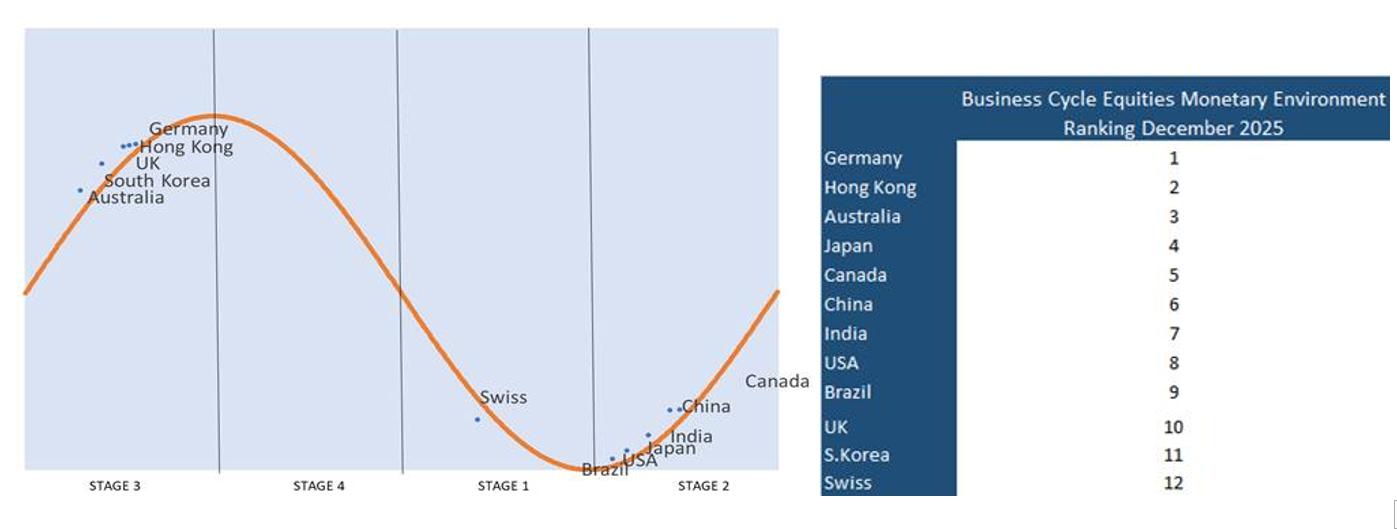
In this report Frank Shostak describes his highly dynamic equities tactical asset allocation framework which delivers specific country capital allocations down to the sector level. In the latest monthly report, Germany rotates into the late cyclical Stage 3 of the business cycle, joining the US, Eurozone, UK, Canada, Australia, Brazil, India, China & South Korea in exhibiting monetary tailwinds. In contrast Switzerland alone continues to exhibiting monetary headwinds ahead. According to the AASE analysis, the cycle itself is a function and product of fluctuations in the rate of growth of money supply, which provide a very reliable leading indicator of business activity, and Stages 2 and 3 correspond to periods of expansion in (lagged) money supply. The chart above shows a visual illustration of where each country will be in the business cycle for the upcoming month. By combining the business cycle staging with Frank’s Liquidity measure AASE derive a country rank, the current state of which is shown in the table above. Sector allocation in each country is determined as per AASE’s sector allocation framework, whereby different sectors of the stock market perform better in some stages of the business cycle than do other sectors.
Edition: 225
- 28 November, 2025
Watching The Tides – The ECB’s search for a new normal: QE, QT, QN
Although the process of monetary policy normalisation in the euro area is well under way, expressed as a share of GDP, total Eurosystem assets are still double what they were a decade ago. The ECB recently laid out its vision of what the journey from QE to QT to QN is likely to involve: the banks and the sovereign bond markets now need to adjust. In this article, Marcel Alexandrovich focuses on the Eurosystem (which is made of the ECB and the 20, soon to be 21, National Central Banks). The first point Marcel makes is that just as the aggregate banking data often disguises what’s actually going on at the country level across the euro area, the same is true when analysing the aggregate Eurosystem balance sheet. Repayment of the Longer-Term Refinancing Operations (LTROs) and QT are reducing the size of the ECB’s balance sheet. One thing which is not clear, however, is who in the future will end up holding the large volume of European sovereign debt that currently sits on the balance sheet of the European banking system.
Edition: 225
- 28 November, 2025
US Tariffs – Trump’s IEEPA alternatives
Although the timing of the Supreme Court’s ruling on the legality of President Trump’s use of the International Emergency Economic Powers Act (IEEPA) to impose tariffs is uncertain, the Trump administration's stance remains one of confidence, despite the perception after the hearing that it is likely to face at least some restrictions. However, if the duties were to be struck down, there are other authorities that the White House might rely on to impose tariffs, with Sections 232, 301, 338, and 122 being possible alternatives. Of these, Section 338 imposes the fewest restrictions on Trump, with the only meaningful restriction being that the tariffs it authorizes are limited to 50 percent, which is higher than any current reciprocal tariff level. The most significant risk of using this authority, though, is that it has no history of use since its creation in the Smoot-Hawley Tariff Act of 1930. This lack of precedent means the president’s efforts to use this authority for tariffs could face legal challenges.
Edition: 225
- 28 November, 2025
Consumer Discretionary
Alibaba’s stepped-up AI investment is pressuring margins, but RFM argues it has now hit critical mass in open-source AI, making it the leading contender in China’s artificial intelligence race. Headline revenue growth in Q2 was only +5% Y/Y, but was +15% adjusting for disposals. The standout was Cloud Intelligence, +34% Y/Y, powered by surging demand for AI services. Qwen now has 180,000+ models on Hugging Face, more than double the No.2 player, giving Alibaba the network-effect scale needed to dominate China’s AI ecosystem. With core e-commerce stabilising and shares far cheaper than Amazon (17x FY26 P/E vs. 29x), RFM sees sentiment turning decisively positive.
Edition: 225
- 28 November, 2025
Healthcare
Tom Tobin thinks there are several secular trends, including AI tailwinds, which makes RDNT a compelling idea even after its share price has rebounded in recent months. Core to Tom’s thesis is his ability to track Diagnostic Radiology staffing at RDNT, monitor turnover, and forecast volume and revenue per clinician. While the current valuation against consensus estimates appears stretched, he can model upside well into 2027 with a number of simultaneous secular tailwinds that justify the premium: 1) continued inpatient-to-outpatient imaging migration; 2) mix shift towards high-margin advanced imaging where demand is being driven by Alzheimer's, Oncology and Cardiology; and 3) AI tailwinds driving incremental revenue and operating leverage.
Edition: 225
- 28 November, 2025
Identifying stock swaps within your portfolio
Mill Street’s Swap Shop report responds to strong demand from equity portfolio managers seeking to use their MAER model (the Monitor of Analysts’ Earnings Revisions) to identify problematic low-ranked holdings and find high-ranked substitutes that preserve overall portfolio allocations. By leveraging MAER’s powerful intra-sector and intra-industry ranking performance, Mill Street highlights potential swaps within the same benchmark universe and industry, helping managers avoid “portfolio inertia” while keeping sector and style exposures consistent. This month’s screens include global large-cap Value stocks amid the recent rotation from Growth to Value, US Financials and Health Care following Mill Street’s sector allocation changes, and additional screens across the S&P 500 and their European equity universe. Click here to access the report.
Edition: 225
- 28 November, 2025
Time to buy Greece
Greece is healing - after a brutal 15-year wait, the country has finally regained its BBB investment-grade rating from Fitch. Despite chronic under-investment in infrastructure, Greek corporates have expanded at home and abroad and now boast strong balance sheets, often with net cash - a rarity in Europe. Ultra-low labour costs and the highest workload in the EU have boosted competitiveness, while political stability since 2019 has restored investor confidence. Yet Greek equities still trade at half their 2008 market capitalisation, leaving substantial upside for companies that are leaner, stronger and more agile than their European peers. AIR’s Buy-rated ideas include Athens International Airport, Motor Oil, National Bank of Greece and Sarantis, each offering 40-100%+ upside.
Edition: 225
- 28 November, 2025
Palantir CEO’s defensiveness raises some red flags
Technology
MYST highlights a worrying behavioural shift after analysing CEO Alex Karp’s recent media appearances. Following the stock’s sharp pullback, he has adopted what behavioural economists call “defensive attribution” - a psychological bias where people facing harsh criticism attribute negative outcomes to external factors rather than accepting personal responsibility. Karp’s responses increasingly dismiss critics, question motives and escalate into personal attacks. While MYST are not insinuating PLTR is a fraud or a bad business, his rhetoric mirrors CEOs from some of the biggest corporate scandals.
Edition: 225
- 28 November, 2025
Elekta (EKTAB SS) Sweden
Healthcare
EKTAB delivered a Q2 profitability beat despite tariffs and FX headwinds, while sales were only slightly soft, helping spark a sharp rebound in the shares. Adjusted EBIT came in 6.5% above expectations and margins rose to 10.1%, supported by mix and pricing. Although China and the US weighed on revenue, order intake grew and China’s book-to-bill ratio exceeded 1.3x suggesting a potential recovery ahead. H2 should be stronger, with improving China trends and US approval of Elekta Evo expected. The new CEO’s restructuring plan - cutting ~450 jobs (10%), simplifying the organisation and cancelling low-quality orders - targets SEK500m+ annual savings. With a robust SEK34bn backlog and solid uptake of new products, AlphaValue maintains a positive view as the turnaround gains traction.
Edition: 225
- 28 November, 2025