Fortnightly Publication Highlighting Latest Insights From IRF Providers
Company Research
The next financial crisis
That we live in a hyper-financialised world is not in dispute, but James Aitken cannot see the net benefits to society from changes like Kalshi, which monetise differences in opinion. He argues that over the long run, monetising any difference in opinion will create negative utility due to the externalities of normalising the idea of betting on everything. And one would think that these betting markets are enormously susceptible to manipulation by state actors; yet such is the path we are on. So what? James says he isn’t tilting against the windmill of the ongoing, hyper-financialisation of everything. Instead, he suggests that the path to the next financial crisis won’t run through (e.g.) private credit, geopolitics or whatever, but instead it will run directly through market structure, period. What happens when, for any period of time from minutes to hours to days, all the machines that intermediate 1x, 2x, or 3x levered ETFs, prediction markets, 0DTE, bonds, stocks etc. decide ‘computer says no’?
Edition: 226
- 12 December, 2025
Real Estate
JSB is defying Japan’s demographics. Despite the shrinking pool of 18-year-olds, Yuka Marosek argues the student-housing leader continues to compound growth thanks to rising university enrolment, a structural shift away from general rentals toward purpose-built student housing and JSB’s unmatched operational moat. While foreign-student demand adds another tailwind. The company runs ~99,300 units with 18 years of 98%+ occupancy and 11 consecutive years of revenue/profit growth. Valuation-wise, JSB trades at an EV/EBITDA of 8.3x and a P/E of 14.4x - levels that appear low given the group’s ability to deliver steady growth.
Edition: 225
- 28 November, 2025
Consumer Discretionary
Alibaba’s stepped-up AI investment is pressuring margins, but RFM argues it has now hit critical mass in open-source AI, making it the leading contender in China’s artificial intelligence race. Headline revenue growth in Q2 was only +5% Y/Y, but was +15% adjusting for disposals. The standout was Cloud Intelligence, +34% Y/Y, powered by surging demand for AI services. Qwen now has 180,000+ models on Hugging Face, more than double the No.2 player, giving Alibaba the network-effect scale needed to dominate China’s AI ecosystem. With core e-commerce stabilising and shares far cheaper than Amazon (17x FY26 P/E vs. 29x), RFM sees sentiment turning decisively positive.
Edition: 225
- 28 November, 2025
How to beat the S&P500 - the Q&A that matter
Trivariate examines six core issues for long-only managers benchmarked to the S&P500: 1) Beta: despite long-term data favouring sub-1.0 beta portfolios, this is currently nearly impossible given the high-beta “Great 8”. 2) Alpha vs. Risk: ~75% of holdings should be for risk management. 3) Diversification: run both a broad risk book and a concentrated alpha book - essentially two portfolios in one; holding a higher number of stocks vs. history. 4) Position Sizing: take large, conviction-weighted bets in names with high company-specific risk / hard to replicate (e.g. Healthcare). 5) Blow-up Avoidance: avoid large exposures to bottom-decile FCF converters, large increases in inventory-to-sales, large intangible accruals and extreme valuations. 6) Macro: portfolio managers must consider what set of macro conditions are best for their portfolio performance.
Edition: 224
- 14 November, 2025
FDJ United (FDJU FP) France
Consumer Discretionary
Trading at the cheapest valuation since listing (9x FY25 P/E) and offering a 10% dividend yield, FDJU has more than discounted temporary headwinds. While regulatory tightening and higher taxes in France, the UK and the Netherlands will cut FY25 EBITDA by ~€55m (145bps margin drag), it is a small dent vs. the €3.3bn in lost market value since 2021. Beyond this, FDJU’s technology-focused, online-diversified model post-Kindred integration is more attractive than ever, underpinned by stable lottery cashflows. AlphaValue expects sentiment and the share price to recover sharply, calling it an exceptional risk/reward setup. Their TP offers more than 100% upside.
Edition: 224
- 14 November, 2025
Consumer Discretionary
Katitas has mastered a business model that many find difficult to replicate: buying, renovating and reselling pre-owned homes with consistent success. With 36% foreign ownership, investors clearly recognise the company’s ability to address Japan’s vacant housing problem and the stock trades at a premium P/E of 18x vs. single-digit averages for residential construction peers. Following strong H2 results and raised guidance on Nov 7th, the stock jumped 10%. Yuka Marosek’s latest piece explains why Katitas’ unique business model deserves that premium.
Edition: 224
- 14 November, 2025
Technology
Richard Windsor argues that data centre revenue is the “elephant in the room” the market is ignoring, with substantial contributions now expected in FY27 rather than FY28. He estimates QCOM’s A200/A250 products could add ~$2bn in incremental data centre revenue, with potential upside if a hyperscaler deal closes soon. Combined with stronger PC growth (he views current forecasts as far too low) and upside optionality from its BMW-linked ADAS stack, QCOM’s diversification beyond smartphones is ahead of schedule. Q4 results beat across all metrics, but the real story is the growth visibility emerging in new segments. With Street EPS forecasts for FY26-27 still overly conservative and the stock trading at ~14x 2026 P/E, it’s easy to see how both multiple expansion and upward estimate revisions could drive a strong rally in the shares.
Edition: 224
- 14 November, 2025
Industrials
Sidoti lifts their target price by 45% following another record-breaking quarter for FIX. 3Q25 EPS and sales beat forecasts by 32% and 16%, respectively, as the company continues to steer its project mix towards the technology sector (mostly data centres). FCF hit $516m (177% of net income) while the order backlog rose 15% sequentially (all organic) and 65% Y/Y (62% organic) to $9.4bn. Expanding modular capacity remains a potential near-term catalyst, while beyond 2026, Sidoti views no shortage of end markets experiencing secular growth (e.g. reshoring, advanced manufacturing, chip plants), or other hyperscalers for that matter, that would like a greater chance to compete for FIX’s services, were current customers to decrease their expenditures. Sidoti now models 2025 EPS of $25.60 (from $22.91), 2026 EPS of $30.34 (from $26.50) and introduces 2027 EPS of $38.50.
Edition: 223
- 31 October, 2025
Consumer Discretionary
PLNT is well positioned in the growing high‑value‑low‑price gym segment with scale and ample runway for growth. New CEO Colleen Keating brings relevant hospitality franchise experience to drive the next phase of growth in the US and internationally. Gen Z is the fastest‑growing membership cohort for the company, supported by initiatives like the “High School Summer Pass”. PLNT continues to refine club formats and contractual terms to improve efficiency and unit economics. 2Xideas expects 2024-31E system‑wide sales CAGR of 11.7%, driven by 6.6% annual net unit growth and 5.0% same‑club sales growth. They forecast an 11.1% EBITDA CAGR and a 44.6% margin in 2031E. European expansion remains an upside not reflected in their forecasts. They see 17.2% annualised total returns based on an exit NTM P/E of 28.0x (17.7x EV/EBITDA).
Edition: 223
- 31 October, 2025
Debt Risk Monitor
TT has launched their first Debt Risk Monitor, highlighting 53 companies across Europe and the Americas, that have been flagged by their proprietary tool as potential debt risks. Previously integrated within TT’s accounting risk framework, the new monitor flags firms where debt concerns exist regardless of whether they see any other accounting issues (i.e. earnings manipulation). The tool detects signs of hidden on- and off-balance-sheet debt, an approach that previously identified Steinhoff and NMC Health ahead of their collapses. Similar to the accounting risk score, the higher TT’s debt risk score, the more indication they have that companies have hidden debts. Clients can access the full monitor, covering 7,500+ listed companies, via TT’s website, alongside historical data, background reports and ongoing monthly updates.
Edition: 223
- 31 October, 2025
Oil: WTI to fall below $50/bbl?
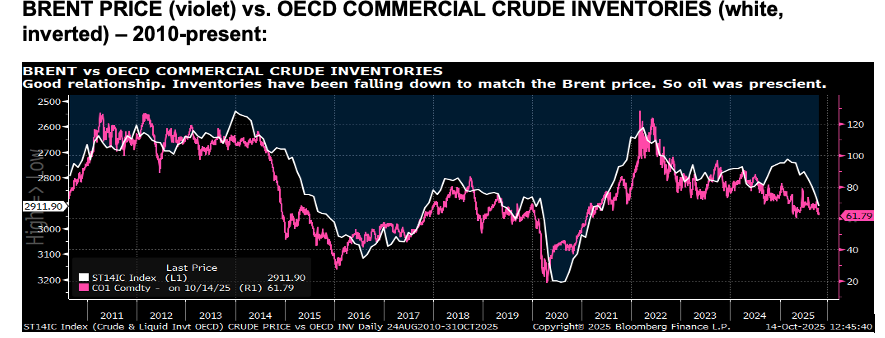
Michael Churchill says if we are in an oil glut, one has to be open to the risk of oil falling below $50/bbl for WTI. Moreover, if Trump has made a deal with Arab leaders to keep that glut going, then there is no floor until some of the North American players lay down rigs or shut in production. Gas is less at risk for this kind of event since it is already so cheap relative to oil. Michael points out that if the new race for global power is focused around AI domination, it stands to reason that the old E&P elites will be gradually losing their power in geopolitics – particularly geopolitical moves meant to keep oil prices firm. Oil prices began falling in January, in anticipation of an increase in OECD crude inventories. Brent peaked at $82/bbl in January. Shortly thereafter (in February) OECD commercial crude inventories hit a low of 2.73b barrels. Since then, Brent has fallen to $62/bbl and OECD inventories have risen 5% to 2.91b barrels.
Edition: 222
- 17 October, 2025
Technology
BTN continues to see several areas where OSIS's results may be unsustainable. The company has reduced its bad debt reserve to just 2% of receivables (vs. a 5-7% historical range), adding ~11 cents to Q4 EPS (OSIS only beat Street estimates by 5 cents). The current reserve for bad debts is at least 200 bps too low; if OSIS had to raise it by 100 bps, it would be a 39-cent headwind for EPS. DSOs have surged to 151 days (historically ~90), making Q4's revenue increase more suspect and the $372m forecast for 1Q26 tougher to reach. Warranty expense was cut again (added 3.7 cents to EPS), while OSIS continues to let its PP&E age and is using fully depreciated equipment - saving 29 cents in EPS last year. Finally, FCF remains weak (negative in 5 of the last 8 quarters).
Edition: 222
- 17 October, 2025
Technology
Could the stock soar over 100%? KCR argues that CSCO isn’t just cheap vs. AI peers - it is cheap relative to the broader market, trading at roughly the same multiple as Kimberly-Clark despite far stronger growth. Networking product orders have risen 10% Y/Y for 4 consecutive quarters, suggesting investor concerns about a slowdown are unwarranted. Meanwhile, the company’s rapidly growing exposure to AI infrastructure products and shift towards subscription-based revenue both support multiple expansion. CSCO trades at one-third of Arista Networks’ P/E multiple and one-quarter of its EV-to-revenue ratio - even a modest narrowing of the valuation gap would translate into substantial gains for CSCO shares. Finally, a ~5% FCF yield is far too high for a company of CSCO’s quality.
Edition: 222
- 17 October, 2025
Unpacking China’s growing pet market
Consumer Discretionary
Marie Boyé examines China’s rapidly expanding pet industry, projected to reach $114bn in 2025, or 10% of global market share - tripling in size since 2020. Growth is led by pet food, followed by veterinary services and accessories, with emerging segments in pet tech, premium nutrition and luxury care. Cats now outnumber dogs, driven by urban lifestyles and regulatory shifts. Despite inflationary pressures, spending on pet essentials remains resilient, underscoring the sector’s defensive nature. Competition is fierce between multinationals and digital-savvy domestic brands leveraging influencer marketing and e-commerce dominance. Changing attitudes towards family and younger consumers’ growing attachment to pets are expected to drive continued spending, innovation and investment across China’s pet sector.
Edition: 222
- 17 October, 2025
Industrials
Under new leadership, Kyodo is accelerating its pivot from the declining paper-printing business towards higher-margin niches such as high-performance packaging materials, flexible packaging and tube products. Margin gains in recent years already reflect this shift and the company’s 10-year plan aims to scale these efforts further. The key question for investors: with DNP and Toppan well ahead in diversification, can Kyodo leverage its niche strengths to establish itself as a viable third player in a consolidating industry. Yuka Marosek argues it can. While Kyodo’s OP recovery appears partially priced in (13.9x P/E vs. DNP at 14x and Toppan at 18.4x), a 4.8% dividend yield should appeal to income investors and with FY26 OP projected +20% y/y and ROE rising to 6.1%, further upside remains possible.
Edition: 221
- 03 October, 2025
On the topic of fiscal velocity
Stephen Jen and Faith Yilmaz introduce the concept of ‘fiscal velocity’, which measures the ratios of changes in nominal GDP to nominal fiscal spending. They find that Asian countries (ex-Japan) may be more efficient in their fiscal spending compared to European countries, a result of their higher spending on investment goods. In contrast, European countries tend to emphasise consumption (e.g. welfare spending). Highly indebted countries such as Japan and Italy allocate a larger proportion of their budget to debt servicing, resulting in little to show for it in terms of GDP. It has also become somewhat fashionable for developed countries to engage in proactive fiscal and monetary policies; this ‘Alt-Keynesian’ posture of ‘doing-more-is-better-than-doing-less’ has helped contribute to the large fiscal deficits and debt, with modest impact on actual GDP growth. On their measure of fiscal velocity, roughly speaking, Asian countries’ fiscal spending may be 7 times more efficient than their European equivalents.
Edition: 220
- 19 September, 2025
Uranium: A quirky year for a quirky commodity
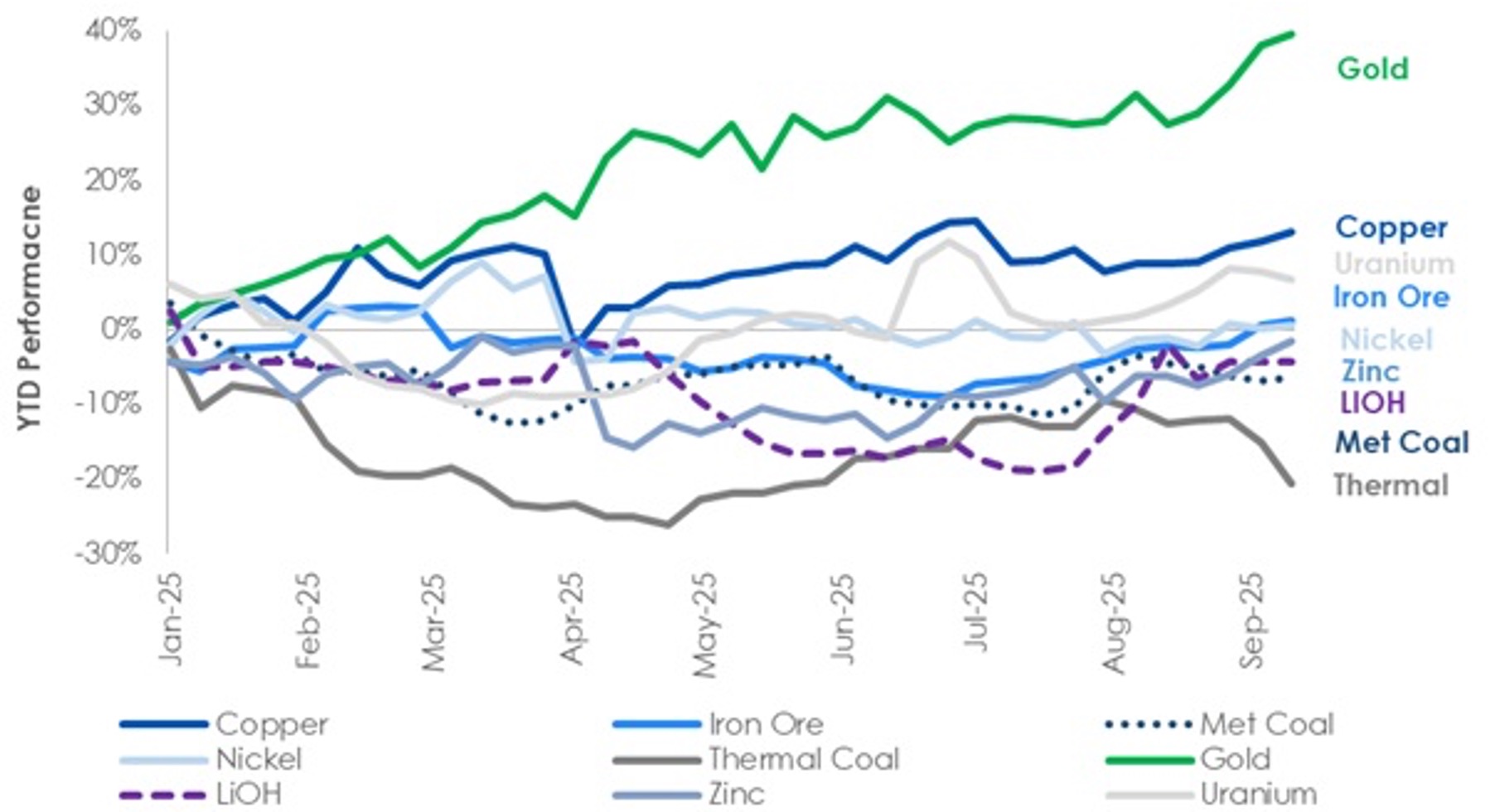
Several commodities have their quirks, and uranium certainly fits into that group. Despite such a strong future outlook, and limited new mine production, this year has feen strong for neither the commodity itself nor many of the producers. Uranium spot prices recently peaked in 2024 at over US$100/lb and have traded lower since. The 2025 price has been pretty much range bound between US$65-80/lb. Annual demand of U3O8 is ~80kt (or ~175Mlb) is heavily reliant on power plant demand with contracts signed years ahead of consumption. Year to date the price is up some 7%, making it one of the better performing commodities, i.e. one of the few that hasn’t fallen on global uncertainty and growth concerns. However, supply-demand would have argued for a price move much better, and it has been well overshadowed by others.
Edition: 220
- 19 September, 2025
Overlooked opportunities in YWR’s QARV rankings
Why do China, shipping, iron ore, hardware, Brazil… all stand out if you screen high ROE’s with low valuation? Erik@YWR sees it as scepticism about global growth on which he is taking a contrarian view. Following this month’s review of YWR’s QARV rankings key themes include: 1) A massive China bull market has only just begun. 2) Opportunities in iron ore, where Fortescue, Rio Tinto and Kumba are delivering ~20% ROEs at <12x P/E despite China’s property crash. 3) The Taiwanese semiconductor supply chain stands out as highly profitable and undervalued. Everyone focuses on Nvidia and the datacentre buildout but misses the whole Taiwanese supply chain behind this. Tokyo Electron and ASML also screen well. 4) Brazil is overlooked, with names like Itau, Vale, Ambev and B3 all screening well. 5) Container shipping - supply-chain diversification could sustain tighter freight rates than investors expect.
Edition: 220
- 19 September, 2025
Tencent (700 HK) & NetEase (NTES US) US
Technology
While China’s e-commerce sector is mired in subsidy fuelled competition, Arete argues this is outweighed by strength in gaming and online entertainment. Record approvals and blockbuster titles underpin upgrades for Tencent and NetEase, while Alibaba shows early signs of a turnaround in quick commerce and cloud. The report also examines mounting cost pressures at Meituan, the lack of near term catalysts at Xiaomi and SEA, and the structural headwinds still facing JD and Baidu.
Edition: 219
- 05 September, 2025
USD: A race to the bottom?
According to Charles Hess, the US strategy is to lower the value of the dollar - without affecting its status as the world’s reserve currency - and encourage domestic manufacturing by increasing the price of imports and lowering the price of exports. Trade will shrink among some trading partners and increase between others (i.e., India and Russian oil), as they rearrange their economic relationships. As the US pulls away from the alliances and allies that have granted it primacy as a global superpower and as the provider of the world’s reserve currency, China is attempting to make available a substitute for the dollar-centred international economy via Beijing-centred international organizations and alliances. These Beijing-centred coalitions increasingly trade in their own currencies. Gold, silver and other hard assets will hold their value and increase in price as the dollar declines.
Edition: 218
- 22 August, 2025
Technology
Boyar argues investor fears around the stock are overblown. While the loss of a respected CEO, macro uncertainty and competitive pressures in the Merchant business have weighed on sentiment, Boyar sees the past year’s share price swing as a textbook case of exuberance turning into excessive pessimism. The company retains leading market positions, a strong operating track record and a mid-teens earnings growth outlook, yet trades at just ~12x forward P/E - its cheapest valuation in over a decade. Wall Street’s intense focus on Clover's short-term performance overlooks the company's host of other valuable business lines, which together contribute ~83% of revenue. Applying a 19x multiple to 2027E EPS of $13.33, Boyar values the stock at $253, implying ~80% upside.
Edition: 218
- 22 August, 2025
High-conviction short ideas
Dick’s Sporting Goods (DKS) - the Foot Locker acquisition will go down as one of the most value-destructive deals in retail history. The first time DKS misses a quarter because of perennial weakness at FL, this newco will trade at 3-4x EBITDA.
Best Buy (BBY) - 100% of EBIT comes from extended warranties, credit and membership - all of which are facing cyclical and secular pressure. Tariffs could take margins to zero, spurring a massive round of store closures.
Lam Research (LRCX) - the most complacent name in semicaps with 2026 WFE expectations set too high especially in DRAM. P/E now 4.5x turns above 3-yr average despite little growth in 2026. Domestic competition in China intensifying longer-term.
Edition: 218
- 22 August, 2025
US: Any easing rally may be short lived
The ongoing wave of T bill issuance looks to be crowding out private sector borrowers in the US credit markets. It’s early days, but Andrew Hunt points out that the data seems to be leaning that way. The US economy is slowing, with little going on outside of the AI boom, and nominal growth currently seems to have a high price / low real growth composition. The crowding out phenomenon will bring about a bear steepening effect in the near term, supporting the USD, although Andrew expects the Fed to respond aggressively. He sees markets being strong and USD weak in 2025/Q4 as a Pavlovian response to rate cuts, and that the new easing will cast the economy’s inflation expectations adrift, leading to nominal growth accelerating for the wrong reasons (i.e. prices not volumes). At some point in the coming year, markets will have to worry about an FOMC tightening and/or entrenched inflation.
Edition: 218
- 22 August, 2025
Why smart money isn’t buying crypto stocks yet
Crypto stocks are unwinding sharply and some of the most hyped names are now down 30-50% from their highs. Markus Thielen says this isn’t just about short-term corrections - it’s about the deeper repricing of crypto’s equity narrative. Some names may still have room to fall, while others could be nearing high-conviction entry points. In June, Markus flagged that several crypto-related stocks were losing momentum, prompting his take-profit recommendation on Coinbase and warning that others could follow - notably Kakaopay, Metaplanet and Circle. Since then, the damage has been significant with all three names falling heavily. Valuations remain stretched - Circle still trades at a forward P/E of 153x, compared to 102x for Coinbase and 69x for Robinhood, leaving room for further downside. A 30% correction in Circle, or similarly in Kakaopay with its 128x P/E, would not be surprising.
Edition: 217
- 08 August, 2025
Healthcare
A growing, cash-generative specialty physician group with limited downside risk. MD offers a nationwide focus on neonatal and paediatric care, and stands to benefit from rising preterm birth rates and increasing demand for complex infant care. Despite these defensive and attractive characteristics, MD trades at just 8x P/E and 7x EV/EBITDA - over a 50% discount to the S&P 500. In recent years, private equity buyers have paid a median 13x EV-to-EBITDA for similar assets. Even a modest multiple re-rating could unlock significant upside - each 1x EV-to-EBITDA multiple improvement would equate to ~$2.75 boost in MD’s share price.
Edition: 217
- 08 August, 2025
The trade war is dead, long live the trade war!
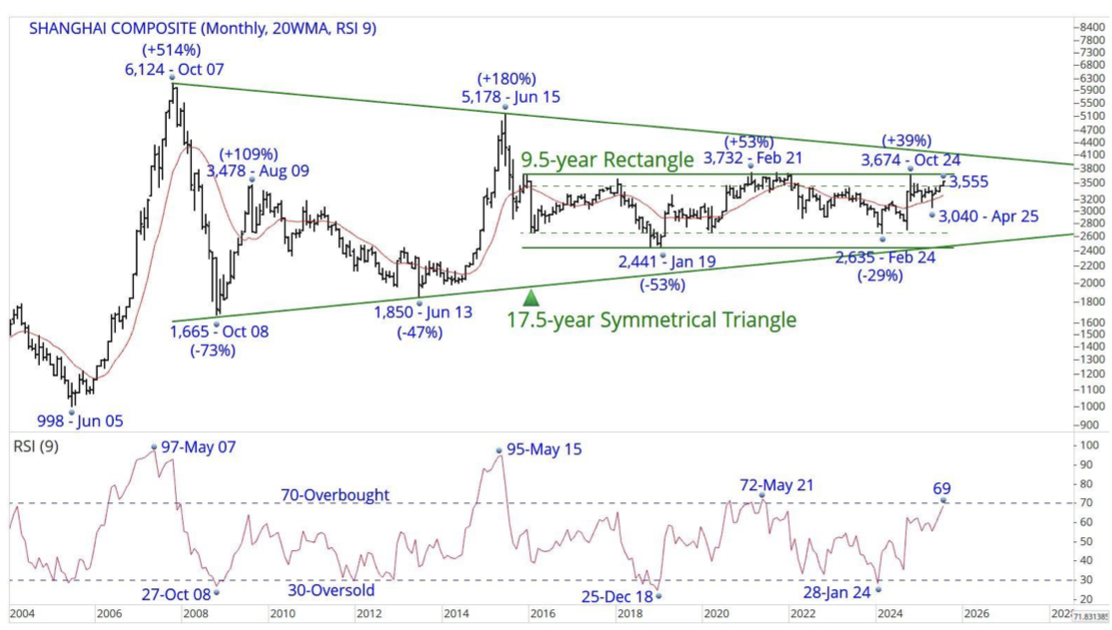
Despite all of the dire headlines about the imposition of a 25% tariff rate on Canada and 30% on Mexico and the European Union, Cam Hui says the only trade war that matters is effectively over. China has won. In the short run, economic policy uncertainty is receding but it’s not fully normalized. According to Cam, it’s time to adopt a risk-on posture. US equities lagged most during the trade war panic, and they are recovering and should be the leadership in the short term. In the long run however, Trump’s America First policies of continuing trade wars and efforts to reshore low value-added industries are likely to erode U.S. productivity and competitiveness. The S&P 500 is already trading at a highly elevated forward P/E of 22.2. Cam believes that equity investors should not expect US equities to continue to outperform global stocks in the next expansion cycle.
Edition: 216
- 25 July, 2025
US: An emboldened bull, dancing on the edge
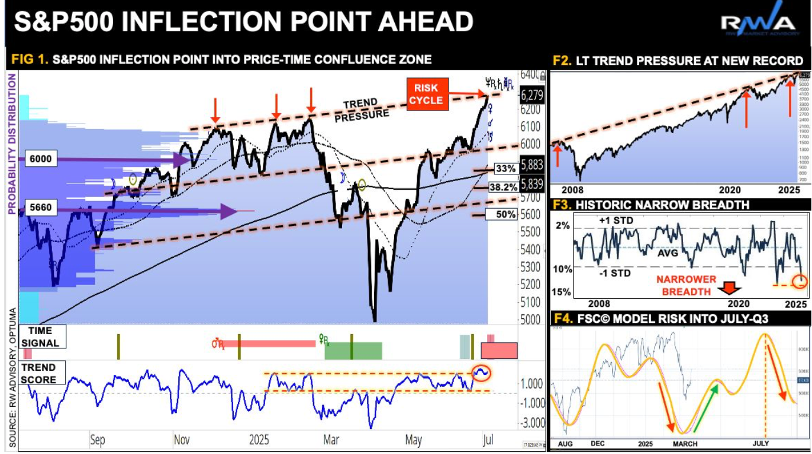
Despite US equities reaching record highs, surface strength masks underlying fragility. The market is pressured by a revival of triple whammy headwinds: momentum exhaustion, inter-market divergences, and macro-cycle pressures. Rising tail risks—such as escalating geopolitical tensions (e.g., a fragile Iran-Israel ceasefire) and potential US trade policy shifts (including 70% tariffs)—threaten to disrupt momentum and increase volatility. RW Advisory warns that timing models and liquidity indicators suggest a possible Q3 inflection point. Investors are urged to prepare by rebalancing toward higher-quality assets, increasing cash allocations, and utilizing tactical hedges. Defensive positioning now may help mitigate potential turbulence expected later in the year.
Edition: 215
- 11 July, 2025
Consumer Discretionary
Stablecoin adoption presents a unique long-term opportunity for BABA. As the US moves to legitimise stablecoins for global transactions and reserves, China must adapt, albeit cautiously. Hong Kong is emerging as a testbed, with Ant Financial well-positioned to play a strategic role. China’s strength in cross-border trade and BABA’s ~29% share in export e-commerce puts the company at the forefront of this transformation. While stablecoins are unlikely to replace domestic payments, they are poised to reshape international transactions and financial influence. BABA’s regulatory track record, global reach and fintech infrastructure give it an edge over peers like PDD, TikTok Shop and Shein. Blue Lotus maintains BABA as a Top Buy, while Futu is also highlighted as a likely long-term winner in the web3.0 world.
Edition: 215
- 11 July, 2025
China’s digital yuan: Ain’t no dollar killer
As China drives forward the world-leading digital yuan project, Ed Yardeni dispels the notion that we are seeing a growing challenge to dollar supremacy. True, Trump’s trade war could be dollar negative, but the US economy isn’t having to deal with the Xi era’s glacial pace of economic and financial reform in a nearly $18trn economy. Although BRICS is gunning for a less dollar-centric future, the yuan sees only a 2.2% share of global foreign exchange reserves – the dollar sits on top with 58%. The PBOC also suffers a trust deficit – why would global institutions trust their e-CNY? There are some arguments that a digital yuan would help solve the country’s weak household demand, but Ed disregards the potential of this bringing enough significant change to cover the festering economic problems. At the end of the day, the nature of the digital asset a country chooses matters far less than the resilience of the economy that undergirds it.
Edition: 215
- 11 July, 2025
Special Sits Idea Forum
While all the stocks presented at MYST's latest buyside event could be considered undervalued, many offered significant (i.e. >50%) upside. The most differentiated ideas included: Blackbaud (improving fundamentals more apparent post-EVERFI divestiture; potential M&A target); HealthEquity (new legislation fuelling dramatic TAM expansion + bond portfolio repricing tailwinds); and JBS (multiple to expand as US listing drives increased passive ownership / index inclusion). More familiar names discussed included: Fluor (huge NuScale Power (SMR) monetisation catalyst not reflected in Street estimates); Teva Pharmaceutical (generics cash cow enabling innovative branded portfolio pipeline development); and Warner Bros. Discovery (well positioned for media consolidation wave amid forthcoming business separation).
Edition: 214
- 27 June, 2025
Vertical Software: Mid-cap winners in mission-critical markets
Technology
Vertical software companies continue to generate superior shareholder returns, supported by durable industry dynamics and deep competitive moats. These firms deliver domain-specific, high-utility solutions that integrate into mission-critical workflows, enabling strong customer retention and product-led growth grounded in sector expertise. Operating in oligopolistic, niche markets with winner-takes-most characteristics, they face limited competitive disruption due to unattractive risk-reward profiles for new entrants. 2Xideas’ in-depth report is structured in 4 parts: a comparison of vertical vs. horizontal software models; a review of the shared operational characteristics of vertical players; a proprietary scoring of 43 mid-cap vertical software names; and 10 highlighted investment ideas including Autodesk, Global-E Online, PTC and Tyler Technologies.
Edition: 214
- 27 June, 2025
Healthcare
KCR highlights the strength and diversification of AMGN's commercial portfolio and drug pipeline, which should drive revenue and EPS growth in 2025 despite looming patent expirations on drugs representing 21% of 2024 sales. AMGN also appears well-positioned to absorb potential pricing and trade pressure from anticipated Trump Administration policies. Yet, the shares trade at just 14x 2025 EPS guidance (30% discount to the S&P 500), despite generating $10.4bn in 2024 FCF (nearly $20/share) and offering a 3.4% dividend yield. KCR sees significant upside in a potential re-rating, estimating each P/E multiple point adds ~$20 to the stock. A key catalyst is the MariTide weight-loss drug; successful trials could drive a ~$55 revaluation.
Edition: 214
- 27 June, 2025
Consumer Staples
Scott Muskin sees WMT as the “Nvidia of Retail” and explains why its equity could be worth a remarkable $250 per share. The upside is grounded in a powerful multi-year strategy driving accelerating earnings growth, supported by automation, expanding e-commerce profitability, surging advertising income, Walmart+ and improving sales mix. Scott draws bullish parallels to his experience in covering Amazon and its journey around enhancing profitability over the last 12+ months, as well as developing a WMT 2034 financial model similar to what he did to appraise AMZN's potential in its North American business. Fixing the “fresh” food offering through improved quality, delivery and in-store experience is also flagged as a critical catalyst for driving frequency, market share gains and a broader halo effect across the entire business.
Edition: 214
- 27 June, 2025
Food delivery winners are Alibaba>Meituan>JD>PDD
Consumer Discretionary
Blue Lotus sees BABA as the likely winner in China’s intensifying O2O war, thanks to its unmatched SKU breadth, vast dormant customer base, Ele.me infrastructure and Alipay ecosystem. O2O provides a strategic opportunity for BABA's new management to refocus its e-commerce business. Meituan and JD face structural limitations: Meituan lacks SKU depth; JD lacks cross-sell leverage. JD may emerge as a secondary winner if it can convert Plus members to food delivery users, though heavy 2025 losses (~RMB12bn) are expected. PDD is most at risk without swift action. Government pressure to cool price wars favours BABA. Meituan’s 618 Instashopping saw explosive growth, but margin challenges remain. JD’s strong start in food delivery may stall amid subsidy rollbacks and financial constraints.
Edition: 213
- 13 June, 2025
Seoul mates: Korean sustainability plays
As the global economy stands at an inflection point, South Korea potentially stands to emerge as a relative winner from deglobalisation. First, Korean firms dominate the global battery supply chain outside of China, with long-term optimism is growing in the industry. Second, South Korea is also an underappreciated nuclear powerhouse, and is now leveraging trade realignments to its advantage, with plenty of room for firms to export their expertise to other markets. Third, Korean firms have quietly become world leaders in desalinisation and water purification tech and are winning contracts that would have otherwise gone to China. For sustainability-minded investors, Korea offers a unique sweet spot: exposure to critical green technologies without the geopolitical baggage of China at reasonable valuations relative to US or European pure-plays in these areas. Their top picks are Samsung E&A, Doosan Enerbility and LG Energy Solution.
Edition: 210
- 02 May, 2025
China E-commerce: Platform differentiation now taking shape
Consumer Discretionary
E-commerce platform growth in 1Q25 remained broadly stable Q/Q, but strategic divergence is now clearly underway. While overall momentum held steady, platform-specific execution and monetisation efficiency began to separate winners from laggards. All major platforms are pushing algorithm and AI-tool enhancements, with mixed results in conversion and traffic ROI. Stocks discussed include: 1) Alibaba - improved monetisation; subsidy efficiency gains allowed BABA to protect margins while growing share; expect better profitability this quarter as the platform leans into smarter traffic and brand segmentation. 2) Pinduoduo - is doubling down on volume and SKU expansion. Efficiency gains in ad/subsidy tools suggest a scalable ROI model is emerging - though monetisation remains back-end loaded.
Edition: 210
- 02 May, 2025
Are water industrial stocks defensive? Absolutely not.
Industrials
Proclamations that the sector is "defensive" and hence a place to hide out in an environment of tariff-induced economic uncertainty are reckless, irresponsible and lack analytical rigour, according to Northcoast Research. Historically, water industrials tend to outperform in bull markets and to underperform in bear markets. Valuation helps to explain why water pure-plays like Badger Meter lag in times of market duress and ahead of a potential downward revision cycle. After all, with the Russell 2000 hardest hit among major indexes, high P/E small caps hardly seem a good place to hide out. A prudent approach for investors looking to play offense is to favour high quality names trading at discount valuations. Examples include Mueller Industries, Advanced Drainage Systems, Gorman-Rupp and Pentair. Meanwhile, investors looking to play defense should look elsewhere.
Edition: 209
- 18 April, 2025
Hungary: A stable but muted outlook
The economy is neither boom nor bust. Domestic activity is still recovering after the 2022-23 shocks, but rather draggy with no clear sign of acceleration. Meanwhile inflation has bounced back up, which keeps MNB from cutting rates further. This combination keeps the current account in mild surplus, and should be a source of support for the forint in the coming quarters. The other defining trend in Hungary in the past two years is the ongoing equity rally led by OTP Bank. However, most of this is due to a boom in operations in Russia and elsewhere, i.e., little to do with Hungarian macro per se. Not much to do at this point. Jonathan Anderson doesn’t mind the HUF carry trade, but on balance he remains on the sidelines.
Edition: 208
- 04 April, 2025
Technology
Revelare recently hosted a call for their clients on APP’s e-commerce advertising expansion. Their guest speaker was Jonathan Snow, co-founder at Avenue Z, an advertising, performance marketing and PR agency managing $75m+ in digital media spend annually across APP, Facebook, Instagram, TikTok Shop, Snap, among other platforms. Mr. Snow provided an update on his agency’s use of APP’s advertising platform for ecommerce clients, growth of brands on the platform, APP’s performance relative to Meta, growth of advertising budgets for APP, how they test for incrementality, audience demographics, CPMs, improvements to the tech stack, and competition from Unity and Liftoff, among other topics.
Edition: 208
- 04 April, 2025
China: What to look out for
This cycle is different from previous rounds in the 2000s and 2010s, in that the downturn has been driven by a collapse in household spending. As a result, the most important indicators are those that highlight consumer and market sentiment. Jonathan Anderson says it is therefore important to watch property sales, equities and (especially) bond spreads. The three higher-frequency data series he watches are property sales, equity pricing - and especially bond spreads, a crucial gauge of where we are in the household "savings glut". All three indicators are now pointing solidly sideways. Property sales are still stuck at the trough, equities have been range-bound and bond yields are receding again after a mid-month jump. I.e., Chinese growth may have stabilized at a muted level, but there's no strong consumer recovery. There's more work to be done.
Edition: 208
- 04 April, 2025
Consumer Discretionary
The world’s largest e-commerce company is considering spinning off its India business and listing it on the domestic stock market. Data localisation requirements and the ability to maintain direct inventory are among the key factors driving this consideration. In recent years, AMZN has also faced certain challenges in India, losing market share to Flipkart and encountering increasing competition from Meesho, which recently raised over $500m in new funding. The Indian e-commerce market is projected to grow from $123bn in 2024 to $292.3bn in 2028, reflecting a CAGR of 18.7%. This rapid growth presents a compelling opportunity. Click here to access Joe Cornell’s Forbes article.
Edition: 208
- 04 April, 2025
Industrial Real Estate outlook
Real Estate
Kolytics' report analyses European and US industrial real estate, examining demand drivers, supply imbalances, valuations and company-specific comparisons. They highlight the structural demand drivers supporting the long-term outlook for industrial real estate, with the Covid-era supply surge now behind us. However, they caution that macro and geopolitical uncertainty could weigh on near-term performance. Following the post-Covid e-commerce and trade boom, valuations have corrected - more sharply in public markets, particularly Europe - creating selective opportunities in the REIT space. Companies covered include Catena, First Industrial, Prologis, Rexford Industrial, Sagax, Segro, Tritax Big Box and Warehouses De Pauw.
Edition: 207
- 21 March, 2025
Intercontinental Exchange (ICE)
Financials
2Xideas publishes deep-dive research on compounding stocks that have the potential to double within 5-7 years. Their latest report focuses on ICE, which has the following key opportunities to drive continued growth and operating leverage: 1) To win share of institutional client workflows as fully automated trading proliferates. 2) Drive growth across its energy franchise with products such as Environmental Futures or Dutch TTF Natural Gas contracts, while continuing to innovate around new products such as carbon allowance credits. 3) Drive a digital‑to‑analog shift in the mortgage origination process, consolidating the mortgage value chain and building marketable mortgage trading and data products in the process. In aggregate, 2Xideas forecasts a 5.3% revenue CAGR and 11.5% adjusted EPS CAGR through 2030E on an NTM P/E of 20x.
Edition: 206
- 07 March, 2025
Consumer Discretionary
While Ashimori primarily manufactures automobile safety parts such as seat belts and airbags, they also have the technology for pipe rehabilitation materials. PALTEM can strengthen existing sewer pipes by coating their surfaces without replacing them. Such technology is expected to play a crucial role in reinforcing essential infrastructure as sewer pipes continue to age. Ashimori’s shares have risen 30%+ over the last 6 months but still trade at a single-digit P/E and P/B of 0.8x. This low valuation has a chance of being corrected once the company’s volatile earnings are stabilised under the new Toyota-trained CEO.
Edition: 206
- 07 March, 2025
Indonesia can’t hold pace
Indonesia's earlier upturn proved short-lived, and activity is weakening again. The latest data show a renewed slowdown in credit and retail spending, with our rough proxy index suggesting real growth of 3.5% or so going into 2025, i.e., neither a recession nor a boom. The pendulum swings back towards fixed income. With listed earnings flat and lacklustre growth momentum, Jonathan Anderson still doesn’t see Indonesia as an equity outperformer. Meanwhile, real rates remain high and BI is taking its time in the easing cycle, which makes carry and duration more interesting. The one potential issue is the rupiah, which has been a roller coaster over the past few quarters and still faces external deficits.
Edition: 205
- 21 February, 2025
Financials
Ping An trades at record low valuations, offers a 6% dividend yield, is highly innovative and growing, but Erik@YWR notes that there is another kicker. Chinese pension reform. Individual retirement plans. This started as a pilot scheme in 2022, but in Dec last year the plan was officially rolled out nationwide. Erik thinks this is going to turn into a big story and will give Ping An a new growth driver which will rerate the P/E from 5.5x to over 10x. He targets a total return over the next 2 years of more than 130%.
Edition: 205
- 21 February, 2025
What’s the right beta for your portfolio?
Trivariate analysed the top 500 US equities for five factors beyond the market: size (top 100 vs. 401-500), growth vs. value, high-quality vs. junk, liquidity and momentum. They focused on 3 different portfolios (min-vol, max-Sharpe, max-return) to show a range of outcomes. Over the last 20 years, the “efficient frontier” or optimal beta for a median portfolio appears to be between 0.95 and 1. If you are looking to lower your portfolio beta efficiently, owning high-quality value stocks with relatively low liquidity is a prudent strategy (e.g. Exxon Mobil, Philip Morris, Lowe’s, Medtronic). If you want to take more risk, the optimal factor loadings would be to add to highly liquid growth stocks that are junk quality (e.g. Tesla, Applovin, Micron).
Edition: 204
- 07 February, 2025
Dollarama (DOL CN) Canada
Consumer Staples
John Zolidis turns bearish having previously removed the stock from his Buy list in early Dec 24 after booking a ~260% gain. His thesis is straightforward: industry tailwinds are shifting to headwinds, DOL shares are extended, estimates are too high and he expects downward revisions to drive a negative re-rating in the shares. The stock currently trades at a P/E of 30.5x and EV/EBITDA of 18.6x on consensus FY25 forecasts vs. 10-year averages of 25x and 17x, respectively. Considering growth well below historical averages in FY25, John believes a multiple below historical averages is warranted; targets ~25% downside.
Edition: 203
- 24 January, 2025
Evolution (EVO SS) Sweden
Consumer Discretionary
A leader in its industry with strong growth potential and >60% operating margins - regulatory hurdles and scale make it very difficult for operators to compete. The online casino industry has been growing at a 24% CAGR over the last 5 years but still only makes up 22% of the market. There is plenty of growth ahead and market share to win for online casino and EVO, and Ben Jones expects double digit growth to continue for the medium term. He believes EVO can generate far more cash than its current valuation and 12x forward P/E would suggest, and thinks it is a good buy at current levels.
Edition: 203
- 24 January, 2025
China Logistics: Moderation, consolidation and overseas
Industrials
China last-mile parcel volume grew 22% Y/Y in 2024, far outpacing e-commerce growth of just 6.7%. The decline in consumer confidence actually drove greater volumes due to consumers buying smaller ticket items more frequently and returning more. Blue Lotus expects these two trends to moderate in 2025. Cross-platform integration is thus the No.1 priority and Blue Lotus sees JD Logistics as the prime beneficiary. They expect ZTO’s share loss to continue amid diminished returns to scale, as well as a return of J&T to overseas expansion to drive its upside. Their top pick in the China logistics space in 2025 is JDL. They maintain a Sell rating for SF Holding. They initiate J&T with a Buy rating and downgrade ZTO to Sell.
Edition: 202
- 10 January, 2025