Fortnightly Publication Highlighting Latest Insights From IRF Providers
Company Research
Chemicals: A brighter shade of recovery
Materials
The TiO₂ industry is emerging from a prolonged destocking cycle into the early stages of recovery, with demand normalising and lean downstream inventories - particularly in coatings - setting up a restocking-driven uplift through 2026. While share prices have already rebounded meaningfully YTD, Hassan Ahmed believes the magnitude of prior declines and improving fundamentals leave room for further upside as volumes recover and pricing firms. Pricing traction is building alongside tightening supply, with over 700kt of capacity closures since 2023 and mounting cost pressure in China supporting discipline. Additional upside could come from anti-dumping measures disrupting Chinese exports and shifting share to Western producers. Hassan highlights Tronox as his preferred name and raises his target price on Chemours.
Edition: 232
- 20 March, 2026
Technology
NTNX reported 2Q26 results above consensus, but Corto believes the quality of the beat is highly suspect. Buried in the Q2 10-Q is the disclosure that the company reclassified previously reported unbilled receivables into a new “contract asset” classification, where consideration is conditional on factors beyond the passage of time. This is significant as revenue has been recognised without an unconditional right to bill or collect. The reclassified balance grew 33% sequentially to $137m, including $71m in non-current contract assets. The $34m sequential increase alone exceeds the $13m revenue beat, suggesting NTNX would have missed the consensus revenue estimate by a wide margin. In addition, Corto’s prior concerns remain intact - absent any evidence of ARR inflection, NRR stabilisation, or FCF recovery, they continue to see material downside in NTNX shares.
Edition: 232
- 20 March, 2026
Technology
Time to take profits - KinNgai Chan downgrades MU to Hold, expecting recent outperformance to moderate into 2H26 and 2027. While memory demand-supply dynamics and pricing remain favourable through 1H26, he sees price increases decelerating meaningfully into the second half as the current imbalance begins to ease. Despite continued strength in AI server demand, broader end markets are expected to soften, with PC and smartphone TAM contracting under the weight of higher memory prices. In addition, Samsung’s potential entry into Nvidia’s HBM supply chain is seen as a further negative catalyst.
Edition: 232
- 20 March, 2026
Technology
A broken IPO trading ~60% below its $25 listing price, with potential to double over the next year and deliver a 3x return over 4 years. Recent share price weakness is due to a market that has indiscriminately punished the entire software sector, as well as the company's usage yield compressing, which bearish analysts have misinterpreted as an erosion in pricing power. NAVN is the technological leader in a $185bn corporate travel and expense market, disrupting legacy incumbents with a unified platform and a differentiated model. The stock trades at ~2.9x EV/FY26 sales based on guided revenue of ~$685m - a clear dislocation for a platform growing ~29% with 74% gross margins and 13% operating margins. A path to 30%+ margins exists at scale. The setup is likened to Booking.com in 2009 when it was trading under $100/share.
Edition: 232
- 20 March, 2026
OpenClaw drives AI shift, but disruption risk overstated
Communications
86Research argues the rise of OpenClaw and AI agents is reshaping China’s internet ecosystem but believes market concerns are overstated. While agent frameworks could emerge as new traffic gateways and LLM platforms have already captured 8-10ppt of global traffic share, the firm sees disruption as more incremental than structural in core consumer use cases. China’s low software penetration supports rapid AI adoption but also limits near-term cannibalisation. Despite execution premiums being assigned to startups and ByteDance, 86Research believes incumbents such as Tencent and Alibaba retain strong underlying advantages and sufficient time to adapt. Recent share price weakness is therefore seen as a buying opportunity. However, they turn more cautious on Kuaishou, removing it from their Top Buy list amid intensifying competitive pressures.
Edition: 232
- 20 March, 2026
US Producer Price Index
For the January PPI report, John Ryding wrote the report "ought to be a blow to hopes of a quick return to 2% and further suggests that monetary policy is accommodative." The report for February adds to this assessment ahead of the oil shock adding to price pressures. Final demand PPI inflation rose to 3.4% from 2.9% on a 12-month basis with all major categories adding to the upward pressure (core goods, food, energy, and services--see table for details). On the old methodology basis for goods, the pipeline pressures were rising strongly even before the oil price shock. Not only is it too soon to say that PPI inflation is moving in a way that it is consistent with a gradual return to 2%, but it is also too soon to say if the upward move in inflation is levelling off.
Edition: 232
- 20 March, 2026
The canary in the gold mine
Although Veritas usually focus on company-specific risks and opportunities, they remark that gold is one area where macro matters, with prices displaying a historical 60-70% correlation with gold miner profitability and share price performance. In their view, gold prices are likely to remain higher for longer, support by various factors. These include the current state of uncontrolled debt – economists main criticism in the 1930s of breaking free of the gold standard was concern that governments would run large deficits without restraint; the USD is losing its status as a reserve currency; that reducing USD debt may not be investor friendly; and that current policies do not indicate that the US is ready to reduce the deficit, but they are causing the USD to devalue, thereby fuelling the gold rally.
Edition: 232
- 20 March, 2026
Academy Sports & Outdoors (ASO US) US
Consumer Discretionary
John Zolidis’ investment case is based on a positive inflection in same-store sales producing valuation expansion as investors give more credit to unit growth and the longer-term opportunity. He believes this thesis remains intact as comps improved to -1.4% in FY25 (vs. -5.1% in FY24) and have turned positive in early FY26, with Q1 likely >2%. While the recent >10% share price drop reflects macro concerns and weak transaction trends (-6.4% in Q4), John views this as partly intentional, driven by ~10% price increases and a shift towards higher-income customers. This mix shift should support higher gross profit per ticket despite lower traffic. With the shares trading at 8x P/E and 5x EV/EBITDA (FY26 estimates) and a 9% FCF yield, ASO is a “bargain”, with an eye towards the upcoming analyst day as a near-term positive catalyst.
Edition: 232
- 20 March, 2026
Salik (SALIK UH) United Arab Emirates
Industrials
Dubai’s growth story is only temporarily disrupted by the US-Iran war, according to Robert Crimes, who updates his long-term model for Salik. Revenue is cut by -13% in 2026E and -11% in 2031E, while traffic declines -6.5% and -6%, respectively. Estimates for 2027-30E follow a similar trend, reflecting regional pressures and a revised assumption of one new toll gate in 2028E (five over 2027-41E unchanged). EBITDA is reduced by -14% in 2026E and -8% in 2031E. Despite this, Salik rises to 3/23 on Insight’s Stock Ranking System; with shares ~20% lower YTD, the stock offers ~145% upside to Robert's TP of AED12.9. The long-term case remains intact, supported by exclusive tolling rights to 2071 and a high FCF, asset-light model
Edition: 232
- 20 March, 2026
Nickel may yet surprise
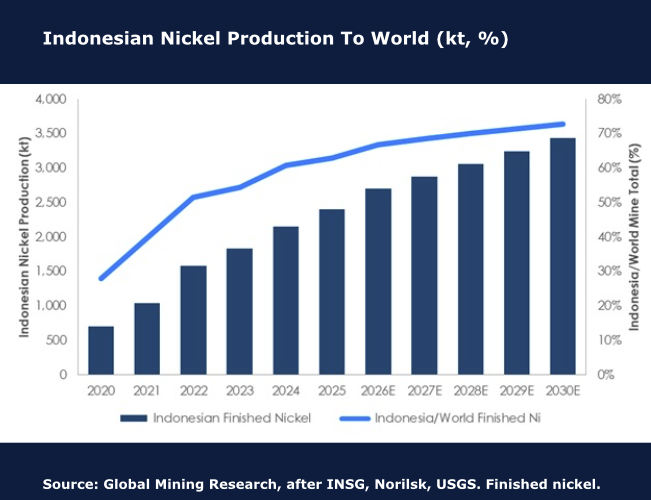
Recent events brought spot nickel up to ~US7.80/lbafterabriefreturnto US8.00/lb. The three major developments that led to this are the Iran war, a decision by the Indonesian government to dramatically cut thermal coal mining permits from 790Mt to 600Mt, and another decision to cut laterite nickel mining permits to 260-270Mt versus 2025 at 379Mt. GMR has calculated an annual nickel demand growth rate at 6.2% CAGR over the last decade, but the unceasing volumes from Indonesia (see chart) have been the issue. New changes may see parts of the global nickel cash cost curve move by ~US$1.50/lb. If laterite ore is really cut back heavily, then the price impact should add to that, but very large inventories could limit substantive price moves for some time. This is all potential; good news for producers like Vale SA, Glencore PLC or MMG Ltd. It’s too late for the Cuban producers where the lack of fuel is triggering closures.
Edition: 232
- 20 March, 2026
Silver futures (SIK26) forecasts
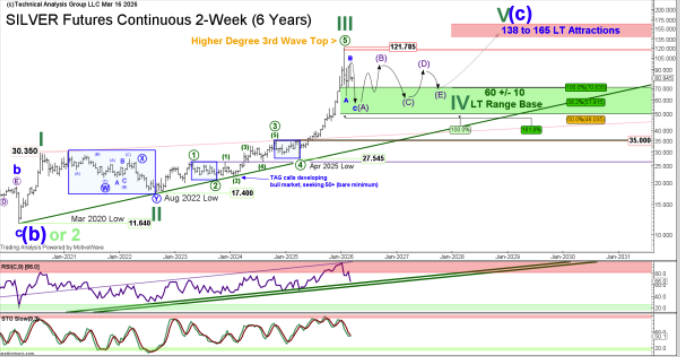
With the attainment of the new low under 78.06, the Technical Analysis Group have closed half of their NT Strategic Short position, established into strength at 95/96, and are placing a trailing stop at 87.70 on the remainder of the trade. Price action from 97.30 has yet to reveal any urgency or impulsiveness to the downside. The team are expecting near term relative outperformance in gold vs silver, and are bullish the 'RATIO' whilst above 57.59, seeking upside in the near term to 67 +/-, and 72.66+. Since raising risk, they have seen a +12% rise to 64.47. The team continues to remain long term bullish and regardless of whether or not they’re in the higher degree 4th wave, they do not expect downside under their proposed 60 +/- 10 LT Long Term Range Base, before ultimately eclipsing this year’s 121.78+ high in the resumption of the underlying bull trend, exposing their next major upside attraction levels of 138 and 165 (see chart).
Edition: 232
- 20 March, 2026
Energy shocks are disinflationary
Barry Knapp examines how the current energy price spike functions as an adverse aggregate demand shock rather than a traditional inflationary driver. The US economy was already showing signs of weakening, causing rising energy costs to act as a “tax” on consumers, suppressing economic activity and threatening to push a fragile economy into a deeper slowdown. The USD is rising alongside energy prices, causing the cost of energy to increase even further. The popular idea that energy shocks automatically bring about long-term inflation can be refuted by looking at history through a different lens: the high inflation of the 1970s was a result of fiscal policy, and the 2022 surge in foods prices actually saw goods prices peak at the moment of the inflation but the disinflationary shock was masked as fiscal spending was still flooding the market. He is waiting for a 10% drop in the S&P500 before considering entry into cyclical sectors.
Edition: 232
- 20 March, 2026
Oil: The price of war
James Burdass senses that the timeframe for any resolution is being significantly pushed back. The White House claims to have "totally obliterated" military installations on Kharg Island while, for now, sparing the oil infrastructure. James believes that there is the increasing inevitability of deploying Marines to Kharg Island, not for a full-scale invasion of the mainland, but as a "Physical Lock" on Iran's economic jugular. The US may be concerned that it has run out of immediate options to end this conflict without significant loss of life and is attempting to pressure its reluctant allies into the fray. We are currently witnessing scenarios James modelled in previous features (mines in the channel, Kharg Island targeted) but considered extreme tail risks. Yet, oil prices remain remarkably anchored around the $100 mark, whereas he would have modelled a spike to $120+ lasting for the duration of the closure, not just for a day.
Edition: 232
- 20 March, 2026
Nicaragua: Same old, same old
Daniel Landsburg Rodriguez dives deep into Nicaragua, a country that displays a stable macro picture yet relies on a narrow set of drivers: remittances, tourism and state-backed projects rather than broad private-sector growth. Investment from China may be spurring growth across the region, but increases dependence on opaque, politically-managed investment. Daniel expects near-term stability to hold but sees limited medium-term upside due to higher oil prices and weaker tourism, along with continued dependence on remittances. He also sees rising risks for ESG-minded investors. On the political front, Daniel expects continuing broad continuity with no sign of restored competition, with opaque policies and politically-driven legal challenges maintaining a strait-jacket over the country.
Edition: 232
- 20 March, 2026
China’s modest uptick
China’s Jan-Feb macroeconomic data pointed to a modest improvement in economic activity, with industrial production, retail sales, and fixed-asset investment all exceeding market expectations, although persistent weakness in the property sector and a slight rise in unemployment highlight ongoing structural challenges. Manufacturing growth was broad-based, led by strong gains in computers and communications equipment (14.2%), railway and shipbuilding (13.7%), and general equipment manufacturing (8.9%), suggesting continued resilience in China’s industrial sector despite external headwinds. Retail sales rose 2.8% year-over-year, accelerating from 0.9% in December. Overall, John Fagan notes the latest data suggests that China’s economy is showing signs of stabilisation early in 2026, supported by industrial momentum, infrastructure spending, and a holiday-driven pickup in consumption. However, he says the persistent downturn in the property market and rising unemployment indicate that underlying growth remains uneven, leaving policymakers likely to maintain targeted policy support to sustain economic momentum in the months ahead.
Edition: 232
- 20 March, 2026
Output growth and the real price of crude oil
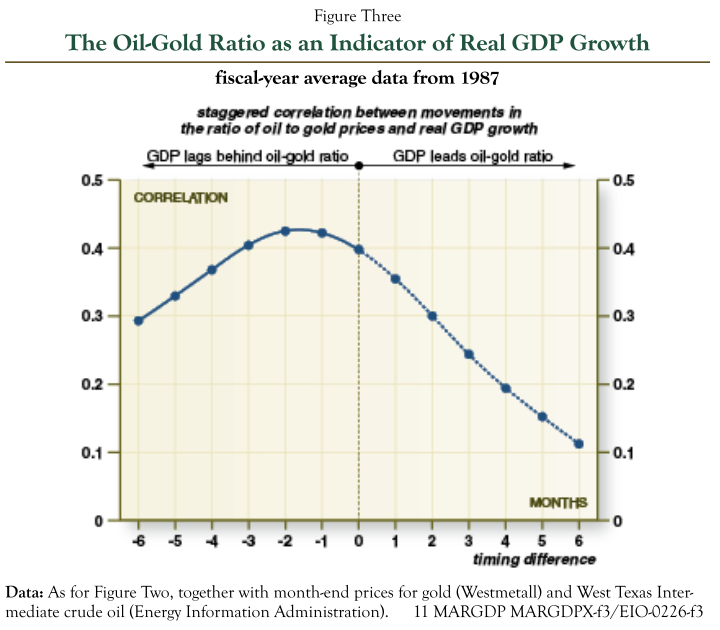
HCWE’s latest report explores the empirical links that connect economic growth with movements in some prominent market-driven prices. They examine the explanatory power of credit spreads, but the data shows that there is a chain of causation that runs mainly from the economy to credit risk; it’s difficult seeing credit spreads having much power to anticipate economic growth. Another source is crude oil prices, which receives much less attention than it deserves when it comes to its explanatory and predictive value. They claim that oil prices lead GDP by an average of two months, with an annual correlation of +0.47. However, many economists convert GDP from current to constant dollars but fail to do this with crude prices, so the team express the real oil price as a ratio between its nominal price and the price of gold. This provides a higher correlation of +0.59 (see chart). There is a strong case for using real oil prices to anticipate the economy.
Edition: 232
- 20 March, 2026
Nigeria: Oil prices present another story
Jonathan Anderson remarks that, again, Nigeria has exceeded expectations on macro adjustment in a low oil price world. Over the past two years the authorities unified and stabilised the NGN rate, hiked rates to positive real levels, tightened fiscal policy, reduced money and credit growth, squeezed import demand, put the external balance in surplus and brought inflation down at home. Even so, Jonathan wasn’t enthused about asset markets with oil at $65/barrel. Sovereign bond and local equity prices already ran aggressively last year, and coming into 2026 he felt both markets were overdone at then-prevailing oil prices. Even the naira trade was likely "running out of steam" with potential fiscal pressures rebuilding. With oil over US$100/barrel, however, it's another story. If global crude prices stay in the triple digits, this makes every market look cheaper - and Jonathan would be particularly interested in FX carry and dollar debt once again.
Edition: 232
- 20 March, 2026
Iran: Hormuz Hold ‘Em
Given continued Iranian escalation, Niall Ferguson likens the US’s choice as one familiar to any poker player: call, re-raise, or fold. Both sides have reason to assess the conflict has validated their theory of victory. Washington has heavily degraded Iranian missile and drone capacity; Tehran has kept the Strait of Hormuz functionally closed. But the current tempo of the war is indecisive. For both sides, to avoid folding—accepting a ceasefire on unsatisfactory terms—escalation becomes necessary. For Tehran, this means mining the Strait given the diminishing effectiveness of its drones and missiles. For Washington, it means a ground campaign in southern Iran to restore freedom of passage before global economic and political disaster. In casino terms, Niall sees little prospect of a diplomatic fold and thus upholds his view that the re-opening of the Strait becomes more likely than not only by mid-April.
Edition: 232
- 20 March, 2026
The upcoming LatAm bank rally
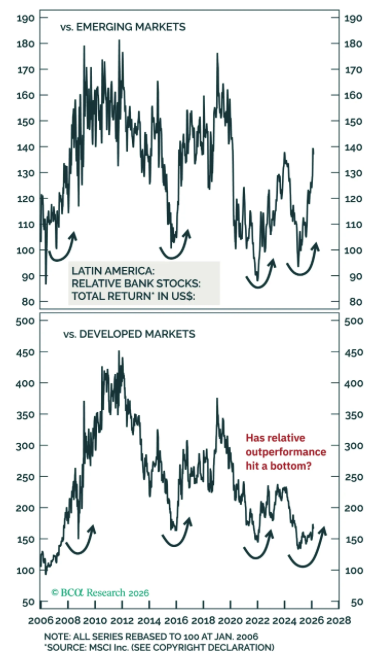
LatAm bank stocks have outperformed EM and DM peers in common currency terms over the past 12 months (see chart). The rally has been driven by both domestic and external factors, and these tailwinds are expected to persist over the medium- to long-term. Falling bond yields due to interest rate cuts and fiscal orthodoxy, reviving domestic demand, robust bank profitability, potential for credit expansion, supportive political backdrops and attractive valuations (despite the recent rally) all point to bank stocks (ex Brazil) being on the eve of a multi-year outperformance relative to global bank stocks. The team recommend going long LatAm ex-Brazil banks / short global bank stocks. Mexican bank equities remain the team’s favourite, followed by Chilean and Peruvian options. The team are also bearish on Brazilian bank stocks due to a poor and worsening domestic macro backdrop and an uninspiring political outlook.
Edition: 232
- 20 March, 2026
Japan’s monetary stability as oil prices rise
Andrew Hunt points out how Japan’s economy is over-monetised, with households therefore diversifying away from cash and fixed income into equities and some foreign assets. He firmly believes this diversification effort has supported equity prices until recent days. Higher oil prices and politics could now accelerate the move out of cash; the BoJ will want to resist this via higher rates and continued QT. Monetary stability would seem to demand this course of action. Higher rates would be (implicitly) designed to dent the flow into equities but would stabilise the JPY & inflation longer term. If higher rates are not enacted and QE returns, could saver confidence in the JPY be lost? This would be problematic for equities over the long term, and for inflation and the JPY, but positive for property prices and perhaps even PCE trends in the near-term. Andrew fears that fiscal primacy will rule the day over the coming months…. Good news for equities near term but not on a three-year view.
Edition: 232
- 20 March, 2026
US: The case for 10% unemployment
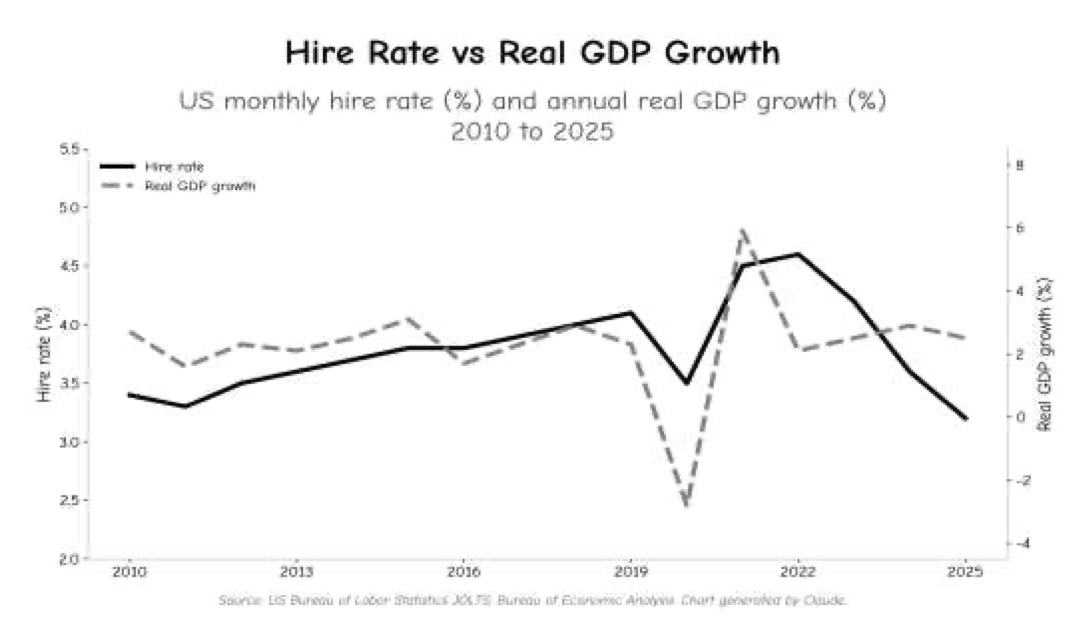
Paul Krake’s latest report rebukes the argument that AI-driven job displacement will be absorbed by new industries generating new work. It is an argument that Paul claims is taken seriously in policy circles, investment committees, and corporate boardrooms, yet it is deeply flawed. The hiring data already shows this, with the hire rate having falling 29% since the post-pandemic peak yet GDP has grown by 8% (see chart). AI is amplifying the pattern that labour is not required for growth. Just a 1 in 10 displacement of knowledge workers, which represent 45% of the US labour force, is enough to push unemployment towards 9% without a recession. Paul claims that the frameworks used to detect labour market stress are not built for an economy where growth and hiring decouple permanently. By the time the unemployment rate confirms what the hire rate has been signalling since 2022, the adjustment will have been compounding for a decade. 10% unemployment in the years ahead is not a tail risk, it is the base case.
Edition: 232
- 20 March, 2026
Black Swans vs Blue Owls
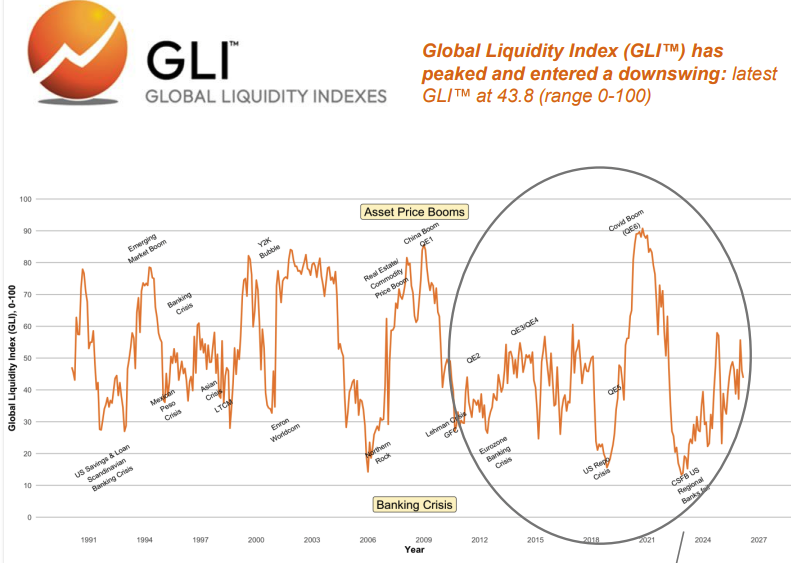
Michael Howell’s Global Liquidity Index (GLI) has peaked and entered a downswing, pushing market conditions towards a ‘Risk Off’ environment. This systemic downturn, rather than the oil spike alone, is the primary force eroding portfolio performance and explains growing stresses in private credit, as exemplified by troubles at firms like Blue Owl. While the Iran conflict-driven oil price spike acts as a negative Black Swan shock, its impact is compounded by the already weakening liquidity cycle. The Fed is managing liquidity to avoid market crashes, while the PBoC is aggressively injecting liquidity. This divergence justifies holding gold and explains why Chinese markets are at an earlier, more favourable stage of the investment cycle. With the liquidity downturn expected to last 12-15 months, the recommended strategy is to pare back credit and US tech exposure. Investors should rotate towards defensive assets like commodities (gold, oil), gradually add to mid-duration Treasuries, and increase holdings in Chinese stocks.
Edition: 232
- 20 March, 2026
Markets are underpricing the risk of recession
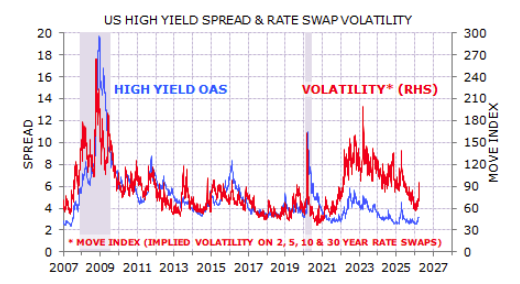
The Iran conflict triggered a minor sell-off in risk assets, implying a low chance of a global recession. But the longer the Hormuz Strait is shut the higher the risk, and he forecasts a 50% risk of recession should the world lose 20% of its oil supply for one quarter. Risk asset markets appear remarkably complacent about this, and credit markets are modestly perturbed. The option-adjusted spread on US high yield bonds has widened by 20bp since the conflict started; the spread is 60bp up from its multi-year January lows (see chart). Even though economic activity has become less energy intensive through the last 60 years, this implies a contraction in energy supply will have an outsized impact on GDP. Gerard estimates a 5% supply decline could pack the same macro punch as a 10% contraction in the 1970s. As it stands, the market is pricing in less than a one-in-five chance of recession, but that seems too low.
Edition: 232
- 20 March, 2026
Space: A slow burn for investors
Industrials
Japan’s space sector remains in transition: technically ambitious, strategically important and increasingly commercial, but still fundamentally dependent on launch reliability and policy execution, with recent progress overshadowed by several high-profile setbacks. Looking ahead, Neil Newman highlights 3 developments which would signal meaningful acceleration in the sector and potentially justify thematic investment consideration: 1) improving the reliability and cadence of H3 launches; 2) continued deployment and monetisation of Earth-observation and SAR constellations; and 3) stronger government procurement as space capabilities become embedded in national infrastructure and security policy. Companies flagged in Neil’s report include Mitsubishi Heavy Industries, Mitsubishi Electric, NEC, IHI, iSpace, Astroscale, Synspective and Axelspace.
Edition: 232
- 20 March, 2026
A World War III involving China is increasingly inevitable
David Murrin believes that the US could secure the Strait of Hormuz in three to four months should it utilise the full range of sensors and combat assets outlined in David’s latest report. However, he anticipates that the US will struggle to deploy and sustain such a high operational tempo, potentially extending the conflict well beyond that timeframe. In addition, there is a high probability that the depletion of American mid-course interceptors, the concentration of US naval and missile defence assets in the Gulf at the cost of Pacific and Atlantic deployments, and the disruption of oil flows as production facilities are damaged during missile/bomb exchanges will generate significant strategic compression. This will, in high probability, provide China with an opportunity to launch a major military campaign across the Pacific without warning to seize control out to the third island chain, potentially in parallel with a Russian escalation against NATO. In his latest report, David explores the possibility of the Iran situation sparking a global war.
Edition: 232
- 20 March, 2026
Risk rising, but so far contained
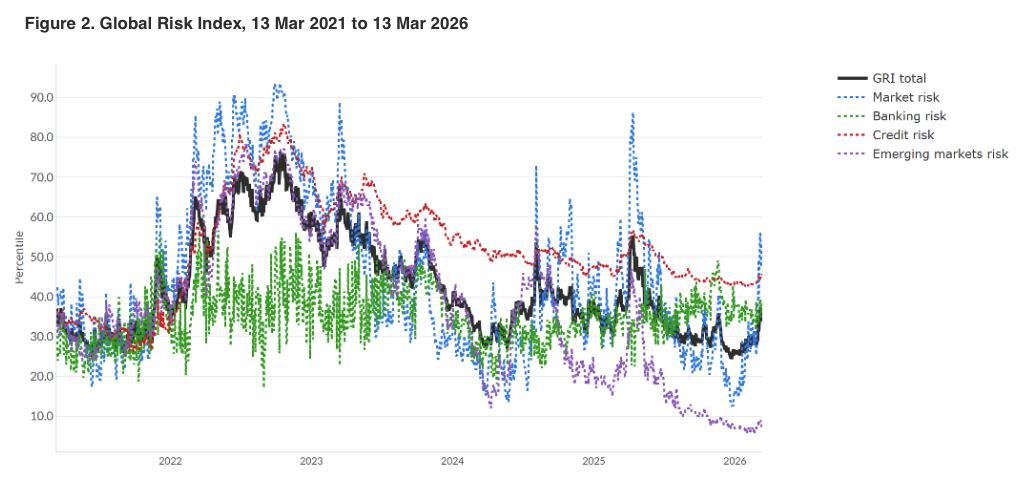
Jeffrey Young’s Global Risk Index (GRI) signals an increasingly risky macro environment, brought on by the prospect of extended disruption to Middle East energy supplies and the Strait of Hormuz. Importantly, however, a dispassionate assessment using various DeepMacro metrics suggests that actual shifts in the global macro backdrop to date are muted. The GRI has risen from what was a very low level in late February to a reading that is in the mid-30s, a level that is relatively muted by historical standards (see chart). Indeed, the rising figure is nearly entirely due to rising financial market volatility, not to credit risk or financial sector risk – increases in the latter would signal a potentially significant deterioration in the environment ahead. Whilst market expectations have worsened towards future economic growth and inflation, Jeffrey’s factors are yet to show any deviation from recent trends.
Edition: 232
- 20 March, 2026
AI: The economics of compute
sees the real story of GTC being the business model of compute. As AI rolls out, capacity demand is moving rapidly towards inference, and Richard would not be surprised to see it end up at 90% of the total market for AI infrastructure. He has long argued that the business case for compute is broken. NVIDIA Corp is claiming they can fix this with its new chips, increasing the revenue per GW by 5x. If true, it would change the economics of compute, and the company stands to improve the economics of AI computing more than anyone else. The fact that the market didn’t understand what Nvidia is trying to say means that it will continue to worry about longer-term growth, and the shares may continue to drift, possibly representing an opportunity to invest in the best AI company at an increasingly attractive valuation. Richard continues to hold Samsung Electronics Co Ltd and Qualcomm Inc for AI, Ouster Inc for robotics, and nuclear power.
Edition: 232
- 20 March, 2026
Financials
Galliano's Financials Research
Victor Galliano upgrades the stock to Buy, arguing that the recent partial disposal of its stake in Nintendo could mark the start of a broader unwind of the bank’s large strategic equity portfolio - its primary source of potential shareholder value creation. The sale generated a ¥75.1bn gain (c.¥90bn proceeds) and reduced Kyoto’s stake from 4.2% to 3.3%, though the remaining holding still represents more than 30% of the bank’s market value. With ¥160bn in gains on stock sales, Kyoto has also been able to crystallise roughly ¥90bn of losses on government bonds, bringing its unrealised losses on the domestic government bonds still on its balance sheet close to zero. Kyoto trades at the lowest PBV among Japan’s top ten banks, while its 4.1% dividend yield also has scope to rise.
Edition: 232
- 20 March, 2026
Regulated Utilities: No place to hide - compressing equity risk premiums
Utilities
Canadian regulated utilities are up ~10% YTD, outperforming the TSX, as rising geopolitical risk has driven a flight to safety and multiple expansion across defensive sectors. The re-rating has pushed equity risk premiums to levels that are difficult to justify against the prevailing rate backdrop and Veritas believes risk-adjusted returns have become materially less compelling at current valuations and recommends underweighting the sector. Their report covers Canadian-listed regulated utilities in their coverage (Emera, Fortis, Hydro One, Canadian Utilities, ATCO). Veritas’ analysis is structured around 3 analytical pillars: 1) current sector valuations relative to a yield-implied terminal capitalisation framework; 2) the macro backdrop governing utility equity performance; and 3) the company-level funding dynamics that determine whether rate base growth translates into per-share value creation.
Edition: 232
- 20 March, 2026
American Eagle Outfitters (AEO US) US
Consumer Discretionary
The Retail Tracker sees improving momentum at AEO, driven by a rebound in Aerie, which returned to growth in late 2025 following assortment resets and a renewed focus on its younger customer. They expect this momentum to continue, supported by a positive contribution from Offline despite some lingering assortment inconsistency. By contrast, the core Eagle brand remains mixed: denim is "solid" with exposure to emerging trends such as ripped jeans and bootcut styles, but tops lack impact (the online range is much better than in store). Increased marketing spend - including partnerships with high-profile celebrities and country music events - is driving traffic and sales. With the stock down ~30% amid recent market volatility, AEO is an attractive opportunity at current levels.
Edition: 232
- 20 March, 2026
The Euro’s extremely important juncture
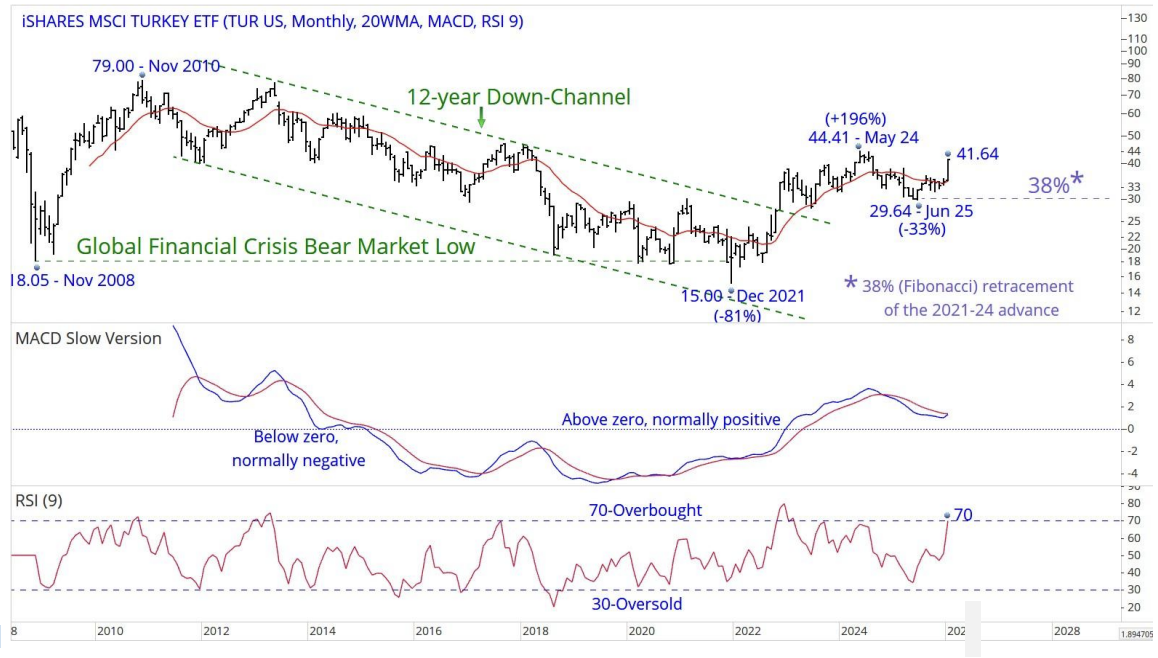
The Euro’s (€1.1416) monthly chart shows a breakout from a 17-year Down-channel, with the currency trading as high as €1.2083 in January this year, up 27% from the Sep 2022 low. Chris Roberts comments how a sustained breakout from the channel, following the 14-year, 40%+ fall in 2008-22, could potentially be very bullish. The near 6% fall from the recent high has taken the Euro back to the rising 20-month WMA and the 9-month RSI back to Neutral 50. Chris is 40% long from €1.1572 and would look to add on a break above the Jan high. His stop stays at a daily close below €1.0954.
Edition: 232
- 20 March, 2026
Technology
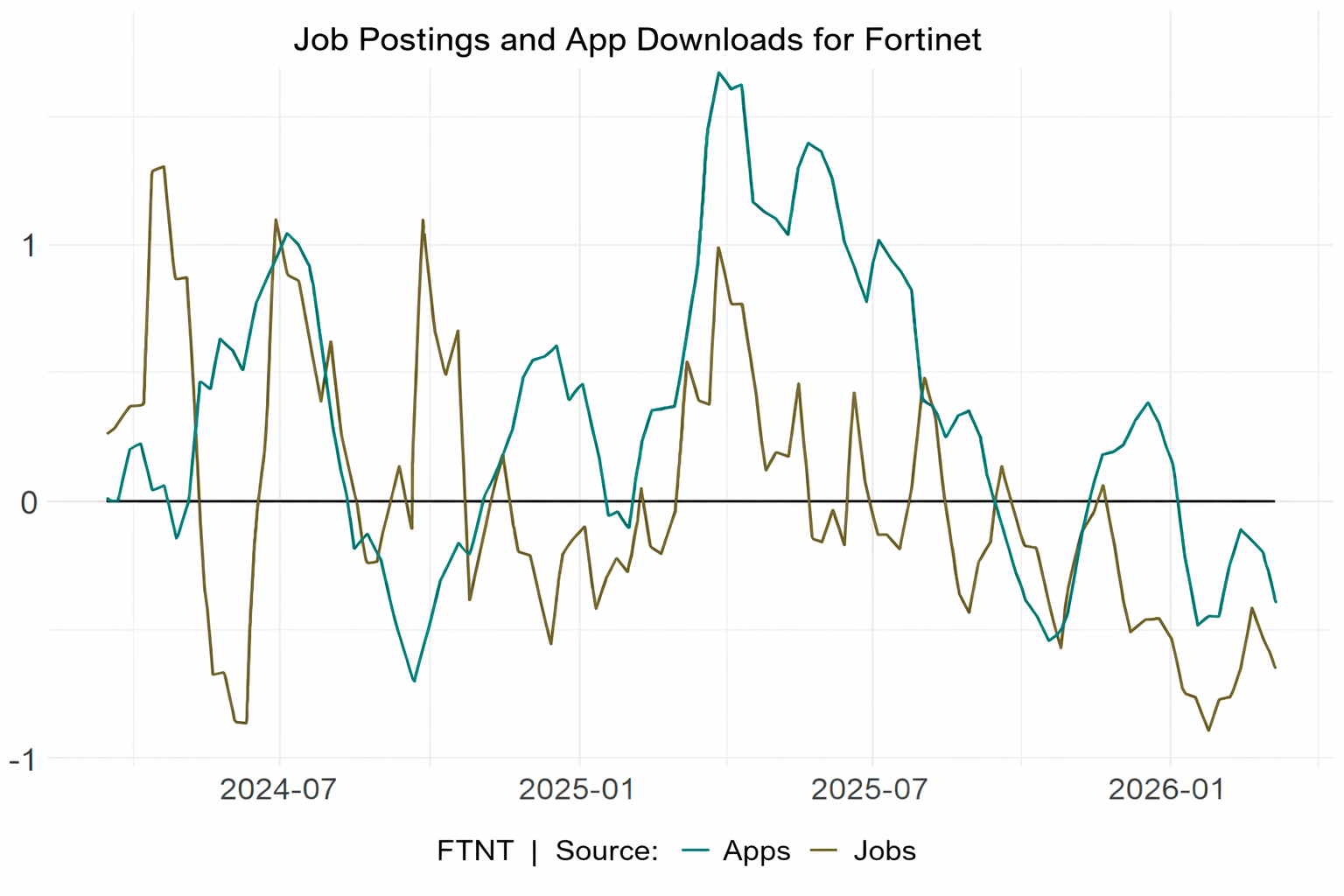
Structurally exposed to the shift from hardware firewalls to cloud-based security platforms and from network-based to an identity-based model, FTNT is losing ground to Zscaler and Cloudflare. Alternative data signals reinforce this view with FTNT ranking in the lowest quartile of AnteData’s measurement of coding activity trends, while freelancer job demand tied to its technologies is declining and downloads of its authentication app are falling. Although the company still holds ~18% of the global firewall market, revenue growth has slowed from ~20% in 2023 to ~12% currently, with AnteData expecting normalisation towards ~5%. With a net income margin already at 27%, they see limited scope for further expansion, making the ~34x earnings valuation appear demanding.
Edition: 232
- 20 March, 2026
Aviation credit markets underpricing geopolitical risk
Industrials
Reno Bianchi’s Aviation Weekly highlights a growing divergence across aviation markets amid rising geopolitical tensions. Airlines have experienced a sharp equity rout, while oil prices have risen by over 40%, with jet fuel surging even more dramatically - up ~70% domestically, ~80% in Europe and more than doubling in Asia. Despite this, from a fixed-income trading perspective, the aggregate market reaction has remained muted. Reno believes this response is overly restrained. It appears fixed-income investors are anticipating a much quicker resolution to the conflict than the equity markets, which may ultimately prove to be a miscalculation. Included in his report is a “post-war monitor” he uses to track key market, oil and jet fuel statistics, as well as trading recommendations, where he continues to recommend maximum caution.
Edition: 232
- 20 March, 2026
Healthcare
The warning signs are still there - a small earnings beat (adj. EPS of $0.68 came in 3 cents above consensus expectations) masks several earnings quality red flags investors should not ignore. BTN has previously flagged DXCM when receivables spiked, with both instances followed by disappointing results. DSOs remain too high, with one day equating to ~$14m of sales and ~1c of EPS, and estimates that, even after adjusting for rebate accruals, DXCM likely still picked up ~2 days of sales in higher receivables. Deferred revenue has continued to be drawn down, contributing an estimated $3-4m to sales. Meanwhile, rebate accruals have risen sharply from ~50 to 109 days of sales, which may indicate pricing pressure is here to stay. BTN also notes EPS benefited from ~1c of lower R&D spend and ~3c from reduced stock compensation in Q4.
Edition: 232
- 20 March, 2026
Allegro (ALE PW) Poland
Consumer Discretionary
the IDEA! remains constructive on the stock following FY25 results, highlighting strong ecosystem monetisation, robust cash generation and disciplined capital returns as key pillars of the investment case. The Polish marketplace continues to fund international expansion while sustaining attractive incremental margins, with ~63% drop-through. Management reiterated its leverage framework centred around ~1x net debt/EBITDA and announced a further PLN 1.6bn FY26 buyback, which the IDEA! sees as offering downside support. However, they caution that management may be underestimating the competitive trajectory of Chinese cross-border platforms such as Temu and Shein. While EU parcel duties from July could slow growth, the competitive threat is unlikely to disappear and could pressure domestic GMV growth over time.
Edition: 232
- 20 March, 2026
ITV (ITV LN) UK
Communications
While ITV describes itself as strongly cash generative, FY25 results tell a different story. Cash inflow from operating activities fell sharply from £333m to £202m. Forensic Alpha also identified several other red flags, pushing ITV’s Risk Score from '8' to '10' (max. rating). Working capital has been a persistent drag, with the headwind widening from £144m in 2024 to £196m in 2025. Trade receivables rose 12% to £500m despite flat sales, driven largely by long-term balances now representing 18% of the total. Contract assets increased 33%, including a jump in non-current contract assets from £4m to £39m. Meanwhile, exceptional charges related to restructuring and M&A rose from £65m to £107m, further weighing on cash flow. For now, the market is focused on the potential sale of the M&E business. If it falls through, attention will shift back to the company’s underlying fundamentals.
Edition: 232
- 20 March, 2026
Guidance warning season
Despite rising geopolitical risk, European corporate guidance has yet to reflect the potential economic impact. In AIR’s recent management meetings, discussion focused almost entirely on AI, with little attention paid to the Iran conflict despite surging energy prices and supply-chain stress that historically drive earnings revisions. The combination of unpriced macro risk and AI-driven sectoral disruption creates a credible basis for expecting a meaningful wave of 2026 earnings guidance revisions across European equities in the coming weeks. And the performance gap between the companies on the right side of these structural shifts and those on the wrong side will broaden. Stock winners include AI infrastructure beneficiaries such as Arm, Elmos, Aixtron and STM, alongside defence exposure at Exosens and Indra Sistemas. Euronext and Auto1 are also seen as largely insulated. Under pressure are Stroeer, Freenet and SES. In IT services, the sector is splitting between “The Conquerors” (Accenture, Cognizant, Reply) and “The Endangered” (Capgemini, Atos, Sage, Dassault Systemes, SAP).
Edition: 232
- 20 March, 2026
Bear’s Den Idea Forum
Short-focused events consistently rank among MYST’s best-performing Idea Forums with their last one yielding a ~70% hit rate and ~8.7% average positive alpha. The dominant theme at this meeting centred on companies confronting new competition driving share loss and margin compression, while other high-level topics included businesses facing AI-related challenges; “fading” cyclical recoveries; and GLP-1-driven demand destruction. MYST felt Calix (BEAD subsidy unwind favours lower-cost solutions + forensic red flags) and TransMedics (organ transplant tech leader facing share loss amid new competition) were “unique” and worth investigating, while convincing bearish arguments were also presented on A O Smith, Dollar General, Old Dominion Freight Line and Uber.
Edition: 232
- 20 March, 2026
Gold stocks chasing copper
The proposed acquisition of Foran Mining Corp by Eldorado Gold Corp, following Harmony Gold Mining Co Ltd acquiring MAC Copper, highlights the appeal of base metal mines for some gold miners. A few companies are forecast to increase base metal exposure, namely Torex Gold Resources Inc with Media Luna, Eldorado Gold Corp with the start-up of Skouries and the acquisition of Foran Mining Corp for the new McIlvanne Bay copper-zinc mine. Two primary reasons for gold stock to chase base metals are operations with minor gold can be reported as “low-cost gold mines” and the EV thematic remains appealing. Copper remains the preferred base metal for GMR, but gold is the preferred commodity for 2026. Recommended gold stocks are Barrick Gold Corp, Agnico Eagle Mines Ltd (upgraded to BUY) and Kinross Gold Corp in the seniors and Equinox Gold Corp, Genesis Minerals Ltd, IAMGOLD Corp and OceanaGold Corp for near-term growth-oriented stocks.
Edition: 231
- 06 March, 2026
Emerging Markets: Stay the course
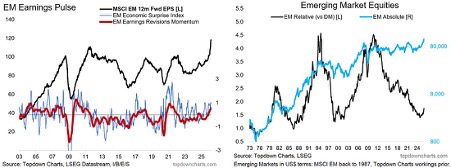
Callum Thomas points out that EM equities are pushing higher in local currency and US$ terms following the previous breakouts (+strong breadth), and the EM vs DM relative performance line is also pushing higher after chalking up a clear inflection point. EM consensus forward earnings are surging, breaking out (basically a fundamental breakout to back the technical breakout). Investor sentiment is starting to get extreme/overheated, as would be expected during a big inflection point and trend change – but it does make it liable to pullbacks as things have moved quickly and far. Valuations still have room to run vs history and vs global peers, but it is clear that EM equities are now no longer cheap. The EM stock/bond ratio is pushing higher after previous breakouts but relative sentiment and relative value are getting elevated. Callum remains bullish EM equities.
Edition: 231
- 06 March, 2026
Japan: The balance of payments and the yen’s outlook
Andrew Hunt says that is difficult to gain a clear picture of Japan’s true Balance of Payments trends; some of the relevant data seems contradictory. Rising JGB yields have slowed capital outflows from Japan (predictable) but not reversed them. Elsewhere, foreign investors have been moving back into JGBs (intriguing) and Japanese equities (interesting). The foreign interest in Japanese equities and the importance of these flows within the BoP data arguably makes the JPY more of a “risk on” currency than safe haven. In the near term, Andrew expects the JPY to remain “choppy” with a bias towards being positively correlated with risk appetite, but any sharp falls would likely be resisted in the near term by foreign central banks. Longer term, Andrew says that the fate of the JPY is inexorably linked with that of the BoJ’s credibility, something that he expects to be undermined over time by fiscal primacy.
Edition: 231
- 06 March, 2026
US manufacturing PMI does not set a new trend
Carl Weinberg points out that the US manufacturing PMI for February printed above its break-even level for a second month in a row, signalling an expansion in the sector. This is a surprise, and a positive one at that. However, Carl notes that the uncomfortable truth is that the correlation between headline ISM manufacturing and current-quarter GDP growth over the last decade is below 0.30. The economy has demonstrated it can grow without industrial growth, which has declined as a share of overall economic activity. The manufacturing sector is sick, barely growing at all. It has been contracting for a long time, and a print or two above 50 does not set a new trend. In short, manufacturing does not appear to be responding well to Trump’s economic policies. Tariffs do not seem to be increasing the business of existing firms, as this survey suggests, or creating new jobs in new firms as the payroll employment data suggest.
Edition: 231
- 06 March, 2026
Making sense of the Citrini AI debate
Cam Hui reviews the controversial report recently published by Citrini Research that rhetorically asked, “What if our AI bullishness continues to be right...and what if that’s actually bearish?” The Citrini report postulates a scenario where AI wipes out millions of jobs, while AI boosters assume widespread productivity gains without disruption. Cam notes that the history of the adoption of disruptive technology indicates that outcomes are never utopian nor apocalyptic. He therefore prefers to adopt a middle ground. Artificial intelligence is a very real technology and its adoption will dramatically change society. There will be some degree of disruption in capital markets and return expectations. Cam points out that the AI bubble never reached the excessive levels of the dot-com bubble, and the degree of price adjustment will be lower. In all likelihood, its collapse will not cause a recession.
Edition: 231
- 06 March, 2026
Approaching peak AI hysteria
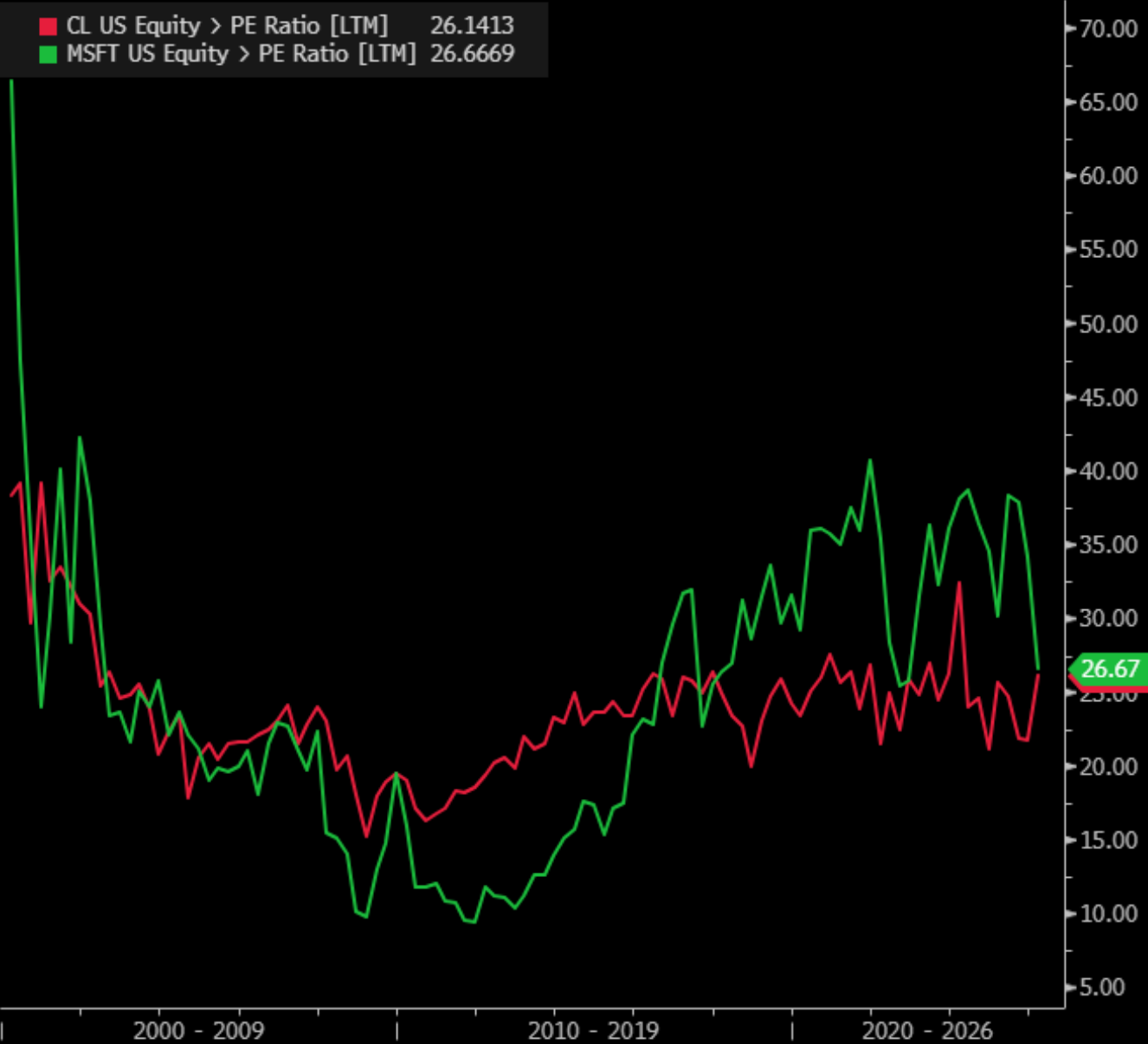
People are gregarious and instinctively follow the impulses of the herd, remarks James Aitken. The past two weeks have been a reminder of the mob mentality, and with dystopian projections on AI hysteria reaching millions of views, James believes we are approaching peak AI hysteria. Just remember when scouring the news: why am I reading this now and who benefits? XAI, Anthropic and OpenAI are all in windows to raise absurd amounts of money at lofty valuations, so it’s no surprise everyone is getting almost daily updates on LLMs about their improvements. DRAM, NAND and H100 rental prices suggest the AI juggernaut and associated memory shortage continues, yet so violent has been the recent shakedown that companies that would seem to have little risk of being disrupted by AI have been smashed, too. Just look at the current P/E of Microsoft (green) vs the current P/E of Colgate (red).
Edition: 231
- 06 March, 2026
The West’s plague of idiots
From David Murrin’s five stages of Empire perspective, the West is suffering from a “Plague of Idiots”. David says it is increasingly evident that the leadership and Western society are experiencing a profound crisis of competence, judgment, and cortisol with which to drive our sense of collective danger and motivation to see and react to the oncoming threats. This crisis extends well beyond individual policy failures; it reflects a civilisation in the late stages of institutional decay and declining effectiveness. The Western order now appears weakened by a loss of strategic understanding and professional competence, and is increasingly marked by complacency, self-absorption, and managerial mediocrity. In an era defined by great-power competition, missile warfare, and systemic instability, such leadership deficits materially increase strategic risk. If left unaddressed, the imbalance may prove the most serious long-term threat of all, and the “Plague of Idiots” will inevitably sabotage the existence of our Western democratic civilisation.
Edition: 231
- 06 March, 2026
China: Channel checks on leading coffee & tea brands
Consumer Discretionary
The competitive environment across the country's leading beverage chains appears to be shifting from aggressive subsidy-led share grabs towards more rational pricing and product-led differentiation. For global investors, this suggests: 1) margin recovery potential after a prolonged discount cycle; 2) strengthened positioning for category leaders with innovation capabilities; and 3) continued consolidation towards scaled operators with diversified product offerings. Luckin’s near-term fundamentals look resilient with Jan SSSG likely >10% and pricing/ASP recovering sequentially. Mixue was modestly softer due to the CNY timing shift, while Guming was a clear relative winner among tea chains with SSSG/GMV +10-15% (still HSD even ex delivery fees) and momentum likely improved further in Feb on holiday & platform campaign effects.
Edition: 231
- 06 March, 2026
Brazil: Stagnation ahead
In the fourth quarter of 2025 Brazil’s GDP rose 0.1% QoQ s.a., broadly in line with the market median (0.1%) and BuySideBrazil’s projection (0.0%). Compared to 4Q/2024, GDP increased 1.8%. In Q4/2025 Brazil’s economic growth relative to 3Q/2025 was mainly driven by stronger exports and services. Services, slightly above expectations, posted a positive performance in the quarter, supported by higher consumer income amid a still-robust labour market. However, Andrea Damico says this momentum already shows signs of exhaustion, with a potential turning point in H1/2026. The key highlight is the sharp slowdown in domestic demand, with the weakest marginal performance in domestic absorption and private consumption since the end of the pandemic in 2021. The clearest sign of this fragility was the sharp decline in imports. Overall, this data reinforces Andrea’s view of cooling economic activity and stagnation in the first half of 2026. BSB’s projection for 1Q/2026 is 1.1% QoQ s.a.
Edition: 231
- 06 March, 2026
Materials
ESI exited a record 2025 with DD organic growth in Electronics and Fermium expects this momentum to continue, which was the key underpinning behind their positive initiation last Sep. Against this favourable backdrop, ESI has accelerated its efforts with two acquisitions, Micromax and EFC Gases, completed in early 2026. The company has exposure to datacentre infrastructure and high-performance computing, yet trades without the “nosebleed” valuations seen elsewhere in the AI supply chain. EBITDA grew MSD in 2H25, with implied 2026 guidance pointing to nearly double that pace - before acquisition contributions, which should lift growth into the mid-teens. Buy reiterated.
Edition: 231
- 06 March, 2026
Energy
A large-cap trading at just ~11x earnings, with a ~12% FCF yield and will pay owners a 10% yield in the very near future. The Coterra deal markedly increases DVN’s stature and shale production in the Delaware Basin without incremental acquisition debt, adding ~4,600 high-return drilling locations, nearly half with sub-$40/bbl breakevens. The combined company expects $1bn+ in annual synergies and plans a $5bn buyback, materially lifting FCF/share and NAV/share. Nevertheless, investors have yet to adequately reflect DVN’s improved fundamentals in its share price, with it continuing to trade at a sharp discount to other E&P players in terms of both P/OCF and at a high required FCF yield. For each 0.5x improvement in its P/OCF multiple or a 1pp decrease in its FCF yield, DVN’s share price will rise by ~$5.
Edition: 231
- 06 March, 2026
G-III Apparel Group (GIII US), VF Corp (VFC US), Dillard's (DDS US) US
Consumer Discretionary
Hedgeye provides updates on 3 of their top Retail shorts. For GIII, they expect the next guide for the year to be an absolute disaster; forecasting a 20%+ cash flow hit from the the loss of major Calvin Klein and Tommy Hilfiger licenses back to PVH, while prior channel stuffing and tougher retail conditions could force the company to increase markdown support to key partners. Meanwhile, VFC is caught between a heavy debt burden and weakening brand momentum; Hedgeye believes a massively dilutive equity raise will ultimately be required. And finally, DDS remains a mispriced security, trading at ~12x EBITDA despite a sharply decelerating model and the company overearning by 800-1,000bp. That suggests that the real earnings power is between $10-20 per share. 5x earnings, is an appropriate department store multiple, suggesting 80-90% downside.
Edition: 231
- 06 March, 2026