Australia: Balance of risks points to RBA remaining hawkish
Australia's economy expanded 0.4% quarter-over-quarter in the second quarter of 2026, picking up from Q1's 0.3% pace. On an annual basis, GDP grew 2.1%, decelerating from 2.5% in the first quarter. The Australian Bureau of Statistics characterised the result as modest growth driven by pockets of private demand partly serviced through higher imports, and mining exports partly facilitated by inventory drawdowns. The quarter leaned heavily on car buying and a long-awaited trade turnaround. For the Reserve Bank of Australia, the headline beat and resilient discretionary spending strengthen the case for the RBA's pre-emptive tightening bias, with the cash rate at 4.35% after three hikes earlier this year, while flat investment and inventory-flattered exports argue underlying momentum is thinner than it looks. The balance of risks points to the RBA holding its hawkish posture, while continued consumption strength would firm the case for another hike.
Is a US debt crisis imminent?
Ed Yardeni points out that US federal spending continues to rise relentlessly. CBO projections show total outlays exceeding $11trn over the next 10 years, driven primarily by mandatory spending and rising interest costs. CBO projections also show annual budget deficits widening from $1.8trn to more than $3trn in 10-15 years. The US remains on an unsustainable fiscal path. However, Ed says it is not yet a crisis. Treasury yields remain in a range broadly consistent with a healthy economy, and Ed expects the 10-year yield to remain between 4.00% and 5.00%. He cites a couple of reasons that support his view: 1) US Treasury Secretary Scott Bessent has taken some actions recently to stop bond yields from rising, and can do more if necessary, and 2) Fed Chair Kevin Warsh is committed to restoring price stability. If inflation remains stubborn, the FOMC will probably raise the federal funds rate in September. That could ease pressure on long-term yields.
Industrials
Two senior board members bought a combined €236,000 of stock between 20th and 31th August at an average price of €53. Their previous purchases were in March 2023 at around $27, when Smart Insider also assigned their highest (+1) ranking, making it notable that both are buying again after a three-year gap at nearly twice the price. Juan Manuel Hoyos Martinez De Irujo, Lead Director since January 2020, bought €73,000 in only his second clean purchase since joining. Vice Chairman Oscar Fanjul Martin bought €163,000, increasing his stake by an estimated 6%, with Smart Insider noting that he has a better-than-average track record. They therefore once again rank the stock +1.
SMRs: A better AI power bet than SpaceX
Utilities
After fifty years of stagnation, Kailash sees the nuclear industry as having a credible chance of revival through small modular reactors, supported by favourable policy and lower upfront capital requirements than legacy plants. While SMRs remain high risk, Kailash believes much of that risk is already reflected in valuations, unlike SpaceX, which carries similar or greater uncertainty but is priced as though commercial viability is assured. On that basis, SMRs may offer the better way to play rising AI-driven power demand. The valuation gap is stark: listed pure plays Oklo and NuScale have a combined market value of ~$9.2bn vs. ~$1.9trn for SpaceX. The key challenge for SMRs is now execution - proving Western projects can be delivered on budget and at scale.
Technology
BTN first highlighted VERX in Nov 24 and the shares have since fallen ~70% despite the company appearing well positioned to benefit from changes in tariffs and VAT regimes. The stock now trades at ~16x forward adjusted EPS, but they still see material earnings-quality concerns. While reported earnings continue to improve, there remains a sizeable gap between adjusted results and the underlying economics of the business. BTN's latest Red Flag Note highlights weak cash generation, the exclusion of recurring software costs that account for nearly half of adjusted EPS, declining contract liabilities and deferred commissions, and several smaller accounting benefits that have helped VERX sustain a pattern of beating adjusted EPS estimates by just 1 cent.
UK strategy insights
Trendrating’s latest analysis provides data-driven insights into the combinations of fundamental parameters that have historically generated the most alpha in UK equities. They have ranked the factor combinations most rewarded by the market across one-, three- and ten-year periods, providing investors with a factual framework for factor-based decision-making. Over the past year, the strongest-performing combination has been Lowest P/E and Highest 3-Month Sales Growth, delivering a 37.2% return and outperforming the benchmark by 17.7%. Lowest P/E combined with Highest 12-Month Sales Growth ranked second, returning 33.4%, while Highest 3-Month Earnings Growth alongside Highest 3-Month Sales Growth returned 32.5%. Top 3-Month Earnings Growth combined with Lowest P/E was the weakest performer. Click here to access the full ranking list.
Crude prices could slingshot higher
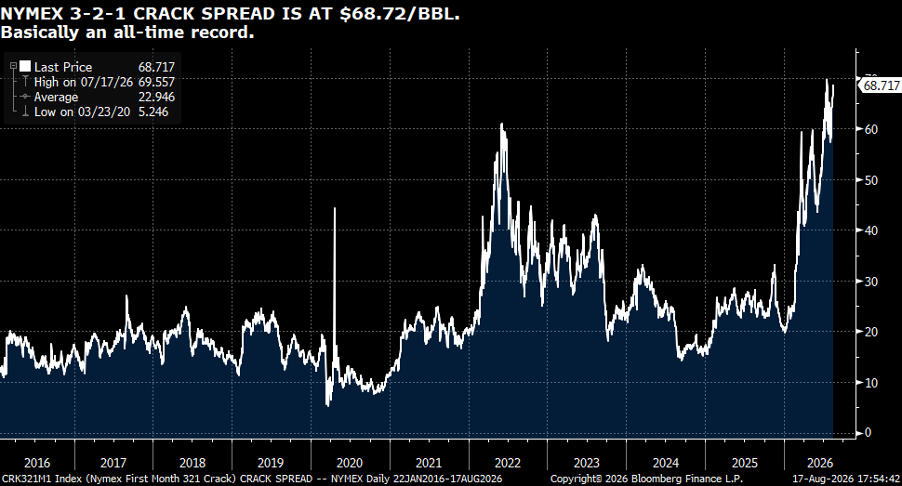
The Nymex 3-2-1 crack spread is back up to $68.72 – about a dollar below its all-time high. Michael Churchill says it’s telling you crude oil prices aren’t low because of weak demand for end products and that there is a huge arbitrage opportunity for crude refiners that is waiting to be pounced on. To get the crack spreads back to its normal $25/bbl, crude would need to be $129/bbl. Michael asks: “Just how much extra oil is the world going to need to rebuild all these reserves?” His rough calculations suggest that if we’ve suffered 165 days of oil production running 8mm barrels/day below normal: that’s 1.32bn barrels ‘missing’. Normal daily demand is 103mm barrels. If we assume 3 million bbls/day would need to go into overall stock rebuilds, then you have 3mm bbl/day of excess demand for 440 days. Politically, there’s no obvious resolution to the Iran situation on the horizon – so the accumulated oil “deficit” keeps growing every day. Michael sees a risk that crude prices could slingshot far higher as countries rebuild reserves just as refiners seek to arb out crack spreads.
China & Hong Kong: The long road back
Active EM managers are not exiting China but selectively rotating into market dislocation, explains Steven Holden. While China and HK average weight remains depressed at 20.14%, active positioning is turning as the benchmark underweight hits its narrowest level in almost a decade. Steven highlights that managers are actively buying into weakness: net estimated flows turned positive at $6.7bn over the seven months to July, led by value managers whose average overweight swung from a trough near -12% to +3.50%. Funds are actively trimming post-reopening consumer winners including Trip.com, Xiaomi, and Meituan to fund a technology self-sufficiency trade. Allocations are aggressively building across AI infrastructure and semiconductor equipment names such as NAURA Technology, Zhongji Innolight, and CATL, which absorbed $1.7bn in inflows. With China carrying roughly the same active weight as Taiwan or South Korea despite a vastly larger market, the current order of play looks temporary, not sustainable.
Argentina: Fading political momentum
Attention is shifting toward the 2027 presidential elections as President Javier Milei polls below 40%, leaving his re-election far from secured while an active opposition stirs market anxiety. Marcos Buscaglia expects the government and BCRA to expand local liquidity and allow interest rates to decline, because consumption financing relies on pesos rather than recent USD-denominated loan relaxations. He forecasts inflation to fall back below 2.0% month-on-month in August, with the central bank likely maintaining benchmark rates around 20% to spur credit growth. Although authorities have treated 1,500 as a line in the sand, they do not expect the central bank to hold this FX level for long if it prioritises low rates. In market terms, Marcos expects short-dated rates to drop, the peso to weaken slowly, and any repricing of hard-currency bonds to wait as sovereign credit spreads remain elevated.
US rates: Has anything really changed?
Markets have gone too far in assuming no further Federal Reserve hikes, contends Jonathan Turek, warning that extrapolating recent softer spot data into the balance of risks is premature. The US economy remains biased towards hikes against a resilient backdrop where the unemployment rate is 4.1%, three-month average non-farm payrolls are adding 20k jobs, energy is above $80, and core PCE sits at 3.3%. Crucially, the $1T annual impulse from AI capex continues to push the cost of capital curve steeper, as bond supply from hyperscalers prevents forward rate cuts. With the FOMC seeking an excuse to hike, terminal pricing of just 35bps at the peak of the curve is far too low, underpricing the risk that the economy accelerates rather than slows in the second half. To capture both Fed terminal repricing and duration-led term premia, Jonathan is re-establishing a short in US rates and added a short in SFRH8 at 96.00.
France: On an unsustainable debt path
When economic growth falls below the real interest rate, public debt enters an unsustainable trajectory. With French growth at 0.8%, 10-year OAT yields between 3.8% and 4%, and inflation around 1.8% to 2.4%, France’s debt-to-GDP ratio sits at 115–116%. Wolfgang Münchau points out that this is wholly unsustainable unless a primary surplus is achieved. There is no surplus in sight. Sébastien Lecornu is unlikely to even reduce the deficit to 5% of GDP ahead of critical elections. Without savings measures, state expenditures are expected to surge by €60bn, driven by an €11bn increase in debt servicing and €12bn in pensions. Unsuccessful savings efforts previously brought down Michel Barnier and François Bayrou; Lecornu has already suspended pension reform. With no parliamentary majority, budget talks will trigger more concessions and tax increases. Expect another season of silly entitlement debates when courageous politicians are needed to sell a blood, sweat and tears narrative.
Technology
Aequitas takes a cautious view on Longsys’ planned ~$500m H-share listing. The memory-products supplier has benefited from the sharp rebound in memory pricing, with FY25 revenue up 31% and PAT margin recovering to 6.1%, while 1H26 revenue more than doubled and PAT surged. However, Aequitas questions the sustainability of this earnings strength: Longsys remains a small global player with just 1.2% market share, relies heavily on a concentrated supplier base and is effectively a price taker, with gross margin only 18% in FY25. Operating cash flow has remained negative and net debt reached ~$1.2bn, although the IPO could nearly halve this. Aequitas also notes that margins may come under renewed pressure as lower-cost inventory is exhausted and replacement wafers are purchased at higher prices.
Technology
Near-term earnings weakness masks a significant expansion in design wins. Q1 operating profit swung to a ¥0.7bn loss, but roughly ¥10bn of automotive revenue was pushed into Q2 by supply-chain changes, while higher R&D and sampling costs reflect investment ahead of new programmes; full-year guidance was maintained. More importantly, the design-win backlog has risen to ~¥1.51trn, with management expecting around 60% to convert into revenue within 4 years. Non-recurring Engineering revenue rose 37% Y/Y, with 91% tied to 7nm-or-more-advanced processes, signalling growing exposure to higher-value applications including North American data centres and hyperscaler custom silicon. Yuka Marosek sees the post-results share-price fall as disproportionate, with the key risk being whether delayed revenue and new production ramps materialise as planned.
Gig economy sector update (UBER, LYFT, DASH, CART) with Gridwise CEO Ryan Green
Technology
Peter Daniel hosted Gridwise CEO & Founder Ryan Green to discuss the scale and evolution of the US gig economy. Gridwise analyses more than 700m trips from 1.5m workers across platforms including Uber, Lyft, DoorDash and Instacart, providing insight into driver supply, pricing, pay and unit economics. The US is the most mature gig market, with independent workers contributing $1.3trn annually. Around 73-76m Americans, or 36% of the workforce, participate in freelance or gig work, with that share projected to exceed 50% by 2027. Rideshare and delivery alone account for more than 8m drivers, while the market is highly saturated with low median net margins. Gig work remains largely supplemental: only 21% rely on it as their primary income source. A recording of the call is available on request.
Everyday essentials, extraordinary pressure
Consumer Staples
Scott Mushkin argues the squeeze on food-at-home is intensifying, with GLP-1 adoption reducing industry volumes just as Amazon and Walmart accelerate their push into everyday consumables. AMZN's essentials business already exceeds $150bn, and he estimates FY26 unit growth of ~25% and revenue growth of ~20%; alongside WMT and Costco gains, this could leave the rest of the market shrinking ~2%. Aggressive pricing and faster delivery should also pressure competitors’ margins, reinforcing Scott’s Sell ratings on Kroger and Dollar General. Pepsico, Campbell's and Constellation (all not covered) are where he is most concerned, but he views the industry as generally uninvestable. Conversely, AMZN’s consumables momentum increases his confidence in his long-term North America retail forecasts and wider industry consolidation over the next couple of years.
Communications
The market is focusing too heavily on GOOGL’s ~$200bn capex bill and not enough on the long-term value of the infrastructure being built, according to Will Nutting. Google Cloud is already running at close to $100bn of annualised revenue, growing 82%, with a 35.6% operating margin and $514bn of contracted backlog. His analysis suggests Cloud could become a $600-700bn business by 2030 and $1.2-1.7trn business by 2035, supporting $400-700bn of operating profit, while the company as a whole could generate $600-900bn of annual earnings. Once the current construction phase slows, depreciation and maintenance capex should look very different from today’s growth capex, allowing it to throw off hundreds of billions in annual FCF. Will sees GOOGL evolving from a search company into a vertically integrated “intelligence utility”, with AI infrastructure ownership potentially becoming the next major investment trade.
TMT Idea Forum
While AI was a dominant theme at MYST’s latest buyside event, several participants deliberately avoided it, migrating towards media-related names, out-of-favour international companies and recent IPOs. The most interesting ideas included:
Disney (DIS) - stale narrative masks broad fundamental improvements + IP moat. TP $150 (40% upside).
Flex (FLEX) - CPI spin-off to unlock hidden hyperscaler growth. TP $250 (125% upside).
Motorola Solutions (MSI) - sleepy Street models ignoring transformational counter-drone acquisitions. TP $700 (45% upside).
SharonAI (SHAZ) - sweetheart Nvidia deal fuels unrecognised EBITDA upside + ASX listing catalyst. TP $200 (245% upside).
Spotify - significant margin upside from restructured label deals, new product features + ads. TP $1,206 (125% upside).
The bankability blind spot in critical minerals
In their latest Situation Brief, OMNISIGHT exposes a critical 'Bankability Blind Spot' in Western critical mineral strategies. The analysis argues that Western financial de-risking frameworks, such as DoD price floors and massive IRA/CRMA subsidies, fundamentally conflate financial bankability with strategic deliverability. While billions are poured into domestic recycling and processing, these efforts ignore the commercial reality of technological sovereignty. Following China's export controls on secondary resource recycling technology, Western startups like Ascend Elements have faced insurmountable IP friction, ultimately leading to bankruptcy despite securing over $1 billion in capital. Surviving projects are increasingly forced into joint ventures with Chinese giants like Huayou Cobalt and GEM. Consequently, Western taxpayers are inadvertently paying an 'Allied Industrial Tax,' where domestic subsidies ultimately fund and entrench Chinese technological hegemony in the midstream processing sector.
Taiwan: Firm inflation pressure
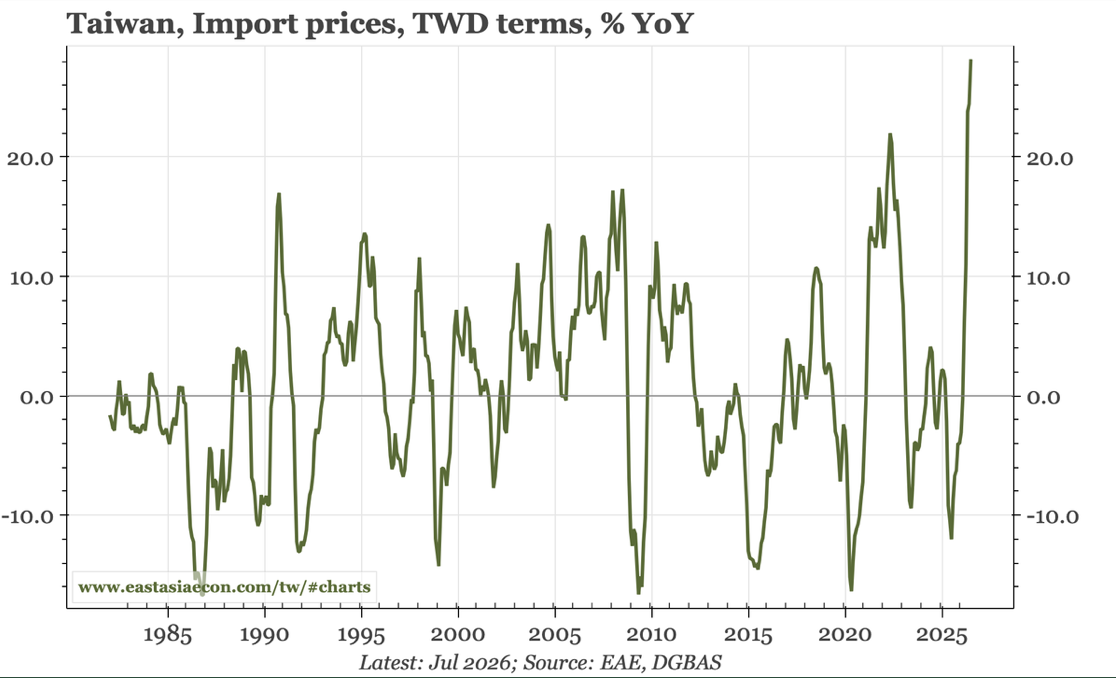
Although headline and core YoY inflation ticked down in July, Paul Cavey thinks overall inflation pressure in Taiwan remains firm. CPI excluding broad energy edged up to over 2% YoY, and despite price pressures easing elsewhere from the Iran War, the MoM annualised rate did not fall below 2%, which he feels is significant given core was closer to 1% last year. Pipeline pressures stay strong, with import price inflation accelerating to 25% YoY and PPI reaching 17%, the highest since the early 1980s. Paul suspects memory chip imports from Korea for AI accelerators are causing cost-push inflation, raising computer prices by 8.2% YoY. While export prices rose even faster to edge up terms of trade, Paul notes that private services inflation remains over 2.5% YoY.
Warsh invites the bond vigilantes
Manoj Pradhan points out that the 1:3 Z6Z7 steepener performed exceptionally well through the Federal Reserve, though Manoj did not anticipate Kevin Warsh would roll out the red carpet for bond vigilantes in his second meeting. Manoj argues that Warsh may get bailed out in the near term by President Trump’s desperation to find a truce ahead of midterms. However, if any truce holds and macro fundamentals once again start driving yields, he expects 100 basis points of hikes to eventually get priced into Z7 and Z8 because a massive procyclical fiscal impulse from the OBBBA will force the Fed to act if the economy overheats. Core inflation currently remains free of pass-through and there are no signs of overheating, but he believes growth remains very strong. Manoj advises that the 1:3 Z6Z7 steepener needs to be rebalanced to reflect President Trump’s truce announcement in conjunction with either 10-year or 30-year exposure.
The AI efficiency trade: Look beyond LLMs
The Sustainable Market Strategies team predicts that specialised energy management companies, industrial automation leaders, and enterprise AI software firms are best positioned to capture durable revenue as AI optimises power usage across grids and heavy industry. They contend that the energy leverage from narrow, purpose-built AI models is orders of magnitude better than the energy paradox narrative surrounding large language models, and investors who conflate the two are misreading the opportunity. Grid and industrial process optimisation present clear mechanisms to extract value: grid tools yield 30-50% fault outage reductions and $10 billion in annual US virtual power plant savings, while edge-deployed industrial models cut plant energy bills by 5-15% with a 50:1 to 500:1 leverage ratio on consumed power. Large-cap infrastructure names provide defensible entries via hardware and integration moats, including Schneider Electric SE, GE Vernova Inc and Eaton Corp PLC.
Industrials
The company continues to command a growth multiple despite producing little underlying growth. Q2 revenue rose just 1.5% Y/Y and still missed consensus, while several accounting tailwinds appear to be supporting reported results. The key concern is contract assets: revenue recognised before it has been billed. These rose by $202m Y/Y, compared with only $25m of revenue growth, and BTN estimates this lower-quality revenue source explains nearly all of XYL’s 12c adjusted EPS beat. Without the contract-asset tailwind, the revenue miss would have been far larger. Contract liabilities also continue to fall both in absolute dollars and as a percentage of sales, raising additional questions about the sustainability of reported revenue growth.
Consumer Discretionary
Iii’s latest Beyond the Street report flags a more cautious read-through from M&M EV dealership checks. The XUV400, XEV 9e and BE 6 all carry discounts of ₹1-3 lakh, with ready delivery available on every model. The XEV 9e, listed at ₹34.49 lakh, is available at ₹31.75 lakh, a 7.94% discount, while state incentives take the effective discount to c.15% before negotiation. This more than reverses management’s 2.7% mid-July price hike. Ready availability is also notable given commentary around lost July production days, a supplier fire and plans to double monthly EV output by end-FY27. Iii concludes immediate delivery and heavy discounting point to demand, not supply, as the binding constraint for M&M’s EV portfolio, raising margin risk if discounting persists as capacity scales.
Energy
Erik@YWR believes the market is overlooking the significance of EXE’s $1.25bn Twin Eagle acquisition, which makes the company North America’s largest natural gas marketer as well as its largest producer. He argues this matters because US natural gas is moving from a supply story to a demand story, with LNG growth, AI/data-centre power demand and reshoring potentially adding 30bcf/day of demand to a c.100bcf/day market. Twin Eagle also gives EXE the trading, storage and logistics capability to monetise gas-price volatility rather than just trying to smooth it out. Erik sees CEO Mike Wichterich pursuing a “hedgehog” strategy: not trying to "vertically integrate" and build a data centre, which some gas producers are trying to do, but by becoming the best and most profitable US natural gas company.
Consumer Idea Forum
MYST’s latest buyside event showcased companies launching new initiatives/products, business inflections/turnarounds and companies with higher-end offerings. Also notable were numerous potential consolidation/M&A candidates. The most compelling ideas included:
DoorDash (DASH) - DashPass “loyalty moat” driving durable share gains + several “call options”. TP $275 (30% upside).
Warby Parker (WRBY) - Eyewear rebounding from cyclical trough + game changing AI glasses launch. TP $60 (130% upside).
D’Alba Global (483650 KS) - Ulta + Costco distribution wins signal K-beauty share gain acceleration. TP ₩415K (70% upside).
Vita Coco (COCO) - Rising competition threatens coconut water fad. TP $42 (35% downside).
Hermes (RMS FP) - Perma-short forced to confront prolonged deceleration or painful supply cuts. TP €1,250 (20% downside).
Technology
The Chair, a Divisional President and the Chief Technology Officer buy a combined €1.4m of shares at c.€8.45. Smart Insider has had a positive rank on the stock since 30th Jan 26, initially triggered by buying from Chair Timo Ihamuotila at €5.37 per share. He subsequently added again in Apr at €9.10 and has now bought once more after the shares retreated from a recent high of €15. The latest cluster is also notable because Pallavi Mahajan, Chief Technology Officer, and Patrik Hammaren, Divisional President, are making their first purchases, despite neither being new to the company. Smart Insider renews its +1 rank (highest rating).
Bitcoin: Trend model turns bullish
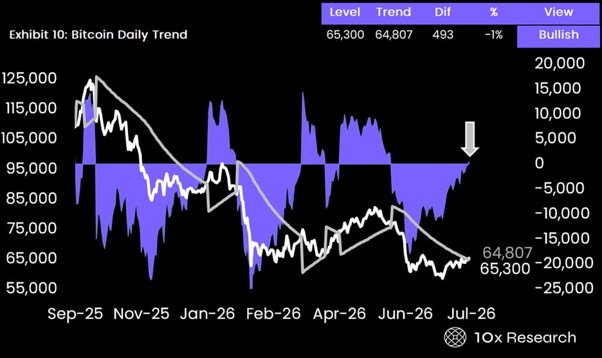
Markus Thielen points out that his Bitcoin trend model has turned bullish. He says that over medium time frames, trend following tends to work well, especially for higher-volatility assets like Bitcoin. And when a trend breaks, it provides a non-judgmental, rules-based level to cut positions. That's precisely why he built the dashboard for his Trading Signals subscribers. Given that his medium-term indicators (weekly data, 1-3 month view) also show Bitcoin as deeply oversold, with those reversal indicators now turning, he takes this bullish trend change seriously. The key level is $70,000, where Bitcoin would also break above its 21-week moving average, a simple but effective bull-vs-bear market indicator that also flagged the bear market coming in October 2025. In addition, his 4-week breakout model confirms this: Bitcoin has made a new 4-week high. Depending on which systematic strategy traders and funds follow, this is another signal that could prompt long positioning and further push prices higher.
Russia & Ukraine: War continues to damage oil and grain exports
Nancy O’Flynn points out that Russia and Ukraine continue strikes on each other's grain and energy infrastructure. Oil loading at the Caspian Pipeline Consortium’s (CPC) terminal on Russia’s Black Sea coast remains suspended after a Ukrainian drone strikes. CPC said that operations at mooring 1 and mooring 3 were suspended. Ukraine said it struck Gazprom Neft’s Yanos refinery site (capacity 300k bpd). In July, Moscow increased targeting of cargo ships and Ukraine’s main grain shipping terminals of Chornomorsk, Odesa and Pivdennyi. Ukraine has lost roughly a third of its Black Sea grain export capacity due to the intensified strikes, according to the Ukrainian Agrarian Council. On July 11 and 12, Russia struck the port of Izmail on the Danube River. Ukraine said it had attacked 183 Russia-linked bulk cargo ships and tankers in the Sea of Azov and the Black Sea as of July 20. Ukraine also struck two key Russian Azov ports in July.
Macro View: The wind finally at my back
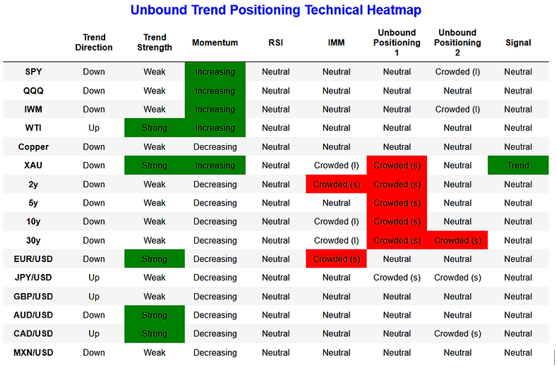
David Woo argued in the Unbound Global Macro Investor that the geopolitical risk premium remains too low. His short-term market bias is: higher oil - lower equities - neutral rates - neutral dollar.
(1) Higher oil: David says the market is under-pricing two risks: that the latest U.S. efforts to break Iran’s denial of Hormuz will ultimately require the deployment of ground troops; and that Iran will act on its threat to close the Red Sea.
(2) Lower equities: Higher oil is bearish for tech stocks. The release of Moonshot’s Kimi K3 model supports the hypothesis that LLMs are rapidly becoming commoditised.
(3) Neutral rates: Inflation breakevens are likely to play catch-up with oil price next week. However, a decline in expected investment returns of AI is bullish for bonds. The better-than-expected inflation data last week supports a 5s-30s steepener.
(4) Neutral dollar: If the AI bubble bursts, the real yield advantage of the dollar will begin to erode.
US economy powers on as FIFA spending & IRS tax rebates fade
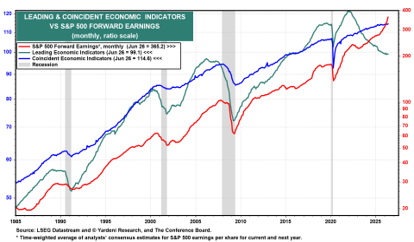
The World Cup is over and an important economic tailwind is beginning to fade. The stimulus from tax refunds is also fading. The total amount refunded to households rose 18.1% y/y to $324.8 billion, putting nearly $50 billion of additional cash into consumers' pockets. With both tailwinds now fading, the economic data are reflecting the slowdown. Ed Yardeni is not concerned. Seven years into his Roaring 2020s scenario, the underlying pulse of the US economy and American consumer remains strong. Redbook same-store retail sales growth cooled to 8.0% y/y in the week ending July 17, but sales growth remains robust by historical standards. The Index of Coincident Economic Indicators (CEI) rose 0.2% to a record high in June. Ed favours S&P 500 forward earnings per share as an economic indicator (see chart). It rose to a record high in June and in recent months, it has been signalling stronger economic growth than the CEI.
Technology
OMNISIGHT deconstructs the engineered float mechanics and vendor-financing arbitrage behind NASDAQ's leading AI Cloud listing. While Wall Street consensus models BRUN as a high-growth AI infrastructure play with a massive contracted backlog, OMNISIGHT’s forensic audit reveals it to be a high-leverage hardware lessor. The company's celebrated 0% redemption rate was artificially created by locking up shares to compress the free float to a mere 1.07m shares - triggering an artificial spike that released millions of insider earnout shares. However, following a recent $45m warrant exercise, this micro-float vacuum is breaking. OMNISIGHT anticipates significant impending float expansion, exposing the stock to heavy dilution and substantial near-term seller pressure.
Earnings season screens
Mill Street has developed an "Earnings Screen Score" ranking methodology that draws on selected inputs from their MAER (Monitor of Analysts’ Earnings Revisions) stock database to identify companies which have strong near-term fundamental momentum going into an earnings report. Mill Street’s research indicates that companies scoring highly in their ranking have a much higher chance of near-term improvements in analyst expectations than those that score poorly. Stocks most likely to produce positive near-term analyst estimate activity in the next couple of weeks include Franklin Resources, Humana, Seagate and Valero. Bottom ranked stocks include Boston Scientific, EchoStar, Intercontinental Exchange and S&P Global. Click here to access the full report.
7 issues for US equity investors
1) The penalty for missing estimates remains severe, with low-valuation stocks that miss EPS facing the harshest market reaction on record. 2) Being underweight the Great 8 has helped performance this year, as breadth finally improved, but Trivariate worries that a big risk for some long-only investors is that they are positioned for the group to continue to lag. 3) Structurally higher gross margins (driven by Semiconductors) help explain why the market can sustain higher valuation multiples than in the past; a market de-rating would therefore likely require a meaningful margin rollover. 4) Financials earnings were solid, but positioning is elevated. 5) The US consumer looks more K-shaped by balance sheet than income statement. 6) The case for long low short interest names and shorting high short interest doesn’t look very compelling. 7) Trailing beta has never been a worse predictor of future beta.
Utilities
MTLN’s Asset Rotation Plan and its impact on cash flow remains poorly understood by the market. Renewable-project SPV sales are treated as revenue-generating contracts rather than disposals, allowing MTLN to recognise “catch-up” revenue once a sale is signed, based on management’s estimate of project completion. Contract assets linked to the plan rose from €0.92bn to €1.41bn in 2025, increasing the risk of later write-downs if assumptions prove optimistic. Forensic Alpha also identifies asymmetric cash-flow treatment: development spending can be classified as capex when projects sit in PP&E, while subsequent sale proceeds may enter OCF after reclassification to inventory. Together with similar treatment of CO₂ allowances, they estimate c.€338m of benefit to reported OCF. MTLN is less cash generative than appreciated, leaving liquidity, leverage and refinancing more exposed if project sales slow.
Technology
AnteData’s alternative-data work points to growing implementation and adoption of SGE software. Measuring coding activity on various platforms, SGE ranks within the top 30% of the companies they track. App downloads, hiring of freelancers and search activity related to its software are all increasing. While SGE’s recent revenue growth already reflects steady adoption, with c.6% annual growth over the past five years and occasional double-digit periods, AnteData’s data support a more positive scenario in which growth stays near the top end of the recent range, around 10% annually. That would take revenue from c.£2.5bn to c.£4bn within five years. Given software operating leverage, costs could rise more slowly than revenue, potentially almost tripling net income to c.£1.1bn, leaving SGE valued at only c.7x year-five earnings.
Asian insider sentiment turns bullish
Smart Insider’s June Asian insider-trading review shows a sharp improvement in sentiment across Asia ex-Japan/Taiwan, with 1,354 insider purchases from 969 companies totalling US$1.3bn, up 70% vs. May, almost double June 2025, and the most buys in a single month since 2020. Selling remained relatively light, leaving the sell/buy ratio at a bullish 0.64. The strongest buying signals were in South Korea, Hong Kong and China. Smart Insider upgraded 30 stocks, the first month with 30+ upgrades, led by tech hardware, chemicals, industrial transport and pharma/biotech. June additions ranked +1 (highest rating) include Bangkok Expressway & Metro, MINISO, Kingsoft, CStone Pharmaceuticals, Hyundai Rotem, Dongwoon Anatech, MLS, Anhui Jinhe Industrial and Yantai Jereh Oilfield Services.
Aequitas reviews two upcoming Asian lock-up expiries with very different risk profiles. For Bharat Coking Coal, the 6 month lock-up on the balance of Coal India’s promoter stake expires on 14th July, releasing c.US$1.3bn of BCCL shares, equivalent to c.70% of the company and 87 days of ADV. However, despite the stock trading c.65% above its IPO price, Aequitas thinks a near-term placement is less likely given Coal India is Government controlled, although medium-term dilution remains possible to lift free float and meet minimum public shareholding rules. GigaDevice looks more exposed to near-term selling: cornerstone investors owning c.2% of the company, worth c.US$1.4bn and eight days of ADV, are released on 12th July and are sitting on huge gains. Aequitas thinks they may look to book profits after the stock’s strong run.
Materials
The market is fundamentally mispricing tier-1 lithium producers by anchoring valuations to depressed spot prices. OMNISIGHT’s latest Master Dossier on ALB exposes a massive structural gap between Chinese spot indexes and actual realised contract pricing. While consensus models assume an $8/kg plateau, ALB’s opaque index-lagged contracts and price floors generated significant FCF, allowing the company to pay down $1.3bn in corporate debt in a single quarter. Furthermore, ALB is demonstrating aggressive capital discipline by intentionally idling capacity, such as the Kemerton Train 1 facility in Australia. This deliberate restriction of Western conversion supply engineers artificial scarcity, ensuring margin protection that algorithmic trading models are currently failing to discount.
Technology
Trivariate models MU’s earnings across thousands of simulated scenarios varying the size and duration of the current memory cycle, concluding that peak earnings are most likely between mid-2028 and late-2029. Their base case assumes that c.75% of the current earnings improvement is structural rather than purely cyclical, driven by AI-related memory demand extending the cycle beyond historical norms. Under this scenario, the company’s peak EPS could approach $190-$200, materially above current Wall Street expectations, while normalised earnings power is estimated at $82-$86 per share after adjusting for cyclicality. The current share price implies only c.5-6x projected peak EPS; if investors ultimately value peak earnings closer to 8x, the stock could be worth $1,500-$1,600/share. Even using normalised earnings the stock appears reasonably valued trading on 11-12x EPS.
Technology
BTN remains sceptical of IPGP’s apparent earnings resilience, arguing recent “beats” have been flattered by unusually wide guidance ranges and accounting tailwinds. The company missed 1Q26 consensus EPS by 2c, but prior quarters looked stronger because management guided to very broad EPS ranges, including 5-35c in both 3Q25 and 4Q25, despite EPS already running around 30-35c in the preceding three quarters. BTN also questions valuation: at c.72x forward adjusted EPS, trailing four-quarter adjusted EPS of $1.40 includes 53c of interest income; excluding this, the multiple rises to c.135x. Earnings quality concerns include several quarters of declining charges against gross profit; prior warranty-accrual reductions that may now reverse as warranty expense rises; extended machinery useful lives; fully depreciated assets supporting margins; and reduced bad-debt reserves despite 74% non-US sales.
Romania fiscal impasse and the panda bond alternative
Eileen Gavin points out that it has been almost seven weeks since the centre-left Social Democratic Party toppled Romania’s government in a vote of no confidence, with no cabinet on the horizon. While veteran Liberal politician Adrian Veștea struggles to secure backers in parliament, Mario Bikarski observes that Romania’s 10-year government bond yield sits highest in the EU, about 1.5 points above that of Hungary and Poland. On June 18th, the finance ministry sold bonds maturing in 2040 at 7.01%, up from 6.64% in March. Beyond the region, panda bonds have become a partial safe haven against the geopolitical events of 2026, with Indonesia and Brazil the latest sovereigns poised to place these yuan-denominated instruments. As the RMB internationalises, these instruments make financial sense for emerging markets, offering green shoots to the sustainable debt market where sovereign issuance in third currencies remains useful for sustainability purposes.
Canada inflation spike provides no cause for hikes
According to data in Screenshot 2026-06-25 at 12.47.26.png, Carl Weinberg observes that headline CPI-based inflation metrics printed higher than expected, if only by a squinch. Technically, headline CPI at 3.2% is pretty far above the 2% midpoint of the inflation target range. However, traditional core CPI was just 1.6% higher than last year, while the Bank’s preferred measures of core inflation, CPI-median and CPI-trim, averaged just 2.05% between them. Sticking to his guns, Carl notes that the BoC did not raise rates at its last meeting because it didn’t have to. Petrol prices were behind the acceleration of headline CPI, but there is little sign those cost increases are bleeding through into core prices. The economy has plenty of slack to absorb the energy price increases, unlike the US where output is camped at the edge of the production possibility frontier. This result gives the BoC no cause to contemplate rate hikes now.
Consumer Staples
Three Non-Executive Directors recently purchased a combined £646,000 of shares at an equivalent price of c.£42 per share, with some transactions conducted through ADRs. Notably, each purchase was their first. Ruby Lu, a Non-Executive since Nov 2021, acquired £374,392 of shares, despite never having bought shares at Yum China, where she has served as a Non-Executive Director since 2016. Judith McKenna, a Non-Executive since Mar 2024, purchased £186,000, having made no purchases while an executive at Walmart or since joining Delta Air Lines as a Non-Executive in 2025. Benoit Potier, a Non-Executive since Jan 2025, acquired £87,000. Smart Insider views the cluster of buys as bullish and ranks the stock +1, their highest rating.
Materials
Lucror sees the proposed CopperTech Metals IPO as credit positive and another step towards improving VRL’s portfolio transparency, liquidity and funding flexibility. The proceeds will mainly be used for growth capex at Konkola Copper Mines and to reduce pressure on VRL holdco liquidity. VRL is also undertaking a broader refinancing, which should extend maturities, lower funding costs and strengthen liquidity; S&P has affirmed VRL at BB and assigned BB- to the proposed senior notes (Lucror generally agrees, except for the notching down of the senior unsecured rating). Lucror also views Twin Star’s recent 1.7% VEDL block sale as modestly credit positive. Their credit bias remains Positive, supported by projected record earnings. They recommend buying the VEDLN 9.85% ’33s at 109.5/8.0%/4.9Y, while holding the rest of the curve.
Technology
BTN remains sceptical re. the sustainability of NTAP’s margin improvements and believes the credit risk associated with the company’s receivables portfolio is greater than many investors appreciate. DSOs have exceeded 60 days in 3 of the past 5 quarters, among the highest levels in recent years. Arrow Electronics and TD SYNNEX together account for c.25-40% of receivables, with both having stretched working capital positions, and their payables and debt obligations significantly exceed expected collections. Margin expansion has been supported by fully depreciated equipment, which BTN estimates contributes c.350bps to margins and c.$1.25 of annual adjusted EPS. Lower R&D and S&M spend also helped the Q4 beat, but these savings may be difficult to sustain as NTAP pursues AI-related customers. Deferred revenue continues to decline as a percentage of sales and the company has discontinued warranty disclosures in its latest 10-K.
Financials
AMP is one of the leading players in global wealth management, an industry with underlying growth characteristics rivalling the fastest-growing segments of the tech sector. Household wealth has quadrupled over the past 35 years and investable assets have increased 1,600%, while an ongoing evolution in investing customers’ tastes and preferences continues to tilt the financial services industry landscape in favour of wealth management vs. asset management entities. AMP’s wealth management revenues and adjusted operating profits have grown at LDD annual rates in recent years, with margins holding around 30%. EPS has also compounded strongly, helped by buybacks that have reduced shares outstanding by 23% since 2020. Despite this, the stock trades on just 10.1x 2026E EPS, below both its own history and peers.
Financials
AIR argues CMBN’s improving efficiency profile is underappreciated, with AI integration expected to accelerate cost reduction and drive the cost/income ratio below 40% in 2026 and 35% in 2027. With no further Swiss rate cuts expected this year and loss provisions forecast to remain <1%, CMBN is probably the most efficient bank in Europe on a risk/reward adjusted basis. The group’s 100% Swiss exposure, no controlling shareholder and attractive risk profile also make it an ideal target for foreign financial institutions seeking CHF and Swiss consumer market exposure. TP CHF130 (35% upside).
China: Externally driven inflation
Paul Cavey says that the rise in China’s producer price index (PPI) that continued in May is of macro significance: it is pushing up industrial sector earnings, and the GDP deflator will likely turn positive in Q2. But it is difficult to find signs of domestically generated inflation that would suggest a real upturn in the economy. PPI inflation did ease MoM in May, but the headline YoY rate climbed to 3.9%, the highest since mid-2022. As would be expected, the driver continues to be upstream commodity prices. The rise in energy prices is also being reflected in CPI, with a 20% YoY rise in fuel costs pushing up the transport and communication component by 5% in May. However, headline CPI was steady at 1.2% YoY. One reason was that food prices in the CPI continued to fall last month. In addition, services inflation remains weak. That reflects the state of domestic demand, though in that regard it is perhaps notable that services inflation isn't deteriorating further.
Japan: Yen under pressure, but data is encouraging
Graham Turner says that the prospect of a rate hike at the FOMC meeting in June casts a harsh spotlight on the Bank of Japan: the BoJ will meet earlier next week, and unless it agrees to tighten policy too, the yen is likely to plumb new lows against the US$. For the Bank of Japan, there is no obvious pressure to hike, as inflation has been well-behaved. The y/y for the Nationwide CPI eased to 1.38% in April. The CPI excluding food, alcohol & energy dipped to 1.06% y/y. Real wages are rising sharply, in part, because of the drop of core inflation as well as fuel subsidies. The labour market in Japan is tight. The unemployment rate fell to 2.5% in April. Total employment jumped to 68.76m, a new high, despite a shrinking population. These are encouraging trends that bode well for Japan’s response to an ageing population, particularly against the backdrop of high government debt.
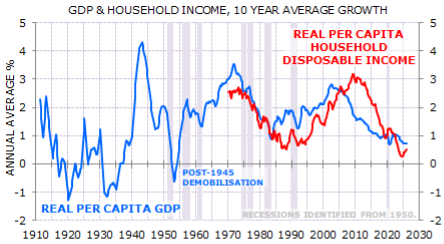
Australia heads back to the doldrums
According to Gerard Minack, Australia is growing at 2.5% – not particularly strong with working-age population rising by 1.75% – but now seems set to slow. Productivity growth remains poor, so 2.5% growth created inflation pressure that the RBA had to respond to. Gerard says the economy will head back to the doldrums of a low per capita expansion. Weaker growth is a factor behind falling EPS forecasts and the prospect of modest equity returns. Australia has had a poor decade. Average per capita GDP growth was the lowest since the 1930s (excluding the post-1945 demobilisation). What matters for consumers is disposable income, not GDP. Per capita disposable income growth was lower than GDP, payback for the mining boom boost received through the prior decade. Australia’s biggest structural economic problem is poor productivity. Poor productivity reflects low capex relative to fast-growing population, so there is little capital deepening. No capital deepening means no productivity growth.