Europe
UK strategy insights
Trendrating’s latest analysis provides data-driven insights into the combinations of fundamental parameters that have historically generated the most alpha in UK equities. They have ranked the factor combinations most rewarded by the market across one-, three- and ten-year periods, providing investors with a factual framework for factor-based decision-making. Over the past year, the strongest-performing combination has been Lowest P/E and Highest 3-Month Sales Growth, delivering a 37.2% return and outperforming the benchmark by 17.7%. Lowest P/E combined with Highest 12-Month Sales Growth ranked second, returning 33.4%, while Highest 3-Month Earnings Growth alongside Highest 3-Month Sales Growth returned 32.5%. Top 3-Month Earnings Growth combined with Lowest P/E was the weakest performer. Click here to access the full ranking list.
Greek Refineries: Higher for longer?
Energy
Greek refining fundamentals look set to remain exceptionally strong after Helleniq and Motor Oil delivered impressive Q2 results, with both benefiting from strong middle-distillate economics, higher volumes and export premia. July and August cracks have surged vs. Q2, with diesel at $85 (from $49), gasoline at $46 (from $21) and jet at $68 (from $52). With both refineries expecting H2 to be at least as good as H1, ResearchGreece raises their 2026-28 EBITDA forecasts and, given the stronger margin outlook, shifts their refining valuation methodology from multiples to DCF. Price targets rise sharply but remain below current share prices, supporting DOI (Do Not Own It) ratings amid uncertainty over where refining margins ultimately settle and are not prepared to chase a speculative trade at current levels.
Industrials
Two senior board members bought a combined €236,000 of stock between 20th and 31th August at an average price of €53. Their previous purchases were in March 2023 at around $27, when Smart Insider also assigned their highest (+1) ranking, making it notable that both are buying again after a three-year gap at nearly twice the price. Juan Manuel Hoyos Martinez De Irujo, Lead Director since January 2020, bought €73,000 in only his second clean purchase since joining. Vice Chairman Oscar Fanjul Martin bought €163,000, increasing his stake by an estimated 6%, with Smart Insider noting that he has a better-than-average track record. They therefore once again rank the stock +1.
Technology
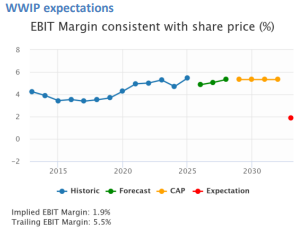
SES continues to look like a strong company with sensible rates of growth, good finances and high levels of financial productivity. Management is also clearly excited by prospects in a world of rapid technological innovation and they recently outlined detail of the targets for 2027 and 2028 which involve continued premium revenue growth along with higher margins. But markets seem to have missed most of this. The implied to Y3 EBITM ratio is only 35. If everything works as it ought to then Willis Welby can still see 100% upside.
North America
Special Sits Idea Forum
Idea diversity at MYST’s latest buyside event was striking, spanning Basic Materials, Industrials, Real Estate, Telecom, Transportation, and, of course, AI / power-related names. Stocks discussed include:
Air Canada (AC CN) - “Going private in plain sight” via buybacks + loyalty programme monetisation. TP C$60 (115% upside).
Chemours (CC) - “Misread” guidance cut masks TiO2 recovery + data centre cooling optionality. TP $30 (95% upside).
FTAI Aviation (FTAI) - Legacy lessor perception obscures MRO growth + data centre power opportunity. TP $550 (190% upside).
Genuine Parts (GPC) - Activist-led industrial distribution separation misvalued under auto parts coverage. TP $186 (35% upside).
Mosaic (MOS) - China phosphate exit + corn inflection creates structurally tighter supply setup. TP $35 (35% upside).
Contrarian Corner
Mill Street’s Contrarian Corner reports highlight stocks where analyst consensus recommendations diverge from the recent trend in consensus analyst earnings estimate revisions. Once they have identified the relevant stocks, Mill Street looks for names which screen well (buy ideas) or poorly (sell ideas) using their six-factor MAER ranking model. Top buy ideas drawn from the Russell 1000 universe currently include Arrow Electronics, Best Buy, Prudential, Reliance and SMCI. Top sells include Boston Scientific, Primoris Services, Somnigroup, TeraWulf and Walmart.
Communications
New Constructs remains firmly bearish despite the stock falling 35% YTD and ~80% since their original report. The core issue is that the fundamentals continue to move in the wrong direction relative to expectations embedded in the valuation. Daily active users are declining in SNAP’s key North American and European markets, while ARPU remains stagnant. At the same time, margins remain negative and cash burn substantial: SNAP has consumed $13.7bn of cumulative FCF (excluding acquisitions) since 2016, including $395m in 1H26. New Constructs argues the current valuation still assumes an implausibly large acceleration in users and monetisation and sees further downside, with their optimistic scenario valuing the shares at just $2.00 vs. $5.70 currently.
Consumer Discretionary
The recent stock decline may suggest otherwise, but TSCO is a structurally stronger business than pre-Covid, supported by a larger needs-based sales mix, deeper customer engagement and store productivity that remains attractive despite moderating comps. Brian McGough views current pressure as cyclical, with discretionary weakness offset by resilience in the core business. He also pushes back on the idea that the pet category is “broken”, arguing assortment, value, digital/subscription and services initiatives can stabilise performance and rebuild share. Longer term, Brian thinks the Street is massively underestimating earnings power, helped by another ~800 stores and potential mid-to-high-single-digit comps when housing recovers. He sees ~50% upside over 18 months and a TAIL double on his base case model.
Consumer Discretionary
The timeshare operator is struggling to attract younger new owners as demographics and holiday preferences shift. TNL’s response has been to drive growth by encouraging existing owners to upgrade to higher tiers, a strategy industry participants told OWS is unsustainable. At the same time, competition to win new customers and sell more “Experiences” could pressure margins. Credit quality is another concern: early-stage delinquencies are edging higher even among borrowers with FICO scores above 700, while loans with recent vintages have dominated write-offs. OWS sees a 2H26/2027 shortfall in new customers, revenue and EBITDA as the key catalyst, with higher loan-loss provisions a further risk to the growth story.
Consumer Staples
John Zolidis sees DLTR’s Q2 as evidence that its multi-price strategy is working, with same-store traffic turning positive after three quarters of declines despite lapping +3.0% growth. Same-store sales rose 3.7%, revenue grew 7% and margins expanded (ex-tariff refunds), while SG&A also leveraged. Importantly, higher price points are not driving customers away and should support basket growth, while materially easier H2 comparisons provide a tailwind to traffic. John views the recent margin confusion around tariff refunds as temporary noise rather than a change in the core thesis. With 5% unit growth, aggressive buybacks and improved unit economics, he remains a buyer following the post-results sell-off.
Stablecoins: Are incumbent banks already too late?
Financials
AI agents are already choosing stablecoins for machine-to-machine payments, with Circle’s USDC emerging as the dominating settlement. Automated systems buying compute and data executed 23m transfers in 30 days, up 64% in a week, with 99.3% settling through USDC. M2M commerce is selecting payment networks on speed, programmability and API compatibility rather than incumbent relationships. If that behaviour scales, deposit migration could erode the float supporting bank lending and pressure NII; Dallas Fed analysis suggests as much as $580bn of lending capacity could be at risk. With a bank-led digital dollar not expected until 2027, investors should consider which regional banks have deposit bases most exposed to float erosion.
SaaSpocalypse dying
Technology
Another excellent performance from Snowflake in Q2 hammers a further nail into the coffin of the SaaSpocalypse theme that had taken the sector down sharply. Richard Windsor sees the results as further evidence that enterprises will continue to need software and are increasingly turning to existing vendors to help deploy AI in a safe and controlled way - a positive read-through for Salesforce, SAP, ServiceNow and Adobe. He is less enthusiastic on SNOW itself, however, given a valuation of more than 150x FY27 P/E. Richard sees better value elsewhere and owns NOW and ADBE, which remain only around 25% of the way to his target prices.
Technology
AVGO has approved a panel fan-out packaging supplier for its META programme, with customer qualification - rather than equipment availability - previously the key constraint on bringing capacity online. The largest accelerator packages have outgrown the conventional round-wafer formats, while rectangular panels offer roughly a third more usable area, albeit with greater warpage risk. JNK sees equipment constraints easing, with the bottleneck now shifting downstream into probe-card test capacity, where below-target yields increase the amount of testing required for each good die. The read-through extends to Advanced Micro Devices, Applied Materials, Onto Innovation, FormFactor and Corning.
Technology
BTN first highlighted VERX in Nov 24 and the shares have since fallen ~70% despite the company appearing well positioned to benefit from changes in tariffs and VAT regimes. The stock now trades at ~16x forward adjusted EPS, but they still see material earnings-quality concerns. While reported earnings continue to improve, there remains a sizeable gap between adjusted results and the underlying economics of the business. BTN's latest Red Flag Note highlights weak cash generation, the exclusion of recurring software costs that account for nearly half of adjusted EPS, declining contract liabilities and deferred commissions, and several smaller accounting benefits that have helped VERX sustain a pattern of beating adjusted EPS estimates by just 1 cent.
SMRs: A better AI power bet than SpaceX
Utilities
After fifty years of stagnation, Kailash sees the nuclear industry as having a credible chance of revival through small modular reactors, supported by favourable policy and lower upfront capital requirements than legacy plants. While SMRs remain high risk, Kailash believes much of that risk is already reflected in valuations, unlike SpaceX, which carries similar or greater uncertainty but is priced as though commercial viability is assured. On that basis, SMRs may offer the better way to play rising AI-driven power demand. The valuation gap is stark: listed pure plays Oklo and NuScale have a combined market value of ~$9.2bn vs. ~$1.9trn for SpaceX. The key challenge for SMRs is now execution - proving Western projects can be delivered on budget and at scale.
Developed Markets
Who’s winning the AI race?
Inferential Focus argues that the implied AI contest between the US and China is not a single race, but two divergent strategies pursuing global pre-eminence. Whilst American hyperscalers spend aggressively on proprietary architectures chasing artificial general intelligence, Beijing exploits practical, open-source models to insinuate technology across its domestic and export economy. American corporate use of Chinese models has surged from 4.5% to 46% this year, with Chinese solutions costing between 60 and 90% less than US alternatives and forcing aggressive domestic price cuts. Inferential Focus expects mounting infrastructure bottlenecks in water and electricity alongside local pushback to slow US data centre buildouts, while massive debt issuance from hyperscalers competing against sovereign borrowing drives interest rates higher. With eighty percent of US AI startups now deploying Chinese models, the two competitors are maturing projects in different orchards, but both share one goal: becoming a ruler of the world.
The end of data centre hypergrowth
The data centre industry has reached the end of hypergrowth as physical constraints and political resistance replace silicon as the binding bottleneck. While demand for compute remains intact and Nvidia sells every advanced GPU it produces, Paul Krake argues that a corporate budget is not the same as energised compute. Regulatory crackdowns, grid capacity exhaustion, and community opposition mean behind-the-meter generation is shifting from an optional advantage to the price of admission, extending deployment schedules to five-to-seven years. Paul predicts an initial broad sell-off across the AI complex, with Nvidia as the primary proxy, as delivery delays lower annual growth rates and compress valuations built on uninterrupted expansion. Subsequently, a selective phase will reward scarce, operational capacity with secured power, whilst hyperscalers eventually benefit from enforced capital discipline. The decisive unit is no longer the GPU ordered; it is the megawatt that can be turned on.
Rising risk from the risk-free rate
Higher bond yields directly threaten equity valuations as the risk-free rate drives up the cost of capital. With UK 30-year gilt yields approaching 5.9% and ten-year yields exceeding 5.2%, long-dated government securities now compete effectively with equities. Higher discount rates disproportionately reduce the present value of high implied growth, leaving US market leaders such as Broadcom, Palantir, Tesla, ServiceNow, and CrowdStrike particularly exposed, alongside European compounders like ASML and SAP. The team stresses this represents a higher hurdle rather than an indiscriminate collapse, noting that leadership can shift towards banks and energy producers. Investors should shift portfolio focus towards less aggressive valuations and undiscounted earnings growth protected by revisions momentum. Prolonged transport constraints in the Persian Gulf and Red Sea risk entrenching high inflation alongside subsiding growth, encouraging uncomfortable comparisons with the 1970s: not attractive.
UK: The Burnham premium on gilts
Graham Turner warns that the Andy Burnham premium is compounding global inflation pressures, leaving gilt yields heading over 6%. While Kevin Warsh’s Jackson Hole address triggered a sell-off in short-dated US Treasuries, UK gilts have sold off rapidly across the curve, with two-year yields jumping 20 basis points and 30-year paper climbing to 5.84%. Escalating commodity prices, with energy jumping 4.6% and broader indices reaching levels unseen since October 2008, coincide with domestic fiscal vulnerability. Net social benefits rose 6.82% year-on-year, pushing debt interest to £97.0bn. Graham highlights that despite informal adviser Lord O’Neill urging the prime minister to end the triple lock and curb excessive welfare spending, Burnham resists crude cuts and prevaricates on defence targets. With Donald Trump pushing for 5% GDP defence spending and geopolitical shocks accelerating, the window to rein in borrowing is closing. The pressure on gilts is rising.
Iceland’s youth shatter EU accession hopes
Following the historic Icelandic referendum, Wolfgang Münchau remarks that an anti-EU majority of 52.8% has exposed the EU’s fading international magnetism. The outcome was driven by an astonishing reversal among young voters: between June and polling day, support among 18-to-29-year-olds collapsed from 63% in favour of accession talks to 60% against. This dynamic was orchestrated by Ung gegn ESB, an effective cross-party youth coalition spanning from Socialists to the Centre Party. Analysts Eiríkur Bergmann and Ólafur Þ. Harðarson conclude that the Yes camp made the fatal error of running an excessively technical, procedural campaign reliant on exaggerated economic claims regarding euro adoption. Conversely, the No campaign triumphed by anchoring its narrative in national sovereignty and the control of local resources. Echoing the UK Remain campaign a decade ago, EU proponents failed to craft an emotional message, dismissing popular resistance as conspiracy. This stupidity is how you lose referendums.
Is a US debt crisis imminent?
Ed Yardeni points out that US federal spending continues to rise relentlessly. CBO projections show total outlays exceeding $11trn over the next 10 years, driven primarily by mandatory spending and rising interest costs. CBO projections also show annual budget deficits widening from $1.8trn to more than $3trn in 10-15 years. The US remains on an unsustainable fiscal path. However, Ed says it is not yet a crisis. Treasury yields remain in a range broadly consistent with a healthy economy, and Ed expects the 10-year yield to remain between 4.00% and 5.00%. He cites a couple of reasons that support his view: 1) US Treasury Secretary Scott Bessent has taken some actions recently to stop bond yields from rising, and can do more if necessary, and 2) Fed Chair Kevin Warsh is committed to restoring price stability. If inflation remains stubborn, the FOMC will probably raise the federal funds rate in September. That could ease pressure on long-term yields.
Australia: Balance of risks points to RBA remaining hawkish
Australia's economy expanded 0.4% quarter-over-quarter in the second quarter of 2026, picking up from Q1's 0.3% pace. On an annual basis, GDP grew 2.1%, decelerating from 2.5% in the first quarter. The Australian Bureau of Statistics characterised the result as modest growth driven by pockets of private demand partly serviced through higher imports, and mining exports partly facilitated by inventory drawdowns. The quarter leaned heavily on car buying and a long-awaited trade turnaround. For the Reserve Bank of Australia, the headline beat and resilient discretionary spending strengthen the case for the RBA's pre-emptive tightening bias, with the cash rate at 4.35% after three hikes earlier this year, while flat investment and inventory-flattered exports argue underlying momentum is thinner than it looks. The balance of risks points to the RBA holding its hawkish posture, while continued consumption strength would firm the case for another hike.
Singapore: Breaking an 18-year ceiling
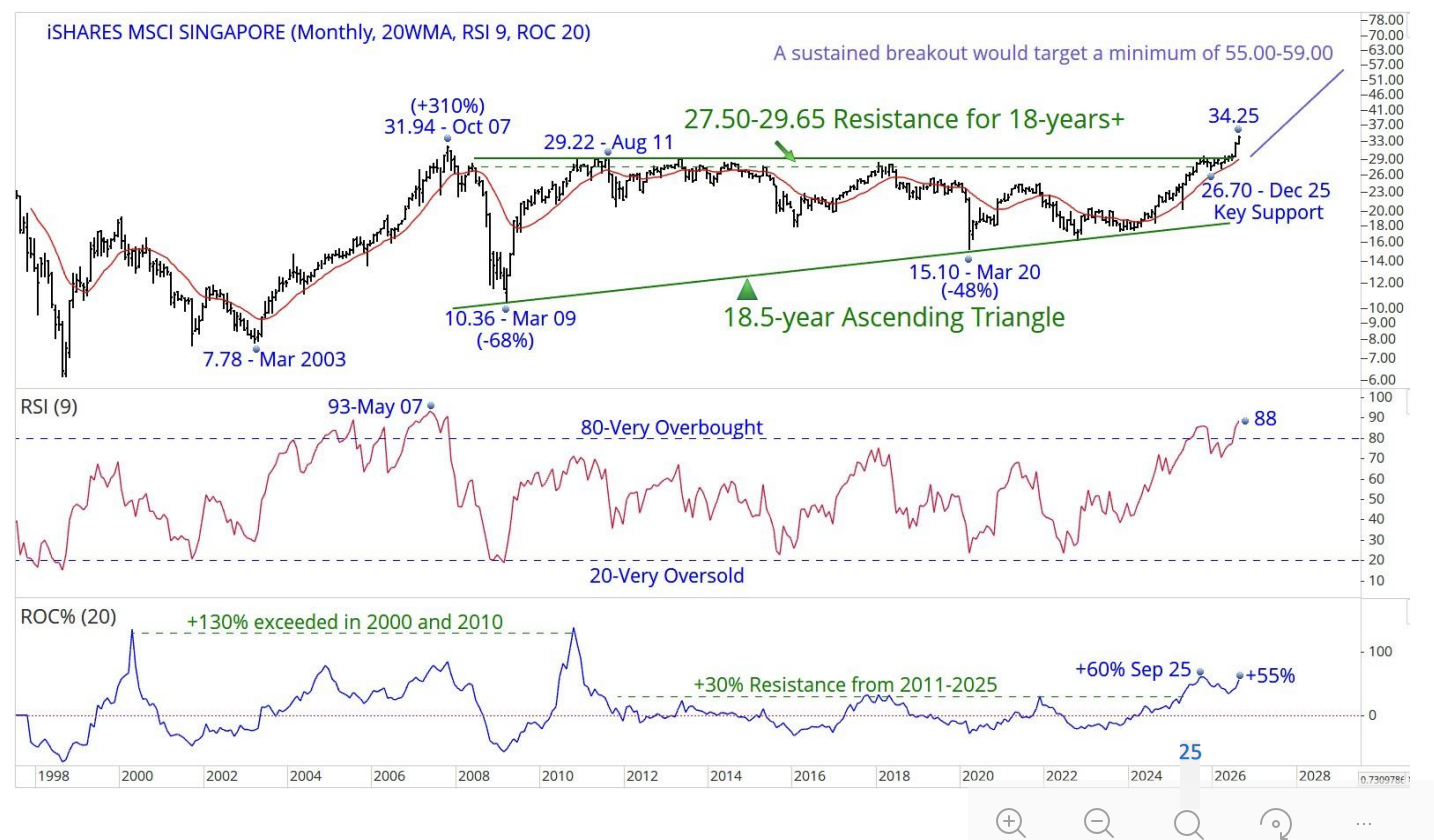
Chris Roberts believes a sustainable secular advance is now underway for the iShares MSCI Singapore ETF (EWS US, last USD33.93), following a near 19-year, classic net sideways, secular bear market. Monthly technicals show a break above an 18-year ceiling extending from USD27.50 to USD29.65. With the ETF trading more than 15% above USD29.65, they view the long-term minimum target as USD55.00-58.84. However, with the 9-month RSI at 88 approaching extremely overbought territory and the 14-week RSI at 79, near-term caution is warranted after the breakout from a 9-month rectangle exceeded its USD32.90 target. Having entered 50% long from USD30.19, Chris is taking partial profits by selling 20% at market. The stop on the remaining 30% long balance stays at a daily close below USD27.85 for now, looking to buy back into a decent setback.
Japan: From walkmans to warships
Neil Newman notes that, contrary to popular belief, Japan is not an export-dependent economy, with exports making up only about 10–13% of its GDP even during the 1980s. Following external trade pressures in the late 1980s, the nation offshored much of its production. Today, roughly 80–85% of Japan’s GDP, is driven internally. The country is shifting its export strategy towards high-value, complete systems and long-term national infrastructure. Driven by a weaker yen, orders for these complex systems have surged since 2023. Neil is projecting the Japanese yen to strengthen to $130USD across the remainder of 2026 and into 2027, propelled by BoJ interest rate hikes and Fed rate cuts. While a stronger currency will broadly benefit the domestic economy, the current transition window offers a temporary bargain price opportunity for Japanese exporters to call time on the yen and secure major deals from foreign buyers before the price rises.
Japan: Takaichi in a bind
Tobias Harris observes that US Treasury Secretary Bessent has publicly leaned on Japan to pursue macroeconomic policies to strengthen the yen, the price of the US participation in a joint foreign exchange intervention. While Bessent’s remarks are aimed at the BoJ in the immediate term, over the longer term US pressure poses a direct challenge to Prime Minister Takaichi Sanae’s fiscal program. Takaichi cannot change course without crippling her government, meaning her defense of her fiscal program could mean more friction with the US, more market anxiety, and more dissent from LDP fiscal hawks to come. Already on the defensive amidst falling approval ratings, she will therefore enter the new Diet session facing renewed questions about the sustainability of her program. Ultimately, it will be Japanese consumers and businesses, stuck between the prospect of higher import costs due to yen weakness or higher borrowing costs due to rising interest rates, who will pay the price for the government’s policies.
Korea: A strong start for GDP in Q3
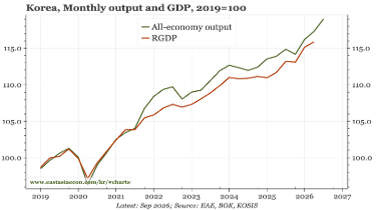
Paul Cavey notes that in July output in South Korea retained the gains of June, and capex spending rose further. Both suggest a strong start for GDP in Q3. Retail sales were weaker last month, but the household sector should start to benefit as the government spends the 20% growth in tax revenue of recent months. The strength in the last couple of months has been in industry. Services output was soft in July, and construction output ticked down too. This year's pick-up in YoY growth has been quite broad-based, though some of that represents recovery from 2025, which for much of industry outside of tech was a difficult year. Korea's current cycle – a commodity price boom – is by nature more capital- than labour-intensive. Given that, rather than the labour market and wages, households are likely to feel more of the benefits via the wealth effect, and fiscal support.
Emerging Markets
Focus buys in EM
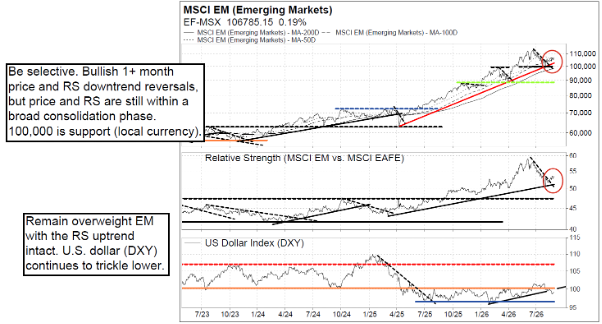
The Vermilion team remains overweight EM relative to global equities and EAFE, noting that eighteen-month relative strength uptrends held strong through the recent July pullback while both ratios reversed above one-month downtrends. They maintain an intermediate-term bullish stance whilst EEM-US trades above $59.50 support, alongside a near-term bullish outlook provided $63.00 holds. Their primary focus centres on non-AI areas that continue consolidating, including SOXX-US, DRAM-US, and CHAT-US. Across countries, Taiwan stands as their sole sovereign overweight, though European emerging markets offer attractive setups across Poland, Greece, Romania, and the Czech Republic. Within sectors, MSCI EM Technology remains their lone overweight position, yet the team actively monitors the space for a potential downgrade because price and relative strength consolidation may persist for the foreseeable future. Instead, the team emphasises buying opportunities across MSCI EM Materials, Energy, Health Care, and Financials, placing all four sectors on watch for upgrades to overweight whilst maintaining key ETF support levels at $59.50 and $63.00 on EEM-US.
Argentina: Difficulties won’t remove Milei
Javier Milei’s political standing in Argentina has weakened since his victory in the 2025 midterms, mostly because of the high real rates inflicted on the economy during the campaign. Oil, gas, agriculture, and mining are booming, but Niall Ferguson points out that other sectors are struggling. This has increased the incentives for Peronist factions to unite behind a single leadership. Yet Peronist unity is very hard to achieve. Niall thus maintains his probability of a Milei re-election in 2027 at 65%. The central bank is well aware of the monetary squeeze in 2025 and will seek to avoid future mistakes; in private they admit the endogenous rate experiment was a mistake. The alternative policy requires tolerating exchange rate depreciation. An economy muddling through at around 2% growth, with inflation continuing to decline (albeit more slowly) and twin surpluses reduces macro risk. This should be good enough for Milei to get re-elected.
China property reform: Far less than meets the eye
China’s latest slate of property sector reforms have been released to great fanfare, but Dinny McMahon says the implications are mostly for the market’s long-term development, not short-term investment and demand. Five government regulators issued a raft of property sector reforms. The sheer flurry of documents makes this look like a big deal. Between them, the PBoC, MoHURD, NFRA, CSRC, and MNR, published nine documents. However, Dinny says there’s far less here than meets the eye. While there are some new measures, most of the documents’ contents repackage piecemeal changes the authorities had previously rolled out. Meanwhile, the reform getting most of the attention – changes to the housing presale system – pulls its punches, as authorities try to balance the need for reform with concerns over the economic impact. Dinny says the reform package is best seen as a statement of ambition. The benefits will only become clear after the property market truly bottoms out and housing demand recovers.
India: Time to upgrade
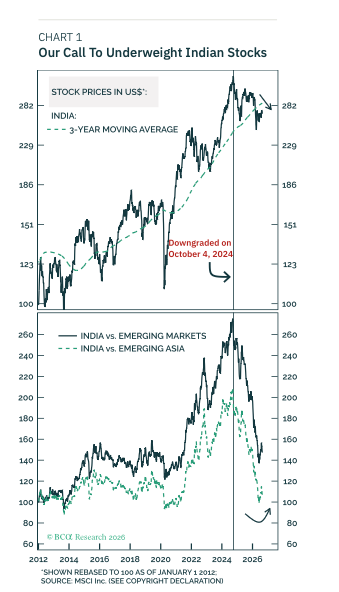
Brian Payne and Arthur Budaghyan argue that India has largely avoided the Hormuz shock, with fuel and fertiliser supplies intact and monsoon rains recovering. Consequently, they headline and core inflation to stay contained, asserting that the central bank’s next move will be a rate cut despite markets pricing in a 65-basis-point hike. Although absolute-return investors should not anticipate an outright equity rally, the analysts believe the bourse’s massive underperformance against emerging market peers is in a late stage. Dedicated EM portfolios should upgrade Indian equities to overweight and shift local bonds from neutral to overweight. In private markets, they advise leading with venture capital over private equity. Investors should now take profits on their short Indian stocks and long Chinese A-shares trade for a 44.5% gain, cut the short small-cap and long large-cap spread at a 16.8% loss, and buy unhedged 10-year domestic bonds.
Indonesia: Extremely hated to less hated
Back in June, the Variant Perception team flagged a cluster of LPPL crash-exhaustion buy signals as marking a capitulation bottom and a tradeable low in Indonesian equities, but they would now take profits as leading indicators have worsened and their tactical outlook models have turned negative. Indonesia growth leading indicators ticked down this month, while the core inflation leading indicator is trending higher. Bank Indonesia is also still prioritising the currency, which leaves little room to ease and results in a very high real policy rate that will start to weigh on domestic demand. Crucially, their tactical outlook model triggered a sell signal on Indonesian equities on August 21st, with the tactical forecast return turning negative again. Indonesian assets have gone from total capitulation to merely unloved, making this an opportune time to take profit on the equity tactical long.
Commodities
Lithium: The aspirational commodity
David Radclyffe notes that after being in a down trend since May 2026, prices look to have potentially bottomed. David observes that lithium remains the aspirational commodity because everyone wants battery chemistry to continue to require lithium, volumes to grow quickly, and consumption to run ahead of supply. Although lithium carbonate retreated from May peaks of US$28/kg to US$21/kg in July on over-supply concerns, prices have moved well above the cost curve that shut in capacity across 2024-2025. David highlights that idled supply is now rushing back to market, with planned restarts at Bald Hill, Wodgina, Ngungaji, and Finniss alongside new hard rock supply. Simultaneously, Rio Tinto PLC targets 200kt/yr installed capacity by 2028, while fast growing Zijin Mining Group Co Ltd targets 120kt in 2026. David argues the market faces opposing drivers: climbing supply is colliding with robust H1/26 demand, where energy storage systems are beating expectations and EV sales see a tailwind from high oil prices.
Hawkish Warsh speech halts the rally in gold and silver
At Jackson Hole, Fed Governor Warsh was hawkish and redeemed his inflation-fighting credibility, arresting (not reversing) the debasement narrative in place since his July press conference debacle. Fed rate hikes are back on the table because inflation is too high. In addition, trade and tariff uncertainties continue. Hostilities between the US and Iran have restarted kinetically and escalated economically. At the same time, the ongoing Russia/Ukraine war is threatening European gas supply ahead of winter, disrupting regional grain shipments, tightening fuel balances, and incentivizing NATO countries to spend recklessly on defense. The Super El Niño is just the cherry on top. Warsh’s hawkish speech at Jackson Hole halted the August gold rally at $4697. While down on the week, gold remains up almost 10% on the month. Silver and platinum have traded in a similar pattern, both lower on the week, but up 15.5% and 9.3%, respectively on the month.
Why Bitcoin could break the pattern
According to Markus Thielen, three narratives are colliding this month: Fed policy, midterm election odds, and seasonal crypto weakness, and most investors are treating them as separate stories. This report connects those threads into a single positioning framework, rather than reacting to each headline in isolation. Oil prices are climbing because of the Iran war, which is pushing up food prices too, and that's adding to inflation pressure. A hawkish Fed repricing changes the calculus for AI infrastructure names, Bitcoin miners, and stablecoin issuers all at once. Rising Treasury yields are quietly doing the Fed's tightening work before any actual hike lands. The stock market tends to do worse when a Republican president faces an opposition-Congress: the Senate outcome alone could swing historical S&P 500 return expectations by nearly 9 percentage points. Bitcoin usually dips in September, especially in midterm years, but tends to recover in Q4, so Markus’ approach is to stay invested but hedge for near-term weakness rather than pulling back entirely.
Gold: On track, but costs a challenge
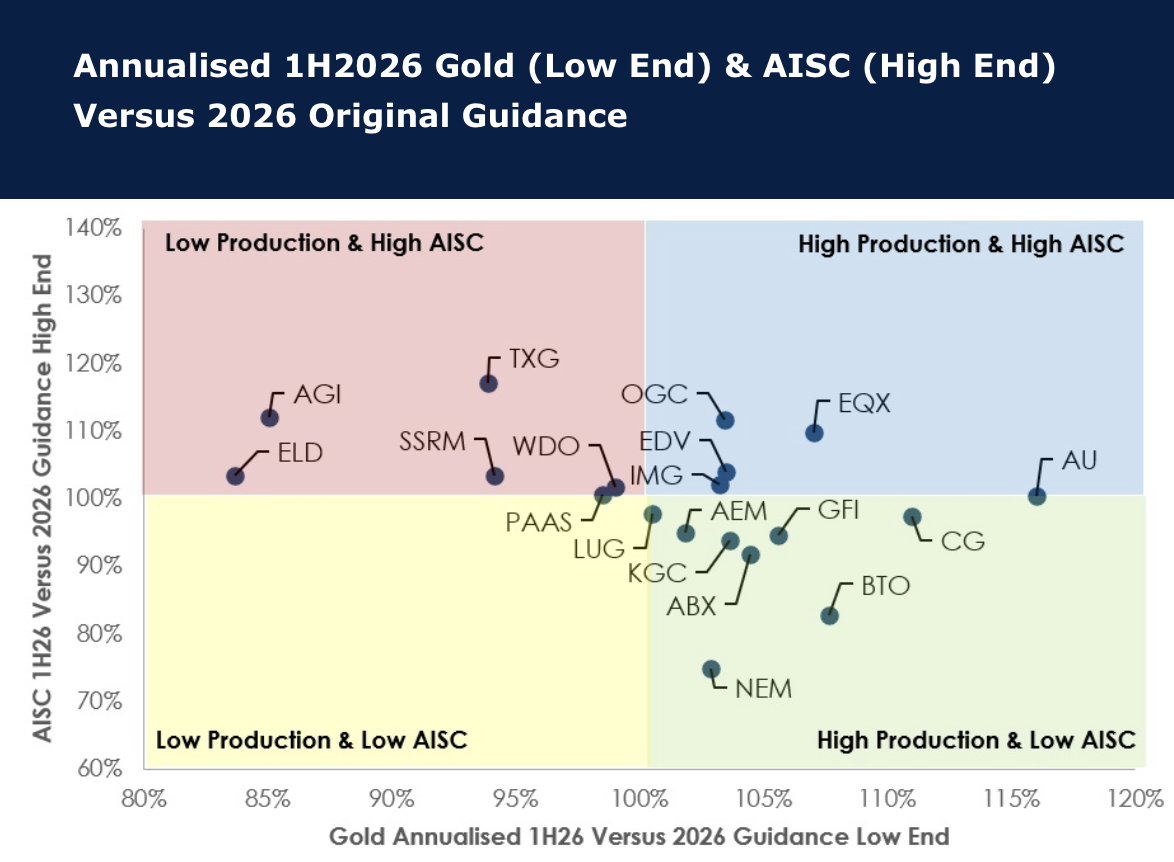
David Radlyffe’s covered gold stocks have seen healthy margins and substantial shareholder returns as a result of the average H1/2026 gold price of US$4,689/oz. Traditionally, H2 is stronger for production for gold producers. Eldorado Gold Corp, Alamos Gold Inc, Torex Gold Resources Inc, SSR Mining Inc, Pan American Silver Corp and Wesdome Gold Mines Ltd are below annualised guidance in 1H26 with Eldorado and Torex relying on project ramp-up to hit guidance. Alamos trimmed guidance. Cost pressures weigh on the gold and silver miners driven by mostly by energy and royalties. Only Newmont Corp and B2Gold Corp are tracking below AISC guidance with Barrick Mining Corp, Centerra Gold Inc, Kinross Gold Corp Lundin, Agnico Eagle Mines Ltd within guidance range. Strong gold prices help margins. GMR preferred miners are lower risk Agnico, Kinross and Fresnillo Plc, and those with higher delivery risk/growth/value potential such as Eldorado, Equinox Gold Corp and Alamos amongst the year-end December stocks.