Why Bitcoin could break the pattern
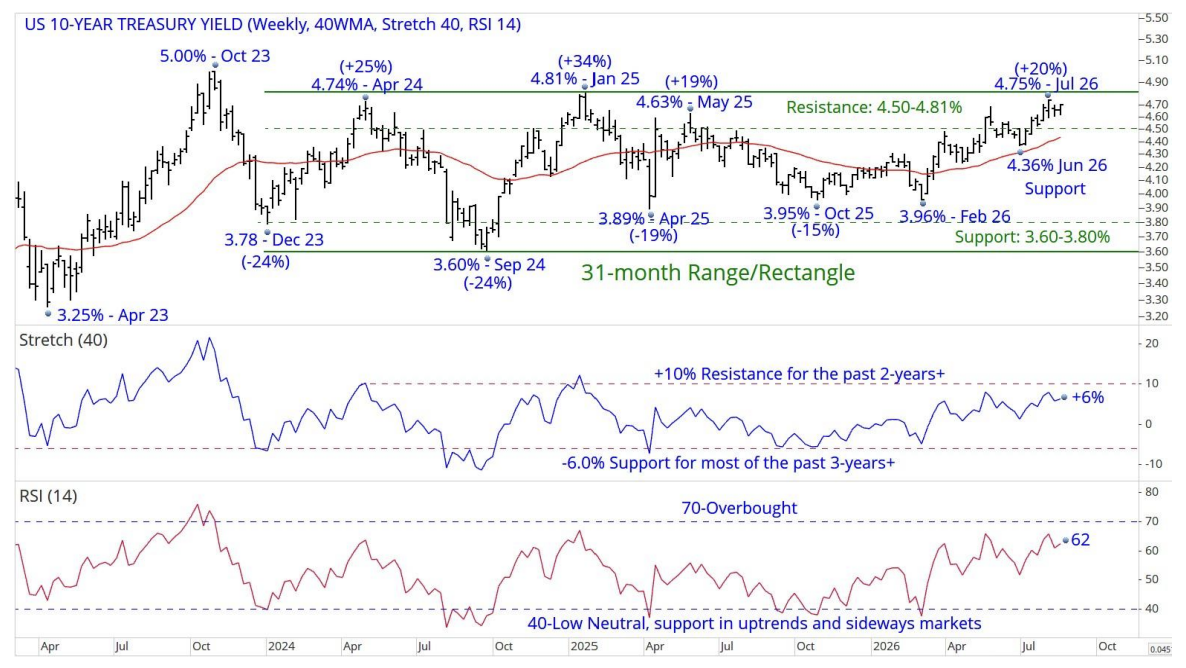
According to Markus Thielen, three narratives are colliding this month: Fed policy, midterm election odds, and seasonal crypto weakness, and most investors are treating them as separate stories. This report connects those threads into a single positioning framework, rather than reacting to each headline in isolation. Oil prices are climbing because of the Iran war, which is pushing up food prices too, and that's adding to inflation pressure. A hawkish Fed repricing changes the calculus for AI infrastructure names, Bitcoin miners, and stablecoin issuers all at once. Rising Treasury yields are quietly doing the Fed's tightening work before any actual hike lands. The stock market tends to do worse when a Republican president faces an opposition-Congress: the Senate outcome alone could swing historical S&P 500 return expectations by nearly 9 percentage points. Bitcoin usually dips in September, especially in midterm years, but tends to recover in Q4, so Markus’ approach is to stay invested but hedge for near-term weakness rather than pulling back entirely.
Hawkish Warsh speech halts the rally in gold and silver
At Jackson Hole, Fed Governor Warsh was hawkish and redeemed his inflation-fighting credibility, arresting (not reversing) the debasement narrative in place since his July press conference debacle. Fed rate hikes are back on the table because inflation is too high. In addition, trade and tariff uncertainties continue. Hostilities between the US and Iran have restarted kinetically and escalated economically. At the same time, the ongoing Russia/Ukraine war is threatening European gas supply ahead of winter, disrupting regional grain shipments, tightening fuel balances, and incentivizing NATO countries to spend recklessly on defense. The Super El Niño is just the cherry on top. Warsh’s hawkish speech at Jackson Hole halted the August gold rally at $4697. While down on the week, gold remains up almost 10% on the month. Silver and platinum have traded in a similar pattern, both lower on the week, but up 15.5% and 9.3%, respectively on the month.
Lithium: The aspirational commodity
David Radclyffe notes that after being in a down trend since May 2026, prices look to have potentially bottomed. David observes that lithium remains the aspirational commodity because everyone wants battery chemistry to continue to require lithium, volumes to grow quickly, and consumption to run ahead of supply. Although lithium carbonate retreated from May peaks of US$28/kg to US$21/kg in July on over-supply concerns, prices have moved well above the cost curve that shut in capacity across 2024-2025. David highlights that idled supply is now rushing back to market, with planned restarts at Bald Hill, Wodgina, Ngungaji, and Finniss alongside new hard rock supply. Simultaneously, Rio Tinto PLC targets 200kt/yr installed capacity by 2028, while fast growing Zijin Mining Group Co Ltd targets 120kt in 2026. David argues the market faces opposing drivers: climbing supply is colliding with robust H1/26 demand, where energy storage systems are beating expectations and EV sales see a tailwind from high oil prices.
India: Time to upgrade
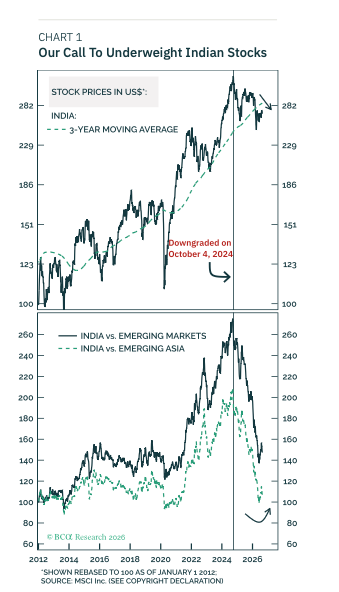
Brian Payne and Arthur Budaghyan argue that India has largely avoided the Hormuz shock, with fuel and fertiliser supplies intact and monsoon rains recovering. Consequently, they headline and core inflation to stay contained, asserting that the central bank’s next move will be a rate cut despite markets pricing in a 65-basis-point hike. Although absolute-return investors should not anticipate an outright equity rally, the analysts believe the bourse’s massive underperformance against emerging market peers is in a late stage. Dedicated EM portfolios should upgrade Indian equities to overweight and shift local bonds from neutral to overweight. In private markets, they advise leading with venture capital over private equity. Investors should now take profits on their short Indian stocks and long Chinese A-shares trade for a 44.5% gain, cut the short small-cap and long large-cap spread at a 16.8% loss, and buy unhedged 10-year domestic bonds.
Argentina: Difficulties won’t remove Milei
Javier Milei’s political standing in Argentina has weakened since his victory in the 2025 midterms, mostly because of the high real rates inflicted on the economy during the campaign. Oil, gas, agriculture, and mining are booming, but Niall Ferguson points out that other sectors are struggling. This has increased the incentives for Peronist factions to unite behind a single leadership. Yet Peronist unity is very hard to achieve. Niall thus maintains his probability of a Milei re-election in 2027 at 65%. The central bank is well aware of the monetary squeeze in 2025 and will seek to avoid future mistakes; in private they admit the endogenous rate experiment was a mistake. The alternative policy requires tolerating exchange rate depreciation. An economy muddling through at around 2% growth, with inflation continuing to decline (albeit more slowly) and twin surpluses reduces macro risk. This should be good enough for Milei to get re-elected.
Focus buys in EM
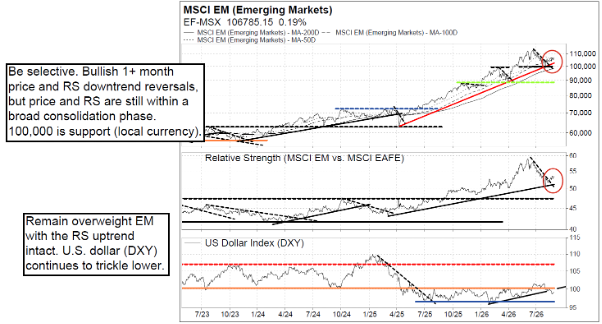
The Vermilion team remains overweight EM relative to global equities and EAFE, noting that eighteen-month relative strength uptrends held strong through the recent July pullback while both ratios reversed above one-month downtrends. They maintain an intermediate-term bullish stance whilst EEM-US trades above $59.50 support, alongside a near-term bullish outlook provided $63.00 holds. Their primary focus centres on non-AI areas that continue consolidating, including SOXX-US, DRAM-US, and CHAT-US. Across countries, Taiwan stands as their sole sovereign overweight, though European emerging markets offer attractive setups across Poland, Greece, Romania, and the Czech Republic. Within sectors, MSCI EM Technology remains their lone overweight position, yet the team actively monitors the space for a potential downgrade because price and relative strength consolidation may persist for the foreseeable future. Instead, the team emphasises buying opportunities across MSCI EM Materials, Energy, Health Care, and Financials, placing all four sectors on watch for upgrades to overweight whilst maintaining key ETF support levels at $59.50 and $63.00 on EEM-US.
Japan: Takaichi in a bind
Tobias Harris observes that US Treasury Secretary Bessent has publicly leaned on Japan to pursue macroeconomic policies to strengthen the yen, the price of the US participation in a joint foreign exchange intervention. While Bessent’s remarks are aimed at the BoJ in the immediate term, over the longer term US pressure poses a direct challenge to Prime Minister Takaichi Sanae’s fiscal program. Takaichi cannot change course without crippling her government, meaning her defense of her fiscal program could mean more friction with the US, more market anxiety, and more dissent from LDP fiscal hawks to come. Already on the defensive amidst falling approval ratings, she will therefore enter the new Diet session facing renewed questions about the sustainability of her program. Ultimately, it will be Japanese consumers and businesses, stuck between the prospect of higher import costs due to yen weakness or higher borrowing costs due to rising interest rates, who will pay the price for the government’s policies.
Singapore: Breaking an 18-year ceiling
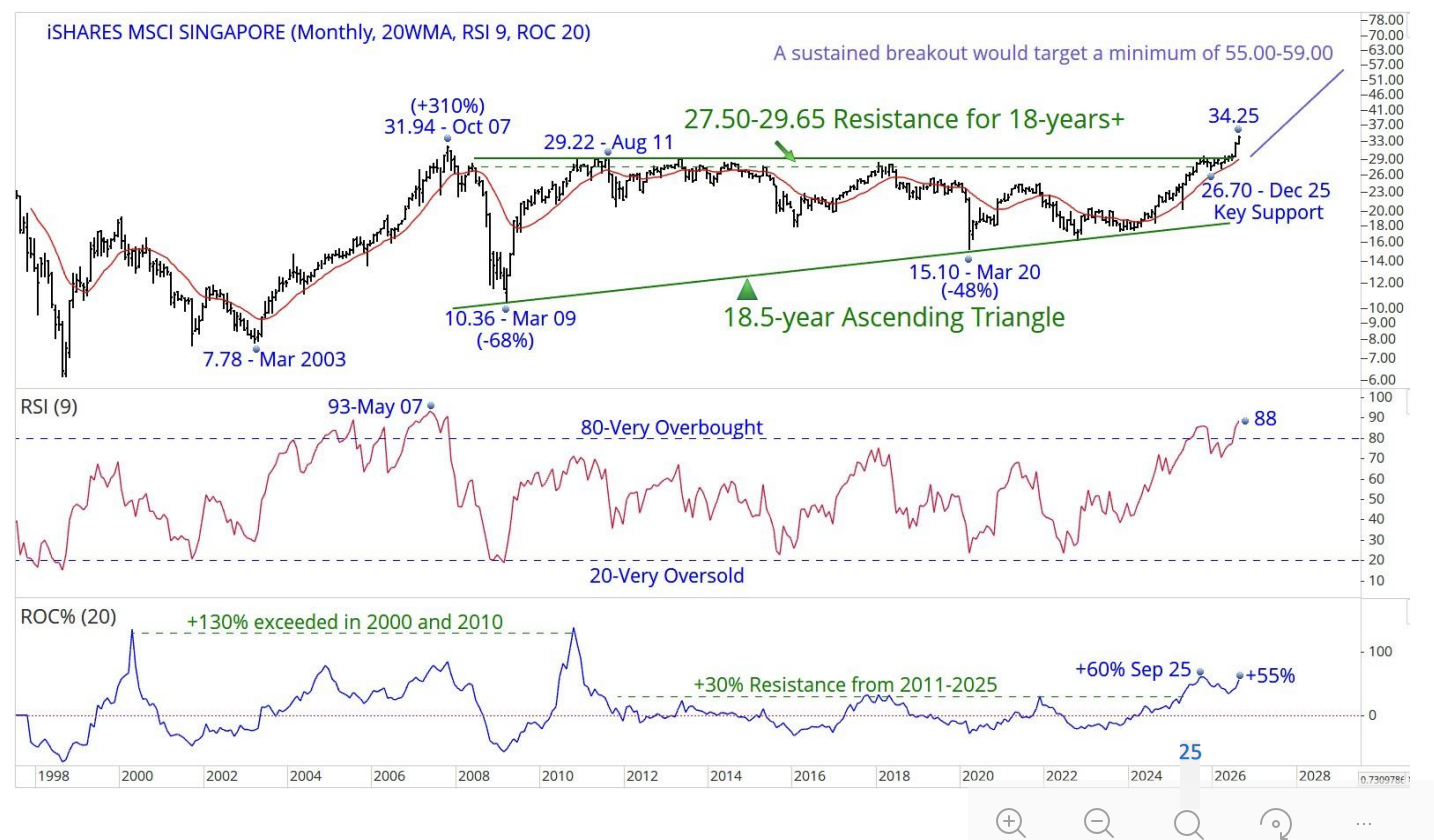
Chris Roberts believes a sustainable secular advance is now underway for the iShares MSCI Singapore ETF (EWS US, last USD33.93), following a near 19-year, classic net sideways, secular bear market. Monthly technicals show a break above an 18-year ceiling extending from USD27.50 to USD29.65. With the ETF trading more than 15% above USD29.65, they view the long-term minimum target as USD55.00-58.84. However, with the 9-month RSI at 88 approaching extremely overbought territory and the 14-week RSI at 79, near-term caution is warranted after the breakout from a 9-month rectangle exceeded its USD32.90 target. Having entered 50% long from USD30.19, Chris is taking partial profits by selling 20% at market. The stop on the remaining 30% long balance stays at a daily close below USD27.85 for now, looking to buy back into a decent setback.
Australia: Balance of risks points to RBA remaining hawkish
Australia's economy expanded 0.4% quarter-over-quarter in the second quarter of 2026, picking up from Q1's 0.3% pace. On an annual basis, GDP grew 2.1%, decelerating from 2.5% in the first quarter. The Australian Bureau of Statistics characterised the result as modest growth driven by pockets of private demand partly serviced through higher imports, and mining exports partly facilitated by inventory drawdowns. The quarter leaned heavily on car buying and a long-awaited trade turnaround. For the Reserve Bank of Australia, the headline beat and resilient discretionary spending strengthen the case for the RBA's pre-emptive tightening bias, with the cash rate at 4.35% after three hikes earlier this year, while flat investment and inventory-flattered exports argue underlying momentum is thinner than it looks. The balance of risks points to the RBA holding its hawkish posture, while continued consumption strength would firm the case for another hike.
Industrials
Two senior board members bought a combined €236,000 of stock between 20th and 31th August at an average price of €53. Their previous purchases were in March 2023 at around $27, when Smart Insider also assigned their highest (+1) ranking, making it notable that both are buying again after a three-year gap at nearly twice the price. Juan Manuel Hoyos Martinez De Irujo, Lead Director since January 2020, bought €73,000 in only his second clean purchase since joining. Vice Chairman Oscar Fanjul Martin bought €163,000, increasing his stake by an estimated 6%, with Smart Insider noting that he has a better-than-average track record. They therefore once again rank the stock +1.
SMRs: A better AI power bet than SpaceX
Utilities
After fifty years of stagnation, Kailash sees the nuclear industry as having a credible chance of revival through small modular reactors, supported by favourable policy and lower upfront capital requirements than legacy plants. While SMRs remain high risk, Kailash believes much of that risk is already reflected in valuations, unlike SpaceX, which carries similar or greater uncertainty but is priced as though commercial viability is assured. On that basis, SMRs may offer the better way to play rising AI-driven power demand. The valuation gap is stark: listed pure plays Oklo and NuScale have a combined market value of ~$9.2bn vs. ~$1.9trn for SpaceX. The key challenge for SMRs is now execution - proving Western projects can be delivered on budget and at scale.
Technology
BTN first highlighted VERX in Nov 24 and the shares have since fallen ~70% despite the company appearing well positioned to benefit from changes in tariffs and VAT regimes. The stock now trades at ~16x forward adjusted EPS, but they still see material earnings-quality concerns. While reported earnings continue to improve, there remains a sizeable gap between adjusted results and the underlying economics of the business. BTN's latest Red Flag Note highlights weak cash generation, the exclusion of recurring software costs that account for nearly half of adjusted EPS, declining contract liabilities and deferred commissions, and several smaller accounting benefits that have helped VERX sustain a pattern of beating adjusted EPS estimates by just 1 cent.
Stablecoins: Are incumbent banks already too late?
Financials
AI agents are already choosing stablecoins for machine-to-machine payments, with Circle’s USDC emerging as the dominating settlement. Automated systems buying compute and data executed 23m transfers in 30 days, up 64% in a week, with 99.3% settling through USDC. M2M commerce is selecting payment networks on speed, programmability and API compatibility rather than incumbent relationships. If that behaviour scales, deposit migration could erode the float supporting bank lending and pressure NII; Dallas Fed analysis suggests as much as $580bn of lending capacity could be at risk. With a bank-led digital dollar not expected until 2027, investors should consider which regional banks have deposit bases most exposed to float erosion.
Consumer Discretionary
The timeshare operator is struggling to attract younger new owners as demographics and holiday preferences shift. TNL’s response has been to drive growth by encouraging existing owners to upgrade to higher tiers, a strategy industry participants told OWS is unsustainable. At the same time, competition to win new customers and sell more “Experiences” could pressure margins. Credit quality is another concern: early-stage delinquencies are edging higher even among borrowers with FICO scores above 700, while loans with recent vintages have dominated write-offs. OWS sees a 2H26/2027 shortfall in new customers, revenue and EBITDA as the key catalyst, with higher loan-loss provisions a further risk to the growth story.
Communications
New Constructs remains firmly bearish despite the stock falling 35% YTD and ~80% since their original report. The core issue is that the fundamentals continue to move in the wrong direction relative to expectations embedded in the valuation. Daily active users are declining in SNAP’s key North American and European markets, while ARPU remains stagnant. At the same time, margins remain negative and cash burn substantial: SNAP has consumed $13.7bn of cumulative FCF (excluding acquisitions) since 2016, including $395m in 1H26. New Constructs argues the current valuation still assumes an implausibly large acceleration in users and monetisation and sees further downside, with their optimistic scenario valuing the shares at just $2.00 vs. $5.70 currently.
Special Sits Idea Forum
Idea diversity at MYST’s latest buyside event was striking, spanning Basic Materials, Industrials, Real Estate, Telecom, Transportation, and, of course, AI / power-related names. Stocks discussed include:
Air Canada (AC CN) - “Going private in plain sight” via buybacks + loyalty programme monetisation. TP C$60 (115% upside).
Chemours (CC) - “Misread” guidance cut masks TiO2 recovery + data centre cooling optionality. TP $30 (95% upside).
FTAI Aviation (FTAI) - Legacy lessor perception obscures MRO growth + data centre power opportunity. TP $550 (190% upside).
Genuine Parts (GPC) - Activist-led industrial distribution separation misvalued under auto parts coverage. TP $186 (35% upside).
Mosaic (MOS) - China phosphate exit + corn inflection creates structurally tighter supply setup. TP $35 (35% upside).
Greek Refineries: Higher for longer?
Energy
Greek refining fundamentals look set to remain exceptionally strong after Helleniq and Motor Oil delivered impressive Q2 results, with both benefiting from strong middle-distillate economics, higher volumes and export premia. July and August cracks have surged vs. Q2, with diesel at $85 (from $49), gasoline at $46 (from $21) and jet at $68 (from $52). With both refineries expecting H2 to be at least as good as H1, ResearchGreece raises their 2026-28 EBITDA forecasts and, given the stronger margin outlook, shifts their refining valuation methodology from multiples to DCF. Price targets rise sharply but remain below current share prices, supporting DOI (Do Not Own It) ratings amid uncertainty over where refining margins ultimately settle and are not prepared to chase a speculative trade at current levels.
The commodities secular bull market resumes
Chris Roberts believes that the broad commodity secular bull market is resuming after the iPath Bloomberg Commodity Index near 17% correction in May/June found support around the rising 40-week WMA (see chart), with the 14-week RSI bottoming at Neutral 46. DJP US broke out of a three-year base in late 2025, and this second advancing phase targets an advance to either 80.00 or 140.00. A break above the May peak of 51.73 should signal an acceleration, making 80.00 too low a target. While precious metals take a break, Chris likes Spot Copper at USD6.59 as it breaks clear of a 19-year ceiling at USD4.00-5.00 with a minimum target of USD8.00-9.00, adding to long exposure this week. Chris also sees Crude Oil setting new all-time highs above USD240.00+, and is holding a small, actively traded long in Spot Brent. He sees grains in late base development, and is holding long positions in Soybeans and Sugar while monitoring Corn and Wheat.
Nigeria: Hanging on and watching oil
Nigerian markets have performed well since March on the back of higher oil prices, with a strong NGN exchange rate yielding high carry gains, solid dollar yields and a further equity rally. Macro trends are more mixed in the first half, however. Export data have yet to show much impact from the oil price spike, the budget position has been weakening and external surpluses are fading at the margin as well. On the positive front, the authorities have kept rates high and lending policy tight, supporting the value of the currency. Jonathan Anderson is looking for signs of improvement in the coming quarters. With oil prices still above US$80/barrel he expects further support on the external and budgetary front and is maintaining his Nigerian portfolio positions for now.
China & Hong Kong: The long road back
Active EM managers are not exiting China but selectively rotating into market dislocation, explains Steven Holden. While China and HK average weight remains depressed at 20.14%, active positioning is turning as the benchmark underweight hits its narrowest level in almost a decade. Steven highlights that managers are actively buying into weakness: net estimated flows turned positive at $6.7bn over the seven months to July, led by value managers whose average overweight swung from a trough near -12% to +3.50%. Funds are actively trimming post-reopening consumer winners including Trip.com, Xiaomi, and Meituan to fund a technology self-sufficiency trade. Allocations are aggressively building across AI infrastructure and semiconductor equipment names such as NAURA Technology, Zhongji Innolight, and CATL, which absorbed $1.7bn in inflows. With China carrying roughly the same active weight as Taiwan or South Korea despite a vastly larger market, the current order of play looks temporary, not sustainable.
China’s cycle concerns v the CNY
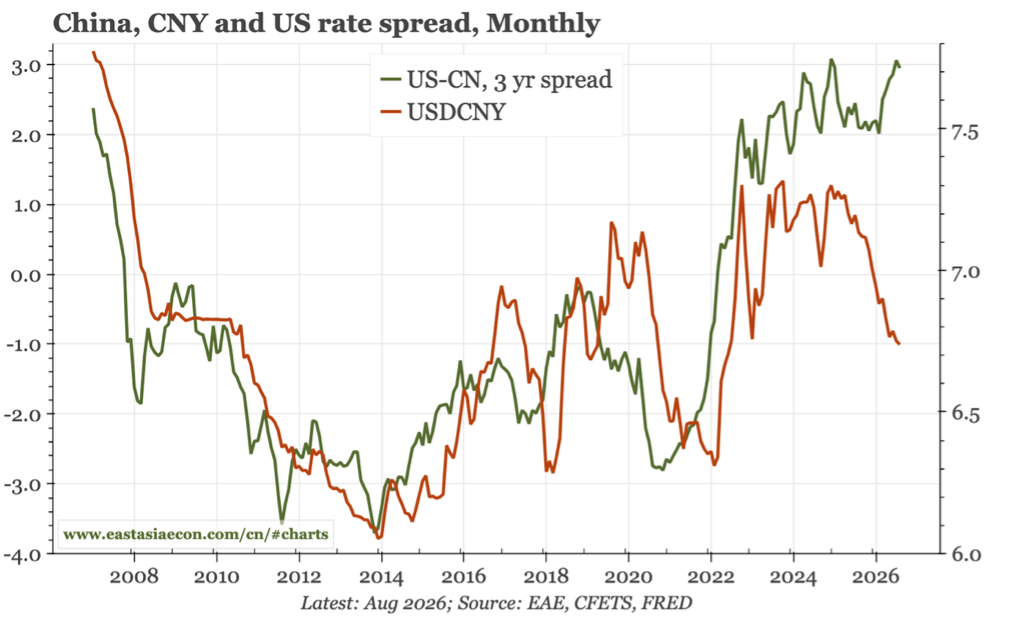
Paul Cavey warns that domestic monetary stabilisation rests on fragile foundations, as China's property market fails to find a firm floor and the decline in starts re-accelerates. With consumption weak, the risk of the PBC restarting monetary easing is rising, directly challenging market confidence in sustained CNY appreciation. Paul is sceptical of a dramatic policy pivot whilst industrial production growth near 5% keeps the annual GDP target in sight. However, as onshore yields drop, renewed easing would create serious headwinds for the currency. Beijing prefers mild appreciation and capital inflows to support monetary reflation, but cannot maintain stability if forced to loosen. While the Politburo gave no sign of fiscal relief for households or property inventories, policy shifts have become non-linear. For Paul, the market's confidence that CNY appreciation continues is entirely at odds with the worsening problems in China's cycle.
US rates: Has anything really changed?
Markets have gone too far in assuming no further Federal Reserve hikes, contends Jonathan Turek, warning that extrapolating recent softer spot data into the balance of risks is premature. The US economy remains biased towards hikes against a resilient backdrop where the unemployment rate is 4.1%, three-month average non-farm payrolls are adding 20k jobs, energy is above $80, and core PCE sits at 3.3%. Crucially, the $1T annual impulse from AI capex continues to push the cost of capital curve steeper, as bond supply from hyperscalers prevents forward rate cuts. With the FOMC seeking an excuse to hike, terminal pricing of just 35bps at the peak of the curve is far too low, underpricing the risk that the economy accelerates rather than slows in the second half. To capture both Fed terminal repricing and duration-led term premia, Jonathan is re-establishing a short in US rates and added a short in SFRH8 at 96.00.
France: On an unsustainable debt path
When economic growth falls below the real interest rate, public debt enters an unsustainable trajectory. With French growth at 0.8%, 10-year OAT yields between 3.8% and 4%, and inflation around 1.8% to 2.4%, France’s debt-to-GDP ratio sits at 115–116%. Wolfgang Münchau points out that this is wholly unsustainable unless a primary surplus is achieved. There is no surplus in sight. Sébastien Lecornu is unlikely to even reduce the deficit to 5% of GDP ahead of critical elections. Without savings measures, state expenditures are expected to surge by €60bn, driven by an €11bn increase in debt servicing and €12bn in pensions. Unsuccessful savings efforts previously brought down Michel Barnier and François Bayrou; Lecornu has already suspended pension reform. With no parliamentary majority, budget talks will trigger more concessions and tax increases. Expect another season of silly entitlement debates when courageous politicians are needed to sell a blood, sweat and tears narrative.
UK gilts: An unexploded bomb supported by carry
Andrew Hunt warns that the Gilt market resembles an unexploded bomb for investors, supported by a sizeable BoE-sponsored carry trade. The domestic case against Gilts is straightforward: large budget deficits exceeding household savings, persistent current account deficits, sticky inflation, and ongoing quantitative tightening. Domestic institutions absorb minimal supply, leaving demand dependent on foreign capital and hedge funds leveraging the massive BoE repo facility to ride the curve. Andrew expects net government debt sales already running at circa £200 billion annually (6.5% of GDP), which will likely rise further under Mr Burnham’s spending ambitions. While carry trades can sustain the unsustainable longer than common sense dictates, their unwinding causes immense capital destruction. If Burnham provides a shock, the resulting sell-off in Gilts and sterling will likely prove far worse than many expect. Gilts should be handled with extreme caution; if the fuse arms, one needs to leave the area rapidly.
Communications
MDC Financial Research's Event-Driven Legal℠ service is monitoring the State Attorneys General Social Media Addiction Trial against Meta Platforms, Inc. (Case #22-03047), where a Jury Trial commenced with Opening Statements on August 18th, 2026, in California. The litigation centres on allegations by 29 State Attorneys General that Meta's social media platforms were designed to be addictive and causes harm to adolescents (among other claims). The Trial is ongoing and is expected to continue through early October 2026. MDC attended Opening Statements and they currently plan to attend at least a portion of this ongoing Trial. Institutional investors can contact MDC for timely insights, court coverage and risk assessment on this and other event-driven equity opportunities.
Consumer Discretionary
Candle Lake’s SEK695 mandatory offer sits below EVO's market price and has no minimum acceptance threshold, so tender participation should be limited. Candle Lake already controls 31.56% of the votes, partly because EVO's substantial share buybacks have reduced the denominator. Further repurchases could increase Kenneth Dart’s ownership without requiring additional purchases. The situation also has fundamental support: EVO trades at 8.7x NTM EBITDA and 11.4x earnings despite a 66% EBITDA margin, c.30% ROIC and more than €1bn of annual FCF. European Research therefore views EVO as a fundamental long with control optionality rather than a conventional merger-arbitrage trade.
Technology
Aequitas takes a cautious view on Longsys’ planned ~$500m H-share listing. The memory-products supplier has benefited from the sharp rebound in memory pricing, with FY25 revenue up 31% and PAT margin recovering to 6.1%, while 1H26 revenue more than doubled and PAT surged. However, Aequitas questions the sustainability of this earnings strength: Longsys remains a small global player with just 1.2% market share, relies heavily on a concentrated supplier base and is effectively a price taker, with gross margin only 18% in FY25. Operating cash flow has remained negative and net debt reached ~$1.2bn, although the IPO could nearly halve this. Aequitas also notes that margins may come under renewed pressure as lower-cost inventory is exhausted and replacement wafers are purchased at higher prices.
Banks: China too cheap to ignore, avoid India
Financials
David Scott sees global banks as still offering substantial value, with China the standout deep-value opportunity. Chinese banks trade at distressed-looking valuations despite resilient loan growth, profitability and well-covered dividends; David argues they are “too cheap to ignore”, with buybacks also looking increasingly likely given the large discounts to book value. China Merchants Bank is his preferred name given superior fundamentals and a valuation now around peer levels. By contrast, he expects Indian banks such as HDFC and Kotak to continue underperforming as intense competition for deposits, staff and lending compresses margins and efficiency. He remains positive on Banorte (a cheap play on Mexico’s growth) and Lion Finance (which is up another 155% since he last recommended it), while highlighting Commercial International Bank as a new Egyptian idea.
Consumer Discretionary
HTHT’s Q2 beat-and-raise showed earnings can compound without waiting for a broad China lodging recovery. Domestic RevPAR remains soft, but network expansion, faster fee-based growth, an increasingly asset-light mix and tight cost control drove ~3ppts of Y/Y margin expansion, prompting 86Research to increase their FY27 revenue and EBITDA estimates. HWC’s expansion remains firmly on track, supported by healthy signings and an improving pipeline, while newer formats such as Hanting 4.0 are delivering stronger economics. Internationally, Europe remained resilient and HWI EBITDA rebounded sharply despite Middle East disruption and Asia mix pressure. 86Research sees margin expansion as structural, with earnings quality improving faster than RevPAR normalises. At ~8x FY27E EV/EBITDA, they see further rerating potential. TP $65/ADS (40% upside).
Materials
GMR sees HBM as one of the strongest ways to play US copper growth, with Arizona emerging as the core of its long-term optionality. Copper World is approaching a sanction decision in late 2026, while the recently acquired Cactus project adds a second large-scale development opportunity and potential synergies. GMR estimates HBM could account for 30-35% of new US copper production by 2035, while projects across its broader portfolio are expected to increase total copper production by ~140kt over the period. The balance sheet has strengthened, 2027 production guidance implies ~30% Y/Y growth at the midpoint, and HBM trades at ~0.9x spot P/NPV10, a discount to Canadian peers. In a market short of copper equities, HBM offers growth optionality at a reasonable price and GMR would be surprised if peers have not noticed.
Industrials
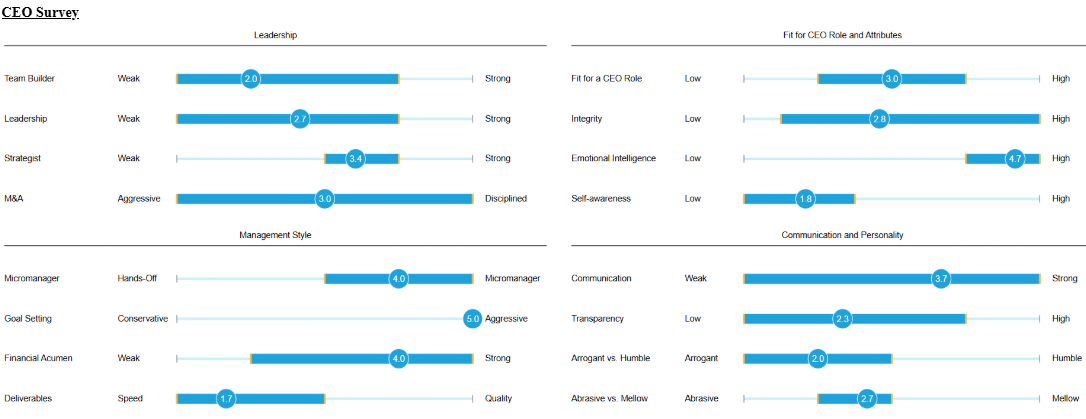
Paragon interviewed six former senior executives at BE who worked with Sridhar for 50+ years combined. Sources provided negative feedback, with his founder-driven intensity also seen as his central weakness. He sets frequently unrealistic goals, can micromanage and override functional experts, struggles with talent selection and delegation, and has produced significant executive turnover, with multiple sources describing weak accountability, inconsistent strategic discipline, limited self-awareness, and serious concerns around transparency and integrity. The group’s success reflects Sridhar’s technological conviction, fundraising ability and persistence, but his dependence on a small group of capable executives and directors to provide operating discipline leaves the organisation vulnerable to overcommitment, leadership churn and execution problems when his ambition runs ahead of the company’s capabilities.
Everyday essentials, extraordinary pressure
Consumer Staples
Scott Mushkin argues the squeeze on food-at-home is intensifying, with GLP-1 adoption reducing industry volumes just as Amazon and Walmart accelerate their push into everyday consumables. AMZN's essentials business already exceeds $150bn, and he estimates FY26 unit growth of ~25% and revenue growth of ~20%; alongside WMT and Costco gains, this could leave the rest of the market shrinking ~2%. Aggressive pricing and faster delivery should also pressure competitors’ margins, reinforcing Scott’s Sell ratings on Kroger and Dollar General. Pepsico, Campbell's and Constellation (all not covered) are where he is most concerned, but he views the industry as generally uninvestable. Conversely, AMZN’s consumables momentum increases his confidence in his long-term North America retail forecasts and wider industry consolidation over the next couple of years.
Consumer Discretionary
Hollister enters back-to-school with strong momentum, heavy social-media visibility and several fast-selling categories. Abercrombie has been weaker, with stale assortments weighing on the brand, but The Retail Tracker sees signs of improvement following merchandise changes and new design leadership; YPB looks very good as well. One notable watchpoint is Hollister inventory: stores were unusually empty in July, prompting questions over potential delivery issues, although The Retail Tracker says this may simply reflect summer product selling through faster than expected. Tougher second-half comparisons remain a headwind, particularly for Hollister, but the combination of sustained momentum there and improving product at Abercrombie leaves ANF well positioned for the remainder of the year.
Communications
The market is focusing too heavily on GOOGL’s ~$200bn capex bill and not enough on the long-term value of the infrastructure being built, according to Will Nutting. Google Cloud is already running at close to $100bn of annualised revenue, growing 82%, with a 35.6% operating margin and $514bn of contracted backlog. His analysis suggests Cloud could become a $600-700bn business by 2030 and $1.2-1.7trn business by 2035, supporting $400-700bn of operating profit, while the company as a whole could generate $600-900bn of annual earnings. Once the current construction phase slows, depreciation and maintenance capex should look very different from today’s growth capex, allowing it to throw off hundreds of billions in annual FCF. Will sees GOOGL evolving from a search company into a vertically integrated “intelligence utility”, with AI infrastructure ownership potentially becoming the next major investment trade.
TMT Idea Forum
While AI was a dominant theme at MYST’s latest buyside event, several participants deliberately avoided it, migrating towards media-related names, out-of-favour international companies and recent IPOs. The most interesting ideas included:
Disney (DIS) - stale narrative masks broad fundamental improvements + IP moat. TP $150 (40% upside).
Flex (FLEX) - CPI spin-off to unlock hidden hyperscaler growth. TP $250 (125% upside).
Motorola Solutions (MSI) - sleepy Street models ignoring transformational counter-drone acquisitions. TP $700 (45% upside).
SharonAI (SHAZ) - sweetheart Nvidia deal fuels unrecognised EBITDA upside + ASX listing catalyst. TP $200 (245% upside).
Spotify - significant margin upside from restructured label deals, new product features + ads. TP $1,206 (125% upside).
Europe’s rally is just getting started
European companies have shattered already-high expectations this earnings season, with the STOXX 600 on track to grow earnings over 22% (+11% excluding energy), the fastest pace since 2Q22. Sales growth has accelerated to 10% Y/Y, while guidance upgrades are outpacing downgrades by the widest margin since at least early 2024. Management commentary has also become more confident, with companies raising capex and defending margins alongside healthy demand. This challenges the view that Europe remains a structurally inferior market, noting that the STOXX 600 has significantly outperformed the S&P 500 since 2025 and that Europe’s largest sectors have limited exposure to low-cost Chinese imports. Autos remain the weak spot, but AIR sees scope for deep-value laggards to benefit if investors start to price Europe as an AI beneficiary rather than an AI developer. Their preferred H2 investment ideas are available on request.
China turns Japanese
Gerard Minack sees China as sharing all the hallmarks of Japan’s lost decades, marked by slowing growth, low inflation, falling rates, rising leverage, and poor equity returns. The key macro problem is a surfeit of saving relative to investment, occurring at a high investment share of GDP that creates excess capacity. GDP growth is increasingly reliant on external demand. High household saving, driven by demographics, the absence of a solid social safety net, and rising inequality, matches debt-funded investment. High investment spending has led to diminishing returns on capital and damped inflation, pushing listed sector return on assets below EM and DM peers. Aggregate profits have risen, but EPS growth badly lags earnings growth. China is delivering lost-decade-Japan-like investment returns: debt does well while equities stagnate. Relative to the rest of the world, Chinese Treasuries have been world-beaters while equities have been terrible. There’s no obvious reason for this to change any time soon without a change in the macro model.
Chinese-led AI deflation
Graham Turner argues that Chinese technology companies are leading the next cycle of deflation, implying interest rates will ultimately need to come down rather than rise. Energy prices spiked following Straits of Hormuz skirmishes, pushing the yield curve higher alongside strong US July services surveys. Markets remain anxious that higher energy costs and resilient data provide the Federal Reserve cover for a rate hike at the upcoming July FOMC meeting. However, Graham believes policymakers are missing the broader disinflationary impact of AI, highlighted by weak unit labour cost growth. US firms are increasingly turning to cheaper Chinese open-source AI models, some priced at one-twentieth of Western alternatives, to drive substantial cost savings. While the AI boom is causing short-term semiconductor bottlenecks, Graham contends that Chinese-induced AI deflation will force rate cuts, though a risk remains that the FOMC gets deflected by near-term energy shocks.
Japan: Buying time
Tobias Harris outlines how joint US-Japan foreign exchange intervention on July 31st provided temporary relief for Prime Minister Takaichi Sanae, but failed to address fundamental Japanese fiscal strain. The bilateral action, involving Japanese sales of up to JPY 11tn in dollar holdings alongside US euro sales to buy yen, aimed to curb disorderly currency movements and mitigate spillovers into US bond markets. However, Tobias emphasises that this devil's bargain cannot substitute for structural reform. With Japanese government bond yields hitting multi-decade highs amidst ambitious state-financed industrial policies and proposed consumption tax cuts, foreign pressure is mounting. US Treasury Secretary Scott Bessent is pushing Tokyo towards Bank of Japan rate hikes, portfolio adjustments by pension funds, or fiscal retrenchment. Tobias expects the ultimate bill to arrive via higher domestic interest rates, a forced fiscal u-turn, or faster rate normalisation at upcoming policy meetings.
Australia: Breaking out down under
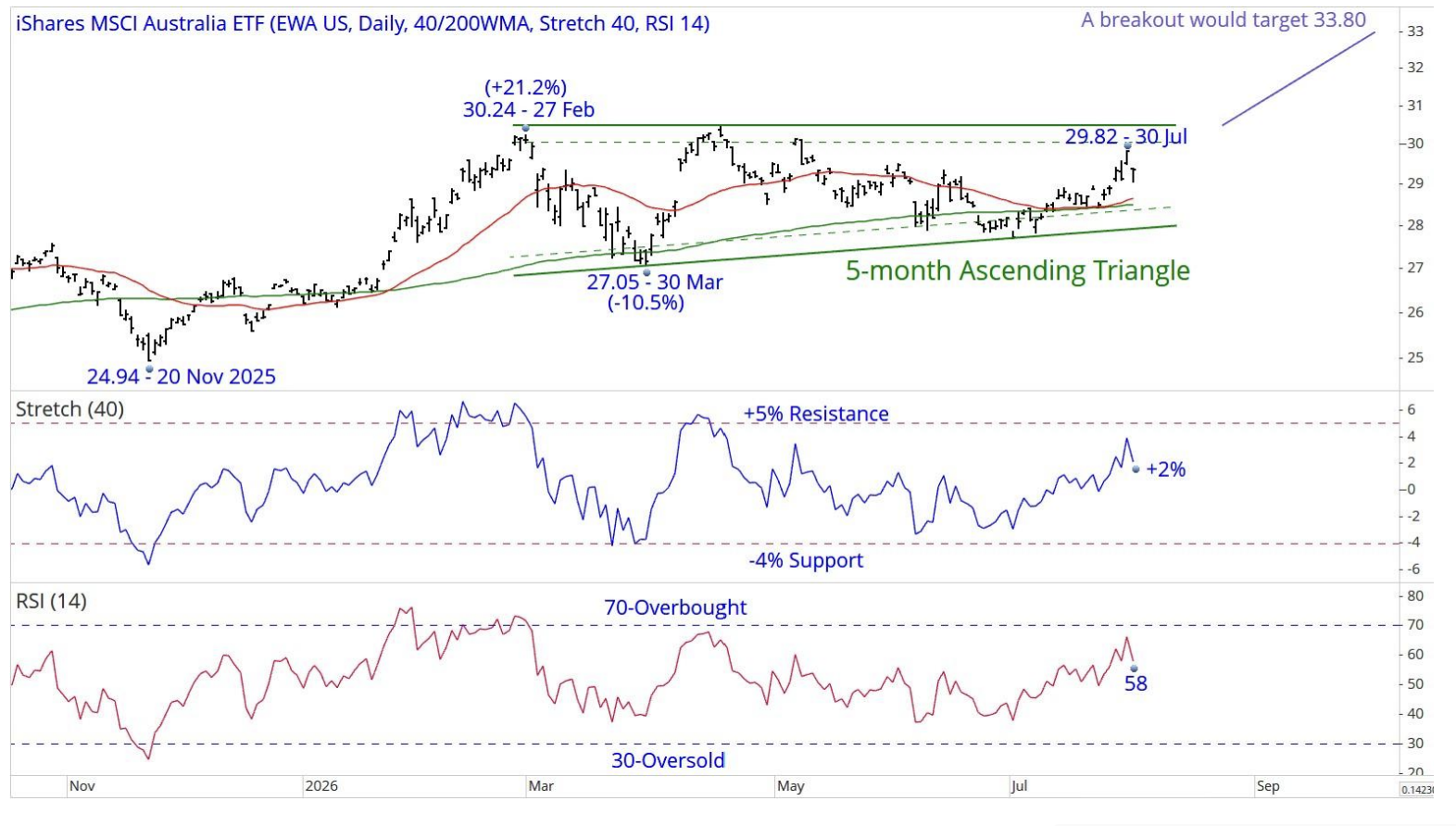
The iShares MSCI Australia ETF (EWA US, USD29.34) broke out from a 55-month Range/Rectangle in Jan this year. The Iran bombings saw a more than 10% sell-off, but Chris Roberts comments that the decline ended in the old resistance zone at USD25.50-27.43, and the ETF recovered to set new uptrend highs. The ETF has formed a potential 5-month ascending triangle, a breakout from which would target USD33.80 but more importantly it would confirm the breakout from the 55-month Rectangle which targets USD39.00+. Chris will look to go 75% long on a weekly close above USD31.00. The stop will be a daily close below USD27.40.
US: Kevin Warsh, lonesome dove
Brian McCarthy argues that Chairman Kevin Warsh is not leading a hawkish charge, but fighting a rearguard action against an FOMC committee ganging up to force a rate hike. While voting members express growing concern over the AI capex boom overheating demand, Brian points out that Warsh openly disputes these characterisations, refusing to view the AI supply shock as inherently inflationary. Warsh tells us he views this as a good family fight, arguing that high prices stem from productive corporate investment rather than share buybacks. Brian expects benign inflation readings and the Chairman's reluctance to forestall a July move, though markets will likely interpret the meeting as a hawkish hold. Furthermore, Brian argues that expectations for a September rate hike will linger unless hyperscaler earnings at month-end reveal a clear slowdown in AI capex growth - any hint of a slowdown would be bullish for rates.
The Fed can create volatility, but should it?
Paul Krake contends that Kevin Warsh is right to elevate the bond market's role in monetary policy, yet warns that removing forward guidance restores suppressed volatility. Paul believes interest rates carry less economic impact than Kevin thinks: fixed-rate mortgages shield homeowners, cash-rich hyperscalers borrow regardless of coupon costs, and supply-side inflation sits beyond the funds rate. Facing the press conference problem, Paul outlines three choices for Chairman Warsh: continue holding press conferences while markets mine every answer, restrict them to policy change meetings, or eliminate them entirely in favour of written statements. With US inflation above target for five years, 30-year yields at 2007 highs, and record debt issuance, an American Liz Truss moment cannot be ruled out. When volatility inevitably produces a casualty, Warsh will face a choice: let markets impose discipline or intervene. The Fed can create volatility, but can it tolerate the consequences?
Europe: Flat growth despite data beating expectations
BCA’s European growth diffusion index, covering 123 components, points to flat growth ahead. The issues stem from energy volatility and supply chain uncertainty weighing on the outlook, with natural gas prices also posing a near-term risk. The European economy is also more sensitive to credit growth given banks’ enhanced role, and both lending standards and credit demand point to a gradual slowdown to stagnation ahead. Sluggish credit dynamics reinforce the need for Germany to deploy its fiscal capabilities to support growth. So far, Europe has borne the costs but not yet received the benefits of looser fiscal spending. Financial conditions are easier than at the peak of Iran tensions, but they have recently stopped easing; European data surprises will revert over the coming weeks. In the near term, this leaves European assets vulnerable relative to their US counterparts. European weakness also creates a tactical opportunity to go long EUR versus USD rates.
Healthcare
AlphaValue argues Q2 results put to rest the execution risk that emerged after the Q1 miss, while the new German reimbursement framework reduces uncertainty around Helios. The key message is not simply the earnings beat, but the quality of the step-up. Kabi’s higher-growth businesses are now translating into structurally higher profitability, with Growth Vectors helping the division enter its 17-19% margin corridor as Biopharma scales and the biosimilar pipeline broadens. This reinforces AlphaValue’s confidence in the 2030 ambition to double Biopharma sales at c.20% margin. At Helios, German volumes have stabilised and the reimbursement framework supports the margin trajectory from 2027. With Kabi margins improving, Helios visibility strengthened and deleveraging improving financial flexibility, AlphaValue maintains their Buy recommendation. TP €62.7 (30% upside).
Technology
JNK argues ADI’s acquisition of Empower and the broader move towards in-package voltage regulators are important, but unlikely to displace board-level power delivery for some time. The issue is scale: today’s rack-class AI accelerators draw so much power that multiple in-package regulators would need to be combined to support a single high-power socket. That keeps the practical solution at the board level for now, where VICR’s vertical power delivery approach remains well positioned through the current design cycle. The risk is that in-package power delivery becomes viable for high-power AI accelerators faster than expected, pulling share from board-level suppliers sooner. JNK sees that risk as limited for now, with customer activity still at the collaboration and development stage rather than committed accelerator sockets, and Broadcom indicating in-package alternatives remain more than a year or two away.
Industrials
While bulls appear to be extrapolating POWL's recent record financial performance far into the future, OWS’s analysis suggests the group has been overearning. They see growing evidence that margins have peaked (their primary short thesis), even if orders remain robust. Near term capacity constraints mean revenue growth is likely to remain mired in the mid-to-high single digits in the quarters ahead. With gross margins expected to be flat (and possibly down as new incremental capacity additions ramp) and R&D trending higher, EPS growth should be underwhelming (mid-to-high single digits) in FY26 and FY27, especially relative to other large electrical equipment peers. At 40X consensus FY26 EPS, POWL remains highly vulnerable to multiple compression. TP $55 (75% downside).
Materials
Frank Mitsch remains constructive on LYB, framing it as one of the clearest economic beneficiaries of the Middle East conflict. The stock is only 6% above where it traded when the Iran war began, despite 2026 and 2027 consensus EBITDA estimates rising 84% and 32%, respectively. Frank shares CEO Peter Vanacker’s view that the Iranian conflict is likely to roil petrochemical markets for “quarters not months”, even if normalisation is unlikely to be linear. For Q3, he expects EBITDA to almost double Y/Y led by the O&Ps. Valuation also looks undemanding at c.5.4x his new 2026 EBITDA estimate with a 4.5% dividend yield. Leverage has dropped sharply to 2.6x and the Cash Improvement Plan continues to progress, with a surprising announcement that it will be making a 30% reduction in its entire management structure.
Consumer Discretionary
Iii’s latest Beyond the Street report flags a more cautious read-through from M&M EV dealership checks. The XUV400, XEV 9e and BE 6 all carry discounts of ₹1-3 lakh, with ready delivery available on every model. The XEV 9e, listed at ₹34.49 lakh, is available at ₹31.75 lakh, a 7.94% discount, while state incentives take the effective discount to c.15% before negotiation. This more than reverses management’s 2.7% mid-July price hike. Ready availability is also notable given commentary around lost July production days, a supplier fire and plans to double monthly EV output by end-FY27. Iii concludes immediate delivery and heavy discounting point to demand, not supply, as the binding constraint for M&M’s EV portfolio, raising margin risk if discounting persists as capacity scales.
Utilities
BEP’s Q2 results superficially support management’s message that cash flow can compound at 10%+, but the composition of growth is a concern. Gains on asset sales now represent c.66% of trailing 12-month FFO, the highest reliance Veritas has observed. Excluding those gains, underlying performance continues to deteriorate, with lower margins, weak generation and declining asset-level cash flow. Management describes asset-sale gains as recurring, but Veritas disagrees, arguing they depend on transaction volumes, buyer appetite, interest rates and market liquidity. They are lower quality than the contracted, inflation-indexed cash flows investors were told would drive growth. More concerning, capital recycling has recently extended into hydro assets at meaningful scale, despite BEP historically presenting hydro as a core competitive advantage. Veritas maintains a Sell rating and intrinsic value estimate of US$20.00 (40% downside).
Technology
The Chair, a Divisional President and the Chief Technology Officer buy a combined €1.4m of shares at c.€8.45. Smart Insider has had a positive rank on the stock since 30th Jan 26, initially triggered by buying from Chair Timo Ihamuotila at €5.37 per share. He subsequently added again in Apr at €9.10 and has now bought once more after the shares retreated from a recent high of €15. The latest cluster is also notable because Pallavi Mahajan, Chief Technology Officer, and Patrik Hammaren, Divisional President, are making their first purchases, despite neither being new to the company. Smart Insider renews its +1 rank (highest rating).