Industrials
Two senior board members bought a combined €236,000 of stock between 20th and 31th August at an average price of €53. Their previous purchases were in March 2023 at around $27, when Smart Insider also assigned their highest (+1) ranking, making it notable that both are buying again after a three-year gap at nearly twice the price. Juan Manuel Hoyos Martinez De Irujo, Lead Director since January 2020, bought €73,000 in only his second clean purchase since joining. Vice Chairman Oscar Fanjul Martin bought €163,000, increasing his stake by an estimated 6%, with Smart Insider noting that he has a better-than-average track record. They therefore once again rank the stock +1.
SMRs: A better AI power bet than SpaceX
Utilities
After fifty years of stagnation, Kailash sees the nuclear industry as having a credible chance of revival through small modular reactors, supported by favourable policy and lower upfront capital requirements than legacy plants. While SMRs remain high risk, Kailash believes much of that risk is already reflected in valuations, unlike SpaceX, which carries similar or greater uncertainty but is priced as though commercial viability is assured. On that basis, SMRs may offer the better way to play rising AI-driven power demand. The valuation gap is stark: listed pure plays Oklo and NuScale have a combined market value of ~$9.2bn vs. ~$1.9trn for SpaceX. The key challenge for SMRs is now execution - proving Western projects can be delivered on budget and at scale.
Technology
BTN first highlighted VERX in Nov 24 and the shares have since fallen ~70% despite the company appearing well positioned to benefit from changes in tariffs and VAT regimes. The stock now trades at ~16x forward adjusted EPS, but they still see material earnings-quality concerns. While reported earnings continue to improve, there remains a sizeable gap between adjusted results and the underlying economics of the business. BTN's latest Red Flag Note highlights weak cash generation, the exclusion of recurring software costs that account for nearly half of adjusted EPS, declining contract liabilities and deferred commissions, and several smaller accounting benefits that have helped VERX sustain a pattern of beating adjusted EPS estimates by just 1 cent.
Technology
The post-results sell-off reflects an expectations miss vs. Seagate’s exceptional print rather than any deterioration in fundamentals. WDC’s June-quarter exabyte shortfall was modest and largely tied to the move towards 40TB ePMR, while STX is benefiting from a richer HAMR mix and higher guided margins. Rosenblatt accepts the margin gap could widen before it narrows but still sees WDC exiting FY28 near 64% gross margin. Importantly, Nearline price/TB growth accelerated to 17% Y/Y and management effectively endorsed sustained high-teens pricing growth through FY27. Product transitions across 40TB ePMR, ultraSMR and 44TB HAMR remain the key catalyst, expected to reaccelerate exabyte growth towards the high-20% range in 2H27. TP $800, while Rosenblatt sees $375-400 as a “back-up-the-truck” level.
Data centres: After the gas rush
The Sustainable Market Strategies team highlights how solar, wind, and BESS hybrids already beat gas on cost at 95% reliability, signalling an aggressive shift in data centre power procurement. Natural gas remains the leading power source for US data centres because turbines meet 99.9% uptime requirements and handle rapid AI load swings, but this advantage looks temporary as utility-scale storage costs continue falling. By 2032–2035, emerging long-duration batteries using iron-air and flow systems could close much of this reliability gap. This structural transition exposes a significant market dislocation among overextended turbine manufacturers. While pure-play BESS names have mostly underperformed over the past year, gas turbine makers have sharply outperformed despite losing momentum, creating a distinct short opportunity for companies such as GE Vernova Inc. Conversely, forward-looking investors should enter a position via a market-cap-weighted basket of underperformed BESS providers and secure exposure to high-growth integrators like Clean Max Enviro Energy Solutions Pvt Ltd.
South Africa: Joburg on the brink
Peter Montalto believes that the Treasury's forthcoming decision on equitable share transfer cutoff to Johannesburg won't create a financial crisis; it will accelerate one already under way. What hangs in the balance is whether Treasury withholds Johannesburg’s July equitable share transfer of just under R3bn under Section 216(2) of the Constitution. Minister Enoch Godongwana's follow-up letter demanded detail on the Eskom and Rand Water debts, but regardless of the tranche decision, the city is in serious trouble. The city is holding about five days of cash against Treasury's 30-day minimum benchmark, facing an unfunded budget gap of about R2.1bn. Before the November election, an Eskom cut-off decision, the Rand Water shutdown, and growing City Power business-rescue talk all land on the same thin liquidity. For banks and creditors exposed to the city or its entities, covenant and facility reviews should assume slower payment.
Materials
The market is fundamentally mispricing tier-1 lithium producers by anchoring valuations to depressed spot prices. OMNISIGHT’s latest Master Dossier on ALB exposes a massive structural gap between Chinese spot indexes and actual realised contract pricing. While consensus models assume an $8/kg plateau, ALB’s opaque index-lagged contracts and price floors generated significant FCF, allowing the company to pay down $1.3bn in corporate debt in a single quarter. Furthermore, ALB is demonstrating aggressive capital discipline by intentionally idling capacity, such as the Kemerton Train 1 facility in Australia. This deliberate restriction of Western conversion supply engineers artificial scarcity, ensuring margin protection that algorithmic trading models are currently failing to discount.
Industrials
Iron Blue initiates coverage on ANDR with a score of 30/60, which is top decile and fertile grounds for shorting. Accounting red flags include significant reliance on percentage of completion revenue recognition, FY25’s ten-year high stripped out restructuring expense, unquantified stripped out acquired technology amortisation, and expanded gap between PPE/RoU capex and the depreciation charge. Iron Blue’s €0.2bn net cash calculation was €0.5bn below ANDR’s headline measure. Governance red flags include a non-independent Chair, Board and Committees as well as KPMG’s tenure now exceeding the ten-year best practise and a surprisingly low audit fee.
Utilities
Iron Blue initiates coverage with a score of 31/60, which is top decile and fertile grounds for shorting. Key factors include the company’s Asset Rotation Plan and other Construction percentage-of-completion and off balance sheet SPV accounting, expansion of balance sheet contract assets, gap between PPE capex and the depreciation charge, aged debtor book, elevated gross cash position, and associates related party transactions. Governance red flags include the non-independent chair, internal appointees to CEO/CFO roles, unusual incentive arrangements and elevated non-audit fees. They also note the 2027 regulatory risk to MTLN’s important Gazprom relationship.
Industrials
The stock was pitched as a long idea at MYST’s latest Industrials Idea Forum, with prior events generating +11.4%, +10.4% and +9.5% average alpha. The presenter argued ENR’s recent underperformance vs. GE Vernova reflects macro-related fears among European investors, not fundamentals, leaving a valuation gap set to close. Multiple catalysts were highlighted, including “super cycles” in Gas Services and Grid Technologies and a profitability inflection in Siemens Gamesa expected in 3Q26. Street estimates are too low, with additional upside from potential changes to the Siemens AG trademark licensing fee and an end to the war in Ukraine. With strong backlog visibility and a clean balance sheet, the presenter has a TP of €225, offering 35% upside.
Guidance warning season
Despite rising geopolitical risk, European corporate guidance has yet to reflect the potential economic impact. In AIR’s recent management meetings, discussion focused almost entirely on AI, with little attention paid to the Iran conflict despite surging energy prices and supply-chain stress that historically drive earnings revisions. The combination of unpriced macro risk and AI-driven sectoral disruption creates a credible basis for expecting a meaningful wave of 2026 earnings guidance revisions across European equities in the coming weeks. And the performance gap between the companies on the right side of these structural shifts and those on the wrong side will broaden. Stock winners include AI infrastructure beneficiaries such as Arm, Elmos, Aixtron and STM, alongside defence exposure at Exosens and Indra Sistemas. Euronext and Auto1 are also seen as largely insulated. Under pressure are Stroeer, Freenet and SES. In IT services, the sector is splitting between “The Conquerors” (Accenture, Cognizant, Reply) and “The Endangered” (Capgemini, Atos, Sage, Dassault Systemes, SAP).
Industrials
With a market cap of $3.6bn, Nichias is an industrial insulation company that Asymmetric has followed for over 20 years. While the shares have outperformed the TOPIX over the long term, the performance gap has widened materially in recent periods, a trend Asymmetric believes can continue, highlighting the group’s: 1) cash-rich balance sheet and strong FCF, supporting rising shareholder returns; 2) ability to raise margins across its business segments; 3) exposure to maintenance work related to nuclear restarts in Japan; and 4) earnings gearing to the slower than initially expected SPE cyclical pick up.
Accounting red flags emerge across multiple names
SMCI moves to Forensic Alpha's maximum ‘10’ risk rating after its 10Q revealed extreme working-capital swings: receivables surged from $2.5bn to $11bn in one quarter, heavily concentrated in a single customer, while payables ballooned to $13.8bn, masking weak cash conversion. Bloom Energy also remains a top concern, with a widening gap between adjusted and statutory earnings, rising contract assets and growing reliance on off-balance-sheet JVs. NiSource’s score rose on higher DSO and advances to unconsolidated VIEs, while Cummins saw a jump in sales to equity investees to $1.70bn, with receivables outstanding from these investees of $523m, suggesting extended credit terms. Other stocks flagged last week include Amentum, Atlassian, Becton Dickinson, Ford and Impinj.
Materials
Forensic Alpha raises their risk score sharply after Dow’s 10-K highlights balance-sheet concerns tied to the Sadara JV with Aramco. Their report highlights a $901m negative investment balance linked to sustained losses at Sadara, reflecting Dow’s exposure through guarantees on ~$1.3bn of debt and a $500m revolving credit facility. Despite these losses, Dow’s net debt has risen only modestly and no new loans to Sadara have been disclosed. Forensic Alpha suggests the company has instead supported Sadara via favourable working capital movements, helping explain weak OCF over the past two years. Notably, 10-K language now indicates performance under guarantees is “no longer remote” ahead of Sadara’s 2026 refinancing. With negative FCF, restructuring costs and rising minority cash leakage, investors should question dividend sustainability and the growing gap between EBITDA and true cash flow.
The Hidden Tailwind: Extending useful lives in AI infrastructure
Technology
Depreciation assumptions have become a meaningful, underappreciated driver of reported earnings as AI infrastructure capex accelerates. As spending shifts from CPUs towards high-cost GPUs and accelerators, the useful lives assigned to these assets directly influence margins, earnings growth and return metrics. Veritas’ analysis estimates that across Meta, Alphabet, Amazon and Microsoft, extensions to asset lives since 2020 boost 2025E net income by ~13% on average. They also assess what this widening gap between accounting lives and economic lives implies for earnings quality, sector capital intensity, financing structures and asset duration risk across the AI infrastructure ecosystem as accelerator upgrade cycles compress.
TikTok’s LatAm move has global reverberations
Report by
Blue Lotus Research Institute
Blue Lotus argues that TikTok Shop (TTS)’s entry into Latin America is the largest e-commerce opportunity in developing countries for 2026. Video and live commerce penetration in LatAm remains <5% of GMV vs. 20-25% in SE Asia, despite larger GMV and strong TikTok engagement - creating a wide opening for disruption. TTS’s traffic advantage is expected to pressure incumbent margins, particularly MercadoLibre and Sea, while driving logistics upgrades. J&T Express emerges as a key beneficiary, with LatAm filling a growth gap as China and SE Asia slow. Blue Lotus also sees strategic upside for Kuaishou, partnership optionality for Grab and longer-term opportunities for Alibaba to reposition internationally.
US monetary policy: QE by another name?
Andrew Hunt says the FRB has U-turned on QT and that other central banks will surely follow as their governments’ fiscal / debt issuance arithmetic bites in a world in which the PBoC now seems less inclined to fund “everyone else’s” deficits. As expected, the Fed has gone down the path of YCC. This is QE-by-another-name, but the “certainty” provided by the Fed’s shift towards guaranteeing stable yields out to three months may have been slightly undermined by the divisions shown in the dot plots and a degree of risk aversion within the banking system. Andrew expects some positive quantity reaction vis-à-vis monetary conditions but perhaps not a large one. The Fed’s move does however confirm that there is little stomach for hard budget constraints in Washington despite the economy’s positive output gap. As such, this will undermine the USD’s internal and external values over the medium term, likely starting with the FX rate.
Industrials
Results will not live up to the enormous expectations surrounding this story, as the company shows almost no customer traction beyond Walmart. While SYM is rolling out systems across 42 WMT distribution centres through 2029, new wins have been minimal, leaving a massive revenue gap ahead. In contrast, competitors Knapp and Witron have announced dozens of new customers since 2022 including new business with WMT. Half of the company’s touted $22bn backlog sits in a stalled SoftBank JV (GreenBox), with little evidence of progress. With heavy insider selling, a recent revenue restatement, TAM overstated and the stock trading at ~10x 2027 sales, the bear case sees estimates beginning to be revised down next year and SYM’s valuation potentially halving.
Materials
Yuka Marosek examines whether ISK can narrow its sizable profitability gap with Nissan Chemical, whose operating margins are more than triple ISK’s. She attributes the gap to ISK’s heavier reliance on lower-margin TiO₂ and inorganic chemicals, while Nissan benefits from higher-value agrochemicals and semiconductor materials. ISK’s mid-term plan aims to shift its portfolio towards higher-value TiO₂, consolidate production under the chloride process, upgrade its functional materials mix and continue disciplined R&D investment. Early signs are constructive: ISK’s Q2 FY3/26 margins have already begun to recover, helped by improving TiO₂ pricing and mix. With further optimisation, new capacity through the MF Material JV and a strengthening agrochemical/vet-pharma pipeline, Yuka sees credible scope for margin expansion and valuation catch-up.
Industrials
BTN views AAON as exhibiting some of the most aggressive revenue-recognition practices in its peer group. The degree to which revenue is pulled forward makes it difficult for the company to sustain momentum from quarter to quarter, resulting in pronounced volatility in reported results and limited visibility into the underlying run rate. Unbilled contract assets remain elevated at 50 days of sales (vs. 27 days a year ago), reflecting AAON’s practice of booking revenue upfront when parts are ordered. Receivables increased $96m sequentially, reaching a new high of 64 days of sales and was the primary driver of the revenue beat. Falling inventory days suggest Q3 was backloaded, consistent with the jump in accounts receivable. OCF remains negative, with BTN sceptical of management’s claims of a swing to positive cashflow in 2025. The company is borrowing and stretching payables to plug the gap.
Industrials
Following publication of its FY24 registration document, Iron Blue increases their SGO score to 27/60 (newly top quartile). This principally reflects FY24’s P&L benefit from compression in the expense for inventory and bad debtor impairment provisions, which could provide a tough comp effect in FY25. They also note two new contingent liabilities related to a new Grenfell Tower claim brought against SGO subsidiaries as well as assumed Australia asbestos liabilities with FY24’s CSR acquisition. For the first time the FY24 annual report quantified SGO’s reverse factoring activities (€106m). Iron Blue continues to flag sustained stripped out costs and an elevated gap between PPE capex and the P&L depreciation charge.
Access to proprietary short-availability data
Report by
Capital Systems
As many quantitative researchers know, reliable historical short-availability data, especially intra-day, is notoriously difficult to obtain. Recognising this gap and leveraging the accessibility of real-time market feeds, Capital Systems began recording real-time short-availability data for all US equities in Aug 23 and for all USDC-denominated cryptocurrencies on the Binance exchange in Jun 24. The data is of particular use in two areas: 1) Reducing assumption bias in short-selling strategies, especially for hard-to-borrow securities. 2) Alpha capture. Why would Capital Systems share such an edge? The firm trades only a small fraction of the markets it monitors, allowing them to offer this unique dataset on a limited basis to select clients.
Technology
Could the stock soar over 100%? KCR argues that CSCO isn’t just cheap vs. AI peers - it is cheap relative to the broader market, trading at roughly the same multiple as Kimberly-Clark despite far stronger growth. Networking product orders have risen 10% Y/Y for 4 consecutive quarters, suggesting investor concerns about a slowdown are unwarranted. Meanwhile, the company’s rapidly growing exposure to AI infrastructure products and shift towards subscription-based revenue both support multiple expansion. CSCO trades at one-third of Arista Networks’ P/E multiple and one-quarter of its EV-to-revenue ratio - even a modest narrowing of the valuation gap would translate into substantial gains for CSCO shares. Finally, a ~5% FCF yield is far too high for a company of CSCO’s quality.
How will China monetise AI differently?
Report by
Blue Lotus Research Institute
China will be a close and capable AI follower, focusing on downstream implementation as the US focuses on upstream. This means the two will not run head-to-head encounters right away, and China can lead in the application of AGI in manufacturing and logistics. Its monetisation path will be more complex but can exist. However, as it stands, China is under-monetising AI vs the US. The Blue Lotus team estimate that consumer (2C) AI applications generated $2.0–3.5bn in the US and $0.3–0.5bn in China (excluding AI-enabled advertising and much of video AI). The US monetises AI globally, with global 2C revenues bringing in ~12x that of China. However, the gap will shorten significantly by 2030, in part by taking a lead on robotics+AGI. The team reiterate their top picks of
Alibaba,
Hesai,
CATL and
Kuaishou.
Baidu stays as a sell.
Consumer Discretionary
Amazon ran steep tool discounts over the holiday, highlighting Lowe’s pricing disadvantage. Across 25 items from brands like Bosch and Dewalt, Lowe’s averaged 27.5% higher prices; 15 items were cheaper on Amazon with average discounts of 34.6%, while only one was cheaper at Lowe’s. This follows R5's year-long observation that Lowe’s prices exceed Walmart’s on common goods. The wide gap raises concerns about Lowe’s gross margins and potential sales/earnings headwinds, even if housing improves. Meanwhile, Amazon’s aggressive pricing supports volume growth and advertising profits—a positive for AMZN but a structural challenge for broader retail.
Hot picks for the heat economy
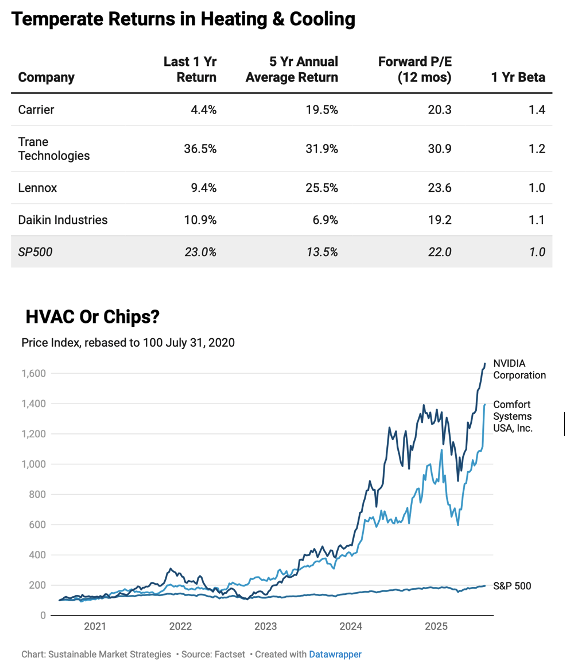
Heat pumps are the go-to solution for building space cooling (and heating), and the Sustainable Market Strategies team expect the bull market in HVAC companies to continue even in the face of subsidy removals. The IEA expects 1.5bn more air conditioners in operation in 2025 than today, driving the need for energy efficient solutions. Heat pump improvements aren’t just good for reducing emissions, they’ve been good for portfolio returns; just take a look at Comfort Systems, which some could mistake for super star Nvidia (see chart). Sure, this performance does stand out among HVAC players, but others have also done well (see table). The tech will become only more important in use cases like food refrigeration and data centre cooling, so demand will see sufficient growth. When it comes to cooling solutions for the data centre boom, look to US companies to fill this gap.
Brazil inches towards settling down
Real growth has held up well, but Jonathan Anderson points at general signs of weakening in underlying activity data. Inflation numbers have peaked across the board and should be fading in the second half. And fiscal consolidation has been very visible on an annual basis. In this environment, both real rates and the rates/growth gap remain extraordinarily high - keeping BRL carry attractive and making eventual rate cuts the dominant theme of the coming 12 months. There are two trends to watch that could potentially impede the carry/easing trades: one is widening external deficits, and the other is apparent recent budgetary slippage. Stay tuned.
Brazil: Maintain long equity exposure
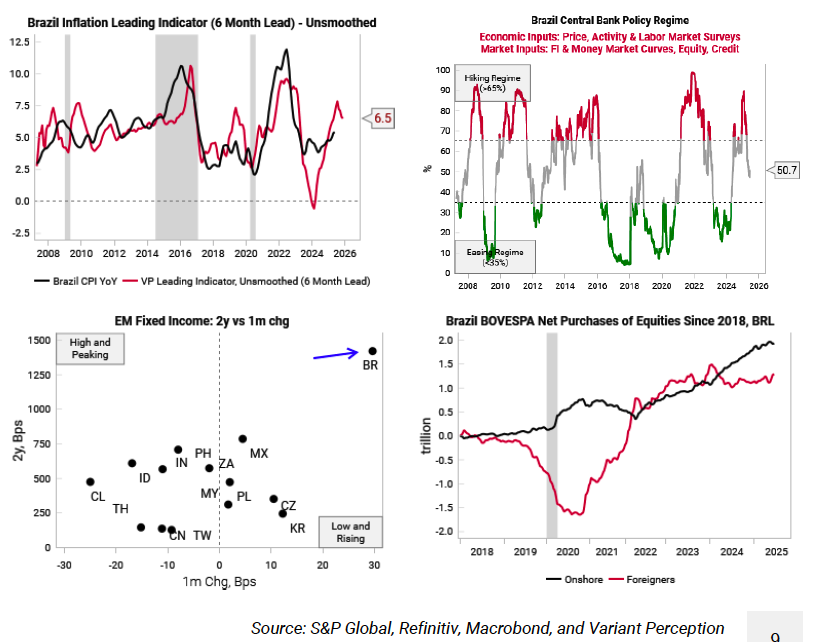
Variant Perception’s inflation leading indicator ticked down again this month, with the unsmoothed 6-month estimate falling to 6.5% YoY (top left chart). Underlying indicators confirm this inflection point, leaving the gap between the Selic rate and inflation the widest since 2005. Brazilian money market futures have also priced in the end of the hiking cycle. Echoing this, the team’s central bank regime model has shifted out of a “hawkish” regime and is now in neutral territory (top right). Meanwhile, the 2-year bond yield in Brazil remains elevated relative to all other EM economies (bottom left). The latest rise in yields over the past month or so is at odds with evidence inflation is rolling over. Investors can expect some lagged negative effects from the tightening cycle, but falling real interest rates are a strong macro setup for domestically-exposed Brazilian equities to move substantially higher from here.
US: TINA and Treasuries
Andrew Hunt asks: has EZ deficit obfuscation helped maintain US Economic Exceptionalism? He believes it has and that the hurdle for US balance of payments problems is in fact quite high. Unlike its peers, the US is an economy with a positive output gap, strong credit growth and it is experiencing above trend growth at present. The Fed’s current rate strategy is therefore right for the moment, but this strategy will not suit others. The crowded short USD position may not therefore work for a while… US households are long equities but a shift to a fully or overfunded budget deficit would ask questions of their current asset allocation. Ultimately, the outlook for markets rests on two questions: how will the US budget deficit be financed and can the news flow actually overwhelm the TINA effect and lead foreign investors to reduce their acquisitions of USD assets?
What’s trending in Retail
Consumer Discretionary
Each week, The Retail Tracker offers an insightful perspective on retail, fashion and consumer trends and what it means for the stocks. So far this year, Garage is a standout, nailing the “sexy x comfy” aesthetic for teens and taking share from Aerie and Pink. Gap and Old Navy are “crushing it” with consistently strong assortments, offsetting tariff challenges through fewer markdowns. Meanwhile, Urban Outfitters and Nuuly are gaining traction, with Nuuly emerging as a promising rental and tech-driven play. Aritzia is showing good momentum with its best assortment in some time. Department stores may be in free fall, but the best Macy’s stores have never looked better. In contrast, Lululemon is losing its way, expanding beyond its core and diluting its brand identity, while Bath & Body Works' range of new items is exhausting.
China: Overblown concerns
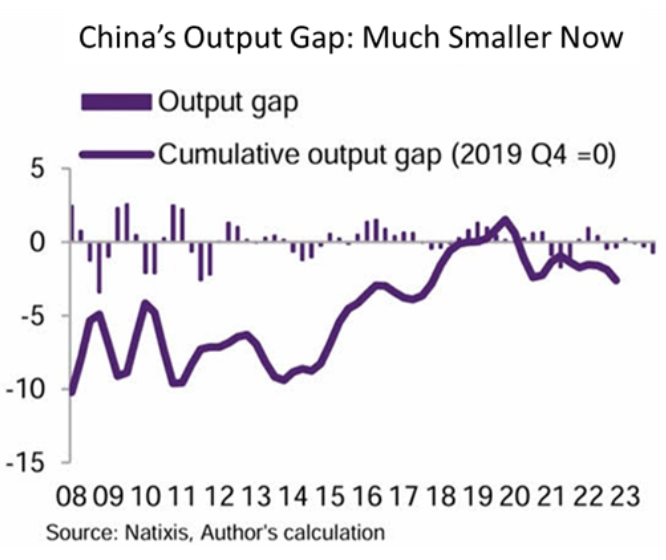
Manoj Pradhan points out that China’s fiscal support started last September, with stimulus starting before the Trump threat even materialised. Stabilising the property sector is a must for releasing consumption, with the ban on mortgage refinancing and falling house prices being some of the biggest reasons for the country’s ailing consumption. Manoj claims that concerns about China being a source of persistent deflationary demand are overblown, with the structural inflection occurring instead over 2012-15. He points to research estimating that China’s output gap over 2012-15 was nearly four times the size of the output gap in the recent downturn (see chart). China is also set to gain more than the US from de-escalation in the trade war. Stay long CHN.
What ails JGBs
The MoF understandably believed that it was being prudent by trying to bolster Japan’s fiscal reserves over recent weeks. However, this overfunding of the deficit, on top of the BoJ’s QT, a weak net external counterpart to liquidity growth, and against a background of only modest JGB demand from the banks, has placed upward pressure on yields and crashed monetary growth when the real economy is already softening. High food prices are inflationary to the CPI but deflationary for growth. Andrew Hunt finds that Japan now possesses a small negative output gap for the first time since the pandemic. Given these trends, investors can expect the MoF/BoJ to conduct a further policy U-turn despite high price rises. Andrew suspects that the BoJ’s actions will soon lean more doveish. Indeed, he says Japan’s shift from over-funding to under-funding could occur as the US Treasury begins its own heavy issuance later this summer, ultimately favouring the USD.
Industrials
Ernesto Lopez Mozo (CFO since 2009) acquired €224k of stock at €44.93 - only his second buy despite a long tenure. His first was €129k at €25.88 in Feb 20, making this latest move notable for both its larger size and higher price, after a gap of over five years. Rafael Del Pino Calvo-Sotelo (Chair since 2009) also made a rare €1.8m buy in Mar 25 at €37.17. Both are encouraging insider signals with shares near all-time highs. Meanwhile, Luke Bugeja (Divisional CEO since 2021) sold €929k worth of shares on the same day, which matches a stock award in Mar 25. This aligns with 2024, when he also sold his full award. The sale is not concerning enough to offset Smart Insider’s positive view.
Shell: To Be(P) or not to Be(P); that’s the question
Energy
Analysts at the IDEA! weigh in on media speculation about a potential Shell acquisition of BP. While Shell has the financial strength to pursue a deal, acquiring BP would involve taking on its $77bn of debt and other long-term liabilities, including those from the Deepwater Horizon spill. Although synergies are possible, integration would be costly and could disrupt Shell’s shareholder returns, which is key to closing its valuation gap with US peers. The deal would also bring in non-core assets and regions Shell has been moving away from, along with notable cultural differences. the IDEA! suggests caution and favours Shell sticking to its current strategy or exploring other deals instead.
Communications
Following publication of its FY24 annual report, Iron Blue increases their WPP score by 3pts to 30/60 (now top decile; fertile grounds for shorting). This reflects: 1) Higher stripped out costs (41% of PBT adj vs. 30% in FY23). 2) Re-expansion of the gap between accrued income and deferred income after narrowing the previous two years. 3) Another fall in balance sheet bad debtor impairment provisions. 4) Compression of trade receivables. 5) Reduced disclosures in several areas following change of auditor. 6) Moderated CEO LTIP ROCE and FCF targets.
Healthcare
Following publication of its FY24 annual report, Iron Blue increases their CTEC score to 28/60 (top quartile / fertile grounds for shorting). Reductions in inventory & bad debtor impairment provisioning contributed 36% of FY24’s Y/Y rise in PBT adj while the trend of restructuring and asset impairment provisions strip outs continued. The gap between PPE/software capex and the P&L D&A charge narrowed Y/Y but remained elevated at 16% of PBT adj. Receivables factoring increased to $43m (FY23: $27m, FY22: nil) while working capital days outstanding compressed to a decade low 47 days (FY23: 57), implying risk of future mean reversion. CTEC lowered the discount rate used to impairment test its goodwill to a blended 10.3% from 13.3% in FY23. This is now below the 11.5% average for Iron Blue’s coverage universe.
Special Sits Idea Forum
MYST’s latest buyside event saw a large group of investors offer a diverse set of ideas spanning various sectors / themes. Stocks highlighted include:
Bayer (BAYN GR) - New management advancing turnaround as litigation resolution approaches. TP €40 (65% upside).
CRH (CRH) - Increased pricing power + Ukraine rebuild opportunity to narrow valuation gap vs. peers. TP $135 (35% upside).
NFI (NFI CN) - Earnings / margins to rebound sharply as production issues ease. TP C$40 (200% upside).
Paramount Global (PARA) - Pending deal approval to trigger “structural bid” from Arbs while streaming business inflects. TP $15 (30% upside).
Parkland (PKI CN) - Substantial SOTP upside amid ongoing strategic alternatives process. TP C$54 (45% upside).
Japan: Throwback to 1987?
Japanese demand pressure increased even as the economy shrank late last year, and supply side potential remains moribund. The wage/price spiral should therefore continue unless global events lead to a deeper slowdown in demand trends / sharp rise in the JPY. Over the long-term, Andrew Hunt continues to believe that Japan will inflate its way out from under the public debt burden and that the JPYUSD is headed for Y200, but currencies are a relative game and he fears that markets could soon see a “repatriation rally” in the JPY that sees it gap higher in a counter trend move as it did in Q4/1987 and Q4/1998. Any upward move in the JPY would scupper the BoJ’s tightening plans. Could JGBs be viewed as a safe haven for returning funds? In real terms, equity prices are elevated – will they be eroded by inflation as they were in the 1970s, or by asset price deflation? Andrew expects more of the former than the latter.
Japan: Wages support surprisingly firm consumption
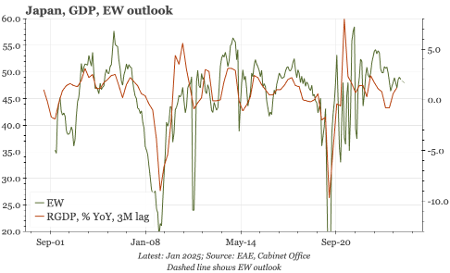
Paul Cavey points out that the first estimate of Q4 GDP was solid, with growth of 2.8% QoQ annualised, much faster than market expectations of a 1% rise. That takes average growth in the three quarters from April 2024 to 2.5%, closing the gap with the growth path suggested by the Economy Watchers survey. RGDP is now once again back above the pre-pandemic level – though as that was now almost five years ago, this comparison shows how slow the economic recovery has been. The big driver of the strong result in Q4 was net exports, which on its own would have generated GDP growth of 3% annualised. While exports were strong, more surprising was the resilience of consumption in Q4. On a per capita basis, private consumption is now the highest since 2014.
The quiet signs of a market top
Bull markets rarely die with fireworks. Instead, remarks Jawad Mian, they fall in a slow, unravelling process. The reason is simple, not all sectors and styles peak at the same time. Looking at thirty bull-market tops since the mid-1920s, the average gap between the first sector peak and the final high has been seven months. A market can stop being a bull market long before the index starts to fall. Jawad recalls the strategy of Jesse Livermore in 1916, who noticed the signs of the market falling one after the other even as the bulls raged around him. A hundred years later, the game–and human nature—remains the same. Investors have been roaring bulls, but, like Livermore, they’re now watching for the shift. And it’s happening.
US-EU tariffs: This is going to get bad
Donald Trump's tariffs on Canada should be a worrying premonition for what will happen to us in Europe. According to Wolfgang Münchau, the most straightforward reason for the tariffs on Canada is that it allows Trump to raise revenue without going to Congress. If he can make the executive orders stick legally, it’s one of the few tools he will have at his sole disposal. The tariffs on Canada cast doubt on the possibility that the EU will be able to escape or cut a deal to rebalance the trade relationship. In the longer term, there could be disintegration of the collective west, as trade restrictions now put Europe in the same position as China. Trump also signed an executive order mandating independent assessments of the economic costs of regulation, and a net reduction of those costs – expect this to massively widen the transatlantic growth gap.
US: Output gap is expanding
Growth may have faltered towards the final weeks of 2024, but in general the last 4-5 months of 2025 witness faster growth than in H1/2024, which Andrew Hunt puts down to being initiated by the wider fiscal deficit. This faster growth looks to have been associated with an expanding positive output gap, suggesting that inflationary pressures are building. These are cyclical and would evaporate if the economy slowed. Real yields in the UST market will continue to be determined by government borrowing trends and their interaction with the banks’ debt monetisation activities, but the nominal inflation component of yields could increase over the coming months unless / until the economy softens. Unless the US returns to QE imminently, yields will rise over the next 5-6 months, or at least until the credit boom ends. Andrew adds that, right now, liquidity is all that matters for US asset prices.
Consumer Discretionary
Iron Blue initiates coverage on ZAL with a score of 28/60, which is top decile (fertile grounds for shorting) and an outlier compared with bottom decile/quartile scores of internet peers Auto Trader (13/60), Rightmove (11/60) and Scout24 (16/40). They highlight 1) Increased use of stripped out restructuring and other costs. 2) Stripped out share-based payments (27% PBT adj). 3) Profit recovery supported by compressed fulfillment, marketing and inventories provision expenses. 4) Pronounced gap between tangibles capex and the depreciation charge. Re. governance, they note CEO variable pay targets that are either undisclosed or below external targets, a non-independent Remuneration Committee and sizeable related party transactions. FY24 sees a change in auditor following the incumbent’s tenure of 13 years.
Industrials
Iron Blue initiates coverage on the stock with a score of 27/60, which is top quartile (fertile grounds for shorting) and their equal highest score in the Capital Goods sector. They highlight 1) Reliance on percentage-of-completion revenue recognition. 2) Sustained stripped out restructuring charges. 3) An ageing debtor book (China construction). 4) Widened gap between capex and depreciation. They also note governance out of line with best practice (elevated non-audit fees, non-independent chair, board & remuneration committee and narrow CEO variable compensation payout metrics) as well as many areas of imperfect disclosure.
Consumer Staples
KCR highlights the uncommon relative value available in blue-chip staples stocks. The data is clear: today is one of the best times in 30+ years to buy select names in the sector and KMB appears to be a stock with rapidly improving fundamentals which investors have overlooked. It trades at ~18x projected 2025 earnings, a 10% discount to the S&P 500 and a ~25% discount to peers, despite the strong and consistent earnings and cash flow growth it has reported over the last eight quarters. KMB also trades at a substantially lower multiple of P/FCF (16x vs. 23x-41x for Clorox, Colgate-Palmolive and Procter & Gamble), while offering a materially higher dividend. If the 6x-7x P/E multiple gap were to be cut in half, KMB’s share price could be revalued higher by ~$25.
Nope, still no flood of Chinese goods
Once again China is posting a strong trade surplus and the news flow is all about mainland exporters rushing to ship goods to the US in advance of US tariffs. The reality, according to Jonathan Anderson, is that Chinese exports are broadly flat and just in line with the rest of EM. The true explanation behind high trade surpluses is a big "import crunch"; Chinese import spending has fallen well below the EM-wide trend in recent years...and the gap is increasing. China's merchandise trade surplus is embarrassingly high at roughly US$1 trillion - but the "basic" BOP balance is much lower, less than US$300 billion, and this is the figure that matters for Chinese macro policy. China has been and will continue to restrict imports and other outward spending by all means possible.
Financials
BBNI is Victor Galliano’s top pick among the Indonesian banks, based on its compelling value and growth credentials. It has the lowest PEG ratio of the big four, undemanding prospective PE multiples and the best PBV ratio to ROE combination. Return trends continue to improve; pre-provision returns have risen after bottoming out in 3Q23, which combine with declining cost of risk to drive better post-provision returns. In addition, the bank’s efficiency ratios have begun to improve. With its CET1 ratio of 19%, BBNI has bridged the gap with Mandiri on capital adequacy and on credit quality it also has the second highest NPL coverage of its peer group, after Permata.
Consumer Discretionary
The company is moving forward with an energy and confidence that has not been seen in a very long time, according to analysts at The Retail Tracker. Despite a lacklustre share price performance YTD, the Gap brand has been showing improvements, while recent collaborations have also impressed. Old Navy looks great. It had a very good BTS and its relaunch of denim with a powerful message was excellent. The ramp up in marketing will only help. Meanwhile, Banana, which had pushed pricing and design too far, seems to be settling back. Although Athleta continues to lag, the stores are cleaner and when they drop a new line, or colour, it is selling. They expect the stock to move higher over the next few months as GAP continues to gain momentum.
India: Diwali bonus
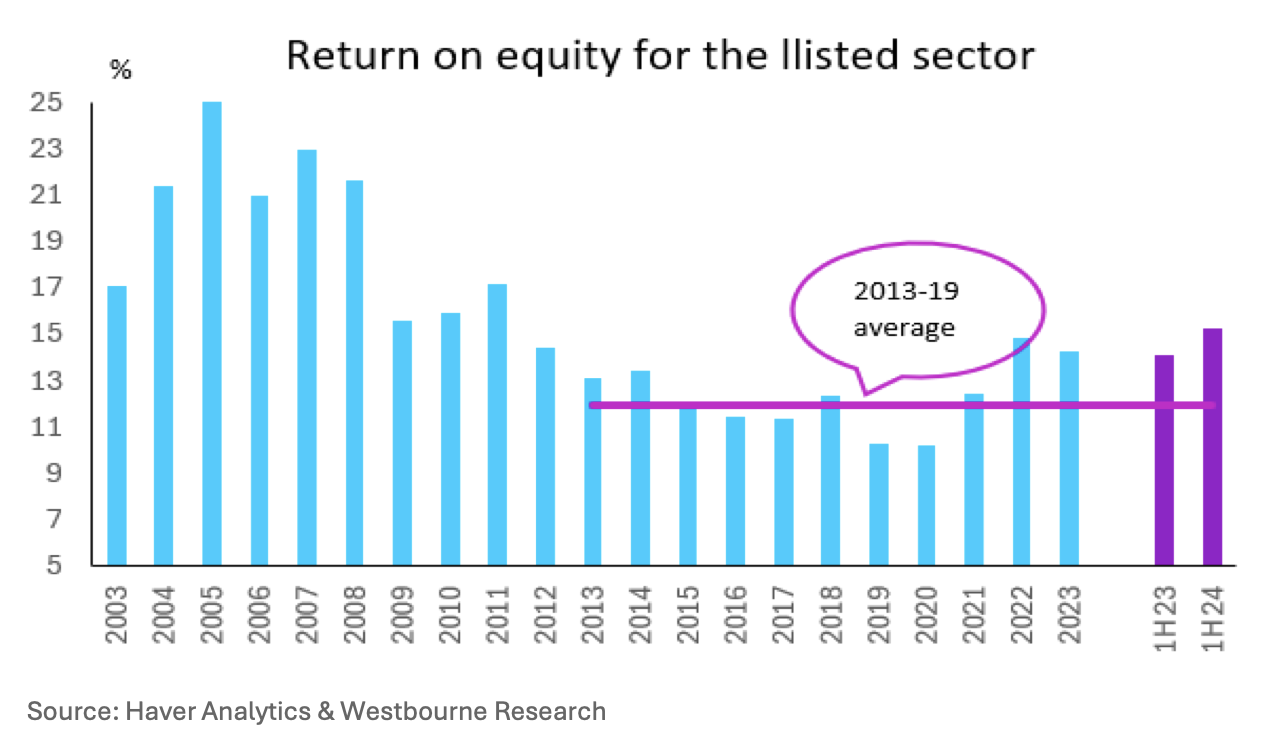
Sharmila Whelan’s latest report dives deep into India’s economy. Business cycle indicators are positive, indicating gathering momentum in the economic upswing, with return on equity climbing robustly since the low point in 2020 (see chart). Even though policy rates are high, the real cost of capital remains low. Private capex is rising and the government is pouring money into infrastructure investment. It’s just a matter of time before the investment cycle goes into full upswing. With the tough structural reforms now over (unlike in China), India represents a multi-year investment story for the foreseeable future. Sharmila recommends overweight Indian equities across industrial sectors and government and corporate bonds, unhedged. Rates are expected to stay on hold in 2024. Coupled with a positive economic outlook, robust corporate earnings, responsible fiscal policies, and a favourable adjusted resource gap, support an unhedged FX position.
Communications
Shares of NTT have slumped this year as concerns on mobile performance and local exchange profitability weigh on sentiment even as regulatory and political uncertainty lingers. At the company’s recent IR day, management was able to address the former, focusing attention on improvements in mobile and its regional businesses although we will have to wait for the politicians and regulators to address the latter. Large-cap telecom peers have performed much better than NTT, which has expanded the valuation gap with NTT looking much more attractive at 11x FY24e EPS vs. KDDI (14x) and Softbank (17x). NTT has also increased its dividend 12 years in a row and Kirk Boodry does not expect it to stop now. TP ¥207 (40% upside).