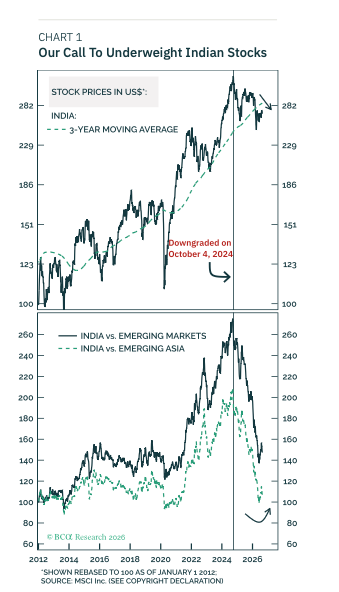
India: Time to upgrade
Brian Payne and Arthur Budaghyan argue that India has largely avoided the Hormuz shock, with fuel and fertiliser supplies intact and monsoon rains recovering. Consequently, they headline and core inflation to stay contained, asserting that the central bank’s next move will be a rate cut despite markets pricing in a 65-basis-point hike. Although absolute-return investors should not anticipate an outright equity rally, the analysts believe the bourse’s massive underperformance against emerging market peers is in a late stage. Dedicated EM portfolios should upgrade Indian equities to overweight and shift local bonds from neutral to overweight. In private markets, they advise leading with venture capital over private equity. Investors should now take profits on their short Indian stocks and long Chinese A-shares trade for a 44.5% gain, cut the short small-cap and long large-cap spread at a 16.8% loss, and buy unhedged 10-year domestic bonds.
Is a US debt crisis imminent?
Ed Yardeni points out that US federal spending continues to rise relentlessly. CBO projections show total outlays exceeding $11trn over the next 10 years, driven primarily by mandatory spending and rising interest costs. CBO projections also show annual budget deficits widening from $1.8trn to more than $3trn in 10-15 years. The US remains on an unsustainable fiscal path. However, Ed says it is not yet a crisis. Treasury yields remain in a range broadly consistent with a healthy economy, and Ed expects the 10-year yield to remain between 4.00% and 5.00%. He cites a couple of reasons that support his view: 1) US Treasury Secretary Scott Bessent has taken some actions recently to stop bond yields from rising, and can do more if necessary, and 2) Fed Chair Kevin Warsh is committed to restoring price stability. If inflation remains stubborn, the FOMC will probably raise the federal funds rate in September. That could ease pressure on long-term yields.
Nicaragua: Ortega’s regime is becoming more overtly dynastic
According to Daniel Landsberg-Rodriguez, President Ortega’s July declaration that competitive elections would end, followed by proposed constitutional changes, further entrenches Ortega-Murillo family control. The reform is expected to receive final ratification next year. Ortega is 80, while Rosario Murillo is already co-president and would automatically succeed him if he dies. The opposition has been largely dismantled and the armed forces remain loyal. For investors, policy arbitrariness remains the principal domestic risk. The government has confiscated more than 135 properties worth over $250 million from denationalised opposition figures, while a purge of thousands of lawyers has further weakened protections for private capital. Externally, US pressure is increasing with new tariffs. Separate Nicaragua-specific tariffs on non-CAFTA-origin goods rise to 10% in 2027 and 15% in 2028. The IMF forecasting 3.4% growth in 2026 despite tighter US immigration and trade policies and the risk of broader sanctions.
Everyday essentials, extraordinary pressure
Consumer Staples
Scott Mushkin argues the squeeze on food-at-home is intensifying, with GLP-1 adoption reducing industry volumes just as Amazon and Walmart accelerate their push into everyday consumables. AMZN's essentials business already exceeds $150bn, and he estimates FY26 unit growth of ~25% and revenue growth of ~20%; alongside WMT and Costco gains, this could leave the rest of the market shrinking ~2%. Aggressive pricing and faster delivery should also pressure competitors’ margins, reinforcing Scott’s Sell ratings on Kroger and Dollar General. Pepsico, Campbell's and Constellation (all not covered) are where he is most concerned, but he views the industry as generally uninvestable. Conversely, AMZN’s consumables momentum increases his confidence in his long-term North America retail forecasts and wider industry consolidation over the next couple of years.
Communications
The market is focusing too heavily on GOOGL’s ~$200bn capex bill and not enough on the long-term value of the infrastructure being built, according to Will Nutting. Google Cloud is already running at close to $100bn of annualised revenue, growing 82%, with a 35.6% operating margin and $514bn of contracted backlog. His analysis suggests Cloud could become a $600-700bn business by 2030 and $1.2-1.7trn business by 2035, supporting $400-700bn of operating profit, while the company as a whole could generate $600-900bn of annual earnings. Once the current construction phase slows, depreciation and maintenance capex should look very different from today’s growth capex, allowing it to throw off hundreds of billions in annual FCF. Will sees GOOGL evolving from a search company into a vertically integrated “intelligence utility”, with AI infrastructure ownership potentially becoming the next major investment trade.
Chinese-led AI deflation
Graham Turner argues that Chinese technology companies are leading the next cycle of deflation, implying interest rates will ultimately need to come down rather than rise. Energy prices spiked following Straits of Hormuz skirmishes, pushing the yield curve higher alongside strong US July services surveys. Markets remain anxious that higher energy costs and resilient data provide the Federal Reserve cover for a rate hike at the upcoming July FOMC meeting. However, Graham believes policymakers are missing the broader disinflationary impact of AI, highlighted by weak unit labour cost growth. US firms are increasingly turning to cheaper Chinese open-source AI models, some priced at one-twentieth of Western alternatives, to drive substantial cost savings. While the AI boom is causing short-term semiconductor bottlenecks, Graham contends that Chinese-induced AI deflation will force rate cuts, though a risk remains that the FOMC gets deflected by near-term energy shocks.
Japan: Sterilised intervention will not save the yen
David Woo is sceptical that recent US-Japan FX intervention will yield durable yen appreciation, viewing the rally as an attractive opportunity to establish new yen-funded carry trades. Because the intervention was sterilised and left monetary conditions unchanged, it failed to activate the portfolio-balance channel or signal a monetary policy shift from the Bank of Japan. Export performance demonstrates that currency weakness stems from a structural loss of global competitiveness to South Korea, Taiwan, and China, rather than temporary mispricing. David argues that rising term premia, catalysed by Prime Minister Sanae Takaichi’s aggressive fiscal stimulus and 380 trillion yen investment plan, remain the primary driver of yen depreciation. Trapped by public debt exceeding 200% of GDP, Japan must maintain structurally low real interest rates. The intervention is not the beginning of a new bull market for the yen, but simply another opportunity to sell it until the next intervention becomes necessary.
Energy
Interim results demonstrate the earnings power of SBM’s Turnkey franchise when major project milestones and asset sales coincide, while the Lease and Operate fleet continues to provide a stable foundation. The substantial backlog increase and guidance upgrade confirm that the company is converting its strong market position into tangible financial outcomes. SBM has a very strong track record when it comes to on-time and on-budget delivery of the current construction portfolio, which should continue to support the conversion of the tender pipeline opportunities into additional order wins. With net debt reduced and cash-flow visibility extended far into the future, the balance sheet and capital-return framework look solid. Overall, the results reinforce confidence in SBM’s ability to generate attractive returns through the next phase of the deepwater cycle.
Technology
Future has seen its share price recover recently having been unfairly hit by the “AIpocalypse” sell-off. The company works with management teams to design and build advanced, practical IT systems and is seeing larger orders come through. Near-term earnings are being held back by a major loss-making order, evident in Q1 operating profit growth of just 3% Y/Y to ¥3.4bn and expected to keep H1 growth similarly muted at c.3% to ¥7.3bn. However, Asymmetric expects earnings growth to reaccelerate from Q3 and into FY3/28, with the shares trading on c.12x FY3/28E earnings. Future’s work sits in upstream, mission-critical areas such as architecture, testing, validation, integration, performance design and systems responsibility, making AI more likely to improve productivity than displace the business. Meanwhile, its next-generation core banking system, Future Bank, also appears close to broader take-off.
Economic strategy commits Japan to risky course of action
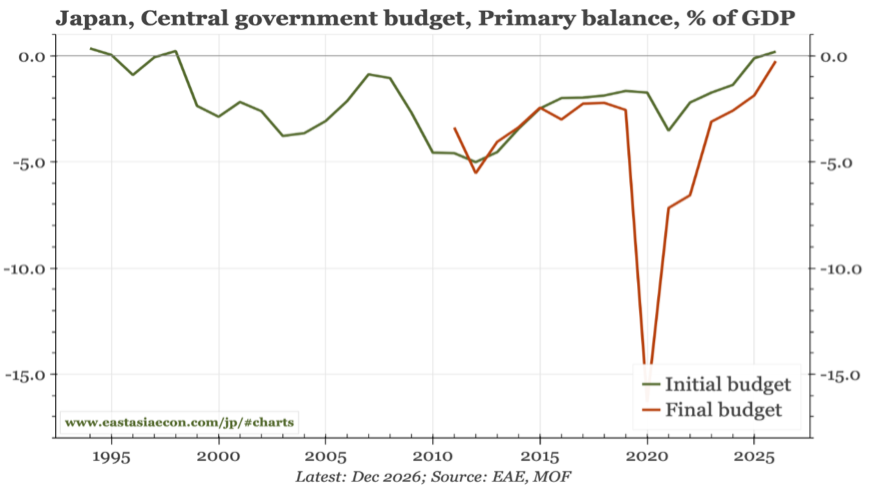
The Takaichi government has formally approved a new growth strategy and ‘Basic Policy on Economic and Fiscal Management and Reform’. These two documents translate Prime Minister Takaichi Sanae’s ambitions to use fiscal tools to build a strong Japan into guidelines for next year’s budget. Tobias Harris says that “growth through security, security through growth” could serve as a tagline for the Takaichi government’s strategic program. Takaichi believes that there are growth opportunities through investments in national security, economic security, cyber security, and energy security, but also that investments in growth industries – particularly artificial intelligence and robotics, information technology, and quantum computing, with an AI transformation (AX) as the single most important goal – will both ensure national prosperity but also safeguard Japan’s “autonomy and indispensability” in the global economy in the coming decades. However, Tobias notes that while the basic policy gestures towards market confidence, these documents show that rising interest rates have not deterred the government from raising outlays.
Macro View: The wind finally at my back
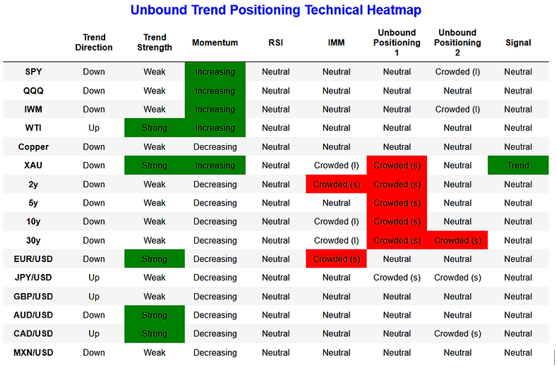
David Woo argued in the Unbound Global Macro Investor that the geopolitical risk premium remains too low. His short-term market bias is: higher oil - lower equities - neutral rates - neutral dollar.
(1) Higher oil: David says the market is under-pricing two risks: that the latest U.S. efforts to break Iran’s denial of Hormuz will ultimately require the deployment of ground troops; and that Iran will act on its threat to close the Red Sea.
(2) Lower equities: Higher oil is bearish for tech stocks. The release of Moonshot’s Kimi K3 model supports the hypothesis that LLMs are rapidly becoming commoditised.
(3) Neutral rates: Inflation breakevens are likely to play catch-up with oil price next week. However, a decline in expected investment returns of AI is bullish for bonds. The better-than-expected inflation data last week supports a 5s-30s steepener.
(4) Neutral dollar: If the AI bubble bursts, the real yield advantage of the dollar will begin to erode.
Healthcare
At 30x forward adjusted EPS, DXCM continues to raise multiple earnings-quality concerns, especially when compared to Insulet, which has cleaner accounting and trades on a lower P/E. Insulet’s rebates and sales incentives are 25 days of sales, while DXCM’s have exceeded 100 days in seven of the past eight quarters and continue to reach new highs. Inventory is also rising despite heavier discounting, with finished goods having tripled. Price discounts should reduce inventory value through a higher reserve, but reserve growth has stalled, supporting EPS. Warranty accruals also look low, while flat dollar R&D spend in Q1 added 3c to EPS as a percentage of sales. Other companies reporting next week where BTN has recently flagged earnings-quality risks include Belden, Church & Dwight and Eaton.
Micron specialty DRAM margins stay elevated
Technology
Specialty memory remains extremely tight, with fabs running close to full, gross margins at historical highs and the next meaningful capacity addition not arriving until 2027. JNK's research indicates specialty memory revenue rose close to 60% Q/Q and ~170% Y/Y last quarter, while Q2 price increases were larger than Q1. Pricing leverage sits with suppliers that still have legacy allocation through next year, including MU's remaining book. Customers are pushing suppliers into long term supply agreements, often with pricing left open, while end customers two and three steps down the chain are approaching component makers directly to secure supply. The key risk is that 2027 capacity additions ease the current squeeze, but JNK believes demand could still run ahead of supply, while a stacked memory product could offer a lower-cost bandwidth alternative to HBM for Broadcom (and Marvell) custom silicon.
Earnings season screens
Mill Street has developed an "Earnings Screen Score" ranking methodology that draws on selected inputs from their MAER (Monitor of Analysts’ Earnings Revisions) stock database to identify companies which have strong near-term fundamental momentum going into an earnings report. Mill Street’s research indicates that companies scoring highly in their ranking have a much higher chance of near-term improvements in analyst expectations than those that score poorly. Stocks most likely to produce positive near-term analyst estimate activity in the next couple of weeks include Franklin Resources, Humana, Seagate and Valero. Bottom ranked stocks include Boston Scientific, EchoStar, Intercontinental Exchange and S&P Global. Click here to access the full report.
Gold & Silver: Near-term price pullback likely
In this presentation, Jeffrey Christian of CPM Group gives a precious metals update focused on the gold price outlook, silver market slump, investor selling, political risks, platinum and palladium weakness, and the US dollar. He explains why gold continues to test the $4,000 to $4,100 area and why a move toward $3,800 remains possible over the next couple of months. Jeff also discusses silver’s test of the $60 level and why CPM Group would not be surprised to see silver move toward $55-$50 in the short term. He explains why some investors have been selling physical gold, silver coins, ETFs, and other positions, while longer term investors continue to hold precious metals as a hedge against economic, political, and financial risks. The presentation also covers China’s physical gold demand, India’s gold selling, political risks involving Ukraine, Russia, NATO, Israel, Turkey, and broader political instability, all of which remain supportive for gold and silver over time. Click here to watch.
Enterprise IT Channel Checks: AI demand meets pricing pressure
Technology
Channel conversations highlighted accelerating AI adoption, tightening cybersecurity spending priorities and growing pricing pressure across the infrastructure market. Partners pointed to rising enterprise demand for AI governance, next-generation SIEM platforms and sovereign cloud solutions, while networking, memory and security vendors continue to push through additional price increases. Sales Pulse also shares fresh partner commentary on key names including HPE, Zoom, RingCentral, Palo Alto, F5 and Nice, along with several emerging trends shaping the enterprise technology landscape heading into quarter-end.
Consumer Discretionary
BROS has assembled a C-suite with the functional depth required for its next phase of growth. CEO Christine Barone has built a leadership bench well matched to the current mandate, combining expertise in capital allocation, site development, retail technology, digital marketing and operational execution to support 185+ annual store openings, improve throughput and scale the brand nationally. The principal risk is cultural rather than operational, with a faster shift towards a more process-driven organisation potentially weakening the founder-led “Dutch Luv” culture that differentiates the brand. Nevertheless, Paragon believes this risk is manageable if management can preserve the customer-facing culture while building a more disciplined, scalable operating model capable of supporting stronger unit economics and a more durable growth algorithm. Their analysis includes diligence memos / interviews on Barone, CFO Guenser, CMO Davilla, CDO Cahoe, CT&IO Krishnababu and CSO Somers.
Bitcoin: The upcoming sixth cycle
Markus Thielen points out that there has been a recurring pattern to Bitcoin cycles: each cycle was defined by a distinct dominant narrative, which in turn demanded a different kind of promoter and attracted an entirely new class of believers. Bitcoin has now completed five bull markets and is navigating its fifth bear market. If a sixth cycle is coming, which Markus believes it is, what drives it, and who is the marginal buyer? He says that the sixth may look less like a reinvention and more like a continuation, driven by the same forces and the same buyers that defined the fifth. What gives him confidence in a sixth cycle is that the primary drivers of the fifth, money printing, dollar debasement, and the search for hard assets outside the traditional system, have not disappeared. If anything, they are compounding and accelerating. Markus believes that the next sovereign debt crisis, whenever it arrives, will not find Bitcoin without an audience.
South Africa: Structural reform faces capital shortfalls
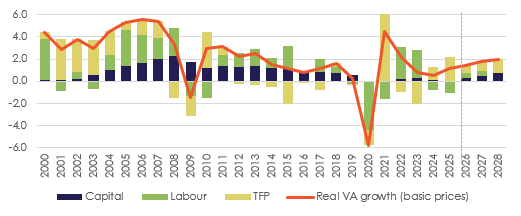
The Macro Advisors team outline how South Africa’s productivity problem has deepened alongside a long erosion in capital formation. While recent total factor productivity gains are welcome, they look more like windfall gains from a dire operating base than evidence of a sustained productivity cycle. Structural reform across logistics, electricity, and ports can lift productivity by restoring the operating base, but this constraint-relief channel is being deployed on a weak capital base. Net investment is just above depreciation, meaning the economy is barely replacing and repairing existing assets rather than expanding the productive frontier. The team struggle to pencil the required 4-5% real gross fixed capital formation growth into their forecasts over the next three years. Without stronger investment crowding into productivity-enhancing assets, potential growth remains stuck at a maximum 2% in the medium run, raising serious challenges for business positivity.
UK: Brexit, 10 years on
In an extensive report examining the paradox of Brexit a decade on, Niall Ferguson observes that leaving the European Union has fallen short of revitalising the economy or curbing immigration. Non-EU trade agreements fail to offset the single market exit, which permanently lowered trade volumes and left business investment significantly depressed. However, Niall believes that Britain's primary drags remain homegrown, driven by an inefficient NHS, rigid planning laws, and severe energy grid fragility exposed by recent shocks. While the likely next Prime Minister Andy Burnham targets incremental alignment on agri-trade and emissions, Brussels will demand politically costly concessions. Consequently, structural domestic blockages and demographic change will continue to impede fiscal consolidation. With public finances failing to recover from the pandemic, persistent energy-induced inflation risks and deep political uncertainty mean the structural rise in borrowing costs is unlikely to reverse, maintaining long-term upward pressure on 30Y Gilt yields.
The Great British Peso
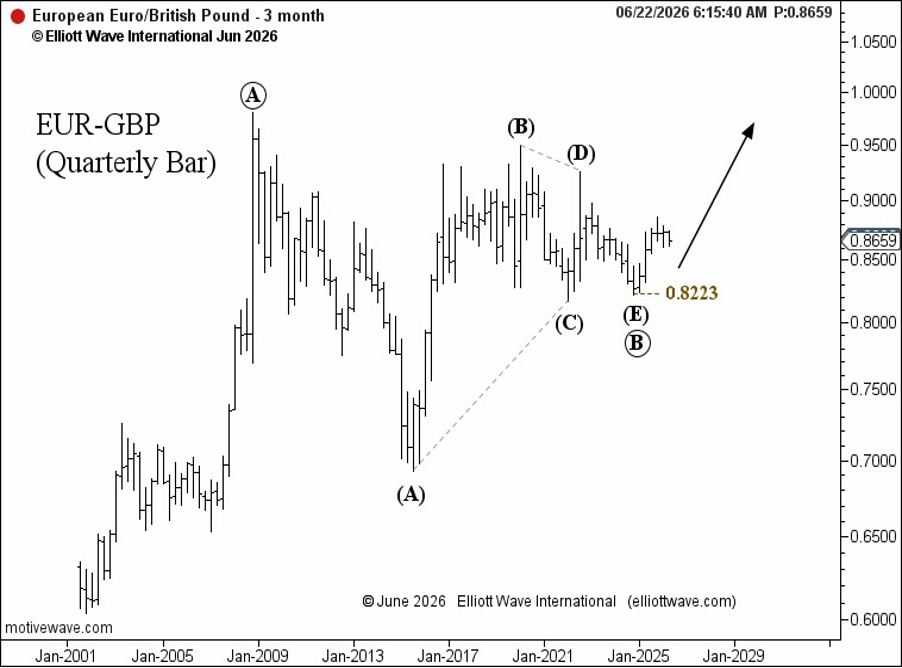
Now that U.K. Prime Minister Keir Starmer has said he will resign, it paves the way for, in all likelihood, Andy Burnham to become the next PM. Murray Gunn points out that in the nineteen years leading up to 2016, the U.K. had three PMs. In the ten years since 2016 there will now have been six PMs. What happened in 2016? Oh yes, that was when Britain became the only country in history to impose economic sanctions on itself by voting to leave the European Union, the planet’s largest economic trading bloc. Since then, social mood has continued to trend negatively, economic growth has been anaemic and the far-right has risen in the political zeitgeist. Sterling still looks like it is appreciating versus the US dollar, but the chart of EUR-GBP shows that it could be set for years of depreciation after completing a triangle from 2008 to 2024. Do not be surprised if developments on these islands become even more dramatic over the next decade.
Ripples of risk-off
Murray Gunn wrote about the dichotomy between the fortunes of Ripple, the cryptocurrency company, and XRP, its token. He pointed out the booming company that has been securing lucrative and high-profile contracts, yet the price of XRP has been declining. Another Bitcoin bust beckons, as the iconic cryptocurrency was declining in the next wave of its ongoing bear market since its peak last year. Bitcoin also sports at least one head and shoulders top pattern which could give it even more bearish implications. Murray pondered whether the crypto slump was a subtle sign that risk appetite was waning, and it might now be finally feeding through into the stock market with the S&P 500 down over 3% last week. Don’t be surprised to hear and read about people attempting to “buy the dip.” And when the stock market struggles to recover, as he suspects, expect increasing panic to ensue.
Japan: Yen under pressure, but data is encouraging
Graham Turner says that the prospect of a rate hike at the FOMC meeting in June casts a harsh spotlight on the Bank of Japan: the BoJ will meet earlier next week, and unless it agrees to tighten policy too, the yen is likely to plumb new lows against the US$. For the Bank of Japan, there is no obvious pressure to hike, as inflation has been well-behaved. The y/y for the Nationwide CPI eased to 1.38% in April. The CPI excluding food, alcohol & energy dipped to 1.06% y/y. Real wages are rising sharply, in part, because of the drop of core inflation as well as fuel subsidies. The labour market in Japan is tight. The unemployment rate fell to 2.5% in April. Total employment jumped to 68.76m, a new high, despite a shrinking population. These are encouraging trends that bode well for Japan’s response to an ageing population, particularly against the backdrop of high government debt.
US: Bond volatility matters most
Ahead of the next FOMC in mid-June, Michael Howell questions the importance of the rate-setting ritual. He argues that the bond market, not the US Fed, is the main force shaping the economy and equity markets. More specifically, what matters most is not bond yields but rather bond volatility. Investors should be watching the MOVE index and closely examine the US Treasury’s actions in the bond market, because they may now matter more than the policy rate itself. Michael argues that the Fed has been sidelined, losing much of its traditional influence over financial conditions. Still, it plays an important financial stability role in smoothing funding operations and specifically maintaining harmony in the crucial repo / collateral markets. Also, he notes that lower policy rates are not always stimulative. Because the private sector is a net creditor to the government, rate cuts can reduce interest income to bondholders and potentially dampen spending.
US: The populist backlash against AI
Matt Gertken and Marko Papic say that the populist backlash against AI could result in bipartisan regulation in 2027, but is especially likely to prompt tax hikes from 2029. Public criticism of the new technology is growing and politicians in the US and abroad are proposing measures such as AI regulation, taxation, redistribution, and restrictions on data centres. Job displacement is the core concern, with opposition to AI strongest in service-oriented economies where workers fear automation. Americans increasingly view AI as developing too quickly, oppose data-centre construction in their backyard, and are becoming less optimistic about the benefits of technology, particularly among younger generations. The investment risk is political, not technological: a recession, AI-driven mass layoffs, inflation, or a major AI-related accident could mobilise voters and lead to aggressive regulation or higher taxes on technology firms as early as next year – and especially after the 2028 election.
Eurozone growth risks mispriced amid hawkish consensus
The Variant Perception team examine the outlook for the Eurozone as inflation leading indicators and breadth remain elevated well above pre-Covid levels. Whilst rising service price surveys put pressure on the European Central Bank to remain hawkish to anchor inflation expectations, matching the market pricing of at least three interest rate hikes over the next year introduces substantial downside growth risks. According to the team, current market dynamics replicate the post-GFC period by overstating inflation fears and underestimating growth destruction. This structural misalignment occurs at a time when Eurozone macroeconomic breadth vs the rest of the G10 remains weak. With the trend component of the firm's tactical outlook model turning decisively negative, the underlying economic setup points toward a sharp growth capitulation rather than a sustained tightening cycle. The team express their bearish view on European growth by selling rallies in the euro.
Greek Equities: Adopting a more cautious stance
ResearchGreece revisits their stock picks and assesses the political outlook ahead of the next parliamentary elections. Macro conditions remain solid, with Q1 real GDP up 2.0% Y/Y, although inflation accelerated to 5.2% Y/Y in May (+0.0% M/M). With the Athens Index up +11% YTD, valuation multiples of non-banks in their universe have expanded to 13.2x P/E and 8.0x EV/EBITDA 2027, leaving more limited upside. Combined with polls pointing to a hung parliament, ResearchGreece is turning more cautious on Greek equities. Banks remain their preferred exposure (solid outlook - volume, rates, asset quality) as a leveraged Greek macro play. They prefer National Bank of Greece, Bank of Cyprus, Piraeus and Optima. Outside banks, they favour selective infrastructure, industrial and defensive names such as OTE, Titan, PPC and Piraeus Port over consumer stocks and cyclicals.
Hang Seng on the launchpad
Erik@YWR argues that the Hang Seng’s sluggish start to 2026 masks a much more attractive setup, with the index described as a “coiled spring” after moving sideways for 15 years in hard-currency terms. He sees 35,000 as achievable, supported by improving fundamentals: based on YWR’s approximation of 89 constituents, earnings growth is expected to accelerate from a 6% CAGR over 2015-2025 to 11% over the next 3 years. Key drivers include 17% EPS CAGRs at Tencent and Alibaba, 6% growth from the major Chinese banks, oil-price support for energy names, 26% growth from BYD and CATL, and a recovery in property stocks. With earnings revisions turning positive, Hong Kong property prices recovering (mainland China prices stabilising) and the index on <10x 2028 earnings, Erik sees meaningful upside.
Consumer Discretionary
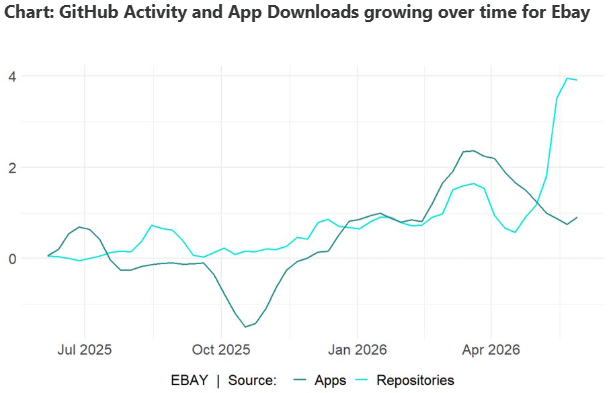
The company ranks in the top 20% of AnteData’s universe, reflecting a strong improvement in coding momentum during 2026. The signal is primarily being driven by rising App activity and exceptionally strong GitHub interest where developers are building pricing tools, arbitrage engines and inventory automations using EBAY as a pricing and transaction platform. AnteData sees the group’s focus on passion-driven goods, including auto parts, collectibles and luxury items, as increasingly important, with these categories now representing >30% of value traded. They believe EBAY can sustain c.8% annual revenue growth over the next 5 years, lifting sales from $11.5bn to $16bn and nearly doubling income to c.$4bn.
Copper’s record prices: What happens next?
In this presentation, Jeffrey Christian of CPM Group gives an update on gold, silver, platinum, and palladium prices before turning to copper. He explains why precious metals appear to be settling into a summer consolidation period, with gold trading near $4,500, silver holding within its recent range, and platinum and palladium also moving within broader trading bands. Jeff then turns the focus to copper, where CPM Group remains constructive on the long-term outlook but less aggressive than many other market forecasts. He discusses why copper demand tied to construction, electrification, vehicles, power grids, AI, and data centres needs to be analyzed with more nuance and less uncritical enthusiasm. While CPM expects the copper market to remain tight, with refined supply falling short of fabrication demand. Jeff also explains why some long-term copper price expectations may be too optimistic.
Click here to watch.
USDJPY: Stable but unsustainable
USDJPY seems stable for now, caught between the upward lift from the negative real interest rates in Japan, and the gravity of valuation and the MoF’s threats of interventions. Stephen Jen believes that the next big move in USDJPY is down. But elevated oil prices may delay the timing of this prospective correction. USDJPY remains elevated near 160. There are several powerful forces pushing USDJPY higher, even though the JPY is already grossly undervalued. Japan’s real interest rates remain very negative. The BOJ’s policy rate is minus-65 bps in real terms, and minus-300 bps relative to the Fed Funds Rate. Further, the negative terms-of-trade shock from higher oil prices is the second driver of USDJPY. In essence, the JPY is the mirror image of the USD, which has been propped up by capital inflows over the years, attracted by the higher carry and capital gains in US equities, pushing the USD deep into overvalued territory.
US: Warsh’s natural bias
In the last week markets have moved to peg the Fed for about 28bps of hikes in the next year, a substantial shift from the 1-2 cuts priced in late February. Warsh assumes the Chair with a challenge to his natural bias – higher productivity via AI implying stronger GDP growth potential (but less inflation and hence need to hike), weak jobs markets but immigration arguably keeping the U/E rate down (which should point to rate cuts), a tighter and smaller Fed balance sheet (that implies rate cuts to offset) and different measures of inflation (trimmed mean over core PCE which conveniently is lower and implies rate cuts). This set of biases imples that Warsh is more of a cutter than a hiker. While the markets peg the first Fed hike in March 2027, Craig Ferguson thinks that the Fed will get an inflation shock in the next 3-4 months that leads to them hiking in Q3.
US: …and the answer is margins
If you want to understand equity markets today, Paul Krake advises to start and end with margins. The blended Q1 2026 net profit margin for the S&P 500 came in at 14.7%, the highest figure since FactSet began tracking the metric in 2009, eclipsing the 13.2% record set just one quarter ago. The direction of travel is unambiguous. What is changing now, and what makes this margin story qualitatively different from the cycle-on-cycle expansions that preceded it, is who participates. The hyperscalers are not building this infrastructure for their own consumption. They are building the road, and the rest of the economy pays a toll to drive on it. The productivity gain accrues to the customer. The S&P at all-time highs is not a puzzle. The cleanest expression of this view in a single trade is long the equal-weight S&P 500 against the cap-weighted index. The next phase of this story is breadth. Equal-weight is how you own it.
The ECB’s coming hike
According to Mark Bathgate, the ECB is likely to hike at their next policy meeting on June 11th. Mark points out that President Lagarde has clearly stated, “memories of 2022 are very fresh” – hence he says that the ECB is going to prioritise its inflation stability mandate and tighten policy to deliver on that. He thinks they will hike 25bps, then suggest that more hikes are possible. The most likely scenario for further hikes after the initial one is an “end of war” outcome – where business/confidence rises, but inflation continues to rise due to the 12-18 months disruptions/inflation in energy-intensive products. The market has moved between pricing 2 and 3 rate hikes over recent weeks – this seems reasonable pricing. A cash rate around 2-2.5% and 100bps curve to the 10-year part of the curve is seen by the ECB as “back to normal”, and a sustainable place for monetary policy to be (also good for the health of the EU banking sector).
AI and its discontents
The AI buildout is transforming the US economy almost uniformly for the better. Output is increasing both as a result of higher investment and higher productivity. If AI works, the US will have an unassailable dominant position in the global provision of services. It appears not everyone agrees. At a commencement speech at the University of Central Florida, the fairly innocuous comment that the rise of AI is the next industrial revolution was met with booing from students. There is clear political backlash against AI, including in America, the country that stands to benefit the most from its development. Yet, technological change has a habit of steamrolling political concerns over its deployment, and technology tends to determine the political economy rather than the other way around. Dimitris Valatsas is not worried (yet) about political opposition derailing US dominance in AI, but it’s worth watching closely.
Beyond Lithium: The next battery boom
Industrials
Battery technology is at a commercial inflection point with the economics now favouring electrification over fossil fuels across an expanding range of applications, a trend accelerated by higher energy prices from the Iran conflict. China continues to dominate the supply chain, with CATL alone controlling ~39% of the global EV battery market and leading in grid-scale storage deployments, but Korean manufacturers offer accessible, liquid alternatives with deep ties to Western automakers and compelling technology road maps of their own. Given the geopolitical and technology risks, investors should build a basket of stocks: CATL for multi-chemistry platform execution at reasonable multiples; LG Energy Solution for contracted backlog and near-term profitability; Samsung SDI for solid-state battery optionality; and Amprius as a higher-risk tech position. BYD is also highlighted as a play on growing EV demand.
Technology
CORZ moves sharply higher in Arete’s AI infrastructure rankings following a major expansion in its long-term power roadmap, with them now modelling 3.6GW of IT load and $6.3bn of NOI by 2032 - up from prior estimates of 1.9GW and $3.7bn, respectively. Arete argues demand for AI compute remains “off-the-charts”, while CORZ is becoming increasingly attractive to hyperscalers through the expansion of its Pecos and Muskogee campuses into gigawatt-scale AI data centre sites. Importantly, the company has leveraged its existing CoreWeave contract into $3.3bn of financing, giving it sufficient capital to begin pre-building new facilities before signing additional leases, which Arete views as a key competitive advantage. With leasable power expected to nearly triple over the next few years, Arete raises their TP to $55 (100% upside) and now ranks CORZ alongside Applied Digital as a top pick in colocation infrastructure.
Industrials
Investors remain far too apathetic towards European construction stocks, overlooking a multi-year infrastructure and housing investment cycle that could materially benefit BAM. The shares have hardly moved so far in 2026, despite the group reporting FY25 revenues up 9% Y/Y to €7.0bn, adjusted EBITDA up 20% to €400m and net profit almost tripling to €211m, while ending the year with €792m net cash, a €13bn order book and a new €40m buyback. BAM will issue new mid-term targets next year, but Europe’s 2026-2030 infrastructure strategy will release ~€600bn of funds further boosting the group’s order book, while civil infrastructure in UK currently faces a "herculean to-do list" that requires a 30-50% increase in investment over the next decade. TP €15 (55% upside).
China’s asset revitalisation: An unanticipated growth boost?
In a 24-page special report, Dinny McMahon discusses the “asset revitalisation” measures that could help end the problem of local government austerity. Over the last few years, China’s local governments have significantly ramped up the amount of revenue they generate by leasing state assets and selling concessions – known as “revitalising” assets. This “asset revitalization” has become a major source of income for a handful of provinces, materially improving their fiscal conditions. Chongqing, the leader, funded 15.1% of provincial general expenditures last year from such activities, up from only 6.8% four years earlier. For China’s financially overstretched provinces, “asset revitalisation” is emerging as a much-needed new channel for expanding revenue. It stands to have a potentially transformative impact, creating an unprecedented opportunity for local authorities to repair their finances, and opening the door to an unanticipated boost in growth over the next couple of years.
Caution in Cote d’Ivoire
Cote d'Ivoire has done extremely well in the past couple of years on the back of explosive agricultural and metals export price gains, with an improving external and fiscal balance and falling sovereign dollar spreads. The medium-term outlook remains buoyant, with new oil and gas projects already coming online and significant further volume gains expected in the next four to five years. However, Jonathan Anderson points out that the base is still relatively low today as a share of total exports, which leaves near-term market sentiment highly geared to cocoa and gold prices. Cocoa markets have already come down hard, and while gold remains relatively buoyant Jonathan does worry about overvaluation relative to fundamentals. With high public external debt exposures compared to dollar earnings, this could be a source of volatility in the dollar sovereign market and a bit of caution is in order.
US S&P: Feeling good
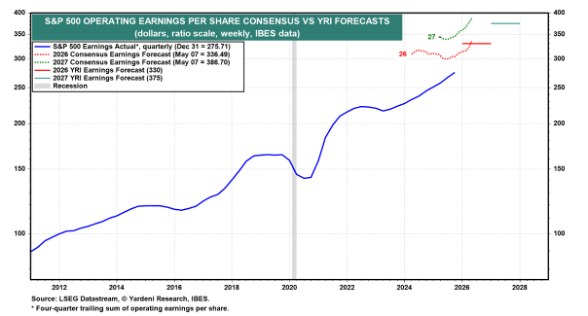
Ed Yardeni is raising his year-end S&P 500 target from 7700 to 8250. He has never seen consensus earnings expectations rise so quickly for the current and coming years as they have in recent months. The result has been an earnings-led meltup in the stock market. Ed is raising his EPS estimates to $330 this year and $375 next year, while sticking with his forward P/E range of 18.0-22.0, resulting in a year-end range for the S&P 500 of 6750-8250. His key assumption is that the economy will remain resilient, and so will earnings. Ed is also raising his probability of a continuation of the Roaring 2020s to 80% from 60% simply by merging it with his meltup scenario (previously at 20%), since he believes that any meltdown will be a buying opportunity and won't trigger a recession or bear market similar to the 1999-2000 Tech Bubble and Tech Wreck.
UK: The next PM
It is unlikely the factions within the Parliamentary Labour Party (PLP) will be able to vote on one candidate, so the election would be decided by the Labour Party’s electoral college (1/3rd MPs, 1/3rd Trade Unions, 1/3rd party members) between the two candidates selected by the PLP. The main candidates include Wes Streeting; Angela Rayner, the most popular of the Soft Left candidates; Ed Miliband, who is the most likely candidate should Rayner decide not to run; and Andy Burnham, who would need to be elected as an MP to be able to run. The current paralysis is bad for the Gilt market due to the likelihood that it pushes borrowing needs up over the coming months due to higher gilt yields, energy subsidies and the defence budget black hole. The potential timeline for election of a new PM is between 2 and 4 months from today.
UK: Everybody hurts
This week’s elections worked out very much as Niall Ferguson expected, with the governing Labour Party mauled, and the populist Reform UK party surging. Nationalist parties ended up in charge of Scotland and Wales. Niall sees the change as being more profound than mere shifts in the balance of party politics, with Britain breaking up into a patchwork of electoral backgrounds in a way that bodes ill for state structure and party coherence. Niall doesn’t see Starmer resigning soon but is certain he will not fight the next election. Badenoch will lead the Tories as her strong personality is beginning to get across to the public. Yet, the country is drifting towards a deeply uncertain election result in 2028/29 where nobody wins and nobody loses. It is hard to be anything but bearish about the country’s future.
Consumer Discretionary
Lululemon shares are trading at both 52-week and five-year lows after a difficult period marked by product challenges and pressure on the brand’s core offering. The source notes that the company had strayed too far from its brand DNA, with limited colour in parts of the range and the departure of its senior merchant. However, early signs of improvement are emerging, including a tighter product offering, more colour and the appointment of a former Nike executive as CEO. While a full turnaround is likely to take time, The Retail Tracker sees potential for the stock to reach $175 over the next 12 months.
Technology
SK Hynix benefits from better demand visibility and reduced investment risk whilst demand for mid- to long-term agreements is increasing as customers seek volume security and price stability. Arete expects these agreements to materially reduce industry volatility and improve earnings stability, supporting its structural AI-driven thesis. They see two key catalysts for sector re-rating: substantial free cash flow generation driving higher capital returns, with details expected by year-end, and the market underestimating earnings durability over the next several years. With SK Hynix trading on 5.5x FY27 earnings and 2.5x book value, there is significant upside ahead.
Argentina: Make hay while the sun shines
Marcos Buscaglia comments on a challenging year of debt services ahead for the government and central bank. Even if debt with the IMF and other multilaterals is rolled over, the debt maturing next year is very high with total hard currency debt services nearing $36bn, of which $18bn pertain to bonded debt. The government already squandered an opportunity to tap markets at the beginning of the year, when the risk appetite for Emerging Markets debt was high. Marcos believes the government is reluctant to issue market debt because of the inevitable rise in interest bills, but he finds that this is both inevitable and not worrisome in the short term. He believes the market is more than willing to take on new Argentine debt, with 10-year rates possibly dropping to low 9s. The government should take advantage.
US: Warsh ready for prime time at the Fed
Based in part on his previous interactions with Kevin Warsh, the prospective next Fed Chairman, John Ryding discusses what he is likely to do when he takes over on 15th May. John says that Kevin understands complex economic arguments but is not wedded to conventional academic wisdom. Kevin hates inflation and firmly believes that it is a monetary phenomenon and that the Fed must take responsibility for it. Although Kevin feared at one point that the Fed might raise its inflation target to 3%, he seemed adamantly opposed to the idea. Kevin brings a great depth of institutional market knowledge to the Fed, which it desperately needs, and is willing to think outside the box. In his prepared statement to the Senate Banking Committee, Kevin made it clear that he believes “monetary policy independence is essential. Monetary policymakers must act in the nation’s interest . . . their decisions the product of analytic rigour, meaningful deliberation, and unclouded decision-making.”
Financials
MRX is a beneficiary of geopolitical instability, particularly in commodity markets, where it is a leading player. The shares have pulled back from recent highs but are only ~12% above the 2025 peak, despite 1Q26 profits likely to rise c.50% Y/Y - implying meaningful multiple compression. Fighting Financials sees scope for this to reverse as volatility persists. Consensus Q1 PBT forecasts sit c.13-14% below management’s end of March guidance, while FY26 consensus implies flat Y/Y performance for the remaining quarters, which is clearly inconsistent with the current earnings trajectory. With the potential to return >60% of its m/cap via dividends and buybacks over the next 5 years, MRX stands out as one of the cheapest, high-quality financials in their investment universe and is one of the few compelling long ideas in a market, where opportunities are largely on the short side.
South Africa: Absorbing an external shock
According to Peter Attard Montalto, what started the year as a macro “big bang” has shifted decisively into an external oil-shock management, with Q2 centred on resilience rather than momentum. Q2 will be dominated by the implications of the Middle East conflict. South Africa is moving from a position of relative macro strength into a live test of its ability to absorb an external shock. Peter notes that considerable resilience is still being shown, especially in the currency, and the impacts are likely to be less severe than in historical counterfactuals. Nonetheless, Peter does not want to gloss over what remains a serious shift. Growth has been trimmed, inflation raised, and rates are now expected to rise in May before easing only next year. Peter assumes there will only be a temporary oil shock through May, but a prolonged conflict remains a key risk that would start to lead to domestic security and supply concerns.
Hungary: Orban’s fall
Katharina Klotz observes that even a heavily engineered electoral system could not save Hungarian Prime Minister Viktor Orbán. As a record share of voters turned out in yesterday’s parliamentary election, the conservative, anti-corruption, and moderately pro-European Tisza party achieved a landslide victory, securing more seats than Orbán ever achieved. Katharina expects Tisza leader Péter Magyar to take office within the next month. For the EU and Ukraine, this is very good news. She expects Magyar to lift Hungary’s veto on Brussels’ €90BN loan to Ukraine (90% probability) rapidly and play a more constructive role in EU policy from defence to China. With a supermajority in parliament, he will also be able to pass rule-of-law reforms required to unlock at least a high share of the €18BN of frozen EU funds (90% probability)—a crucial lifeline for Hungary’s struggling economy.