SaaSpocalypse dying
Technology
Another excellent performance from Snowflake in Q2 hammers a further nail into the coffin of the SaaSpocalypse theme that had taken the sector down sharply. Richard Windsor sees the results as further evidence that enterprises will continue to need software and are increasingly turning to existing vendors to help deploy AI in a safe and controlled way - a positive read-through for Salesforce, SAP, ServiceNow and Adobe. He is less enthusiastic on SNOW itself, however, given a valuation of more than 150x FY27 P/E. Richard sees better value elsewhere and owns NOW and ADBE, which remain only around 25% of the way to his target prices.
UK strategy insights
Trendrating’s latest analysis provides data-driven insights into the combinations of fundamental parameters that have historically generated the most alpha in UK equities. They have ranked the factor combinations most rewarded by the market across one-, three- and ten-year periods, providing investors with a factual framework for factor-based decision-making. Over the past year, the strongest-performing combination has been Lowest P/E and Highest 3-Month Sales Growth, delivering a 37.2% return and outperforming the benchmark by 17.7%. Lowest P/E combined with Highest 12-Month Sales Growth ranked second, returning 33.4%, while Highest 3-Month Earnings Growth alongside Highest 3-Month Sales Growth returned 32.5%. Top 3-Month Earnings Growth combined with Lowest P/E was the weakest performer. Click here to access the full ranking list.
Industrials
AlphaValue raises their FY26 estimates on better H2 visibility, stronger automation penetration and an improving margin mix. The order backlog is up 23% Y/Y, while a greater contribution from smaller, higher-margin orders should offset the heavier weighting of lower-margin key-account projects seen in H1. FY27 sales and EBIT estimates rise 3%, with FY28 forecasts increased 5%. AlphaValue expects continued growth in warehouse automation to increasingly offset weakness in ITS, supported by long-term structural drivers including labour shortages, the continued expansion of e-commerce and the growing importance of reverse logistics. While competition from Asia, particularly Chinese players, remains a drag, AlphaValue believes the expanding secondary market for lithium-ion battery-powered trucks should remain supportive and become increasingly relevant over the coming years. TP €35 (45% upside).
Limited impact of US tariffs on wood producers
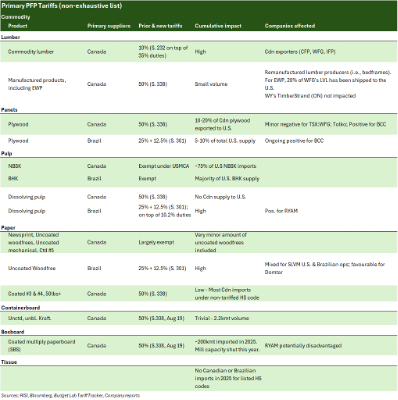
The series of new US tariff announcements include 50% tariffs on ~5% imports from Canada, a 25% tariff on Brazilian imports and 10–12.5% tariffs on virtually all trading partners. The new tariff suites apply to more categories, with the latest possible impact on Canadian exports appearing to be in paperboard and plywood. Although plywood will see some direct impacts (table), public companies in Canada have little exposure. US plywood producers should benefit from lower Brazilian uncoated woodfree imports, although the team expect incremental impact on the names in their coverage universe. Given the inflationary impact on freight/personal transportation from the Iran war, persistently high rates, and escalating domestic energy costs, the team are cautious on the housing market outlook and underlying consumer demand. They see limited benefit to US producers from these latest tariff machinations, with some producers benefiting from one category but hurt by another (e.g., Sylvamo Corp, Rayonier Advanced Materials Inc).
Healthcare
At 30x forward adjusted EPS, DXCM continues to raise multiple earnings-quality concerns, especially when compared to Insulet, which has cleaner accounting and trades on a lower P/E. Insulet’s rebates and sales incentives are 25 days of sales, while DXCM’s have exceeded 100 days in seven of the past eight quarters and continue to reach new highs. Inventory is also rising despite heavier discounting, with finished goods having tripled. Price discounts should reduce inventory value through a higher reserve, but reserve growth has stalled, supporting EPS. Warranty accruals also look low, while flat dollar R&D spend in Q1 added 3c to EPS as a percentage of sales. Other companies reporting next week where BTN has recently flagged earnings-quality risks include Belden, Church & Dwight and Eaton.
Utilities
MTLN’s Asset Rotation Plan and its impact on cash flow remains poorly understood by the market. Renewable-project SPV sales are treated as revenue-generating contracts rather than disposals, allowing MTLN to recognise “catch-up” revenue once a sale is signed, based on management’s estimate of project completion. Contract assets linked to the plan rose from €0.92bn to €1.41bn in 2025, increasing the risk of later write-downs if assumptions prove optimistic. Forensic Alpha also identifies asymmetric cash-flow treatment: development spending can be classified as capex when projects sit in PP&E, while subsequent sale proceeds may enter OCF after reclassification to inventory. Together with similar treatment of CO₂ allowances, they estimate c.€338m of benefit to reported OCF. MTLN is less cash generative than appreciated, leaving liquidity, leverage and refinancing more exposed if project sales slow.
Are E(U) ready?
Examining the Ankara summit, Niall Ferguson delineates an alliance defined by greater European self-sufficiency in conventional deterrence and reduced American forces on the Continent. Niall considers Europe's conventional capabilities sufficient to deter Russia, but warns that the rift in the transatlantic alliance leaves vast capability and logistical gaps to fill before Europe becomes conventionally defensible by 2030. He identifies Washington's plans to reduce force commitments as the most consequential development within NATO, creating an operational window that a recovering Russia could exploit to expose the dwindling credibility of Article 5. For Niall, Europe's greatest vulnerability is the US reduction in logistics rather than combat aircraft, as a shortage of air-to-air refuelling and strategic airlift yields a substantially thinner margin of security. While he places low odds on a conventional Russian attack, Niall foresees Moscow continuing hybrid and covert operations below the politically contested Article 5 threshold.
Industrials
An under-covered EPCO-linked electrical engineer, Toenec is now the cheapest among its peers, trading on <12x P/E with a 3.4% dividend yield. Asymmetric argues margins should continue to benefit as higher-margin private projects increase while pricing on EPCO work also improves. They see substantial order potential in Japan's industrial heartland of Chubu, driven by enterprise digitisation, factory automation, AI-enabled manufacturing, logistics and broader power infrastructure investment, with AI datacentre projects also expected to expand beyond Tokyo and Osaka as costs rise. Earnings have consistently beaten initial OP guidance in recent years. Toenec has raised its MTP 2027 targets and is increasing investor engagement, while any Chubu Electric Power stake reduction could improve free float and governance perception.
Technology
The new market narrative is focused on Arm’s AGI CPU strategy, under which the company targets $15bn of additional FY31 revenue, but AlphaValue sees major execution, customer and market risks. FY26 revenue grew from $4bn to $4.9bn but was heavily supported by related-party licensing and services revenue from a SoftBank affiliate, while external licensing revenue declined. Margins also remain far from the FY31 model: non-GAAP operating margin has stayed in the low-to-mid 40% range, while GAAP margins are significantly lower once share-based compensation is included. AlphaValue also questions whether selling server CPUs risks competing with Arm’s own licensees and undermining its neutral IP model. Even assuming management’s FY31 targets, the shares trade around 40x highly optimistic 5-year-forward EPS vs. 230x current P/E. The stock is disconnected from fundamentals. TP $97.8 (70% downside).
Consumer Staples
The group is caught in no man’s land as the hypermarket format structurally declines and Dutch hard-discounter Action (920 stores across France) dismantles the mid-market. Across virtually every European consumer sector since early 2026, the pattern is uniform: shoppers are aggressively trading down. Inflation has destroyed pricing power. Pierre-Olivier Essig remains sceptical of Alexandre Bompard’s strategy, viewing it as a weaker imitation of E.Leclerc’s model. The dividend is also viewed as increasingly vulnerable. Ahead of H1 results on 23rd July, Pierre forecasts 2026 operating margin down 25bps and top-line/EBIT down 4% LFL. TP €11 by end-2026 (30% downside). Pierre presented his short thesis at our latest Best Equity Short Ideas Conference - click here to listen.
Industrials
An under-covered Japanese small-cap (Asymmetric has been the only one highlighting this stock over the last few years) benefiting from ageing domestic industrial assets, decarbonisation investment, renewed focus on energy security and a shrinking pool of nationwide plant engineering providers (according to management, only Raiznext and Sankyu now have nationwide petrochemical coverage, together controlling c.50-60% of the market). The company has beaten its initial operating profit guidance for each of the past five years, including FY25 OP of ¥14.7bn, 36% above its initial target. Although FY26 guidance implies a 12% decline to ¥13bn, Asymmetric sees this as conservative given management tends to forecast only on projects already in hand. The shares trade on c.13x P/E with a 5.2% yield, while ENEOS’s 28.7% stake creates potential corporate-action optionality.
3 (non-AI) trillion-dollar trends
As we hit the near term financial and physical limits on AI spend, Erik@YWR shifts his focus to 3 non-AI themes with trillion-dollar potential. First, a prolonged state of insecurity in the Persian Gulf could force a structural re-architecture of global energy supply, benefiting alternative routes, LNG, refining, chemicals and infrastructure plays outside the Middle East (e.g. Turkey, Nigeria, US). Second, higher inflation and interest rates could extend the outperformance of DM banks, which remain cheap, under-owned and increasingly important in funding data-centre capex and new energy infrastructure. Third, China, which nobody owns and is at an earnings inflection point. Erik also wonders if Chinese construction companies could benefit from the rearchitecting of the world energy supply or Hong Kong as a financing hub for new infrastructure.
Tanzania: Stuck on stocks, better on flows
Buoyed by higher gold export prices and tourism revenues, Tanzania has made its way to broad external balance on the "basic" BOP front, which in turn has allowed it to stabilize the shilling and lower interest rates. Jonathan Anderson points out that the main risks here are higher oil import costs and a potential reversal in metals markets, but for the time being the country is holding the line. This still leaves Tanzania with a very high stock of external sovereign liabilities relative to dollar earnings, i.e., the country is effectively "stuck" on a long-term treadmill of IMF and other multilateral refinancing support and restructuring of bilateral obligations. The only good news here is that market participation in Tanzania's dollar debt burden is close to zero, which reduces pressure on rates and funding flows during the adjustment process.
Greek Equities: Adopting a more cautious stance
ResearchGreece revisits their stock picks and assesses the political outlook ahead of the next parliamentary elections. Macro conditions remain solid, with Q1 real GDP up 2.0% Y/Y, although inflation accelerated to 5.2% Y/Y in May (+0.0% M/M). With the Athens Index up +11% YTD, valuation multiples of non-banks in their universe have expanded to 13.2x P/E and 8.0x EV/EBITDA 2027, leaving more limited upside. Combined with polls pointing to a hung parliament, ResearchGreece is turning more cautious on Greek equities. Banks remain their preferred exposure (solid outlook - volume, rates, asset quality) as a leveraged Greek macro play. They prefer National Bank of Greece, Bank of Cyprus, Piraeus and Optima. Outside banks, they favour selective infrastructure, industrial and defensive names such as OTE, Titan, PPC and Piraeus Port over consumer stocks and cyclicals.
Industrials
ABM’s 2Q EPS beat was driven by stronger-than-expected revenue growth, with sales up 8.4% Y/Y and gains across all five segments for the fifth consecutive quarter. Technical Solutions, Aviation and Manufacturing & Distribution each grew by more than 15%, supported by organic gains and acquisitions. Sidoti’s FY26/FY27 EPS estimates of $4.03/$4.55 imply annual growth of 17.0% and 13.0%, respectively, while their FCF per share estimates of $4.25/$4.42 imply FCF yields of 10.0%/10.4%. ABM’s shares have traded at an average premium of 5% over the last 20 years to the S&P Small Cap 600 Index on a forward P/E basis but currently trade at a 34% discount. Sidoti maintains their Buy rating and $68 target, implying c.50% upside.
Industrials
EFN’s ~25% share price pullback over the past six months reflects concerns around lagging services revenue, moderating originations and potential AI disruption, but Veritas argues the fundamental impact is being overstated. Services revenue should recover as growth in Vehicles Under Management drives demand with a 12-15 month lag, while softer origination volumes have been offset by higher net financing revenue yields and growth in serviced-only VUMs. AI risk appears manageable, with the most exposed services representing only ~20% of annual delivery, while higher-touch offerings remain more defensible. Despite EFN’s stronger ROE profile, the stock trades below its five-year average P/E of 16.5x. They expect ROE to expand into the low-20% range and believe EFN's valuation multiple should re-rate as services revenue grows to the HSD range.
Defence Supply Chains: Hidden chokepoints, mispriced risk
The Iran conflict is not a regional event - it is a structural accelerant for the global Defence-Industrial Base. OMNISIGHT maps three converging chokepoints: China's gallium export controls (directly threatening F-35 radar integration timelines), Hormuz-driven sulphur disruptions cascading into propellant supply chains, and Qatar helium export risk affecting precision electronics. Combined, these create a butterfly chain that materially compresses production cadences for Tier-1 contractors in H2 2026 - a risk the market is currently underpricing. OMNISIGHT's institutional divergence analysis yields explicit ratings: Accumulate Lockheed Martin and BAE Systems; Hold RTX and Northrop Grumman; Reduce Rheinmetall, where a P/E of 90-100x leaves zero margin for delivery disappointment.
Where’s China’s fiscal crisis?
Things continue to look absolutely awful on the Chinese public sector front. Not only is China already one of the most heavily indebted economies in the EM universe, it also runs ever-widening public deficits. Then there’s the looming pension crisis. In short, claims Jonathan Anderson, this appears to be a disaster in the making. So, why haven’t things exploded? On the one hand, there are already growing austerity pressures in the economy, as local governments hike levies and fees on businesses and push for higher pension contributions. I.e., the fiscal mess is already becoming a drag on activity and growth. At the same time, however, there is no sign of budgetary funding stress. Why? Because the government completely controls both funding costs and flows via its state-owned monopoly in the commercial banking system, which in turn holds virtually all fiscal and "quasi-fiscal" debt. The real question is about the health of banks, not budgets.
US: Warsh’s natural bias
In the last week markets have moved to peg the Fed for about 28bps of hikes in the next year, a substantial shift from the 1-2 cuts priced in late February. Warsh assumes the Chair with a challenge to his natural bias – higher productivity via AI implying stronger GDP growth potential (but less inflation and hence need to hike), weak jobs markets but immigration arguably keeping the U/E rate down (which should point to rate cuts), a tighter and smaller Fed balance sheet (that implies rate cuts to offset) and different measures of inflation (trimmed mean over core PCE which conveniently is lower and implies rate cuts). This set of biases imples that Warsh is more of a cutter than a hiker. While the markets peg the first Fed hike in March 2027, Craig Ferguson thinks that the Fed will get an inflation shock in the next 3-4 months that leads to them hiking in Q3.
AI and Say's Law
Without a doubt, AI is a transformative tech with a strong future. However, Andrew Hunt says that some of the markets’ assumptions appear wayward to him. To “believe” in the AI Boom and in current market valuations, one must assume that the risk-free rate in the economy is at an equilibrium level currently; that there is minimal misallocation of capital occurring; that this is not simply just another credit boom; that forecast rates of likely AI take-up are accurate; and that Say’s Law will prevail (i.e. supply will create demand). Andrew finds evidence that many of these preconditions have likely already been invalidated. In previous manias, the “bell-was-rung-at-the-top” by often esoteric events within the plumbing of the credit system. It remains to be seen whether Mr Warsh will begin a quantitative tightening in the face of rising inflation, or bow to the political realities.
Technology
DSG combines one of the logistics software industry’s strongest network-effect moats with a highly disciplined acquisition strategy. The key differentiator is the company's proprietary Global Logistics Network, which processes >24bn transactions annually and embeds DSG deeply into mission-critical compliance and supply-chain workflows, supporting gross retention in the mid-to-high 90% range and NRR above 100%. Management’s acquisition track record is also underappreciated, with 34 deals completed since 2016 generating >15% RoAIC while maintaining a conservatively financed balance sheet. Based on 12% annual revenue growth, stable‑to‑expanding margins, and an exit NTM non‑GAAP P/E of 22x, 2Xideas forecasts mid‑teens annualised total shareholder returns through FY33E.
US S&P: Feeling good
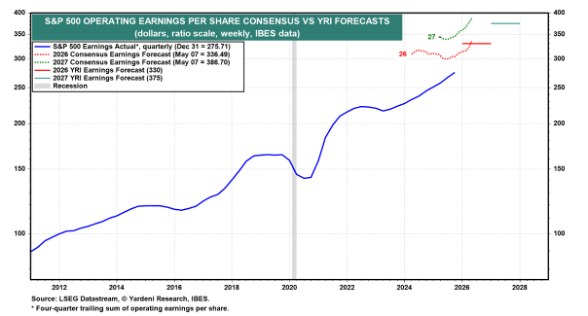
Ed Yardeni is raising his year-end S&P 500 target from 7700 to 8250. He has never seen consensus earnings expectations rise so quickly for the current and coming years as they have in recent months. The result has been an earnings-led meltup in the stock market. Ed is raising his EPS estimates to $330 this year and $375 next year, while sticking with his forward P/E range of 18.0-22.0, resulting in a year-end range for the S&P 500 of 6750-8250. His key assumption is that the economy will remain resilient, and so will earnings. Ed is also raising his probability of a continuation of the Roaring 2020s to 80% from 60% simply by merging it with his meltup scenario (previously at 20%), since he believes that any meltdown will be a buying opportunity and won't trigger a recession or bear market similar to the 1999-2000 Tech Bubble and Tech Wreck.
Consumer Staples
Sprouts Farmers Market reported encouraging 1Q26 results, reinforcing QuoVadis Research’s bullish stance. Revenue, same-store sales, margins, and EPS all modestly exceeded company guidance and Street expectations, suggesting management has regained control after the sharp slowdown experienced in 2H25. The company also deployed all 1Q26 free cash flow toward share repurchases, buying back 1.9M shares at an average price of $73.68, with QuoVadis modeling $500M in buybacks for full-year 2026. While guidance was largely maintained, the EPS outlook was slightly raised, signaling improved visibility. At just 13x P/E and 8x EV/EBITDA on consensus 2026 estimates, the stock undervalues Sprouts’ strong ROIC-driven growth and favorable risk-reward profile.
Innolight: AI optics leader targets H-Share listing
Technology
Aequitas offers an early look at Innolight as it aims to raise ~$5bn in an H-share listing (up from ~$3bn in late 2025), potentially making it one of Hong Kong’s largest deals this year. The company is the global leader in optical transceivers and is benefiting from strong demand driven by AI-related data centre capex. Growth has been exceptional, with revenue up 122% in 2024, 61% in 2025 and a further 192% YoY in 1Q26, alongside margin expansion. With revenue heavily concentrated among hyperscalers and shares already trading at elevated multiples (~37x FY26 P/E), the key question for investors is how much of this growth is already priced in.
Industrials
2Xideas latest deep-dive focuses on APG - a high-quality compounder, supported by market leadership and durable advantages in a regulation‑driven, non‑discretionary end market. Demand for fire protection inspection and maintenance is underpinned by stringent compliance requirements, while low customer cost supports pricing resilience. The group differentiates through national scale, premium service and investment in skilled labour. With significant consolidation runway and a proven M&A playbook, APG is well‑positioned for sustained DD earnings growth. 2Xideas forecasts revenue growth of 7.4% p.a. (2025-2032E), adjusted EBITDA margins rising from 13.2% to 17.9% and cumulative FCF of $7.8bn (~45% of m/cap). Applying a 20x exit NTM P/E 2032E, they estimate total shareholder returns of 12.9% p.a. over this period.
Industrials
Grid constraints threaten to slow data centre construction growth, potentially disrupting STRL’s key revenue growth and margin expansion engine. Early signs are already visible, with decelerating construction data, softer backlog and margin pressure in its core E-Infrastructure segment. The CEC acquisition is a desperate move by management to mask a plateau in its site prep business and expand into Texas ahead of increasing competition. With cash flow moderating (and diverging meaningfully from adjusted earnings), insider selling rising and valuation elevated (~22x EV/EBITDA), OWS is targeting more than 30% downside.
Materials
GMR upgraded KGH to Buy, following the recent pullback, arguing the stock offers a cheaper, lower-risk way to gain silver exposure. KGH is a much larger silver producer than often appreciated, with silver contributing ~26% of 2026 revenues (rising to ~32% at higher prices), supported by stable production and assets in low-risk jurisdictions. GMR forecasts earnings to rise ~70% Y/Y, with a base case of $79/oz silver in 2026, falling to $52 and $47 thereafter. The stock trades on ~7.7x 2026 P/E and ~4.4x EV/EBITDA (vs. ~7-8x for peers), with ~6.3% FCF yield. Valuation becomes increasingly compelling above $60-70/oz silver. Additional support comes from net debt trending to zero by 2028 and declining royalty charges.
Equities downgraded to neutral
Sam Burns has downgraded equities to neutral and raised cash in response to a deterioration in his indicators and increased macro risk and may do so further. Since the beginning of March when the US/Israel-led war in the Middle East started, his Equity Risk Model has deteriorated further, now below the 50% level and thus no better than neutral. While equity P/E ratios have declined, higher bond yields have largely offset the rise in earnings yields, leaving his Implied Growth Model still at elevated levels. Macro uncertainty has surged (again) and investors are focusing on how long and how bad the supply disruption in the Middle East will be – markets expect just a few months, but that timeline is gradually lengthening as escape routes for Trump are reduced. The positives are that earnings estimates are holding up so far, and short-term oversold conditions are in place.
Communications
While the market treats APP as an AI play, Andrew Freedman sees it is an infrastructure monopoly story. APP’s true moat is MAX, its mediation platform controlling >60% of mobile gaming impressions and supplying the auction data that powers AXON - without it, AXON’s performance is materially weaker. Andrew’s analysis includes how the company's 2025 game divestiture created a structural data deficit; why the identity graph is more fragile than the market appreciates; how E-Commerce scaling faces a bifurcated reality; why the mediation monopoly is under attack and the spread is unsustainable; and, how the regulatory cascade creates asymmetric downside.
Technology
The group's competitive moat is anchored by three mutually reinforcing advantages: 1) a proprietary, cloud‑native payments infrastructure with direct integrations into 50+ national payment systems across the world, creating a durable cost leadership position that compounds with scale; 2) a Mission Zero pricing philosophy, that continuously reinvests operational efficiencies and scale benefits into lower prices, driving organic volume growth and deepening customer stickiness; and 3) a growing platform business, which is transforming potential competitors into distribution partners, expanding the company's netting pool and lowering unit costs across the entire network. 2Xideas forecasts 14.7% revenue CAGR and 15.9% underlying income CAGR to FY32E. Assuming a conservative 20x exit NTM P/E, this supports ~17.5% annualised TSR.
Consumer Discretionary
John Zolidis’ investment case is based on a positive inflection in same-store sales producing valuation expansion as investors give more credit to unit growth and the longer-term opportunity. He believes this thesis remains intact as comps improved to -1.4% in FY25 (vs. -5.1% in FY24) and have turned positive in early FY26, with Q1 likely >2%. While the recent >10% share price drop reflects macro concerns and weak transaction trends (-6.4% in Q4), John views this as partly intentional, driven by ~10% price increases and a shift towards higher-income customers. This mix shift should support higher gross profit per ticket despite lower traffic. With the shares trading at 8x P/E and 5x EV/EBITDA (FY26 estimates) and a 9% FCF yield, ASO is a “bargain”, with an eye towards the upcoming analyst day as a near-term positive catalyst.
Communications
While the company likes to describe itself as strongly cash generative, FY25 results tell a different story. Cash inflow from operating activities fell sharply from £333m to £202m. Forensic Alpha also identified several other red flags, pushing ITV’s Risk Score from '8' to '10' (max. rating). Working capital has been a persistent drag, with the headwind widening from £144m in 2024 to £196m in 2025. Trade receivables rose 12% to £500m despite flat sales, driven largely by long-term balances now representing 18% of the total. Contract assets increased 33%, including a jump in non-current contract assets from £4m to £39m. Meanwhile, exceptional charges related to restructuring and M&A rose from £65m to £107m, further weighing on cash flow. For now, the market is focused on the potential sale of the M&E business. If it falls through, attention will shift back to the company’s underlying fundamentals.
Start slowly closing oil positions on any further rise in price
William (Buff) Brown observes that the US/Israeli-Iranian conflict has spread throughout the region with major interruptions in oil transit in the Arabian Gulf, with Iranian missile strikes in neutral Gulf countries, i.e. Oman, Bahrain, UAE, etc. While most were strikes directed against US assets, there were also strikes against civilian areas. With regard to oil transit, Iran has claimed that the Strait of Hormuz is effectively “closed”. However, it is not closed in the sense that Iran is, as of yet, targeting vessels en masse and/or has mined the 2-mile-wide outbound channel. The situation remains highly dynamic, however, and could change one way or another at any time. In any event, with the prompt NYMEX crude oil contract trading above $70.00 per barrel, he suggests maintaining the status quo for the time being, but on any further material price strength slowly begin closing out long positions. He does not recommend going short as prices rise.
South Korea: Words of warning
Jonathan Anderson observes that Korean equities shot up another 50% in the first two months, making Korea the best-performing market on the planet in 2026 so far. He notes that this is heavily due to the AI boom and Samsung, but "domestic Korea" has continued to rally this year as well. However, there's still no support from domestic macro. As before, Korea's economy is flatlining or contracting almost everywhere he looks: durables, construction, retail, credit, earnings. And while exports are rebounding, memory prices still haven't been able to bring Korea back to the EM-wide average trend. Jonathan says it will be hard to motivate further gains in local names. Equity multiples have already eliminated the famed "Korea discount" and continue to rise at the margin, i.e., corporate reforms have already been priced in well in advance of actual results - and there's no sign that the rally is boosting earnings and growth potential as of yet.
Approaching peak AI hysteria
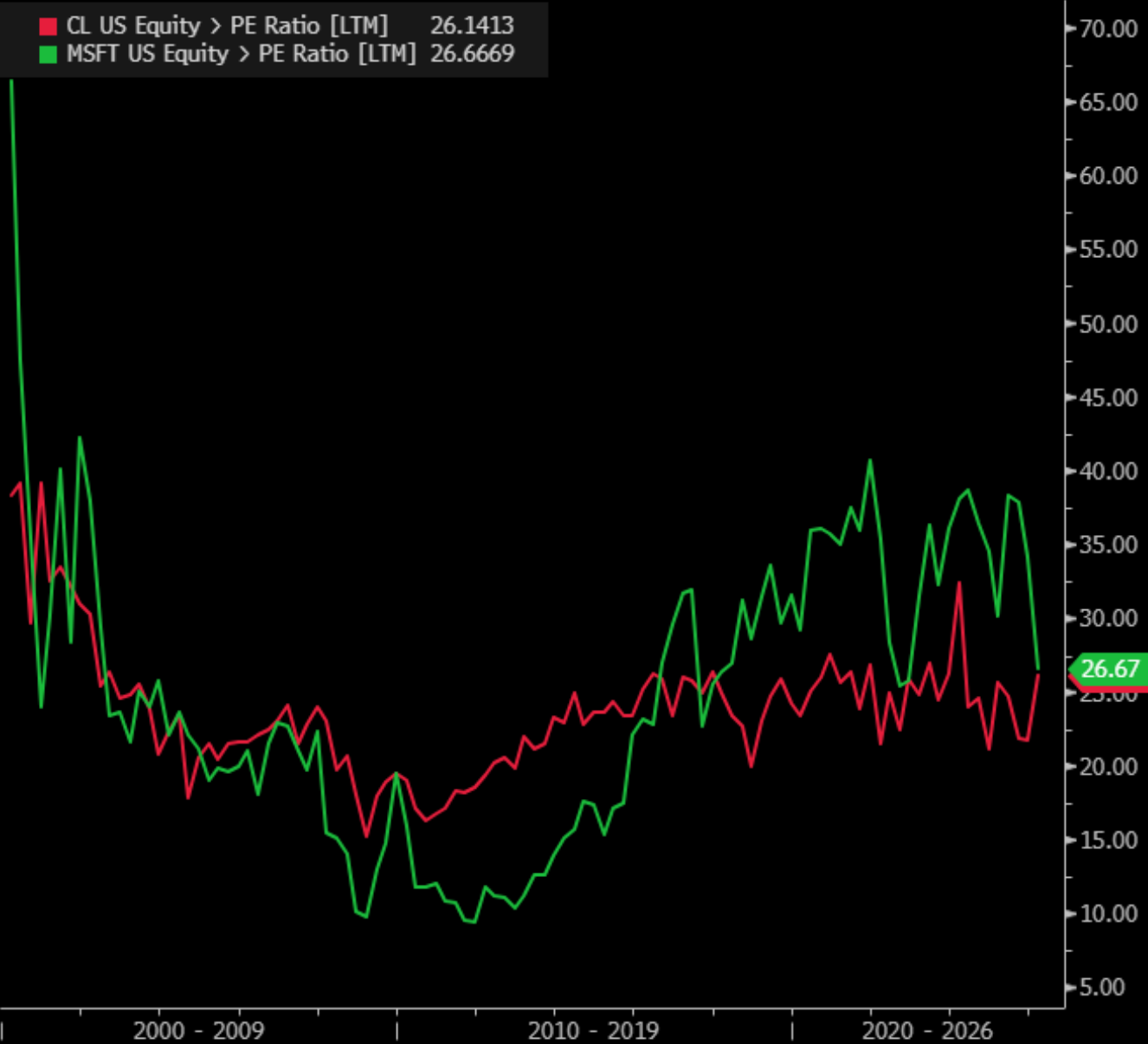
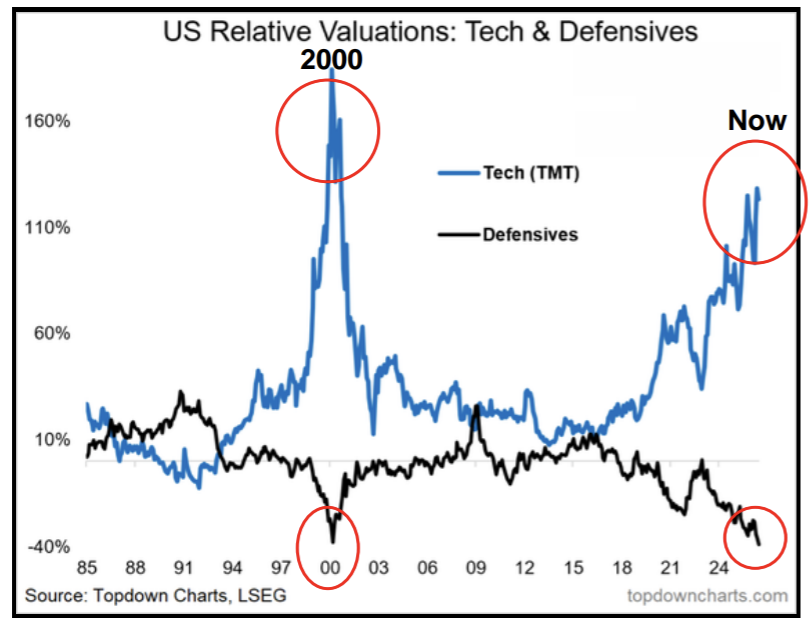
People are gregarious and instinctively follow the impulses of the herd, remarks James Aitken. The past two weeks have been a reminder of the mob mentality, and with dystopian projections on AI hysteria reaching millions of views, James believes we are approaching peak AI hysteria. Just remember when scouring the news: why am I reading this now and who benefits? XAI, Anthropic and OpenAI are all in windows to raise absurd amounts of money at lofty valuations, so it’s no surprise everyone is getting almost daily updates on LLMs about their improvements. DRAM, NAND and H100 rental prices suggest the AI juggernaut and associated memory shortage continues, yet so violent has been the recent shakedown that companies that would seem to have little risk of being disrupted by AI have been smashed, too. Just look at the current P/E of Microsoft (green) vs the current P/E of Colgate (red).
Energy
A large-cap trading at just ~11x earnings, with a ~12% FCF yield and will pay owners a 10% yield in the very near future. The Coterra deal markedly increases DVN’s stature and shale production in the Delaware Basin without incremental acquisition debt, adding ~4,600 high-return drilling locations, nearly half with sub-$40/bbl breakevens. The combined company expects $1bn+ in annual synergies and plans a $5bn buyback, materially lifting FCF/share and NAV/share. Nevertheless, investors have yet to adequately reflect DVN’s improved fundamentals in its share price, with it continuing to trade at a sharp discount to other E&P players in terms of both P/OCF and at a high required FCF yield. For each 0.5x improvement in its P/OCF multiple or a 1pp decrease in its FCF yield, DVN’s share price will rise by ~$5.
Gross margins are rolling over, but net margin expectations remain high
Median gross margins for the Top 500 peaked at 46.4% in Feb 25 and have since fallen to 44.9% in Jan 26, yet bottom-up forecasts imply continued strong net income growth - likely reflecting embedded AI-driven productivity assumptions. Historically, Trivariate finds valuation multiples correlate more closely with gross profit growth than net income growth, implying further multiple expansion will require renewed gross margin strength or a structural shift in how markets reward earnings. Their quantitatively derived longs (e.g. Merck, T-Mobile, McDonald’s) have had recent multiple expansion and are forecasted to have margin expansion, but not more net margin than gross margin expansion. While shorts (e.g. Amphenol, Salesforce, Arista Networks, Las Vegas Sands) screen for gross margin contraction but net margin expansion, reducing estimate achievability.
Consumer Discretionary
The shift from puffer-only to broader fashion outerwear (wool, shearling, fur) has expanded consumers’ wardrobes, with MONC well positioned at the intersection of function and luxury. Its core styles are not overly trend-led, supporting their status as long-term investment pieces with resale value. Pricing sits above Canada Goose and Herno, but below Prada and Loro Piana, sustaining an attractive premium tier. Beyond outerwear, The Retail Tracker sees opportunity in functional yet fashionable handbags (e.g., a travel line between Rimowa and Away). Footwear remains strong but still lacks a viral breakout moment. Meanwhile, early signs of a streetwear revival could lift visibility for Stone Island and help the brand extend beyond its core. Under new leadership, renewed energy in the stock could support a move back towards the 52-week high.
The best FX trade for 2026
In Stephen Jen’s view, USDJPY may be the best (i.e., with the highest Sharpe ratio) FX trade for 2026. With the dominant election victory, Stephen points out that the LDP has enough popular support for PM Takaichi to go through with her 3%-GDP worth of fiscal stimulus. With inflation still above the BOJ’s target (headline CPI is down to 2.1%, but core-core is still hovering around 3.0%), this prospective fiscal stimulus will likely be met with accelerated or earlier rate hikes by the BOJ. Stephen says that the US Fed and the BOJ will continue to converge in 2026, with the former cutting while the latter is hiking. Stephen argues that the US dollar itself is in a structural descent, and the particular policy mix in Japan should lead to a stronger JPY. He still views 125 as a very reasonable target for USDJPY this year.
The Korea rally for 2026?
With the Korean index rallying through year-end, Jonathan Anderson examines the outlook. Part of the trend, of course, is the ongoing massive global IT boom. But, as before, the main story at home is the sharp rerating of the rest of the index; "domestic Korea" jumped dramatically over the past nine months on promises of corporate reforms. There's zero support from domestic macro. Korea's economy is flatlining or contracting almost everywhere Jonathan looks: durables, construction, retail, exports, credit, earnings. As a result, it's hard to motivate further gains. Korean multiples are already converging on EM-wide levels as the "Korea discount" narrows, i.e., reforms have already been priced in well in advance of actual results - and even in the strong success case this may not necessarily impact aggregate earnings and growth potential going forward. In short, at the macro level Jonathan doesn’t see significant upside potential from here.
TikTok’s LatAm move has global reverberations
Report by
Blue Lotus Research Institute
Blue Lotus argues that TikTok Shop (TTS)’s entry into Latin America is the largest e-commerce opportunity in developing countries for 2026. Video and live commerce penetration in LatAm remains <5% of GMV vs. 20-25% in SE Asia, despite larger GMV and strong TikTok engagement - creating a wide opening for disruption. TTS’s traffic advantage is expected to pressure incumbent margins, particularly MercadoLibre and Sea, while driving logistics upgrades. J&T Express emerges as a key beneficiary, with LatAm filling a growth gap as China and SE Asia slow. Blue Lotus also sees strategic upside for Kuaishou, partnership optionality for Grab and longer-term opportunities for Alibaba to reposition internationally.
Consumer Discretionary
A debt-free company with robust cash flows, CHWY boasts a dominant and growing market share in an industry that is not only adding customers each year but also seeing rising spend per customer. KCR - former bears now turned bullish - highlights CHWY’s resilient, subscription-heavy model, with 84% of revenues recurring, strong demographic tailwinds and a fully built, highly automated fulfilment network that drives meaningful operating leverage as volumes scale. Despite offering better growth prospects and carrying lower risk, CHWY trades at ~21x forward P/E, a ~10% discount to the S&P 500 and at <19x EV/adjusted EBITDA vs. ~25x for the index. With margins at ~5.4% and a credible path towards 10%+, each 100bp margin gain could add ~$6 per share, supporting a compelling re-rating case.
Argentina holds the line
So far so good, claims Jonathan Anderson. Not only is the post-election government holding the line on the budget, it is also maintaining the sharp policy changes of last summer, i.e., tight quantitative monetary conditions, positive real interest rates and FX market liberalization. There’s no "landing" yet. Overall credit is still growing at a 50%-plus y/y annualized pace, with inflation also stuck in the 30%-35% y/y range on a sequential basis. And the external balance is worsening again as demand pressures continue to build. There’s still work to do after all. Even so, Jonathan is taking NDF peso exposure. The forward market is pricing a dramatic peso depreciation over the coming quarter, which seems unlikely under current macro conditions, and the team are taking a tactical position here. By contrast, Jonathan remains on the sidelines in the dollar sovereign and equity markets.
From tightening to tailwinds
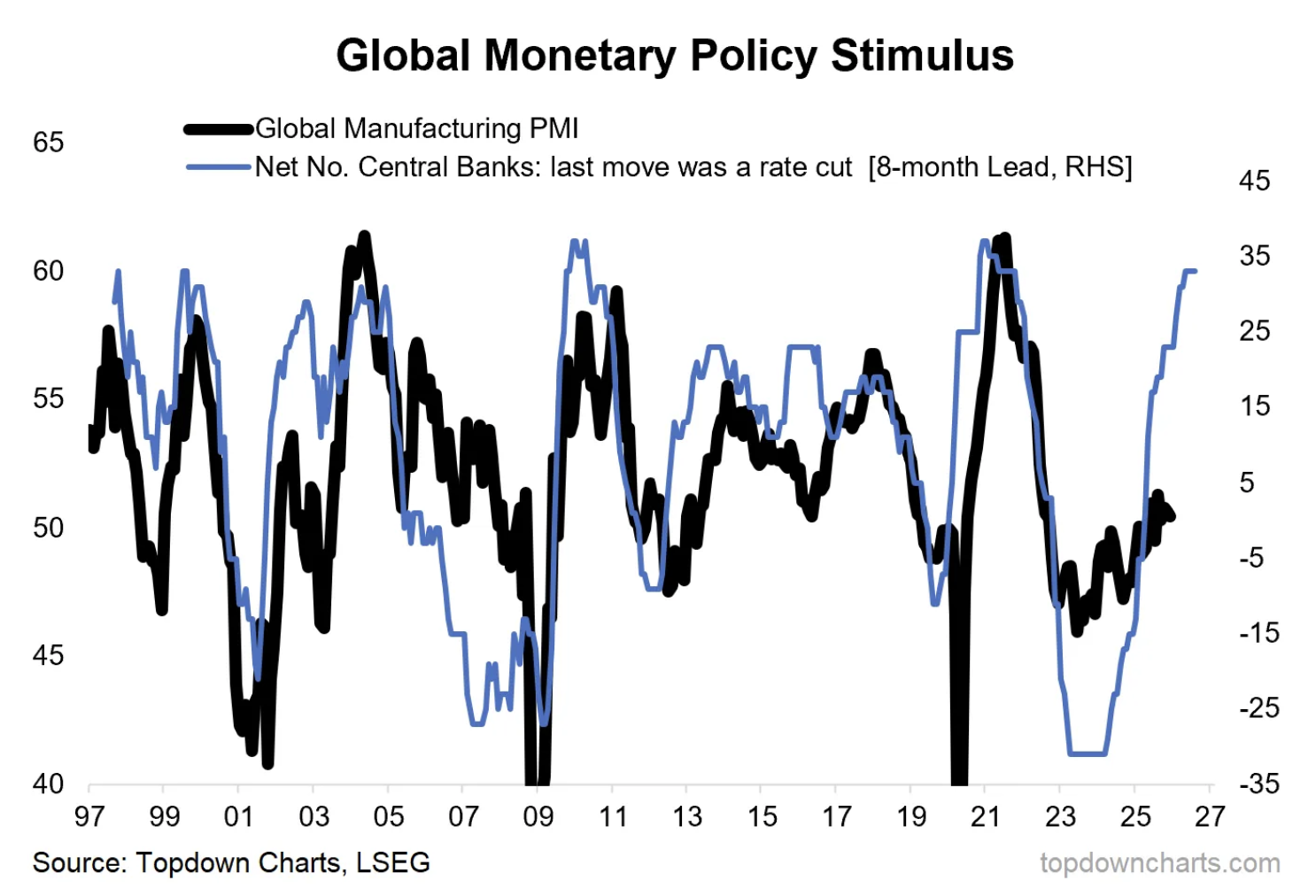
Callum Thomas says that the biggest story in macro of the 2020s will echo on into 2026, with monetary policy going from tailwind in 2020 to tightening in 2023, and back to tailwinds again now. This is coming at a time where nascent signs are showing an upturn in the macro pulse from previous stagnation (e.g. the global manufacturing PMI). Callum points out that the path laid out by the monetary policy leading indicator in the graph below is a very interesting one indeed, and it’s not the only sign. The OECD leading indicators are also pointing to a major improvement in the global economy. Aside from monetary tailwinds there are several other factors working into this thesis such as fiscal stimulus, thematic capex, inventory cycles, and so-on. But there are a couple of logical flow-on effects we need to watch should this play out as planned. One key flow-on will almost certainly involve inflation resurgence.
Technology
Arete upgrades SAP to Buy, citing improving demand visibility as the ECC end-of-support deadline drives renewed urgency around S/4 and cloud migrations. Based on their CIO and partner checks, sentiment towards SAP has improved in 2025 vs. 2024, especially in the last few months, with more customers accelerating or restarting migration plans. While large-enterprise resistance persists, RISE adoption has shown clear signs of improvement. Arete sees limited displacement risk from GenAI, which CIOs view as years away from impacting core enterprise platforms; instead, GenAI may act as an indirect catalyst, easing migrations via automation and code clean-up. Applying a ~30x P/E multiple to their higher FY27E EPS yields a new €270 FY26 TP, implying 30% upside.
Industrials
the IDEA! remains bullish on INPST following the announcement of an indicative proposal for a potential takeover. Looking at interested parties, European logistics peers risk facing antitrust hurdles, while e-commerce platforms such as Amazon or Vinted are unlikely to acquire the group outright. Private equity is viewed as the most plausible route, offering long-term capital, strategic support and operational flexibility. A consortium including PPF, Claure Group and Advent would already control ~38% of shares, with INPST CEO Rafal Brzoska’s 12.5% stake potentially tipping control. Re. valuation, the IDEA! sees EUR 16.00 (IPO price) as a floor for any deal, with their DCF analysis suggesting a potential value of EUR 18.12 per share, reflecting INPST’s substantial growth potential and European leadership in OOH deliveries.
The next financial crisis
That we live in a hyper-financialised world is not in dispute, but James Aitken cannot see the net benefits to society from changes like Kalshi, which monetise differences in opinion. He argues that over the long run, monetising any difference in opinion will create negative utility due to the externalities of normalising the idea of betting on everything. And one would think that these betting markets are enormously susceptible to manipulation by state actors; yet such is the path we are on. So what? James says he isn’t tilting against the windmill of the ongoing, hyper-financialisation of everything. Instead, he suggests that the path to the next financial crisis won’t run through (e.g.) private credit, geopolitics or whatever, but instead it will run directly through market structure, period. What happens when, for any period of time from minutes to hours to days, all the machines that intermediate 1x, 2x, or 3x levered ETFs, prediction markets, 0DTE, bonds, stocks etc. decide ‘computer says no’?
Real Estate
JSB is defying Japan’s demographics. Despite the shrinking pool of 18-year-olds, Yuka Marosek argues the student-housing leader continues to compound growth thanks to rising university enrolment, a structural shift away from general rentals toward purpose-built student housing and JSB’s unmatched operational moat. While foreign-student demand adds another tailwind. The company runs ~99,300 units with 18 years of 98%+ occupancy and 11 consecutive years of revenue/profit growth. Valuation-wise, JSB trades at an EV/EBITDA of 8.3x and a P/E of 14.4x - levels that appear low given the group’s ability to deliver steady growth.
Consumer Discretionary
Alibaba’s stepped-up AI investment is pressuring margins, but RFM argues it has now hit critical mass in open-source AI, making it the leading contender in China’s artificial intelligence race. Headline revenue growth in Q2 was only +5% Y/Y, but was +15% adjusting for disposals. The standout was Cloud Intelligence, +34% Y/Y, powered by surging demand for AI services. Qwen now has 180,000+ models on Hugging Face, more than double the No.2 player, giving Alibaba the network-effect scale needed to dominate China’s AI ecosystem. With core e-commerce stabilising and shares far cheaper than Amazon (17x FY26 P/E vs. 29x), RFM sees sentiment turning decisively positive.
How to beat the S&P500 - the Q&A that matter
Trivariate examines six core issues for long-only managers benchmarked to the S&P500: 1) Beta: despite long-term data favouring sub-1.0 beta portfolios, this is currently nearly impossible given the high-beta “Great 8”. 2) Alpha vs. Risk: ~75% of holdings should be for risk management. 3) Diversification: run both a broad risk book and a concentrated alpha book - essentially two portfolios in one; holding a higher number of stocks vs. history. 4) Position Sizing: take large, conviction-weighted bets in names with high company-specific risk / hard to replicate (e.g. Healthcare). 5) Blow-up Avoidance: avoid large exposures to bottom-decile FCF converters, large increases in inventory-to-sales, large intangible accruals and extreme valuations. 6) Macro: portfolio managers must consider what set of macro conditions are best for their portfolio performance.