Materials
After estimate cuts in recent months, Frank Mitsch sees a meaningful change in direction at Dow. Successful price increases at the end of Sep, improving margin expectations and self-help measures helped support Q4 EBITDA guidance of $1.5bn, ~9% above consensus. He also sees signs that Chinese customers are beginning to return after a period of inventory drawdown, with spot PE pricing up sharply, while feedstock dynamics and the US natural-gas versus oil advantage provide further support. Despite this improving backdrop, Dow’s share price is back near pre-Iran-war levels even though 2026 and 2027 consensus earnings are materially higher than they were then. Frank argues that a stronger balance sheet and rising near-term profitability deserve more than the ~5.5x EBITDA multiple currently implied, with a ~4.6% dividend yield providing additional support.
Consumer Staples
BID remains an attractive way to play the structurally resilient shift towards eating out of home, with scaled distributors capturing more of the economics than restaurant operators themselves. Foodservice demand has compounded through the financial crisis, Covid, inflation, delivery apps and GLP-1 adoption, while barriers to entry in broadline distribution remain high because of route density, cold-chain infrastructure, purchasing scale and technology. BID combines that structural backdrop with record FY26 trading margins, light gearing, strong cash generation and a proven bolt-on acquisition model. Europe remains the main profit engine, while the UK offers the largest margin upside. Despite this, the company trades at just 16.5x FY26 P/E vs. materially higher US peer multiples.
Technology
SITM is approaching an important competitive inflection as its MEMS timing products increasingly meet the low-jitter requirements of high-speed AI networking, while retaining advantages in stability, programmable frequency control and integration. Rosenblatt expects a clean beat-and-raise quarter, forecasting Sep/Dec revenue of $300m/$325m, while seeing substantial operating leverage as the business scales: every additional $50m of revenue adds ~$0.90-1.00 to FY28 EPS and each 100bps of operating-margin expansion adds ~$0.50. With consensus assuming only ~31% incremental EBIT margins, Rosenblatt sees room for further earnings upside. Yet the stock trades broadly in line with premium semiconductor peers despite stronger growth (forecasts sustainable 20-25% long-term revenue growth) and superior gross margins. TP $750 (50% upside).
Technology
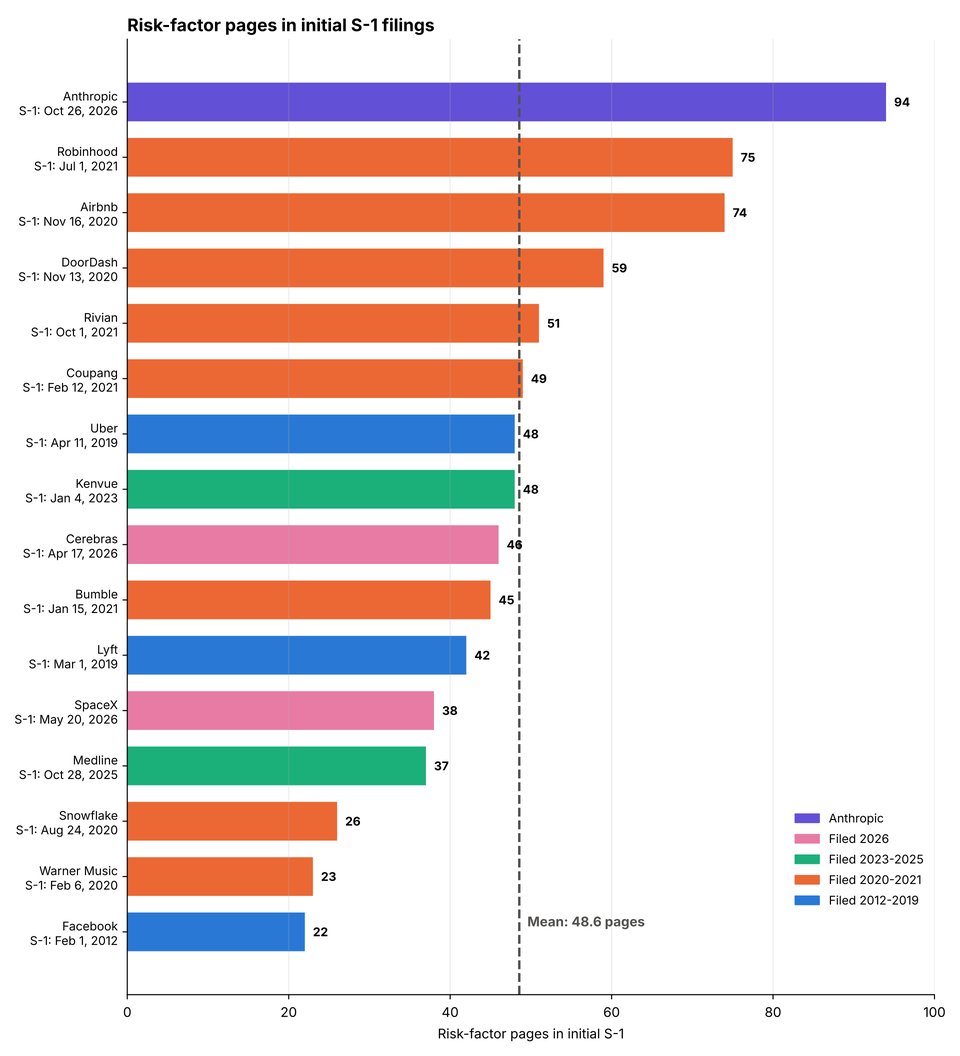
Anthropic’s S-1 contains one of the most extensive risk-factor sections footnoted has seen in a major US IPO. The company devotes 93 pages to risks, nearly twice the average for large US listings and well above recent IPOs such as Cerebras and SpaceX. The section has also grown materially from the 78 pages disclosed in Anthropic’s July filing. Several individual risks run for multiple pages, including constraints on compute availability and the possibility of models behaving in unintended, misaligned or autonomous ways. footnoted cautions that their comparison is not exhaustive across every S-1 filed since 2001 (when the SEC’s electronic repository of historical filings began), but among major IPOs over the past two decades, Anthropic stands out clearly for the scale of its risk disclosure.
Communications
Craig Huber sees OMC’s Q3 results as further evidence that AI is not disrupting the top line, with organic revenue growth accelerating to 7.2% - the best quarterly performance since 4Q22 and, excluding the post-Covid rebound, since 3Q11. Adjusted EPS rose 22% Y/Y to $2.73, while adjusted EBITA reached $1.13bn and margin expanded to 17.6%; on a pro forma basis, core margin improved 200bps as Interpublic synergies and stronger organic growth outweighed reinvestment in technology and agentic AI. Craig now forecasts 2026-28 organic growth of 5.8%/5.0%/4.5%, EBITDA of $4.58bn/$4.85bn/$5.33bn and core EBITDA margins of 18.1%/19.0%/20.0%, with adjusted EPS of $10.33/$11.80/$14.40. He sees attractive risk/reward with the shares trading at just 7.0x/5.7x 2027/28E adjusted EPS. 12-month TP $100 (25% upside).
Technology
ASM’s results were well ahead of expectations, but the bigger surprise is the outlook: the upward revision to this year’s revenue forecast pales beside 2027, where ASM is projecting growth of at least 35%. Demand remains supported by AI-related investment and customer capacity ramps, with strong activity at 2nm and 3-5nm and the first meaningful contribution from 1.4nm. Its served available market at 1.4nm should increase by a solid double digit vs. 2nm, alongside higher market share. the IDEA! also expects substantial operating leverage next year, with gross margins benefiting from newer systems and opex lagging revenue growth, driving adjusted operating income up ~50% to just over €2.0bn. At ~15.5x EV/EBIT, they see the valuation as very modest, underpinning a highly attractive investment case.
UK: Rate expectations too high
Darren Winder believes that current market interest rate expectations are materially too high and can be expected to be revised down in due course. Monthly GDP increased by 0.7% in the three months to August, outpacing growth of 0.6% in 2026 Q1 and 0.5% in Q2. Even if output fell by up to 0.2% in September, Q3 growth would be higher than Q2, leaving four-quarter growth close to 2%. Assuming a 0.3% uptick in Q4, output growth in 2026 as a whole would reach 1½%, beating 1.2% in 2025 and the OBR Spring Statement forecast of 1.1%. Information and Communications output rose 6½% year-on-year, standing 40% above pre-pandemic levels, while manufacturing was up 2% and construction remained broadly unchanged. Lower household saving and continued strong investment offset inflation and interest rate pressures, with Darren projecting real GDP growth averaging around 2% in 2027 as inflation drops to 2%.
Consumer Discretionary
Management was clear that market conditions have deteriorated over the past 3 months, with higher interest rates, inflation, gas prices, and tougher housing affordability. Yet Lennar Corp persists with increasing incentives and sacrificing margins to maintain even-flow production. This strategy risks slow-motion financial “suicide”, as there is no natural bottom to margin degradation when chasing demand at affordability. This pressure stems from their land bank structure; unable to renegotiate take-down pace, Lennar must buy lots and burn inventory or incur higher option fees. FY26 EPS is forecast at USD4.80/share (down from USD5.47/share), with FY27 lowered to USD4.54/share (down from USD6.38/share) as margins compress under 7% interest rates. LEN trades at 16.3x FY26 P/E vs 16.1x for peers, and 1.04x adjusted tangible book value vs 1.35x for the group. Fair value estimate is USD68/share vs GAAP book value of USD91/share.
Industrials
Following analysis of its FY25 annual report, Ed Steele and Shailja Periwal trim their Sandvik AB score to 23/60 from 25/60, principally reflecting FY25's much reduced level of stripped-out restructuring expense. Ed and Shailja calculate that stripped-out costs represented 4% of PBT adj in FY25 (ex M&A-related items) down from 13% in FY24, whilst stripped-out restructuring costs fell to 2% from 11%. Offsetting, they flag compressed balance sheet bad debtor and inventory impairment provisions, with bad debtor provisioning falling to 3.1% of gross receivables, a 10-year low. The gap between provisions expensed above the line and used or released moderated to 3% of PBT adj. Governance concerns persist: only three of ten directors clearly meet independence requirements, non-audit fees to PwC remain above average at 15%, and whistleblower reports rose 19% to 518 cases with a higher substantiation rate.
Technology
Global Mining Research upgrades First Quantum Minerals Ltd from sell to hold, arguing that severe peer underperformance leaves investment metrics more compelling, while headline confusion over Cobre Panama obscures what appears to be a preference for a new operating agreement. Although news agencies latched onto the Commission’s recommendation for an “orderly closure”, the report is clear that the state cannot afford to fund closure or international arbitration, with First Quantum retaining the right to recommence ICC proceedings (>USD27bn). GMR assumes no full restart and continues to ascribe a conservative USD2bn risked option value (a 1 in ~5 chance). A recommissioning phase treating 38Mt of stockpiles offers a potential window until ~2H 2027 to reach an agreement, while the environmental audit failed to identify any material non-compliance. On this basis, the shares trade at 1.1x spot P/NPV10, 9.2x 2027E EV/EBITDA and a 4.7% FCF yield, with net debt/EBITDA falling to ~1.4x by 2030E. David Radclyffe sets a 12-month target price of C$39.60 and rates the stock HOLD.
Greek Banks: Solid fundamentals, less valuation headroom
Financials
Ahead of Q3 reporting, ResearchGreece notes that Greek banks offer solid fundamentals driven by high-single-digit volume growth, rising fees and healthy asset quality. However, with the sector trading at 1.59x and 1.46x P/TBV for 2026 and 2027 while offering 5.5% to 6.7% distribution yields, there is less valuation headroom. The firm favours National Bank of Greece SA, Bank of Cyprus Holdings PLC, Piraeus Bank SA, and Optima Bank SA. NBG and BoC are preferred for their straightforward balance sheets, strong capital ratios, and high distribution yields. Optima leads across almost every profitability component with superior earnings growth, while Piraeus offers a compelling risk/reward profile. Sustaining business lending above €9bn a year could prove challenging despite European funding initiatives. NBG and BoC earn OWN IT ratings with TPs of €19.3 and €12.2, while Piraeus and Optima hold TPs of €11.1 and €14.6 respectively.
Consumer Discretionary
Bennett Cheer sees Domino's Pizza Inc as an active short ahead of the 3Q print, citing diminishing returns from promotional discounting, deteriorating run rates, and the absence of a credible driver for a back-half inflection. September's pullback in national deals exposed severe promotional reliance; card transactions plunged 430bps QoQ and foot traffic decelerated 340bps to 1.0% YoY as order counts broke down. Domino's operates as a barbell on order count and ticket, but Bennett warns that trading order volume for ticket squeezes franchisee profitability, supply chain volumes, and unit economics, with international operations offering no offset. Management already trimmed US net new store targets to ~175, and adding units into slowing comps risks cannibalisation. With 3Q US same-store sales tracking at -0.2% versus consensus at 0.73%, the full-year low-single-digit guide appears untenable. He models 2027 EPS at USD19.99againsttheStreetatUSD20.82; a multiple derating from 14.5x to 13.0-13.5x PE indicates downside to USD260toUSD270. Rating: Best-idea short.
US Midcaps, two years on
Industrials
Kailash Capital Research argues that midcap allocations have shrunk to an unprecedented 19.4% of the Russell 1000, setting a fresh six-decade low beneath the dot.com trough. Although the relative trade lagged by 3.6% since year-end 2024 (Russell 1000 up 32.3% vs. 28.7% for midcaps), valuation spreads have stretched right back to dot.com peak extremes. The Russell 1000 trades at 3.3x sales (the 99.9th percentile historically) versus 1.7x for midcaps, leaving the relative price-to-sales multiple at 1.9x. Crucially, the largest 50 stocks trade at 6.0x sales, matching the dot.com record of 3.5x the midcap sales multiple. Sector concentration has also intensified, with IT expanding to 36% of the large-cap benchmark, whereas midcaps offer broader US economic exposure led by Industrials at 17%. Kailash Capital Research reiterates funding midcaps by trimming mega caps, ranking AES Corp (AES), Cheniere Energy Inc (LNG), Popular Inc (BPOP), Axis Capital Holdings Ltd (AXS), and Halliburton Co (HAL) at the top of their 25-stock screen.
Muted US tariff relief fails Canadian lumber
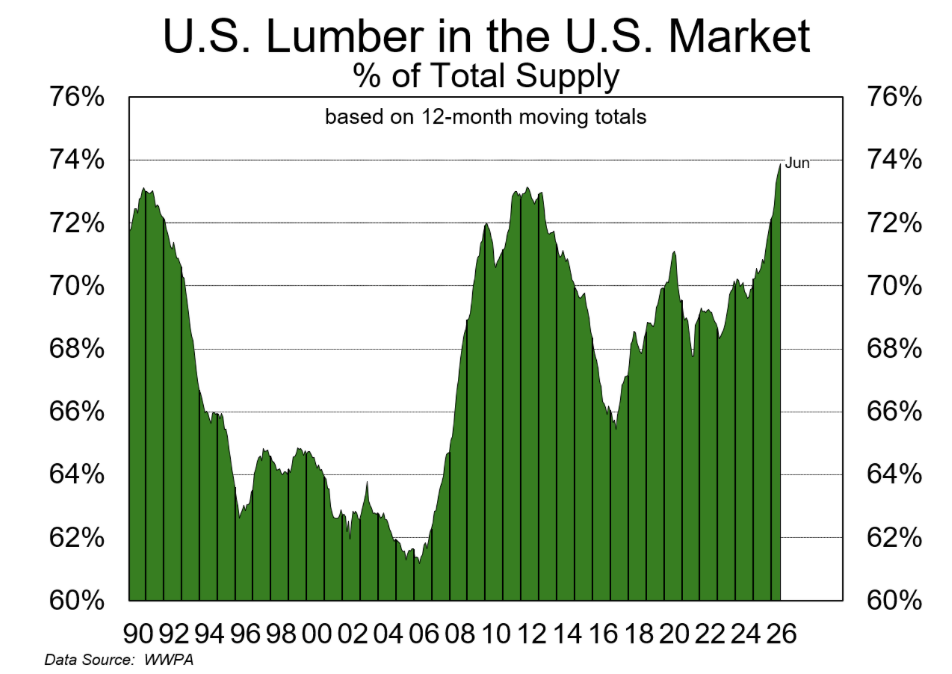
A ~10% reduction in combined anti-dumping and countervailing duties will not trigger a wall of wood across the 49th parallel, as Canadian exporters confront slumping demand and elevated structural costs. Following the US Department of Commerce seventh administrative review, final rates broadly match preliminary figures, lowering the combined All Others rate by roughly 50bps and WFG by almost 1%. However, with 10% Section 232 tariffs remaining in place, the combined duty and tariff burden hovers around ~35%, leaving US market share at a new high. Median cash costs for Northern BC commodity sawmills fall from USD530 to approximately USD495, still well above current Western S-P-F 2x4 prices of USD450. While lower-cost mills in Alberta, Ontario, and the Maritimes may pull back into the black, caution remains urged on Canadian lumber names against rising mortgage rates and slowing US homebuilding activity.
Paybacks aren’t the impediment
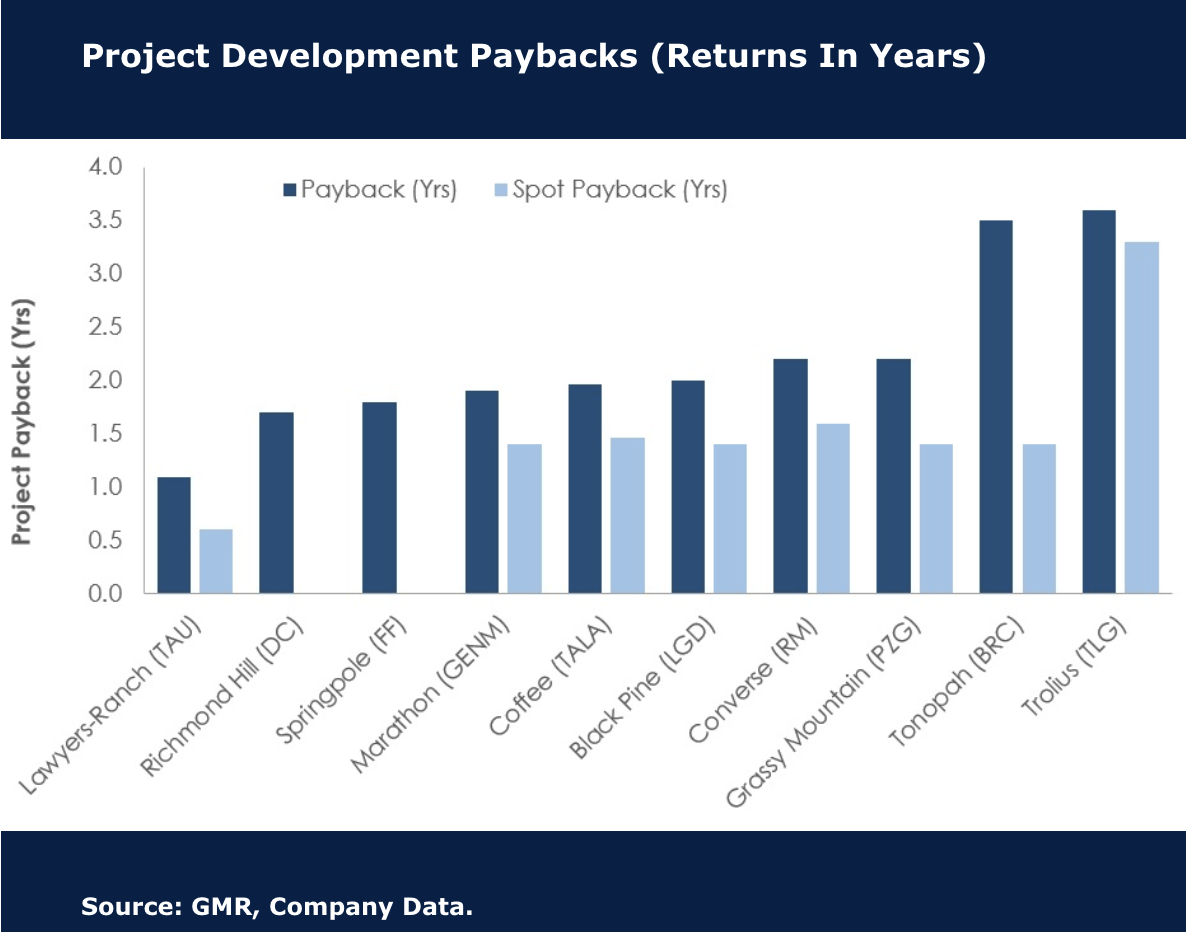
Paybacks aren’t the impediment to production growth across precious metals and copper, writes David Radclyffe following the Mining Forum Americas in Colorado Springs. Across ten sampled developers, base case paybacks averaged ~2.2 years (ranging from ~1.1 to ~3.6 years), falling closer to ~1.6 years at spot prices or US$4,000/oz. These low paybacks imply robust IRRs and favourable NPV/capex ratios, confirming that financial return metrics are not restricting development; rather, study completion timelines and permitting processes remain the key bottlenecks. Meanwhile, structural inflation has elevated capital intensity, which averaged >US$100M/Mt of annual processing capacity. Simple open pit heap leach projects sat at the lower boundary, whilst small underground operations with complex cyanidation exceeded >US$250M/Mt, and Grassy Mountain surpassed >US$300M/Mt. Radclyffe concludes that whilst spot economics provide compelling incentives to advance discoveries into production, statutory permitting, social licence, and study timelines ultimately dictate development schedules.
Contained pain in European credit
Long credit is fundamentally an embedded short volatility position. As realised and implied volatility rises, there is some pressure on some parts of the credit markets, corporate bond prices down, credit spreads wider. James Aitken notes the iTraxx Europe Crossover Index is at 315 basis points, out from 240 basis points in early July, but the acute strain sits where one or two leveraged players have been heavy sellers of the first loss tranche (0%-10%) and recycled the premium received into other credit exposures. The recent mark to market on these short credit protection exposures has been rough, ditto the decline in Virgin Media and Multiversity bonds. However, James expects it is not a systemic issue; the two most aggressive leveraged players hold abundant capital, maintain stable clients, and one just raised another USD$1.5bn. Expected European nominal GDP growth picking up means you cannot quit on European credit. Overall, it should be ok.
Argentina: An entry point in credit
Economic activity plummeted 2.9% mom and 1.4% yoy in July, an unusual reading driven by one-offs that will revert. Marcos Buscaglia expects activity expanded nearly 1% yoy in August alongside a strong seasonally adjusted recovery, before edging up more slowly in September. Output volatility reached 1.6 times historical levels during 2026, explained statistically by sector swings and net taxes, with tariff adjustments and fiscal policy serving as primary drivers. Marcos cuts his 2026 GDP growth forecast to 2.0% to mark to market July’s plunge, leaving the third quarter likely to signal recession absent upward revisions. Yet the ex-primary economy should stabilise or expand marginally, aided by expansionary monetary policy, low real ex-ante rates, provincial spending, soaring exports, investment spillovers, and ending inventory drawdowns. The recent sell off provides a good entry opportunity in credit as fundamentals remain very strong.
EPS drives equities as markets derate
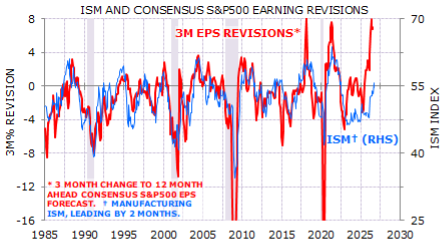
Gerard Minack reviews the continually rising forecasts of corporate earnings forecasts, which are supporting global equity markets that are now derating. Markets started to derate because the AI earnings boom is unlikely to be sustained. It is also typical for equities to derate in tightening cycles. The derating in the AI boom is a contrast to the valuation-driven TMT cycle. US equities have underperformed since early 2025, despite America’s AI leadership. The fact is, AI doesn’t make money, selling to AI companies does. Meanwhile the sell side keeps revising up its earnings forecasts. The US upgrades over the past 3 months have only been matched in the post-Covid rebound and after the Trump corporate tax cut (Exhibit 1). Equities now face a new headwind: monetary policy tightening. All three G3 central banks – the Fed, ECB & BoJ – have hiked this month. Gerard notes it’s typical for equities to derate as central banks tighten. If the AI trade falters, there could be an extended reversal for growth.
Materials
Just three months after GMR warned that NST looked vulnerable to a takeover, Gold Fields has made an unsolicited A$27/share bid at a 22% premium. They identified GFI as one of the more logical strategic buyers, and the combination scores highly on GMR’s M&A rationale framework given the asset overlap, potential synergies, combined production of 4-5Moz/year and greater Australian weighting for GFI. NST has rejected the proposal as opportunistic, but at just 0.58x spot P/NPV5 it remains one of the cheaper large-cap gold names despite producing more than 1.5Moz annually and owning high-quality assets. GMR now asks whether this is simply the opening salvo, while pressure will be on the new CEO to deliver KCGM and show value within the portfolio.
NSE IPO: It’s not running away
Financials
At its IPO price of ₹1,785, NSE was valued at ₹4.42tn (US$46bn), equivalent to 40.8x Sree Capital’s FY27E earnings estimate. Despite its dominant market position, selling pressure remains even after listing. Derivatives regulation, CAS, RBI funding restrictions, competition from BSE / MSE and the potential NCL structural issue remain key overhangs. Future share-price performance will depend heavily on how the regulatory landscape for derivatives evolves.
Healthcare
Foveal has published a new PCVX / VAX-31 note ahead of the OPUS-1 adult pneumococcal vaccine readout expected later this month. They have gone serotype by serotype across the key comparisons with Merck’s PCV21 and Pfizer’s PCV20, assessing where VAX-31 is most likely to beat or miss management guidance, how material those deviations could be, and the adult IPD burden associated with each serotype. They identified a few areas where they think the likely read-through is not fully reflected in the current market framing, without this being a simple binary upside / downside event.
Ageing well & growing strong
Healthcare
An ageing US population provides a powerful structural tailwind for this healthcare-services company, with demand also supported by rising behavioural-health needs. New Constructs’ thesis is backed by a long record of execution: revenue and NOPAT have compounded at 8% and 11% annually since 2006, while Core Earnings have grown 12% compounded annually. The company improved its NOPAT margin from 5% to 9% in the TTM even as invested capital turns fell from 1.5 to 1.3. Rising NOPAT margins offset invested capital turns, driving ROIC from 8% in 2006 to 12% in the TTM. More recently, revenue and NOPAT have still compounded at 8% and 9% since 2021. With admissions and revenue per admission rising, strong FCF and shareholder returns, New Constructs sees a rare combination of durable demographic tailwinds, improving economics and a cheap valuation.
Consumer Staples
Q2 was another strong quarter, with sales up 19% Y/Y and earnings up 85%. Management cut FY EBIT guidance by 4% on higher input costs and outlined €127m of gross capex to double production capacity by 2028 and triple it by 2030. The key point, however, is that capacity - not demand - is increasingly the constraint on growth. ResearchGreece upgrades the stock to OWN IT and raises their target price to €41.3 from €25.1, arguing their previous DCF horizon to 2030 failed to capture the company’s higher-for-longer sales growth potential. They extend the DCF to 2035, assuming 2026-35 sales, EBITDA and net income CAGRs of 13-14% and FCF conversion of 65-68%, with their 10% WACC and 3% terminal growth rate unchanged.
China: Beijing’s monetary policy dance
Dinny McMahon points out that Beijing has promised to support the economy with “counter-cyclical adjustments” to its monetary policy – but he is confident this won’t include rate cuts. This is because the PBoC is desperate to preserve bank net interest margins (NIMs), which slipped to 1.41% at end-June as bond-market migration drove early loan repayment and repricing. Relief instead flows through two channels: large firms migrating from bank loans to cheaper bond financing, and smaller firms getting interest-rate subsidies and relending quotas. This policy support is generous and underused, so Dinny expects Beijing to focus on deployment and maintaining liquidity in the bond market. He expects 10-year Chinese government bonds to trade at 1.6-1.8%, with H2 liquidity needs managed via open-market operations and the PBoC’s medium-term lending facility. This is because an RRR cut would either erode bank NIMs or flatten the yield curve as banks deploy the freed liquidity into long-dated bonds.
China: August macro releases were mixed
Industrial production in China beat estimates but consumption and investments deteriorated further. Industrial production rose 5.2% y-o-y in August and 5.3% in 8M/26, led by high-tech and export-oriented manufacturing. Retail sales growth slowed for a second consecutive month to 0.4%. The main drags were automobiles, gold and furniture, partly offset by communication devices and tobacco and alcohol. Fixed asset investment (FAI) contracted 7.2% in 8M, decelerating for a sixth straight month. High-tech FAI was the sole bright spot at +5.2%, but was outweighed by declines in infrastructure, manufacturing, and property investments. Private investment (-10.1%) continued to lag public investment (-3.6%). The surveyed jobless rate edged up to 5.3%. In the property sector, residential property sales fell 13.1% y-o-y in 8M/26, while property investment slumped 19.9%. New home sale prices decreased 0.17% m-o-m in August. Only 21 of 70 cities recorded stable or higher new home prices. A durable recovery in property investment is unlikely before prices stabilise and inventories normalise.
Brazil: Fiscal reform will anchor duration
Niall Ferguson is bullish on BRL/USD and local currency duration, arguing that Brazil's sovereign debt market is exhibiting signs of deep distress with the government debt market flashing red. While Brazil's fiscal trajectory appears unsustainable, analysts believe investors will start questioning the direction of travel absent reform, yet they maintain high confidence that whoever wins the presidential election - Luís Inácio Lula da Silva or Flávio Bolsonaro - will focus on fiscal adjustments. Unlike in pre-Milei Argentina, a long-established political consensus exists not to let the plane crash into the mountain, leaving default extremely unlikely at under 1%. Niall views Brazilian local rates as offering attractive risk-adjusted returns, with shallow fiscal reform emerging as the most probable post-election path. With term premium differentials driving their real effective exchange rate model, Niall sees limited downside risk and recommend positions across local currency duration and BRL/USD.
US: Billionaire politics
Charles Hess observes that megadonors to this year’s US political campaigns favour Republicans by about 4:1. According to estimates reported in the media, billionaire donors are contributing $844.5bn to Republican campaigns, while they are providing $211.9bn to Democratic campaigns. Charles comments that it is hardly surprising that extremely wealthy donors tend to be more supportive of the Republicans. In contrast, Charles also notes that of the households who visited an Ohio food bank, more than half said they were forced to choose between paying for utilities or paying for food. In households with children, the number was 65%. Meanwhile 48%said they had to choose between affording medicine or food. Charles comments that while market and asset increases continue to boost many households’ assets, trade-offs continue to be a way of life for many people in what he refers to as the Desperation Economy.
Tokenised Equities: Liquidity is arriving before regulation
Financials
The failure of the CLARITY Act to advance leaves the regulatory discount on tokenised equities unresolved, but the bigger signal is that digital stock settlement is already developing meaningful liquidity outside traditional market hours. Tokenised versions of listed equities traded $7.9bn last month, including $1.01bn over Labor Day weekend while traditional exchanges were closed, with digital shares still trading at discounts to their conventional counterparts. Nasdaq’s $100m investment in Kraken’s parent to build stock-settlement infrastructure reinforces the idea that incumbents are preparing for a more digital market structure. The Bridge sees the longer-term risk in 24/7 settlement and tokenised derivatives eroding pricing power across exchanges, brokers and listed-derivatives platforms.
Words matter
Trivariate analysed earnings-call language from January 2011 onwards across the 1,000 largest US equities by m/cap to identify which communication patterns contain investable information. Management has become increasingly “flowery”, but mainly because numerical references have fallen sharply rather than adjective use rising. The strongest signal is that “numbers speak louder than words”: companies with high adjective-to-number ratios subsequently tend to underperform, with the effect particularly strong in Industrials and Materials and driven mainly by the outperformance of low-ratio companies. Forward-looking and positive Q&A commentary can also be constructive. Quantitatively derived stock ideas include Boeing, Corning, Parker-Hannifin, Starbucks and Cummins on the long side, while IBM, Valero, Constellation Energy, HCA and Grainger appear among the shorts.
The high price of high volatility
Investors are paying near dot-com-era prices for high volatility stocks despite fundamentals that remain exceptionally weak. These companies trade at 5.2x sales vs. 3.1x for low-volatility stocks, while the high volatility cohort averages just a 31st-percentile ranking on KCR’s Aggregate Score - a level seen in only 24 of 449 months since 1989. Consensus long-term EPS growth expectations are now 54%, in the 99th percentile and above March 2000, even though current sales growth is only around the cohort’s historical median. Sentiment is also stretched, with short interest at a 23-year low. Strip out the few large winners and the typical high volatility company has a -371% net margin, negative FCF yield and dilutes shareholders by ~6% annually. Low volatility offers the far better valuation / fundamental trade-off. Click here to access the full report, including a list of KCR’s Top & Bottom Ranked Stocks.
Industrials
ACS is AIR’s top European infrastructure-building pick, supported by strong earnings momentum, a rapidly growing order book and significant hidden value. H1 sales rose 8.5% Y/Y and EBITDA 12.8%, while new orders increased 15.3% to €36.5bn and the backlog reached €105.8bn, with AI/Tech the largest source of new business. The balance sheet has also strengthened materially, moving from €2.2bn net debt a year ago to €1bn net cash, while 2026 net profit guidance implies ~35% growth. The key valuation argument is that ACS’s 80% stake in Hochtief is worth ~€26.5bn, effectively leaving the rest of the group valued at only ~€1.5bn. AIR expects data centres to drive near-term growth, followed by energy infrastructure and longer-term nuclear opportunities. TP €140 (50% upside).
Australia: Balance of risks points to RBA remaining hawkish
Australia's economy expanded 0.4% quarter-over-quarter in the second quarter of 2026, picking up from Q1's 0.3% pace. On an annual basis, GDP grew 2.1%, decelerating from 2.5% in the first quarter. The Australian Bureau of Statistics characterised the result as modest growth driven by pockets of private demand partly serviced through higher imports, and mining exports partly facilitated by inventory drawdowns. The quarter leaned heavily on car buying and a long-awaited trade turnaround. For the Reserve Bank of Australia, the headline beat and resilient discretionary spending strengthen the case for the RBA's pre-emptive tightening bias, with the cash rate at 4.35% after three hikes earlier this year, while flat investment and inventory-flattered exports argue underlying momentum is thinner than it looks. The balance of risks points to the RBA holding its hawkish posture, while continued consumption strength would firm the case for another hike.
Is a US debt crisis imminent?
Ed Yardeni points out that US federal spending continues to rise relentlessly. CBO projections show total outlays exceeding $11trn over the next 10 years, driven primarily by mandatory spending and rising interest costs. CBO projections also show annual budget deficits widening from $1.8trn to more than $3trn in 10-15 years. The US remains on an unsustainable fiscal path. However, Ed says it is not yet a crisis. Treasury yields remain in a range broadly consistent with a healthy economy, and Ed expects the 10-year yield to remain between 4.00% and 5.00%. He cites a couple of reasons that support his view: 1) US Treasury Secretary Scott Bessent has taken some actions recently to stop bond yields from rising, and can do more if necessary, and 2) Fed Chair Kevin Warsh is committed to restoring price stability. If inflation remains stubborn, the FOMC will probably raise the federal funds rate in September. That could ease pressure on long-term yields.
Industrials
Two senior board members bought a combined €236,000 of stock between 20th and 31th August at an average price of €53. Their previous purchases were in March 2023 at around $27, when Smart Insider also assigned their highest (+1) ranking, making it notable that both are buying again after a three-year gap at nearly twice the price. Juan Manuel Hoyos Martinez De Irujo, Lead Director since January 2020, bought €73,000 in only his second clean purchase since joining. Vice Chairman Oscar Fanjul Martin bought €163,000, increasing his stake by an estimated 6%, with Smart Insider noting that he has a better-than-average track record. They therefore once again rank the stock +1.
SMRs: A better AI power bet than SpaceX
Utilities
After fifty years of stagnation, Kailash sees the nuclear industry as having a credible chance of revival through small modular reactors, supported by favourable policy and lower upfront capital requirements than legacy plants. While SMRs remain high risk, Kailash believes much of that risk is already reflected in valuations, unlike SpaceX, which carries similar or greater uncertainty but is priced as though commercial viability is assured. On that basis, SMRs may offer the better way to play rising AI-driven power demand. The valuation gap is stark: listed pure plays Oklo and NuScale have a combined market value of ~$9.2bn vs. ~$1.9trn for SpaceX. The key challenge for SMRs is now execution - proving Western projects can be delivered on budget and at scale.
Technology
BTN first highlighted VERX in Nov 24 and the shares have since fallen ~70% despite the company appearing well positioned to benefit from changes in tariffs and VAT regimes. The stock now trades at ~16x forward adjusted EPS, but they still see material earnings-quality concerns. While reported earnings continue to improve, there remains a sizeable gap between adjusted results and the underlying economics of the business. BTN's latest Red Flag Note highlights weak cash generation, the exclusion of recurring software costs that account for nearly half of adjusted EPS, declining contract liabilities and deferred commissions, and several smaller accounting benefits that have helped VERX sustain a pattern of beating adjusted EPS estimates by just 1 cent.
UK strategy insights
Trendrating’s latest analysis provides data-driven insights into the combinations of fundamental parameters that have historically generated the most alpha in UK equities. They have ranked the factor combinations most rewarded by the market across one-, three- and ten-year periods, providing investors with a factual framework for factor-based decision-making. Over the past year, the strongest-performing combination has been Lowest P/E and Highest 3-Month Sales Growth, delivering a 37.2% return and outperforming the benchmark by 17.7%. Lowest P/E combined with Highest 12-Month Sales Growth ranked second, returning 33.4%, while Highest 3-Month Earnings Growth alongside Highest 3-Month Sales Growth returned 32.5%. Top 3-Month Earnings Growth combined with Lowest P/E was the weakest performer. Click here to access the full ranking list.
Crude prices could slingshot higher
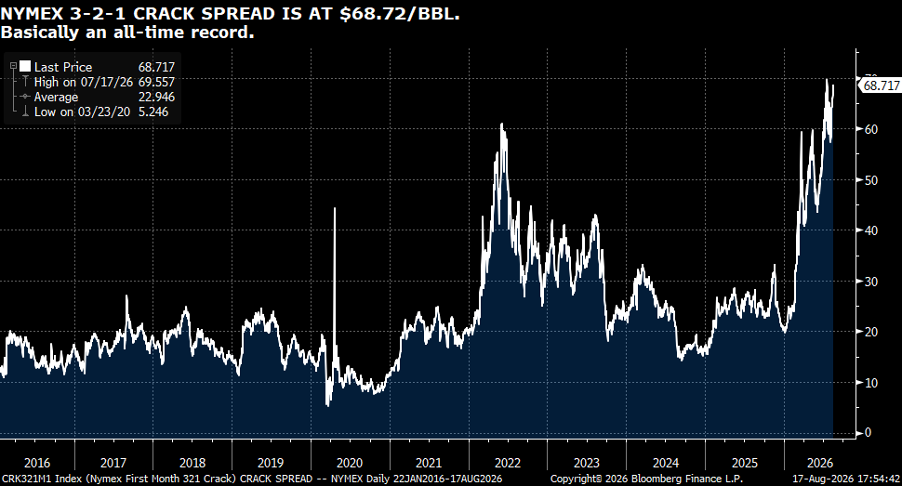
The Nymex 3-2-1 crack spread is back up to $68.72 – about a dollar below its all-time high. Michael Churchill says it’s telling you crude oil prices aren’t low because of weak demand for end products and that there is a huge arbitrage opportunity for crude refiners that is waiting to be pounced on. To get the crack spreads back to its normal $25/bbl, crude would need to be $129/bbl. Michael asks: “Just how much extra oil is the world going to need to rebuild all these reserves?” His rough calculations suggest that if we’ve suffered 165 days of oil production running 8mm barrels/day below normal: that’s 1.32bn barrels ‘missing’. Normal daily demand is 103mm barrels. If we assume 3 million bbls/day would need to go into overall stock rebuilds, then you have 3mm bbl/day of excess demand for 440 days. Politically, there’s no obvious resolution to the Iran situation on the horizon – so the accumulated oil “deficit” keeps growing every day. Michael sees a risk that crude prices could slingshot far higher as countries rebuild reserves just as refiners seek to arb out crack spreads.
China & Hong Kong: The long road back
Active EM managers are not exiting China but selectively rotating into market dislocation, explains Steven Holden. While China and HK average weight remains depressed at 20.14%, active positioning is turning as the benchmark underweight hits its narrowest level in almost a decade. Steven highlights that managers are actively buying into weakness: net estimated flows turned positive at $6.7bn over the seven months to July, led by value managers whose average overweight swung from a trough near -12% to +3.50%. Funds are actively trimming post-reopening consumer winners including Trip.com, Xiaomi, and Meituan to fund a technology self-sufficiency trade. Allocations are aggressively building across AI infrastructure and semiconductor equipment names such as NAURA Technology, Zhongji Innolight, and CATL, which absorbed $1.7bn in inflows. With China carrying roughly the same active weight as Taiwan or South Korea despite a vastly larger market, the current order of play looks temporary, not sustainable.
Argentina: Fading political momentum
Attention is shifting toward the 2027 presidential elections as President Javier Milei polls below 40%, leaving his re-election far from secured while an active opposition stirs market anxiety. Marcos Buscaglia expects the government and BCRA to expand local liquidity and allow interest rates to decline, because consumption financing relies on pesos rather than recent USD-denominated loan relaxations. He forecasts inflation to fall back below 2.0% month-on-month in August, with the central bank likely maintaining benchmark rates around 20% to spur credit growth. Although authorities have treated 1,500 as a line in the sand, they do not expect the central bank to hold this FX level for long if it prioritises low rates. In market terms, Marcos expects short-dated rates to drop, the peso to weaken slowly, and any repricing of hard-currency bonds to wait as sovereign credit spreads remain elevated.
US rates: Has anything really changed?
Markets have gone too far in assuming no further Federal Reserve hikes, contends Jonathan Turek, warning that extrapolating recent softer spot data into the balance of risks is premature. The US economy remains biased towards hikes against a resilient backdrop where the unemployment rate is 4.1%, three-month average non-farm payrolls are adding 20k jobs, energy is above $80, and core PCE sits at 3.3%. Crucially, the $1T annual impulse from AI capex continues to push the cost of capital curve steeper, as bond supply from hyperscalers prevents forward rate cuts. With the FOMC seeking an excuse to hike, terminal pricing of just 35bps at the peak of the curve is far too low, underpricing the risk that the economy accelerates rather than slows in the second half. To capture both Fed terminal repricing and duration-led term premia, Jonathan is re-establishing a short in US rates and added a short in SFRH8 at 96.00.
France: On an unsustainable debt path
When economic growth falls below the real interest rate, public debt enters an unsustainable trajectory. With French growth at 0.8%, 10-year OAT yields between 3.8% and 4%, and inflation around 1.8% to 2.4%, France’s debt-to-GDP ratio sits at 115–116%. Wolfgang Münchau points out that this is wholly unsustainable unless a primary surplus is achieved. There is no surplus in sight. Sébastien Lecornu is unlikely to even reduce the deficit to 5% of GDP ahead of critical elections. Without savings measures, state expenditures are expected to surge by €60bn, driven by an €11bn increase in debt servicing and €12bn in pensions. Unsuccessful savings efforts previously brought down Michel Barnier and François Bayrou; Lecornu has already suspended pension reform. With no parliamentary majority, budget talks will trigger more concessions and tax increases. Expect another season of silly entitlement debates when courageous politicians are needed to sell a blood, sweat and tears narrative.
Technology
Aequitas takes a cautious view on Longsys’ planned ~$500m H-share listing. The memory-products supplier has benefited from the sharp rebound in memory pricing, with FY25 revenue up 31% and PAT margin recovering to 6.1%, while 1H26 revenue more than doubled and PAT surged. However, Aequitas questions the sustainability of this earnings strength: Longsys remains a small global player with just 1.2% market share, relies heavily on a concentrated supplier base and is effectively a price taker, with gross margin only 18% in FY25. Operating cash flow has remained negative and net debt reached ~$1.2bn, although the IPO could nearly halve this. Aequitas also notes that margins may come under renewed pressure as lower-cost inventory is exhausted and replacement wafers are purchased at higher prices.
Technology
Near-term earnings weakness masks a significant expansion in design wins. Q1 operating profit swung to a ¥0.7bn loss, but roughly ¥10bn of automotive revenue was pushed into Q2 by supply-chain changes, while higher R&D and sampling costs reflect investment ahead of new programmes; full-year guidance was maintained. More importantly, the design-win backlog has risen to ~¥1.51trn, with management expecting around 60% to convert into revenue within 4 years. Non-recurring Engineering revenue rose 37% Y/Y, with 91% tied to 7nm-or-more-advanced processes, signalling growing exposure to higher-value applications including North American data centres and hyperscaler custom silicon. Yuka Marosek sees the post-results share-price fall as disproportionate, with the key risk being whether delayed revenue and new production ramps materialise as planned.
Gig economy sector update (UBER, LYFT, DASH, CART) with Gridwise CEO Ryan Green
Technology
Peter Daniel hosted Gridwise CEO & Founder Ryan Green to discuss the scale and evolution of the US gig economy. Gridwise analyses more than 700m trips from 1.5m workers across platforms including Uber, Lyft, DoorDash and Instacart, providing insight into driver supply, pricing, pay and unit economics. The US is the most mature gig market, with independent workers contributing $1.3trn annually. Around 73-76m Americans, or 36% of the workforce, participate in freelance or gig work, with that share projected to exceed 50% by 2027. Rideshare and delivery alone account for more than 8m drivers, while the market is highly saturated with low median net margins. Gig work remains largely supplemental: only 21% rely on it as their primary income source. A recording of the call is available on request.
Everyday essentials, extraordinary pressure
Consumer Staples
Scott Mushkin argues the squeeze on food-at-home is intensifying, with GLP-1 adoption reducing industry volumes just as Amazon and Walmart accelerate their push into everyday consumables. AMZN's essentials business already exceeds $150bn, and he estimates FY26 unit growth of ~25% and revenue growth of ~20%; alongside WMT and Costco gains, this could leave the rest of the market shrinking ~2%. Aggressive pricing and faster delivery should also pressure competitors’ margins, reinforcing Scott’s Sell ratings on Kroger and Dollar General. Pepsico, Campbell's and Constellation (all not covered) are where he is most concerned, but he views the industry as generally uninvestable. Conversely, AMZN’s consumables momentum increases his confidence in his long-term North America retail forecasts and wider industry consolidation over the next couple of years.
Communications
The market is focusing too heavily on GOOGL’s ~$200bn capex bill and not enough on the long-term value of the infrastructure being built, according to Will Nutting. Google Cloud is already running at close to $100bn of annualised revenue, growing 82%, with a 35.6% operating margin and $514bn of contracted backlog. His analysis suggests Cloud could become a $600-700bn business by 2030 and $1.2-1.7trn business by 2035, supporting $400-700bn of operating profit, while the company as a whole could generate $600-900bn of annual earnings. Once the current construction phase slows, depreciation and maintenance capex should look very different from today’s growth capex, allowing it to throw off hundreds of billions in annual FCF. Will sees GOOGL evolving from a search company into a vertically integrated “intelligence utility”, with AI infrastructure ownership potentially becoming the next major investment trade.
TMT Idea Forum
While AI was a dominant theme at MYST’s latest buyside event, several participants deliberately avoided it, migrating towards media-related names, out-of-favour international companies and recent IPOs. The most interesting ideas included:
Disney (DIS) - stale narrative masks broad fundamental improvements + IP moat. TP $150 (40% upside).
Flex (FLEX) - CPI spin-off to unlock hidden hyperscaler growth. TP $250 (125% upside).
Motorola Solutions (MSI) - sleepy Street models ignoring transformational counter-drone acquisitions. TP $700 (45% upside).
SharonAI (SHAZ) - sweetheart Nvidia deal fuels unrecognised EBITDA upside + ASX listing catalyst. TP $200 (245% upside).
Spotify - significant margin upside from restructured label deals, new product features + ads. TP $1,206 (125% upside).
The bankability blind spot in critical minerals
In their latest Situation Brief, OMNISIGHT exposes a critical 'Bankability Blind Spot' in Western critical mineral strategies. The analysis argues that Western financial de-risking frameworks, such as DoD price floors and massive IRA/CRMA subsidies, fundamentally conflate financial bankability with strategic deliverability. While billions are poured into domestic recycling and processing, these efforts ignore the commercial reality of technological sovereignty. Following China's export controls on secondary resource recycling technology, Western startups like Ascend Elements have faced insurmountable IP friction, ultimately leading to bankruptcy despite securing over $1 billion in capital. Surviving projects are increasingly forced into joint ventures with Chinese giants like Huayou Cobalt and GEM. Consequently, Western taxpayers are inadvertently paying an 'Allied Industrial Tax,' where domestic subsidies ultimately fund and entrench Chinese technological hegemony in the midstream processing sector.
Taiwan: Firm inflation pressure
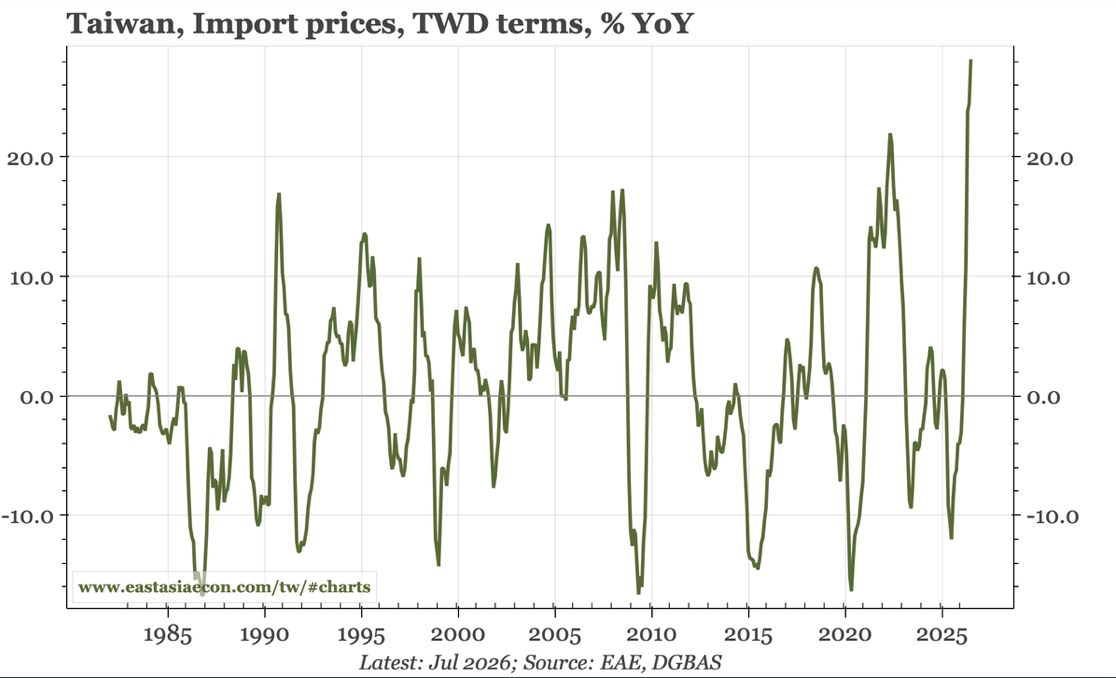
Although headline and core YoY inflation ticked down in July, Paul Cavey thinks overall inflation pressure in Taiwan remains firm. CPI excluding broad energy edged up to over 2% YoY, and despite price pressures easing elsewhere from the Iran War, the MoM annualised rate did not fall below 2%, which he feels is significant given core was closer to 1% last year. Pipeline pressures stay strong, with import price inflation accelerating to 25% YoY and PPI reaching 17%, the highest since the early 1980s. Paul suspects memory chip imports from Korea for AI accelerators are causing cost-push inflation, raising computer prices by 8.2% YoY. While export prices rose even faster to edge up terms of trade, Paul notes that private services inflation remains over 2.5% YoY.