Europe
Greek Banks: Solid fundamentals, less valuation headroom
Financials
Ahead of Q3 reporting, ResearchGreece notes that Greek banks offer solid fundamentals driven by high-single-digit volume growth, rising fees and healthy asset quality. However, with the sector trading at 1.59x and 1.46x P/TBV for 2026 and 2027 while offering 5.5% to 6.7% distribution yields, there is less valuation headroom. The firm favours National Bank of Greece SA, Bank of Cyprus Holdings PLC, Piraeus Bank SA, and Optima Bank SA. NBG and BoC are preferred for their straightforward balance sheets, strong capital ratios, and high distribution yields. Optima leads across almost every profitability component with superior earnings growth, while Piraeus offers a compelling risk/reward profile. Sustaining business lending above €9bn a year could prove challenging despite European funding initiatives. NBG and BoC earn OWN IT ratings with TPs of €19.3 and €12.2, while Piraeus and Optima hold TPs of €11.1 and €14.6 respectively.
Industrials
Following analysis of its FY25 annual report, Ed Steele and Shailja Periwal trim their Sandvik AB score to 23/60 from 25/60, principally reflecting FY25's much reduced level of stripped-out restructuring expense. Ed and Shailja calculate that stripped-out costs represented 4% of PBT adj in FY25 (ex M&A-related items) down from 13% in FY24, whilst stripped-out restructuring costs fell to 2% from 11%. Offsetting, they flag compressed balance sheet bad debtor and inventory impairment provisions, with bad debtor provisioning falling to 3.1% of gross receivables, a 10-year low. The gap between provisions expensed above the line and used or released moderated to 3% of PBT adj. Governance concerns persist: only three of ten directors clearly meet independence requirements, non-audit fees to PwC remain above average at 15%, and whistleblower reports rose 19% to 518 cases with a higher substantiation rate.
Consumer Discretionary
Arete Research initiates coverage of Garmin Ltd with a Buy rating, viewing its highly profitable Fitness and Outdoor smartwatches and tech ecosystem as undervalued. Garmin leads smartwatch innovation, while expanding into new form factors via the Cirqa screenless band and an anticipated Cirqa smart ring. Alternative data indicates the group will continue extracting maximum consumer surplus through a broadening premium SKU offering whilst holding entry-level model pricing steady to drive user acquisition. Long-term optionality centres on transforming into a holistic software platform, with subscription offering Connect+ forecast to exceed USD500m by FY33. On continued momentum across segments, FY28E sales and operating profit forecasts sit +2%/+12% ahead of consensus. Arete sets a USD335 YE27 target price (21% upside), derived from an equal-weight blend of 17x EV/FY28 Adj. EBITDA and a 10-year DCF. Rating: BUY.
North America
Technology
Meta Platforms Inc has launched its flagship closed models, Muse Wonder and Muse Wonder Full, retaking the high ground in AI benchmarks and addressing software generation to monetise compute against Anthropic PBC. Richard Windsor argues there is no moat in models; the ecosystem battle will instead be decided by ownership of the user touchpoint, where Meta holds an entrenched distribution advantage across its 3bn global users. Muse Wonder will power the core of Meta's consumer AI services, with the Muse agent already topping Apple Inc and Android download charts. Richard expects the maturing agent ecosystem to consolidate down to three or four dominant players to avoid commoditised returns, positioning Meta ahead of rivals like OpenAI Inc and Anthropic. The traction of Muse alongside enterprise compute monetisation underpins a valuation of at least USD$770 per share, where he maintains his position.
Weston family strikes boot deal
Consumer Staples
Wittington Canada’s USD$8.9bn acquisition of Boots UK Ltd alongside Fairfax Financial Holdings Ltd reinforces Galen Weston’s preference to preserve capital-allocation flexibility rather than privatise George Weston Ltd (GWL) to eliminate its 132.3bn in equity. Financing appears manageable following the Weston family’s reported ~£4bn sale of Selfridges Group Ltd in 2022. Common control of Boots and Shoppers Drug Mart Corp creates operational benefits across beauty, proprietary brands, healthcare services, and digital loyalty, while Per Bank has shown an appetite to import global practices. These initiatives could support Shoppers’ performance and Loblaw Cos Ltd’s valuation over time. Given GWL’s 52.6% interest in Loblaw, intrinsic gains flow directly to NAV. The transaction leaves the USD$115 NAV and BUY rating unchanged, which assumes a persistent 12.5% holdco discount.
Midcaps, two years on
Industrials
Kailash Capital Research argues that midcap allocations have shrunk to an unprecedented 19.4% of the Russell 1000, setting a fresh six-decade low beneath the dot.com trough. Although the relative trade lagged by 3.6% since year-end 2024 (Russell 1000 up 32.3% vs. 28.7% for midcaps), valuation spreads have stretched right back to dot.com peak extremes. The Russell 1000 trades at 3.3x sales (the 99.9th percentile historically) versus 1.7x for midcaps, leaving the relative price-to-sales multiple at 1.9x. Crucially, the largest 50 stocks trade at 6.0x sales, matching the dot.com record of 3.5x the midcap sales multiple. Sector concentration has also intensified, with IT expanding to 36% of the large-cap benchmark, whereas midcaps offer broader US economic exposure led by Industrials at 17%. Kailash Capital Research reiterates funding midcaps by trimming mega caps, ranking AES Corp (AES), Cheniere Energy Inc (LNG), Popular Inc (BPOP), Axis Capital Holdings Ltd (AXS), and Halliburton Co (HAL) at the top of their 25-stock screen.
Technology
Sajal Dogra reviews Penguin Solutions Inc delivered a beat-and-raise quarter that pulled the bull case forward by a full year, guided by FY27 EPS of USD4.45 versus a prior bull-case FY28 EPS of USD4.54. The FY27 outlook assumes flat memory revenue, with sequential expansion driven entirely by Computing; segment revenue estimates rise to USD782m for Advanced Computing and USD1.40bn for Memory. Backward-looking Services softness is countered by 17 AI-infrastructure customer additions carrying three-to-five-year contracts. Management projects Advanced Computing and Memory growth of ~40% and ~50% in FY27, while non-hyperscale AI compute should near-double to ~USD600m alongside accelerating bookings. Heterogeneous NVIDIA Corp and Advanced Micro Devices Inc architectures reinforce the strategic positioning of vendor-agnostic ClusterWare. CXL memory penetration should exceed 10 50-60m quarterly run-rate ahead of inflection in 2H FY27 and >30% gross-margin potential. Sajal raises the price target to USD100 from USD80 on 20x FY28E EPS of USD$5.01; Reiterate Buy.
Consumer Discretionary
Bennett Cheer sees Domino's Pizza Inc as an active short ahead of the 3Q print, citing diminishing returns from promotional discounting, deteriorating run rates, and the absence of a credible driver for a back-half inflection. September's pullback in national deals exposed severe promotional reliance; card transactions plunged 430bps QoQ and foot traffic decelerated 340bps to 1.0% YoY as order counts broke down. Domino's operates as a barbell on order count and ticket, but Bennett warns that trading order volume for ticket squeezes franchisee profitability, supply chain volumes, and unit economics, with international operations offering no offset. Management already trimmed US net new store targets to ~175, and adding units into slowing comps risks cannibalisation. With 3Q US same-store sales tracking at -0.2% versus consensus at 0.73%, the full-year low-single-digit guide appears untenable. He models 2027 EPS at USD19.99againsttheStreetatUSD20.82; a multiple derating from 14.5x to 13.0-13.5x PE indicates downside to USD260toUSD270. Rating: Best-idea short.
Buy Cipher Digital Inc into convertible-induced weakness, viewing its USD850m 0% convertible (upsized to USD1bn via a USD150m greenshoe) and offer to equitise part of its 2030 notes as a rational funding move. The financing meets an acute near-term cash need ahead of data hall completions in 4Q26 and 1Q27, unlocking September’s Barber Lake extension, where a second 10Y lease adds USD5.2bn in revenue. The original 10Y lease cost USD2.2bn to build against USD3.9bn in revenue. With additional costs of USD734-759m, partly from tenant change orders, and only 50% of the tenant’s USD375-400m overrun share recovered via rent, Cipher is investing a net ~USD550m more. Only USD832m of its USD4.6bn cash at 2Q26 was unrestricted. With credit markets difficult, the convertible with capped calls limits dilution to 5-6%, versus 10+% for straight equity, locking in an attractive return on capital.
Technology
Global Mining Research upgrades First Quantum Minerals Ltd from sell to hold, arguing that severe peer underperformance leaves investment metrics more compelling, while headline confusion over Cobre Panama obscures what appears to be a preference for a new operating agreement. Although news agencies latched onto the Commission’s recommendation for an “orderly closure”, the report is clear that the state cannot afford to fund closure or international arbitration, with First Quantum retaining the right to recommence ICC proceedings (>USD27bn). GMR assumes no full restart and continues to ascribe a conservative USD2bn risked option value (a 1 in ~5 chance). A recommissioning phase treating 38Mt of stockpiles offers a potential window until ~2H 2027 to reach an agreement, while the environmental audit failed to identify any material non-compliance. On this basis, the shares trade at 1.1x spot P/NPV10, 9.2x 2027E EV/EBITDA and a 4.7% FCF yield, with net debt/EBITDA falling to ~1.4x by 2030E. David Radclyffe sets a 12-month target price of C$39.60 and rates the stock HOLD.
It’s playing out as sustaining technology, not disruptive
NYSE parent Intercontinental Exchange Inc filed with OKX for a 24/7 venue trading digital versions of 60-plus stocks, NVIDIA Corp and Space Exploration Technologies Corp among them, and Securitize Inc launched digital shares of 12 US companies. While consensus views this as market structure disruption by blockchain upstarts, it is playing out as sustaining technology: ICE keeps the listing, Robinhood Markets Inc keeps the customer, and the SEC keeps the gate. Like ETFs, the economics belong to license and distribution owners rather than plumbing vendors. The same split shows in listed crypto names: HOOD delivers a 43.9% operating margin and 23.6% ROE, while Coinbase Global Inc sits at negative 13.9%. With record September trading reaching USD$15.6bn (+16.4% M/M), revenue lands on a regulated broker priced at 48x earnings. Exposure rests with after-hours venues, market makers and custodians reliant on a 4pm market close, not disrupted exchanges.
Consumer Discretionary
Report by
Abacus Research
AB
Speed of system change is the bet, as cheaper alternatives threaten the entire delivery segment and a new system 50%-75% cheaper is likely to come into force. Separately, app ownership may be disaggregated by AI agents. For personal transport, Tesla Inc is the only viable solution that will scale today, leaving Uber Technologies Inc facing a terminal value question. Its P/E multiple is unlikely to expand unless it proves it is relevant in the AI and robotics era, and the only route to a long-term win is turning capital-heavy by buying Cybercabs and displacing its own drivers (~75% of costs). Cybercab targets long-term operating costs of ~USD0.20 per mile and pricing of USD0.30-0.40 per mile, against UberX at USD1.20-2.00. If Sun Belt expansion migrates high-margin urban miles to Tesla, Uber’s network densification works in reverse. Uber offers an interesting 9.2% FCF yield on 2027 estimates, but the outcome is binary: an IRR of 15%+ or catastrophic disruption.
Consumer Discretionary
Management was clear that market conditions have deteriorated over the past 3 months, with higher interest rates, inflation, gas prices, and tougher housing affordability. Yet Lennar Corp persists with increasing incentives and sacrificing margins to maintain even-flow production. This strategy risks slow-motion financial “suicide”, as there is no natural bottom to margin degradation when chasing demand at affordability. This pressure stems from their land bank structure; unable to renegotiate take-down pace, Lennar must buy lots and burn inventory or incur higher option fees. FY26 EPS is forecast at USD4.80/share (down from USD5.47/share), with FY27 lowered to USD4.54/share (down from USD6.38/share) as margins compress under 7% interest rates. LEN trades at 16.3x FY26 P/E vs 16.1x for peers, and 1.04x adjusted tangible book value vs 1.35x for the group. Fair value estimate is USD68/share vs GAAP book value of USD91/share.
Technology
Huber Research Partners downgrades Netflix Inc to Underweight from Overweight, arguing the stock is currently fairly valued as platform engagement stalls and top-line expansion slows. Craig Huber flags press reports that Netflix is preparing to reduce headcount by 5%, alongside viewing hours that rose just 2% to 97bn in 1H26 (down an estimated ~5% per subscriber). YouTube’s US TV and streaming market share reached 14.2% in July against Netflix’s 7.8% (down from 8.8% a year prior), domestic price increases will likely have to become less aggressive, and management’s openness to large M&A following an aborted pursuit of Warner Bros Discovery Inc signals pressure to defend scale. Craig highlights that engagement reporting will be reduced from twice yearly to annually from 1Q27. Huber establishes a 12-month price target of USD70 (down from USD85), based on 14.0x 2028E EBITDA of USD20.97bn or 16.3x EPS.
Developed Markets
Rotation into investment-grade AI bonds
Following an exceptional four-year run in global equities, the case is building to rotate a portion of AI exposure into high-quality investment-grade corporate credit ahead of 2027. Paul Krake argues that this shift is not predicated on an imminent earnings collapse or a repeat of the 2000 dot-com crash, but on a macroeconomic inflection point: data-centre construction and AI capital expenditure have become outsized drivers of US non-residential investment, and that spending trajectory is approaching a peak. As grid bottlenecks, regulatory hurdles, and prolonged enterprise deployment cycles slow infrastructure expansion, broader US economic growth looks set to moderate below 2%, creating the backdrop for falling Treasury yields. High-grade credit, particularly across fortress balance sheets like Microsoft and Alphabet, offers an asymmetric defensive hedge. Even if credit spreads widen modestly from current compressed levels, attractive starting yields alongside falling benchmark rates should allow high-quality corporate debt to outpace equities vulnerable to multiple compression.
A coming crisis? Bet on it
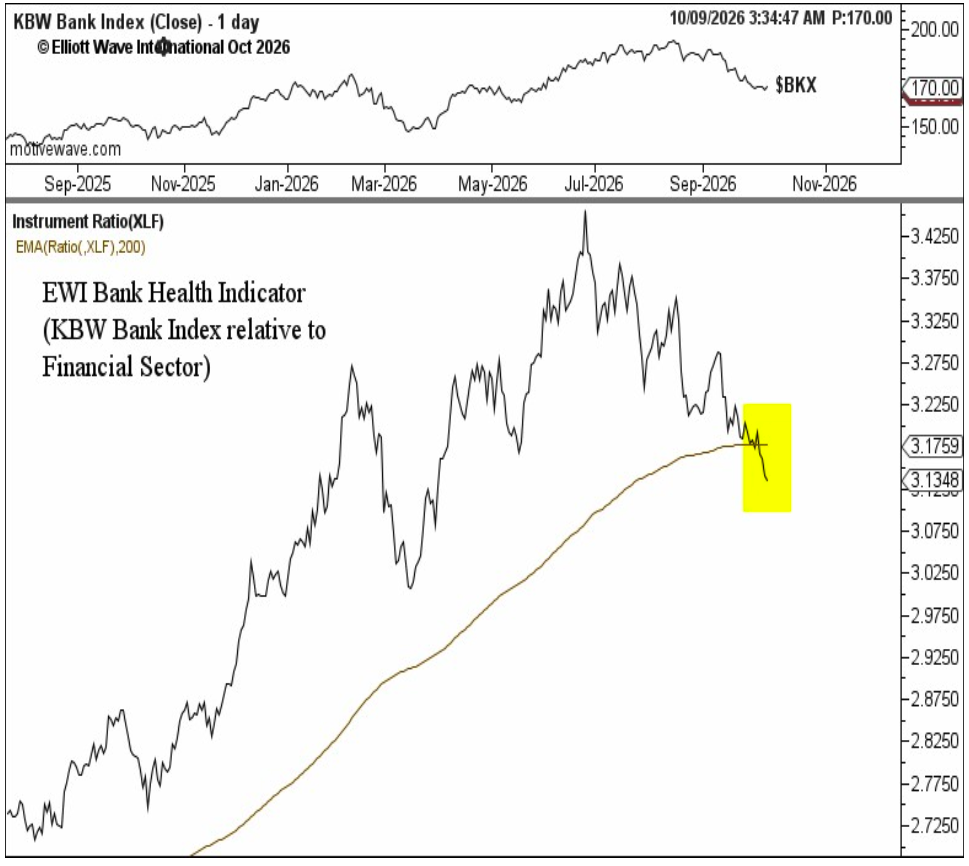
Surging bank lending to hedge funds has quietly revived acute systemic vulnerabilities across the financial sector, leaving prime brokers deeply exposed to a sudden unwind. Over the past decade, and particularly since 2020, bank lending to hedge funds has tripled while prime brokerage revenues have doubled. This aggressive balance sheet expansion has pushed leverage among the top 15 hedge funds above 12 times Gross Asset Value to Net Asset Value, a figure likely exceeding 20 times once derivative positions are factored into calculations. While post-crisis regulations were designed to de-risk commercial banking, prime brokerage arms have stepped in to supply the rocket fuel. Murray Gunn warns that this fragility is now threatening to breach the surface, with the relative strength of banks versus the wider financial sector rolling over against its 200-day moving average. Combined with deteriorating technical trends, the next crisis will almost certainly reverberate straight back into the banking system.
In the face of sovereign debt
Global public debt is projected to approach 100% of GDP by 2029, yet debt levels alone rarely trigger crises. Konstantin Fominykh argues that point-of-no-return thinking misreads sovereign stress; debt crises represent multiple-equilibrium events where sustainability hinges on borrowing costs, growth differentials, and political credibility rather than crossed thresholds. While reserve-currency status buys time for the US despite annual federal deficits heading past USD$2trn, interest payments absorb a fifth of revenue. France faces acute vulnerability from political fragmentation and rising yields without monetary autonomy, requiring roughly 3% to 4% of GDP in primary balance improvement. Meanwhile, Japan and the UK remain central cases to watch for rate shocks. Ultimately, the decisive question is which governments can credibly tighten fiscal policy before markets force their hand; on this test, France and the US score worst. TenViz holds a Sell on 10Y France and 10Y UK.
Global overheating
According to Manoj Pradhan, the hawkish stance of the new chairman of the Federal Reserve, Kevin Warsh, means all the hikes appropriate for a modest recovery from the mid-cycle slowdown have been priced in before that recovery materialises. Manoj notes that in the near term, fully pricing in hikes alongside an exogenous rise in bond yields is restrictive for the ex-AI part of the US economy and the global economy. Midterms in six weeks add uncertainty, given the rising chances of a Democratic sweep and a potentially dangerous White House response. Beyond the ongoing mid-cycle slowdown, no one knows what the labour market revival will look like, but past episodes and the added element of expansionary fiscal policy suggest a 2H/90s-type scenario. If we navigate the near-term uncertainty, which Manoj expects we will, overheating in the US and global economies will become increasingly likely.
Guardians of the blue economy
Sophie Biro finds that developed economies are moving the blue economy from a policy aspiration to an investable asset class. Where developing economies make 60-90% of commitments contingent on external support, developed countries frame targets as unconditional domestic obligations, so investments sit within policy environments with binding regulatory commitments and greater policy predictability. Private capital dominates, and most sectors require no concessional subsidy. Offshore wind is now a core component of mitigation pathways, with GWEC projecting capacity to rise from approximately 83 GW in 2024 to more than 410 GW by 2035. The IMO Net-Zero Framework vote was postponed to October 2026, moving binding global carbon pricing for shipping to around 2028. Barbados’s USD 150 million debt conversion cut its borrowing cost from 7.2% to 4.9%, while Uruguay’s bidirectional sustainability-linked sovereign bond falls in rate when the country outperforms on targets and rises when they are missed. For investors, the opportunity lies in financing ocean-related infrastructure and navigating the evolving regulatory and governance architecture.
Notes from Brussels
Brussels faces an accelerating race against the clock ahead of the spring 2027 French presidential elections, compelling leaders to settle for stagnant compromises across critical policy fronts. Niall Ferguson expects European leaders to agree on the next budget, though resistance from the frugal six will prevent significant cuts to agricultural subsidies, leaving proposed competitiveness buckets squeezed. In trade, Berlin has turned hawkish as lost export markets drive German economic weakness, clearing the path for an Industrial Accelerator Act mandating Made in Europe quotas alongside a US Section 301 equivalent. Meanwhile, Belgium will uphold its veto against using Euroclear Russian frozen assets for Ukraine loans, forcing reliance on bilateral contributions as public support for financing weapons slips to 56%. Europe will still stop short of an escalating trade conflict, settling on minimum import prices for Chinese hybrid cars. These defensive trade instruments cannot counter the second China shock; they can only soften it.
Contained pain in European credit
Long credit is fundamentally an embedded short volatility position. As realised and implied volatility rises, there is some pressure on some parts of the credit markets, corporate bond prices down, credit spreads wider. James Aitken notes the iTraxx Europe Crossover Index is at 315 basis points, out from 240 basis points in early July, but the acute strain sits where one or two leveraged players have been heavy sellers of the first loss tranche (0%-10%) and recycled the premium received into other credit exposures. The recent mark to market on these short credit protection exposures has been rough, ditto the decline in Virgin Media and Multiversity bonds. However, James expects it is not a systemic issue; the two most aggressive leveraged players hold abundant capital, maintain stable clients, and one just raised another USD$1.5bn. Expected European nominal GDP growth picking up means you cannot quit on European credit. Overall, it should be ok.
Are US stocks cheap?
The S&P 500 has pushed to all-time-highs through a pandemic, tariffs, the Iran war, and a 10-year Treasury yield spiking near 5.3%. Through it all, earnings have done the heavy lifting. Forward earnings growth near 40% is at a level investors have rarely seen. This year, earnings growth added more than 27 points to the S&P 500’s return, while a shrinking P/E took away more than 15. Even as the S&P hits record highs, the forward P/E of the index has fallen to 19, below its 5-year average. Tech, the market’s biggest sector, drove much of this drop. It went from the most expensive sector at 30.7x to below 22.5x in a year, as its earnings outran prices. Meanwhile, the 10-year yield is up ~475 bps from its lows, and it now pays about as much as the S&P 500’s earnings yield. If yields roll over, stocks at these levels look compelling. However, Francois Trahan says if yields keep climbing, earnings will have to continue carrying the market alone.
US: Bleeding through to consumer spending
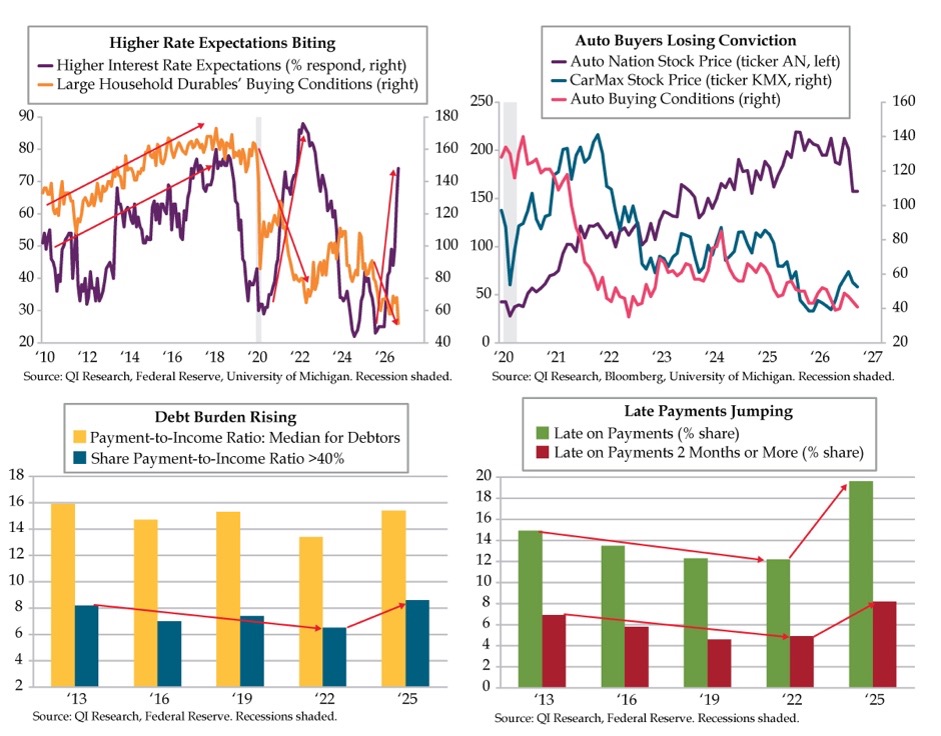
According to Danielle DiMartino Booth, the “Never count out the US. consumer” motto is on thin ice. A report released every three years by the Fed showed household finances entering 2026 with some record-weak readings, which preceded the Iran War and the higher inflation it’s delivered. UMich Large Household Durable Buying Conditions fell 16 points in October to a record low of 52, the seventh-largest MoM decline since 2010; the deterioration pairs with a spike in Higher Interest Rate Expectations from 25% in January to 74%, the highest since late 2022. The record-low reads on UMich buying conditions for household durables, along with weakening restaurant sales, warn of unexpected weakness in holiday spending. Even luxury goods credit card purchases have declined for three months running according to Citi’s proprietary data.
The inflating EPS bubble offsets US equity derating
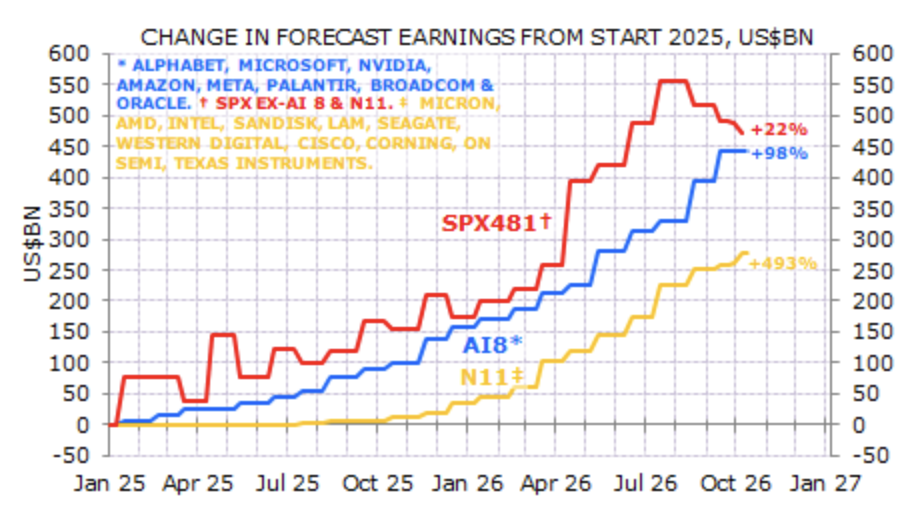
Gerard Minack argues that the September quarter reporting season will confirm the US is in the middle of an epic profit boom, offsetting valuation pressure from rising interest rates. Year-ahead forecast earnings have risen by USD1.2trn since early 2025, driven by the AI supply chain feasting on capex spending by AI providers, even whilst no one is making money from AI. Gerard expects earnings growth to continue offsetting multiple compression into 2027. Forecast earnings for the AI8 are up USD450bn, or 98%, while forecasts for 11 second-tier supply-chain stocks surged by USD$250bn, or almost 500%. The net effect is that AI leaders have outperformed whilst derating, leaving the Next 11 trading at a prospective PE below 14. If this is a bubble, it is an earnings bubble rather than a valuation bubble; the primary risk to medium-term US equity returns is not that valuation normalises, but that EPS growth does.
Emerging Markets
Brazil: Political ambitions meet reality
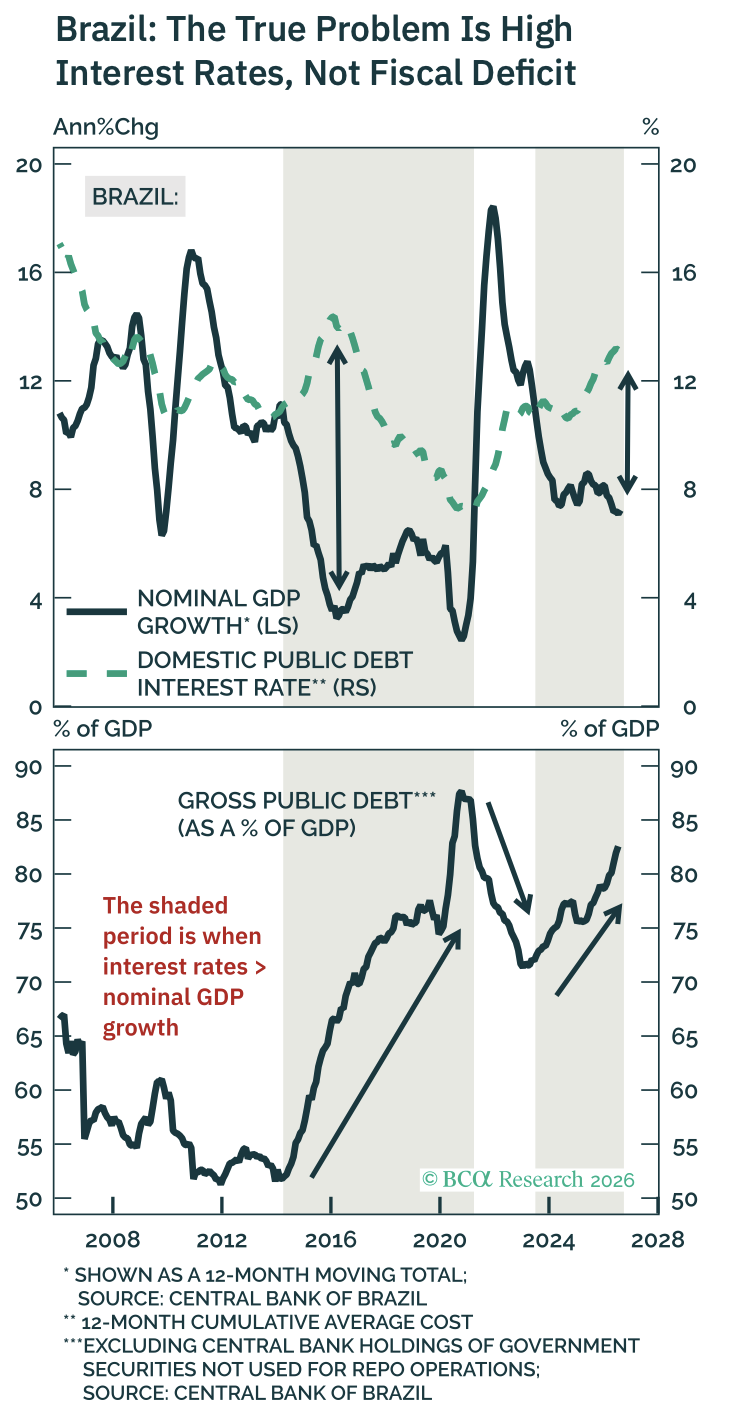
Public debt arithmetic trumps ideology, ensuring a right-wing administration under Flávio Bolsonaro will struggle to stabilise public debt without triggering recession. Stabilising the debt ratio demands roughly 3% of GDP in irreversible fiscal tightening, a move politically implausible for any government. Comparing Brazil to Argentine shock therapy is incorrect; Brazil lacks Argentina's mandate for economic pain. Two cyclical paths emerge: symbolic fiscal restraint leaves public debt on an unsustainable trajectory, whilst marginal fiscal tightening tips an already cooling economy into recession in 2027. Barring an unlikely multi-year bull market in commodities, nominal GDP will remain well below borrowing costs. Upgrade Brazilian equities to neutral, local currency bonds and sovereign credit to overweight within respective EM portfolios. Close long MXN/short BRL, long Mexican banks/short Brazilian banks, pay Brazilian swap rates, and long Brazilian CDS, as this political bet has backfired.
China: External factors to the rescue
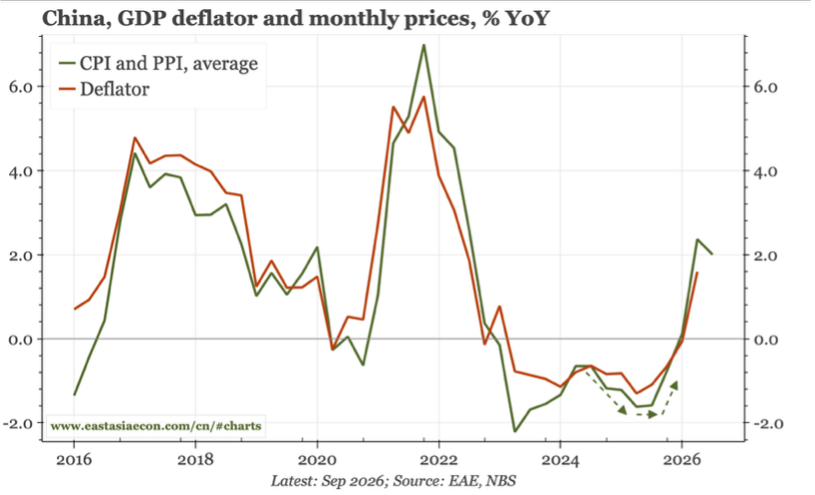
Paul Cavey notes that external factors continue to be the driving force of China's cycle dynamics was once again evident in the strength of both exports and PPI inflation in September. The combination puts a floor under overall nominal growth and makes it unlikely that domestic policy becomes more aggressive. One driver of the export strength is global demand for AI-related tech. In today's preliminary release, that is most obvious in the further acceleration in semiconductor export growth to 136% YoY. Data through August suggests almost all of that rise will be because of prices, not volumes. However, auto exports were also strong in September, and for cars, the balance is the opposite than for chips, being more volumes than prices. The external boost to China can also be seen in the acceleration of PPI inflation to 5% YoY in September, a new high since 2022.
Colombia’s reverse honeymoon
Back in early August, Daniel Lansberg Rodriguez predicted a “reverse honeymoon” for Abelardo de la Espriella as early institutional resistance would limit his ability to govern outside of security and foreign affairs. Centro Democrático’s (CD) congressional challenge and Abelardo’s subsequent reliance on executive authority have since borne out Daniel’s warning. Parties backing Abelardo currently hold 61% of the Senate and 66% of the Chamber, yet CD led both houses in overriding his veto of an appointments bill. Daniel expects CD to cooperate selectively while preserving its claim to lead the right and speak for business. Since late July the Ten-year TES yields have climbed ~80bp to 12.96%, although the peso and COLCAP retain year-to-date gains of ~18% and 22%. Daniel’s base case sees US$8.3–8.5bn in first-year IMF access in 2027 if fiscal commitments prove credible. BanRep’s hike to 12.25% likewise points to no further rate cuts before 1H2027 while El Niño inflationary concerns remain live.
Korea: AI spillovers
South Korea has emerged as one of the clearest macro expressions of the global artificial intelligence investment cycle, propelled by semiconductor manufacturers exercising extraordinary pricing power rather than greatly expanded production volumes. Fixed contract prices for 16Gb DDR5 DRAM rose from USD37.5 in May to USD48.0 in September, driving an 84% year-on-year surge in total exports to a record USD121bn. Niall Ferguson expects the Bank of Korea to hike another 25bps in November and continue tightening into the first half of 2027 as external strength reflates domestic activity. Meanwhile, geopolitical friction persists across both the Demilitarized Zone and stalled bilateral US negotiations over a contentious USD50bn Alaska liquefied natural gas initiative. Niall remains constructive on the Korean won and neutral relative to consensus on Korean equities, noting neither US investment friction nor North Korean threats alters this stance.
South Africa: Longer term lower-yield regime still intact
South Africa’s yield curve has risen since March, with the SAGB 10-year yield now at 8.9% from just below 8% at the end of February. However, Peter Attard Montalto still sees the longer term lower-yield regime as intact, and almost all of this move has been US related inflation and real rates not SA equivalents. Despite the oil shock and the subsequent global bond sell-off, SA yields remain 150-270bp below levels from just 18 months ago. Looking ahead, Peter remains constructive on the long end despite the difficult macro backdrop. He now sees the 10-year ending 2026 around 8.6% from 8.9% currently, which is still well above our 8.2% forecast before the war, while we continue to see yields just below 8% end-2027. Peter retains his MPC view of the first cut now only in July next year, which should keep the short end stable, but risks remain strong for a 25bp hike in January if fuel prices continue higher and El Niño risks intensify.
Yemen: War and security
The security environment around the Bab al-Mandab Strait has changed considerably. An advance by Yemen’s Houthi rebels in September saw the Iran-backed movement seize a number of strategic locations across the country’s west coast, most notably the port city of Mocha. However, a counter-offensive by the Yemeni government (alongside Saudi air support) in early October now appears to have partly eroded the Houthis’ gains. While fighting continues, the Houthis retain considerable missile, drone and maritime capabilities to threaten shipping and Saudi infrastructure. The escalation is increasingly important for reasons extending well beyond Yemen. It has reopened questions around the limits of US security guarantees to Gulf partners. Furthermore, it sits at the intersection of overlapping conflicts stretching from Iran and the Gulf through the Red Sea and into Sudan, Ethiopia, Somalia and Somaliland. The crisis accordingly underscores the ongoing development of an overarching conflict system straddling the Middle East and Africa.
Commodities
Can Saudi deliver oil?
James Burdass says that the market may be overestimating Saudi Arabia’s ability to convert spare production capacity into deliverable crude when several connected conflict theatres threaten its processing facilities, transport infrastructure, export terminals and maritime routes at the same time. At the same time, renewed fighting in Yemen and threats to Red Sea shipping have created additional uncertainty around Saudi Arabia’s alternative export route. Its East–West Pipeline transports crude from the kingdom’s eastern oil-producing region towards Yanbu on the Red Sea, reducing its dependence on the Strait of Hormuz. Yet if Gulf infrastructure and Red Sea shipping are threatened simultaneously, the alternative route could become less effective at precisely the time it is most needed. James points out that the key investment question is how reliably could Saudi Arabia maintain exports through a sustained and geographically broader security crisis.
Paybacks aren’t the impediment
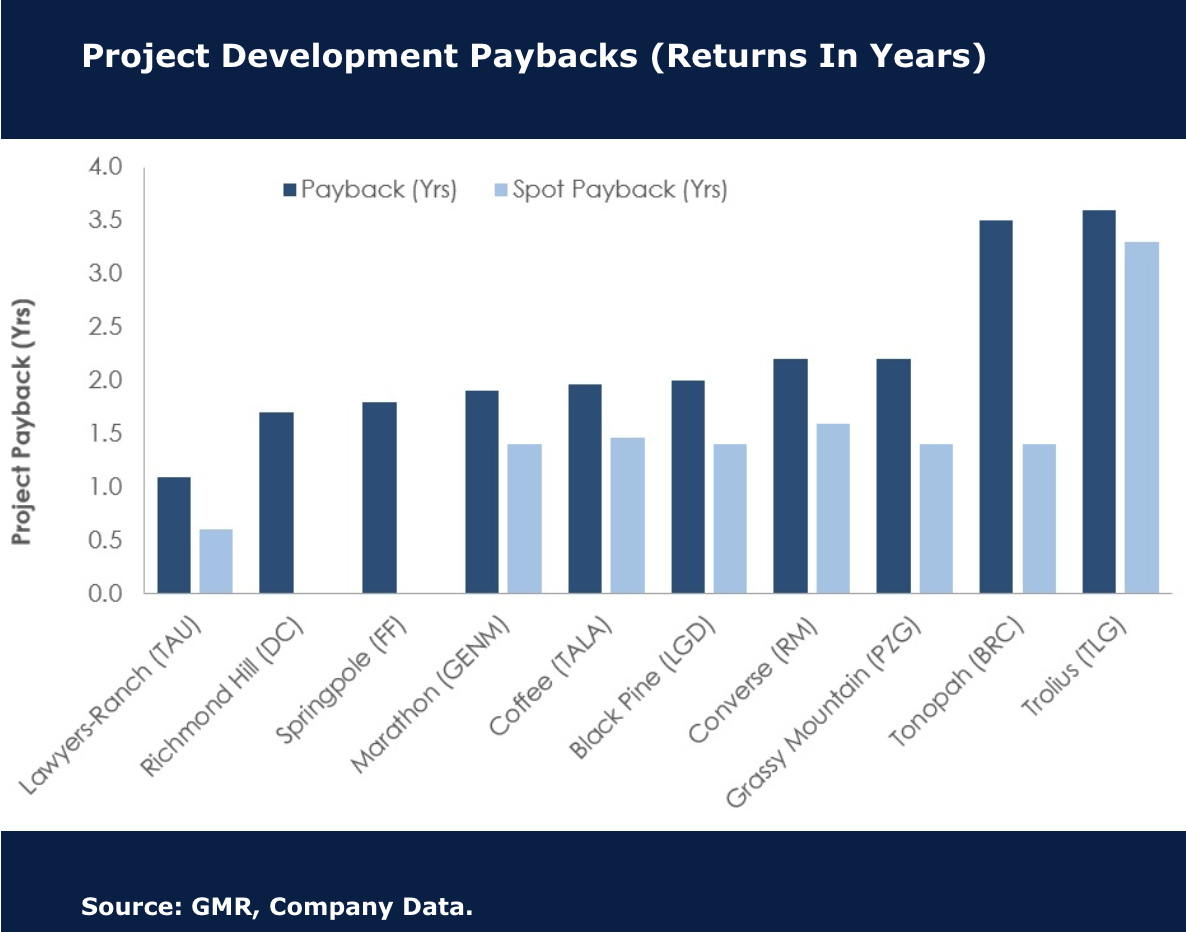
Paybacks aren’t the impediment to production growth across precious metals and copper, writes David Radclyffe following the Mining Forum Americas in Colorado Springs. Across ten sampled developers, base case paybacks averaged ~2.2 years (ranging from ~1.1 to ~3.6 years), falling closer to ~1.6 years at spot prices or US$4,000/oz. These low paybacks imply robust IRRs and favourable NPV/capex ratios, confirming that financial return metrics are not restricting development; rather, study completion timelines and permitting processes remain the key bottlenecks. Meanwhile, structural inflation has elevated capital intensity, which averaged >US$100M/Mt of annual processing capacity. Simple open pit heap leach projects sat at the lower boundary, whilst small underground operations with complex cyanidation exceeded >US$250M/Mt, and Grassy Mountain surpassed >US$300M/Mt. Radclyffe concludes that whilst spot economics provide compelling incentives to advance discoveries into production, statutory permitting, social licence, and study timelines ultimately dictate development schedules.
Oil has more upside than AI
David Woo argues that crude retains far greater asymmetric upside than technology, driven by an expanding geopolitical conflict distribution that consensus markets have failed to price. While semiconductor equities unwind and AI capex faces intensifying return-on-investment scrutiny, Brent has advanced 6.3% to USD$106.65 following escalating tanker strikes in the Persian Gulf and the Houthi strike on Riyadh airport. David observes that Tehran is steadily withdrawing the maritime tolerance previously dangled before Saudi Arabia as Washington attempts to pull Riyadh back into its strategic orbit. With the geographic scope of tanker attacks widening towards Qatar and Oman, midterms will not cap near-term petroleum upside, even as temporary White House strike restraint limits an instantaneous breakout. Long Brent offers less favourable entry value than a week ago; freight, tanker equities and selected LNG exposure provide cleaner hedges against continued maritime disruption, alongside an existing long December WTI call spread.
Altcoin Season Isn't Over, but the Money Is Rotating
Altcoin season is not over, but the money is rotating, as Bitcoin dominance climbs to 59.6% and tactical models switch back towards favouring the primary benchmark. Market breadth remains historically constructive, with 78% of tokens trading above their 200-day moving average and the proprietary altcoin season index holding in the 90th percentile at 56%. However, median correlation to Bitcoin has compressed to 50% across a six-month stretch below 60%, approaching prior cyclical peaks. A further drop in correlation towards 40% to 45% would signal an explicit profit-taking trigger, whilst a breach above 60% indicates altcoin season has formally concluded. Capital is actively rotating into fee-generating exchange tokens on Solana, Base, and TRON, whilst dumping legacy Ethereum DeFi protocols. Maintain core exposure to Bitcoin alongside sectors showing broadening breadth and weakening correlation, specifically Infrastructure, select DeFi venues, L1s, and L2s, whilst avoiding speculative rebounds across Meme, Gaming, and CeFi tokens.
Is gold still behaving like a gold haven?
Milan Vaishnav explains that a safe haven is not an asset that rises whenever the news turns unsettling. Elevated geopolitical tensions and oil supply concerns have failed to buoy spot gold, which touched its lowest level since early August on September 28. Milan argues that the interest rate channel has proved decisive: the US Federal Reserve raised its target interest rate by a quarter of a percentage point in September, and higher Treasury yields impose a stiff opportunity cost on a metal paying no interest. Concurrently, persistent US dollar firmness has compounded headwinds, making gold more expensive for foreign buyers. A technical divergence between price and momentum would merely warn of easing selling pressure rather than trigger an outright reversal. Gold must stop forming lower lows, hold support, and break above its recent lower high to confirm buyers are regaining control.
Muted US tariff relief fails Canadian lumber
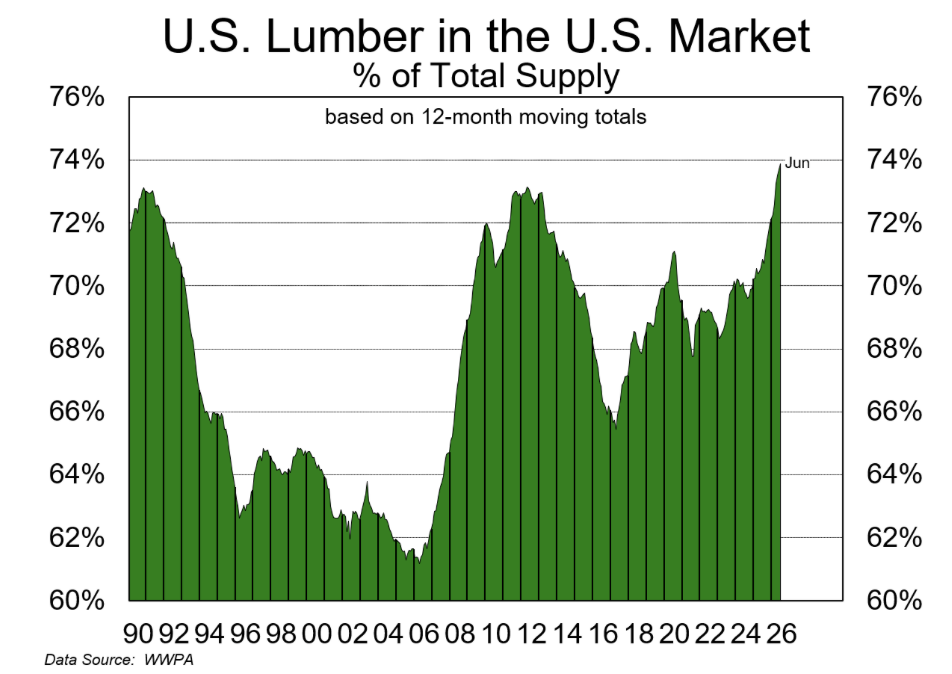
A ~10% reduction in combined anti-dumping and countervailing duties will not trigger a wall of wood across the 49th parallel, as Canadian exporters confront slumping demand and elevated structural costs. Following the US Department of Commerce seventh administrative review, final rates broadly match preliminary figures, lowering the combined All Others rate by roughly 50bps and WFG by almost 1%. However, with 10% Section 232 tariffs remaining in place, the combined duty and tariff burden hovers around ~35%, leaving US market share at a new high. Median cash costs for Northern BC commodity sawmills fall from USD530 to approximately USD495, still well above current Western S-P-F 2x4 prices of USD450. While lower-cost mills in Alberta, Ontario, and the Maritimes may pull back into the black, caution remains urged on Canadian lumber names against rising mortgage rates and slowing US homebuilding activity.