Technology
Huber Research Partners downgrades Netflix Inc to Underweight from Overweight, arguing the stock is currently fairly valued as platform engagement stalls and top-line expansion slows. Craig Huber flags press reports that Netflix is preparing to reduce headcount by 5%, alongside viewing hours that rose just 2% to 97bn in 1H26 (down an estimated ~5% per subscriber). YouTube’s US TV and streaming market share reached 14.2% in July against Netflix’s 7.8% (down from 8.8% a year prior), domestic price increases will likely have to become less aggressive, and management’s openness to large M&A following an aborted pursuit of Warner Bros Discovery Inc signals pressure to defend scale. Craig highlights that engagement reporting will be reduced from twice yearly to annually from 1Q27. Huber establishes a 12-month price target of USD70 (down from USD85), based on 14.0x 2028E EBITDA of USD20.97bn or 16.3x EPS.
Industrials
Following analysis of its FY25 annual report, Ed Steele and Shailja Periwal trim their Sandvik AB score to 23/60 from 25/60, principally reflecting FY25's much reduced level of stripped-out restructuring expense. Ed and Shailja calculate that stripped-out costs represented 4% of PBT adj in FY25 (ex M&A-related items) down from 13% in FY24, whilst stripped-out restructuring costs fell to 2% from 11%. Offsetting, they flag compressed balance sheet bad debtor and inventory impairment provisions, with bad debtor provisioning falling to 3.1% of gross receivables, a 10-year low. The gap between provisions expensed above the line and used or released moderated to 3% of PBT adj. Governance concerns persist: only three of ten directors clearly meet independence requirements, non-audit fees to PwC remain above average at 15%, and whistleblower reports rose 19% to 518 cases with a higher substantiation rate.
It’s playing out as sustaining technology, not disruptive
NYSE parent Intercontinental Exchange Inc filed with OKX for a 24/7 venue trading digital versions of 60-plus stocks, NVIDIA Corp and Space Exploration Technologies Corp among them, and Securitize Inc launched digital shares of 12 US companies. While consensus views this as market structure disruption by blockchain upstarts, it is playing out as sustaining technology: ICE keeps the listing, Robinhood Markets Inc keeps the customer, and the SEC keeps the gate. Like ETFs, the economics belong to license and distribution owners rather than plumbing vendors. The same split shows in listed crypto names: HOOD delivers a 43.9% operating margin and 23.6% ROE, while Coinbase Global Inc sits at negative 13.9%. With record September trading reaching USD$15.6bn (+16.4% M/M), revenue lands on a regulated broker priced at 48x earnings. Exposure rests with after-hours venues, market makers and custodians reliant on a 4pm market close, not disrupted exchanges.
Top 20 UK SMID stocks
Their Systematic Analysis Model (SAM) ranks 290 UK stocks by combining revisions momentum, shareholder value and valuation to identify the most attractive opportunities. Hikma Pharmaceuticals and SigmaRoc are the latest additions to their top 20 ideas. HIK screens as unusually cheap for its quality, ranking in the top quintile on capital-returns valuation and trading at just under 8.5x FY2 P/E. ROCE has been improving since 2022, revisions momentum has strengthened for 8 months and is back above median, while a new CFO and strategic reset provide meaningful recovery potential. SRC has seen ROCE grind higher with OPAT margins increasing materially following the successful integration of CRH assets. It is still very cheap with the market implying it can only do 6% ROCE with the FY2 forecast at 8%. Revisions Momentum is back above median and improved significantly over the past 3 months. There is also scope for further M&A. TPs are 1900p for HIK and 216p for SRC.
Materials
Just three months after GMR warned that NST looked vulnerable to a takeover, Gold Fields has made an unsolicited A$27/share bid at a 22% premium. They identified GFI as one of the more logical strategic buyers, and the combination scores highly on GMR’s M&A rationale framework given the asset overlap, potential synergies, combined production of 4-5Moz/year and greater Australian weighting for GFI. NST has rejected the proposal as opportunistic, but at just 0.58x spot P/NPV5 it remains one of the cheaper large-cap gold names despite producing more than 1.5Moz annually and owning high-quality assets. GMR now asks whether this is simply the opening salvo, while pressure will be on the new CEO to deliver KCGM and show value within the portfolio.
China: August macro releases were mixed
Industrial production in China beat estimates but consumption and investments deteriorated further. Industrial production rose 5.2% y-o-y in August and 5.3% in 8M/26, led by high-tech and export-oriented manufacturing. Retail sales growth slowed for a second consecutive month to 0.4%. The main drags were automobiles, gold and furniture, partly offset by communication devices and tobacco and alcohol. Fixed asset investment (FAI) contracted 7.2% in 8M, decelerating for a sixth straight month. High-tech FAI was the sole bright spot at +5.2%, but was outweighed by declines in infrastructure, manufacturing, and property investments. Private investment (-10.1%) continued to lag public investment (-3.6%). The surveyed jobless rate edged up to 5.3%. In the property sector, residential property sales fell 13.1% y-o-y in 8M/26, while property investment slumped 19.9%. New home sale prices decreased 0.17% m-o-m in August. Only 21 of 70 cities recorded stable or higher new home prices. A durable recovery in property investment is unlikely before prices stabilise and inventories normalise.
Words matter
Trivariate analysed earnings-call language from January 2011 onwards across the 1,000 largest US equities by m/cap to identify which communication patterns contain investable information. Management has become increasingly “flowery”, but mainly because numerical references have fallen sharply rather than adjective use rising. The strongest signal is that “numbers speak louder than words”: companies with high adjective-to-number ratios subsequently tend to underperform, with the effect particularly strong in Industrials and Materials and driven mainly by the outperformance of low-ratio companies. Forward-looking and positive Q&A commentary can also be constructive. Quantitatively derived stock ideas include Boeing, Corning, Parker-Hannifin, Starbucks and Cummins on the long side, while IBM, Valero, Constellation Energy, HCA and Grainger appear among the shorts.
Consumer Discretionary
Iii’s latest Beyond the Street report flags a more cautious read-through from M&M EV dealership checks. The XUV400, XEV 9e and BE 6 all carry discounts of ₹1-3 lakh, with ready delivery available on every model. The XEV 9e, listed at ₹34.49 lakh, is available at ₹31.75 lakh, a 7.94% discount, while state incentives take the effective discount to c.15% before negotiation. This more than reverses management’s 2.7% mid-July price hike. Ready availability is also notable given commentary around lost July production days, a supplier fire and plans to double monthly EV output by end-FY27. Iii concludes immediate delivery and heavy discounting point to demand, not supply, as the binding constraint for M&M’s EV portfolio, raising margin risk if discounting persists as capacity scales.
Consumer Idea Forum
MYST’s latest buyside event showcased companies launching new initiatives/products, business inflections/turnarounds and companies with higher-end offerings. Also notable were numerous potential consolidation/M&A candidates. The most compelling ideas included:
DoorDash (DASH) - DashPass “loyalty moat” driving durable share gains + several “call options”. TP $275 (30% upside).
Warby Parker (WRBY) - Eyewear rebounding from cyclical trough + game changing AI glasses launch. TP $60 (130% upside).
D’Alba Global (483650 KS) - Ulta + Costco distribution wins signal K-beauty share gain acceleration. TP ₩415K (70% upside).
Vita Coco (COCO) - Rising competition threatens coconut water fad. TP $42 (35% downside).
Hermes (RMS FP) - Perma-short forced to confront prolonged deceleration or painful supply cuts. TP €1,250 (20% downside).
US: Slower wages despite lower jobless rate
Graham Turner notes that jobs growth in the US slowed in June to +57k, but the unemployment rate fell to 4.19%. Graham says that it is tempting to put one of these numbers down to statistical noise, but they can both be right and may reflect the new norm. Prior to Covid, Fed research had suggested that the breakeven for non-farm employment growth was slowing to around 60-65k m/m. New research suggests that the breakeven for payrolls has dipped to 10k m/m, implying that the labour market is getting tighter and warrants a Fed hike. But the June payroll report also revealed a decline in the growth rate for average hourly earnings for production and non-supervisory workers. Real average hourly earnings are contracting for all employees. Graham says that disruption to the labour market from technology (AI) suggests that NAIRU has also fallen sharply: the case for a Fed hike is not proven.
UK Growth Stocks: Low expectations in Melrose, ConvaTec and AI jeopardy names
Willis Welby screens UK large-cap growth stocks using their proprietary expectations-analysis approach, assessing share-price-implied margins and returns against consensus forecasts. Their latest screen covers companies above US$4bn m/cap, with consensus Y3 revenue growth above 6%, positive Y3 EBIT margins, attractive Y3 IROCE and implied-to-Y3 EBITM ratios below 110. Twelve stocks make the screen. Among aerospace names, BAE has the clearer defence-spending story, but Melrose looks more forgotten, with an implied-to-Y3 EBITM ratio of just 27, leaving scope for the shares to more than double. Compass remains a strong all-round compounder, while investment in new products has driven good underlying results at ConvaTec, which still offers 60%+ upside. Willis Welby also revisits AI-jeopardy stocks RELX and Experian: despite barrier-to-entry concerns, both are currently benefiting from AI through stronger revenue growth and higher margins and may now be very cheap.
Finding value in junior miners
The large cap copper miners are expensive, trading as much as 3.4x NPV10 on David Radclyffe’s base case assumptions and as much as 2.3x on spot copper prices. Better value can be found in the smaller to mid-cap miners, which often offer attractive growth paths and M&A upside. Risks are sometimes higher in the smaller copper companies. with share liquidity another trade off. Of the five stocks covered in David’s latest report, the best financial leverage to higher copper prices are Taseko Mines Ltd and Atalaya Mining Copper SA, while the lowest leverage is with Sandfire Resources Ltd having strong margins. However, Capstone Copper Corp has the best four-year growth outlook assuming Santo Domingo delivery. The implied copper price (10% nominal discount rate) shows most stocks are near the spot price levels. Out of the group, David prefers Taseko Mines Ltd which offers value, FCF yield, leverage and growth, with Atalaya Mining Copper SA herein upgraded to BUY.
Technology
BTN remains sceptical re. the sustainability of NTAP’s margin improvements and believes the credit risk associated with the company’s receivables portfolio is greater than many investors appreciate. DSOs have exceeded 60 days in 3 of the past 5 quarters, among the highest levels in recent years. Arrow Electronics and TD SYNNEX together account for c.25-40% of receivables, with both having stretched working capital positions, and their payables and debt obligations significantly exceed expected collections. Margin expansion has been supported by fully depreciated equipment, which BTN estimates contributes c.350bps to margins and c.$1.25 of annual adjusted EPS. Lower R&D and S&M spend also helped the Q4 beat, but these savings may be difficult to sustain as NTAP pursues AI-related customers. Deferred revenue continues to decline as a percentage of sales and the company has discontinued warranty disclosures in its latest 10-K.
Technology
NTNX's Q3 revenue and EPS beat was aided by exceptionally conservative guidance and accounting / cost factors that may not be sustainable. Management had guided Q3 revenue to just 6-8% growth despite maintaining a higher full-year growth outlook, creating a favourable setup for a beat, similar to Q2. BTN also highlights rapid growth in contract assets, which contributed around three days of sales to revenue recognition over the past two quarters, more than enough to explain the reported beats. Meanwhile, deferred revenue has been broadly flat for two years and continues to decline on a days-of-sales basis, while deferred commissions suggest weaker new customer acquisition. Margins also appear supported by low depreciation, declining capex, and reduced cash R&D and S&M intensity.
Greek Equities: Adopting a more cautious stance
ResearchGreece revisits their stock picks and assesses the political outlook ahead of the next parliamentary elections. Macro conditions remain solid, with Q1 real GDP up 2.0% Y/Y, although inflation accelerated to 5.2% Y/Y in May (+0.0% M/M). With the Athens Index up +11% YTD, valuation multiples of non-banks in their universe have expanded to 13.2x P/E and 8.0x EV/EBITDA 2027, leaving more limited upside. Combined with polls pointing to a hung parliament, ResearchGreece is turning more cautious on Greek equities. Banks remain their preferred exposure (solid outlook - volume, rates, asset quality) as a leveraged Greek macro play. They prefer National Bank of Greece, Bank of Cyprus, Piraeus and Optima. Outside banks, they favour selective infrastructure, industrial and defensive names such as OTE, Titan, PPC and Piraeus Port over consumer stocks and cyclicals.
Real Estate
Craig Huber argues that the near-50% YTD fall in CSGP’s share price has created an attractive entry point, with investor concerns around AI competition and Homes.com losses now overdone. His 2026/2027 adjusted EPS estimates are above consensus at $1.40/$2.00, with revenue forecast to rise 18.0%/15.4% to $3.833bn/$4.424bn and adjusted EBITDA to reach $833.8m/$1.142bn. The group also has $1bn remaining on its share buyback programme (representing ~7.5% of current m/cap). The stock trades at 16.8x 2027 adjusted EPS or 13.9x EBITDA. If you exclude the Homes.com losses (where there is a lot of flexibility in the expense base; sees losses dropping to ~$300m this year), CSGP is trading at only 9.4x 2027 EBITDA. Information services is a sector that historically trades around 25x EBITDA, if not higher. Craig is an “aggressive buyer” at these levels with a conservative $50 12-month price target, implying ~50% upside.
Alpha generating Healthcare Shorts
Healthcare
Bios Research publishes a new short idea that they believe is materially overvalued, with a m/cap in the $7-10bn range, significant ADV and ~50% downside potential. They also highlight additional Q2 and Q3 shorts (m/caps >$10bn) across biotech, healthcare services and medtech, alongside several M&A candidates and stocks that are attractive as a basket for investors looking to add exposure in what they believe is a new biotech bull cycle. So far in 2026, they have closed a long idea in Crinetics Pharmaceuticals for a ~59% gain and several shorts: ARS Pharmaceuticals (+46%), AbCellera Biologics (+43%), Summit Therapeutics (+42%), Butterfly Network (+34%) and TransMedics (+22%). Since inception in Feb 2012, Bios has published 194 short ideas with a c.70% absolute hit rate.
Consumer Discretionary
Alex Barron believes the acquisition is an important signal for the US homebuilder sector, supporting his view that the bottom of the cycle is here and now is an opportune time to buy into the sector at great valuations. The deal values TMHC at 1.24x 2Q26 book value, 1.17x Alex’s 2026E book value and 12.9x 2026E EPS. His fair value estimate was $72/share. While Berkshire is unlikely to pursue an immediate acquisition spree, the deal opens the door for TMHC to become a larger consolidator over time. Alex also notes rising sector M&A, including Dream Finders attempted hostile bid for Beazer Homes, which he thinks would likely need to move closer to 0.8-0.9x book value to succeed.
Special Sits Idea Forum
MYST’s buyside events continue to deliver impressive performance (~19% avg. alpha on highlighted ideas at their previous Special Sits Forum). Their latest event featured a high number of potential takeouts / M&A plays, business separations, several Media stocks and various AI-related companies. The most compelling ideas included:
Chemours (CC US) - Refrigerant share gains + “free kicker” from steepening China TiO2 cost curve. TP $46 (110% upside).
ITT (ITT US) - High-quality pumps pure-play experiencing positive mix shift. TP $284 (45% upside).
Valmont Industries (VMI US) - “Non-obvious” AI infrastructure play benefitting from utility pole pricing inflection. TP $709 (35% upside).
Fundrise Innovation Fund (VCX US) - AI / Anthropic proxy trading at ~10x NAV with upcoming lock-up expiry catalyst. TP $50 (75% downside).
Real Estate
Ben Jones remains bullish on M/I Homes as volumes remain solid despite higher mortgage rates, signalling ongoing demand. Despite the US housing market showing some weaknes, increased incentives, higher LTVs, lower interest rates ahead should continue to provide support. Current operating margins of 9.3% are below recent highs but only slightly under historical averages, with long-run margins around 11%. The company’s strong balance sheet position allows them to withstand downturns and capitalise on land opportunities. Ben favours their disciplined capital allocation, balancing cash reserves and share buybacks. A persistent US housing shortage should continue supporting home prices over the long term.
Financials
MRX is a beneficiary of geopolitical instability, particularly in commodity markets, where it is a leading player. The shares have pulled back from recent highs but are only ~12% above the 2025 peak, despite 1Q26 profits likely to rise c.50% Y/Y - implying meaningful multiple compression. Fighting Financials sees scope for this to reverse as volatility persists. Consensus Q1 PBT forecasts sit c.13-14% below management’s end of March guidance, while FY26 consensus implies flat Y/Y performance for the remaining quarters, which is clearly inconsistent with the current earnings trajectory. With the potential to return >60% of its m/cap via dividends and buybacks over the next 5 years, MRX stands out as one of the cheapest, high-quality financials in their investment universe and is one of the few compelling long ideas in a market, where opportunities are largely on the short side.
Healthcare
The market is overly focused on a perceived peak in TIDES-driven growth. While the 100,000-litre ramp in 2026 supports ~RMB 20bn of visible revenue, a multi-year growth stack extends beyond this, with ASO, cyclic peptides and RNAi contributing through 2029. The underappreciated angle lies in small molecule D&M, where management guides to 15%+ growth but scepticism persists following weaker 2025 delivery. Horizon Insights sees upside from commercialisation orders, overseas formulation expansion and TIDES precursor demand. If this segment outperforms, valuation upside is substantial (2H26 order disclosures will be a key catalyst). With CDMO utilisation improving and sector demand recovering, the company is well positioned for a rerating as growth re-accelerates beyond TIDES.
US: The AI boom continues
Graham Turner comments that there is plenty of inflation stuck in the pipeline despite some respite for energy prices. The headline CPI was up 0.87% m/m in March but the core CPI was well behaved. The key will be broader, second-round effects from the higher headline numbers. That will depend on consumer resistance: slower wage growth and uncertainty over job prospects due to AI could limit the ability of companies to push prices up more generally. The oil price shock has not yet had much impact on services demand, if the non-manufacturing ISM is any guide. The new orders index rose in March to its highest level since February 2023. There could be a delayed reaction to the Iran conflict, but Graham sees this as a potential sign that the US economy is indeed quite resilient. Low core inflation and no clear evidence that the energy shock or AI are damaging the economy would represent a big buying opportunity for equity investors.
Industrials
2Xideas latest deep-dive focuses on APG - a high-quality compounder, supported by market leadership and durable advantages in a regulation‑driven, non‑discretionary end market. Demand for fire protection inspection and maintenance is underpinned by stringent compliance requirements, while low customer cost supports pricing resilience. The group differentiates through national scale, premium service and investment in skilled labour. With significant consolidation runway and a proven M&A playbook, APG is well‑positioned for sustained DD earnings growth. 2Xideas forecasts revenue growth of 7.4% p.a. (2025-2032E), adjusted EBITDA margins rising from 13.2% to 17.9% and cumulative FCF of $7.8bn (~45% of m/cap). Applying a 20x exit NTM P/E 2032E, they estimate total shareholder returns of 12.9% p.a. over this period.
Memory earnings power has shifted structurally. Valuations haven’t
Technology
The memory cycle is being misread as cyclical rather than structural, with no near-term earnings peak as AI drives sustained demand. Capacity cannibalisation from HBM and SOCAMM is expected to constrain DRAM supply into 2028, with NAND also remaining tight, while LTAs could see future output effectively prepaid - reducing downside risk and reinforcing earnings durability. Yet valuations remain anchored to legacy frameworks, underestimating pricing power and cash generation, with net cash potentially >50% of m/cap by FY27 for players like SK Hynix and Kioxia. Within memory, Arete sees NAND fundamentals as more compelling than DRAM in the near term. They also upgrade Samsung to Buy, with a continued beat-and-raise cycle expected in coming quarters.
Communications
While the company likes to describe itself as strongly cash generative, FY25 results tell a different story. Cash inflow from operating activities fell sharply from £333m to £202m. Forensic Alpha also identified several other red flags, pushing ITV’s Risk Score from '8' to '10' (max. rating). Working capital has been a persistent drag, with the headwind widening from £144m in 2024 to £196m in 2025. Trade receivables rose 12% to £500m despite flat sales, driven largely by long-term balances now representing 18% of the total. Contract assets increased 33%, including a jump in non-current contract assets from £4m to £39m. Meanwhile, exceptional charges related to restructuring and M&A rose from £65m to £107m, further weighing on cash flow. For now, the market is focused on the potential sale of the M&E business. If it falls through, attention will shift back to the company’s underlying fundamentals.
Healthcare
Sidoti reiterates their constructive stance on LMAT, arguing the company’s increasingly dominant niche positioning supports durable pricing power, margin expansion and visible multi-year growth. With price increases contributing meaningfully to organic growth and ~8% additional pricing expected in 2026, Sidoti sees LMAT as insulated from reimbursement and tariff pressures given its focus on critical, non-deferrable vascular procedures and predominantly single-use devices. The company will continue to benefit from the continued sales force expansion and additional European product approvals over the next several years. Backed by a strong balance sheet and capacity for accretive M&A, Sidoti increases their 2026 revenue estimate to $275.5m (from $264m) and EPS estimate to $2.86 (from $2.39). For 2027, they raise their revenue estimate to $291m (from $278m) and EPS estimate to $3.09 (from $2.67).
Delivering alpha in 2025; positioning for 2026
Healthcare
In 2025, Bios published 12 short ideas and 2 longs, delivering a 78% absolute hit rate, with 7 of 14 positions closed intra-year. Notable winners included Anavex Life Sciences (~77% absolute return to short sellers), Butterfly Network (~49%) and Arcellx (~30%), while 89bio returned ~115% on the long side. Looking ahead, top short ideas for 2026 include a ~$40bn medtech facing reimbursement pressure, new competition and GLP-1 headwinds; a ~$20bn biotech exposed to excessive hype, competitive threats and clinical trial failure; and a ~$10bn commercial pharma/biotech likely to see material y/y sales declines and poor regulatory environment. On the long side, Bios highlights a $1.5bn development biotech with strong data and potential for FDA approval in 2H26 and a ~$600m biotech with multiple assets in development and 3+ years of cash, where material licensing / M&A potential exists.
Consumer Discretionary
Brian McGough thinks the market is materially overestimating the company’s long-term earnings power. Investors are buying into BOOT’s ambition to expand from ~515 stores to 1,200, but Hedgeye’s M.A.P.S. (Market Area Performance Study) analysis suggests the company has already exhausted its most profitable “power alley” stores tied to mining, agriculture and construction - locations with a healthy 70/30 workwear-to-fashion mix. Incremental growth is now shifting to more expensive, fashion-heavy stores that rely on a Western Wear trend that Brian believes is in the late innings. In aggregate, he estimates BOOT needs ~7% comps just to leverage occupancy (the highest hurdle in retail), while many new stores carry rent escalators exceeding 10%. Brian sees sustainable EPS closer to ~$4 vs. consensus TAIL expectations >$8, implying up to ~75% downside.
US Healthcare + Merger / Arb Catalysts: What’s next from DC
Healthcare
2026 is shaping up to be an active year for US healthcare policy, with President Trump's focus on affordability impacting Congressional and Administration priorities. Near term, Congress is considering spending legislation impacting clinical labs (Quest Diagnostics, Labcorp), diagnostics (Natera) and life science tools (Danaher, Thermo Fisher). Investors are also awaiting clarity on MFN deals and their impact on companies that have not yet signed agreements with the Administration. Beyond HC, Aldis also leverages their connectivity to provide timely insights and updates around M&A with regulatory catalysts, including Nexstar-Tegna and Union Pacific-Norfolk Southern. Contact us below for further information on events hosted by Aldis and access to their content library.
Bank stocks face constructive 2026
Financials
The fundamental setup for US bank stocks in 2026 remains attractive, with mid-teens EPS growth driven by improving NII, benign credit costs, positive operating leverage and continued buybacks. Deregulation is a key secular tailwind, already contributing to a powerful 2025 re-rating, but valuations remain cautious at roughly 55% of the market multiple. While early-2026 performance may favour the investment banks, Charles Peabody would not be surprised if the stocks of JPMorgan Chase, Morgan Stanley and Goldman Sachs peaked in 1Q26 as he expects that to be the peak Y/Y revenue and PPNR momentum for these companies. He sees NII as a more durable revenue source throughout 2026, which favours the regional bank stocks. Charles sees the greatest relative upside in Citigroup, M&T Bank, US Bancorp and PNC Financial.
The perils of premium valuations
Trivariate analysed the top 900 US equities by m/cap at each point in time to see how many stocks traded above 40x price-to-forward earnings for the first time in at least 3 years. On average this impacted 30 stocks per year. Historically, this valuation “ascension” is most common in Technology, followed by Financials, Real Estate and Consumer Discretionary, and rare in Utilities and Consumer Staples. Once stocks eclipse 40x, multiples typically contract to ~32.6x within 12 months, with 20% falling as low as 14x. Only 38% remain above 40x after one year and just 25% after two years. While the data suggests there is no need to panic sell a stock right when it first reaches a price-to-forward earnings multiple of 40x, it does appear that beginning 6- to 9-months later, the probability of outperformance begins to significantly deteriorate.
Communications
Craig Huber downgrades NFLX to Underweight following its $82.7bn agreement to acquire Warner Bros Discovery’s studios, HBO and HBO Max streaming assets - a major strategic shift he views as unnecessarily risky. He argues the deal brings significant regulatory hurdles, adds heavy leverage and could slow NFLX’s organic revenue growth while pressuring margins. Large US media acquisitions rarely succeed and NFLX had excelled for 15+ years without pursuing major M&A. With the deal likely taking 12-18 months to close, Craig expects a prolonged stock overhang. Re. Paramount’s hostile bid, he believes PSKY would need to raise its offer to $32/share to fully entice shareholders away from NFLX’s attractive proposal.
Financials
MCAP is emerging with the strongest momentum in Japan’s once-tainted M&A consulting sector. Unlike scandal-hit peers, MCAP avoided reputational damage and is now growing faster than Nihon M&A, generating higher margins and trading on just ~15x FY9/26 earnings despite forecasting >30% Y/Y profit growth (which may well prove conservative). Deal sizes are rising, consultant numbers are compounding 20-25% annually and MCAP’s high-incentive pay model draws top sales talent, keeping churn low. The company’s Recof subsidiary remains a drag, but restructuring should push it towards profitability. With improving industry governance, fears of a “kabarai-style” crackdown fading and cash piling up from strong FCF, the shares are attracting renewed investor interest.
Earnings manipulation, anyone?
Two Rivers has recreated the Beneish model showing the highest potential manipulators and highlighting stocks such as QXO (due to M&A-driven sales spikes for AI supply chain plans), Joby Aviation (high growth amid declining margins), Rivian (rising accruals suggesting expense capitalisation), Alpha Metallurgical Resources (falling gross margins) and Pinterest (rising balance sheet accruals and sales growth). The model's inputs are similar to some that Two Rivers use in their own Stock at Risk's Earnings Quality model - albeit with some additional proprietary “secret sauce”.
Materials
Ben Jones reiterates his bullish view with the stock up ~200% since initiation in July 23. AAZ is set to enjoy a dramatic increase in net income as well as FCF which is expected to swing from -$2m (2024) to c.$126m (2026) - a 45% FCF yield on today’s m/cap. He expects AAZ to develop 3 new mines (without raising equity) over the next 5 years which will boost copper production from 2.1kt in 2023 to around 40kt per year from 2028. Ben increases his base case price target from £3.70 to £5.59 (150% upside), assuming long-term copper prices at $4.50/lb, but with optionality to £8.00+ if long-run copper averages $5.50/lb, as forecast by Citi and BAML. Since publication of Ben’s report, AAZ has disclosed it is in preliminary takeover talks - unsurprising given his view that the market continues to undervalue the company’s asset base and growth profile.
Industrials
Still the best infrastructure play in Greece - ResearchGreece raises their TP to €30.6 (from €26.9) following model updates reflecting recent milestones, including commencing operations at Attiki Odos, progress at Kasteli Airport and securing the North Crete motorway concession, with Egnatia Odos still pending. Following its energy JV with Motor Oil, GEK’s results will now focus on construction and concessions, with the power and supply business equity-accounted. ResearchGreece sees Attiki and Egnatia driving a doubling of Group EBITDA by 2028, valuing operating concessions, Egnatia and Kasteli Airport at €21/share, equivalent to ~90% of GEK’s current m/cap. Updated forecasts factor stronger motorway traffic and higher financing costs, with valuation led by concessions (69% of total) in their SOTP model.
Industrials
Forensic Alpha increases their PRY risk score from 5 to 8 (out of 10) following release of the company’s 9M25 results. Flags identified point towards issues re. cash flow presentation, notably a sharp increase in receivables factoring (€351m vs. €126m in 3Q24), which boosted OCF by ~€225m but was not discussed in management’s presentation or call. A closer look at “Trade and other payables” raises further questions, with a balance of €426m classified as “Other” - representing ~10% of net debt - has more than doubled Y/Y. Combined, factoring and payables effects account for >50% of reported FCF. Investors should be cautious in extrapolating the positive trends highlighted by management, particularly considering the company’s growing appetite to deploy its balance sheet for M&A under its new CEO.
Blow-up avoidance guide - how are you dealing with the S&P500 being an AI factor bet?
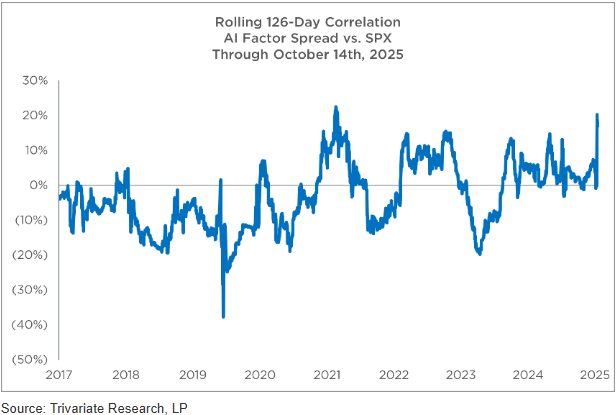
While there are plenty of high-quality AI-exposed stocks to own, the challenge is that many non-Tech names have also become correlated to the AI trade. Trivariate screened for stocks with low correlation (<0.2) to their AI Semiconductors basket, that are up >10% in the past 6 months, top-half quality and beta <1 - identifying 28 stocks with a m/cap >$50bn. Given the recent huge moves in speculative names, Trivariate also advises preparing a sell/short list for a potential market rollover. They highlight 24 stocks ($1bn+ m/cap) that are up >100% in 6 months, in the most expensive EV/sales decile and the bottom half of their quality model, companies with high short interest and lower 2026 EPS estimates than at the start of the year, meaning the recent big moves in stock prices are despite a deteriorating nearer-term fundamental outlook.
Consumer Discretionary
Brian McGough reiterates his bearish view on FND despite the stock’s ~50% drop since his Apr 24 short call (vs. the S&P +33%). Brian is updating his analysis using his M.A.P.S. (Market Area Performance Study) framework, which tracks store performance by opening cohort. His latest findings suggest that stores opened in 2024 & 2025 are performing even worse than earlier cohorts, reinforcing that FND’s weak comps are structural, not cyclical. New units also show rising market overlap with the likes of Home Depot and Lowe's. While FND is often seen as a housing-recovery play, Brian expects another ~30% downside as earnings, growth guidance and unit expansion continue to disappoint.
Capital Markets at Risk: Jefferies echoing Bear Stearns
Financials
Charles Peabody believes we are in the mature phase of the capital markets cycle, with revenues likely topping out in 2026, while stocks are expected to turn lower well before then. He recommends selling Morgan Stanley and Goldman Sachs on near-term strength. Credit and liquidity stresses are emerging following the automotive credit, Tricolor and First Brands developments, while syndicated loan offerings are being pulled. He sees echoes of Bear Stearns at JEF, noting that MS and BlackRock have ended relations with Bonita Point, the JEF subsidiary housing First Brands receivables, just as this rapidly growing broker reached top-tier status. Sell Capital Markets, Buy NII - he favours Citi, M&T, Citizens Financial and UBS.
A compelling growth story
AIR highlights Spain as the Eurozone’s standout growth opportunity, further supported by US immigration tightening redirecting talent and labour. The country is benefitting from its strong position in the EU’s €750bn Next Generation EU program, minimal exposure to US tariffs and insulation from Chinese industrial competition. A rapid transition to renewables has driven a 40% decline in wholesale electricity prices over five years, while lower structural taxes and spending continue to support competitiveness. Preferred sector calls include Infrastructure (Acciona, Ferrovial, Sacyr) with robust project pipelines supported by public and private investment; Banking & Insurance (CaixaBank) benefitting from SME exposure and high household savings rates; Real Estate (Merlin, Metrovacesa) poised for catch-up gains vs. other European countries amid supply constraints; and Defence, where Indra Sistemas is well positioned for M&A.
Technology
PAR has repositioned itself as a pure-play technology company following the divestiture of its government business, while expanding its TAM through the acquisitions of Stuzo and TASK, which extended its cloud-based unified commerce platform into convenience stores, fuel retailers and new international markets. Although management flagged some caution on ARR growth in 2025, Sidoti expects the company to achieve its 20% growth target in 2026, supported by recent contract wins and a ~$100m pipeline (excluding two large deals, one potentially closing by year-end). The recent share price sell-off is unwarranted, as PAR is well-positioned to win larger customers with more potential for upselling and margin expansion. An improved balance sheet also allows for increased flexibility around further M&A opportunities. TP $97 (150% upside).
Can a demand sanction on Chinese biotech help US companies?
Healthcare
Report by
Blue Lotus Research
Blue Lotus examines the early-stage pipelines of 25 Chinese biotech companies (CBT), covering 177 drugs and 278 rival drugs worldwide across 80 biotargets. CBT claims 5 dominant leads, 8 competitive leads and 8 co-leads. Of the remaining 59 biotargets, US biotech companies (USBT) hold leads in 43, of which 31 face "me-better" Chinese competition and 12 "me-too". CBT has been winning by quantity and now increasingly by quality. This raises a dilemma: US demand sanctions could ease competitive pressure for ~49 USBTs (~14% of sector m/cap) but it might also restrict patient access to innovative therapies. Innovent, BeOne, Duality, Junshi and Akeso are highlighted as top early-stage innovators, while 3SBio and SinoBio appear undervalued.
Technology
At its upcoming CMD, TKH is expected to set new mid-term targets to 2029: turnover >€2bn, EBITA margin >18%, ROCE 22-25% and net debt to EBITDA / leverage ratio <2x. While broadly consistent with prior goals, the updated plan is likely to emphasise organic growth. Crucially, with its investment cycle complete and working capital set to normalise, TKH is forecast to generate €600-650m in FCF in the next couple of years. This underpins scope for materially larger share buybacks - potentially €300m, or ~20% of current m/cap - alongside dividends and bolt-on M&A. the IDEA!’s DCF points to fair value of €51.30/share, implying ~50% upside.
Industrials
FLY was highlighted at Revelare’s Space Industry Investor Idea event - while still relatively unknown post-IPO, its current multiple prices in significant execution risk. Of its $1bn 2027 revenue target, ~$770m is backlogged and as launch cadence accelerates, EBITDA margins are expected to expand sharply to 30-40%. A diversified backlog, milestone-based contracts and a major Northrop Grumman deal further strengthen credibility. The presenter believes a $10bn valuation is reasonable as a starting point (vs. the current $6bn m/cap) and expects a positive earnings report in Nov as well as another launch coming this fall. Once long-onlys see 2-3 quarters of execution, investors will enter the stock in a much more material way.
Consumer Discretionary
M&M’s decision to pre-announce GST benefits - branding itself as a “consumer-first” OEM - may be less about patriotism and more about inventory management. Dealer checks reveal heavy discounting, even on new models like the Thar Roxx, despite expectations for strong festive demand. Wholesale dispatches have trended down since May, with August volumes (~40k) significantly lower than even last year’s levels. Discounts are valid only until Sep 21st, ahead of GST 2.0 implementation, suggesting M&M is flushing dealer stock to enable a push into Oct’s festive peak. While this strategy could boost near-term volumes, it raises margin risk and potential disruption to the EV transition.
Industrials
FAN stands out as a high quality (29% FY24 FCF RoE) mid-cap building products and business services company that has bucked the trend of sluggishness across its core markets. The business has had a very successful buy-and-build strategy, using excess FCF and modest leverage to undertake earnings accretive M&A. The recent acquisition of Fantech exemplifies this and Fighting Financials thinks consensus estimates underestimate the full benefits of this deal. Beyond fundamentals, FAN also fits the profile of UK SMID-caps attracting takeover interest with 1) geographically diversified revenues; 2) high returns on capital; 3) modest leverage; and 4) suffering a discount due to trading on the troubled UK market.
Healthcare
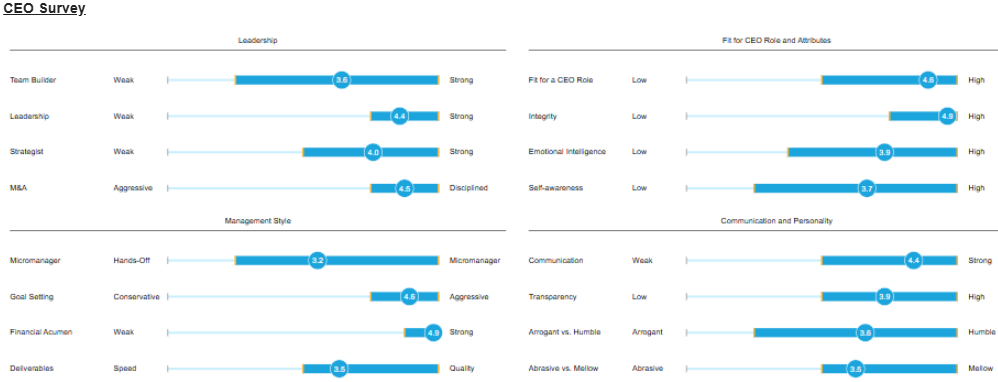
Paragon interviewed 7 former senior executives at ATS who worked with BAX's new CEO, Andrew Hider, for more than 36 years combined. Feedback was universally positive. Hider is a disciplined, process-driven leader who blends Danaher-style operational rigour with strong communication and an ability to scale businesses via organic growth and M&A. At ATS, he drove cultural transformation via the ATS Business Model, delivering margin expansion and shareholder returns, though his intense stretch targets and competitive nature created a high-pressure environment that could limit collaboration and agility. His success at BAX will hinge on whether he can balance his relentless operational focus with greater strategic flexibility and adaptability to the slower-moving, more regulated dynamics of the pharmaceutical industry.
Financials
The Genius Act has changed America’s relationship with crypto, making it the most attractive country in the world for stablecoins. Abacus’ latest report notes that while the pace of adoption is still unclear, long-term disruption of financial incumbents appears inevitable. CRCL’s model is attractive if USDC can scale, though Abacus estimates ~10x growth is needed to deliver a reasonable IRR - a challenging hurdle. Blockchains are expected to replace legacy infrastructure, with SWIFT the first casualty. Visa and Mastercard face limited near-term risk, but crypto is the primary long-term threat to their duopoly. Stablecoins have the potential to reach >$2trn m/cap in the next few years vs. $260bn today. Abacus sees CRCL as a compelling risk/reward play, with upside potential of 195% outweighing downside risk of 50%.