SK Hynix: The memory leopard will not change its spots
Technology
SK Hynix delivered an excellent Q3 and the near-term outlook remains exceptionally strong, with memory prices up 25%+ Q/Q and the company already sold out for 2027. DRAM demand next year is expected to grow faster than industry supply, while pricing should continue rising, setting up further strong revenue and profit growth; Richard Windsor suspects SK Hynix may even be lowballing its 2027 outlook. Where he disagrees is with the industry’s claim that memory cyclicality is over. Gross margins across memory are already around 86%, and while long-term agreements now cover 50% of SK Hynix’s 2027/28 production, Richard doubts they will prevent a price crash once supply eventually exceeds demand. AI-driven memory demand should keep that risk at bay for now, leaving the 12-month outlook excellent, but he sees 2028 as the point when the cycle could begin to turn.
Technology
ASM’s results were well ahead of expectations, but the bigger surprise is the outlook: the upward revision to this year’s revenue forecast pales beside 2027, where ASM is projecting growth of at least 35%. Demand remains supported by AI-related investment and customer capacity ramps, with strong activity at 2nm and 3-5nm and the first meaningful contribution from 1.4nm. Its served available market at 1.4nm should increase by a solid double digit vs. 2nm, alongside higher market share. the IDEA! also expects substantial operating leverage next year, with gross margins benefiting from newer systems and opex lagging revenue growth, driving adjusted operating income up ~50% to just over €2.0bn. At ~15.5x EV/EBIT, they see the valuation as very modest, underpinning a highly attractive investment case.
European Industrials: The China risk investors are missing
Willis Welby sees a “second transformation” of Chinese manufacturing as an underappreciated threat to European industrials. China’s first advantage came from cheap labour after joining the WTO; the next could come from widespread deployment of AI and robotics, materially improving factory and supply-chain efficiency while retaining a lower-cost workforce. The risk extends beyond Chinese exports into Europe: more efficient domestic competitors could also displace European companies in China and take share from them elsewhere globally. Willis Welby therefore highlights European manufacturers with significant Asian exposure and relatively demanding valuations, including Sandvik, Alfa Laval, Atlas Copco, Epiroc, Hexagon, EMS-Chemie and DSM-Firmenich. All currently have positive earnings momentum, but their valuations leave them vulnerable if Chinese competitive pressure becomes a more prominent investor concern.
South Africa: Longer term lower-yield regime still intact
South Africa’s yield curve has risen since March, with the SAGB 10-year yield now at 8.9% from just below 8% at the end of February. However, Peter Attard Montalto still sees the longer term lower-yield regime as intact, and almost all of this move has been US related inflation and real rates not SA equivalents. Despite the oil shock and the subsequent global bond sell-off, SA yields remain 150-270bp below levels from just 18 months ago. Looking ahead, Peter remains constructive on the long end despite the difficult macro backdrop. He now sees the 10-year ending 2026 around 8.6% from 8.9% currently, which is still well above our 8.2% forecast before the war, while we continue to see yields just below 8% end-2027. Peter retains his MPC view of the first cut now only in July next year, which should keep the short end stable, but risks remain strong for a 25bp hike in January if fuel prices continue higher and El Niño risks intensify.
The inflating EPS bubble offsets US equity derating
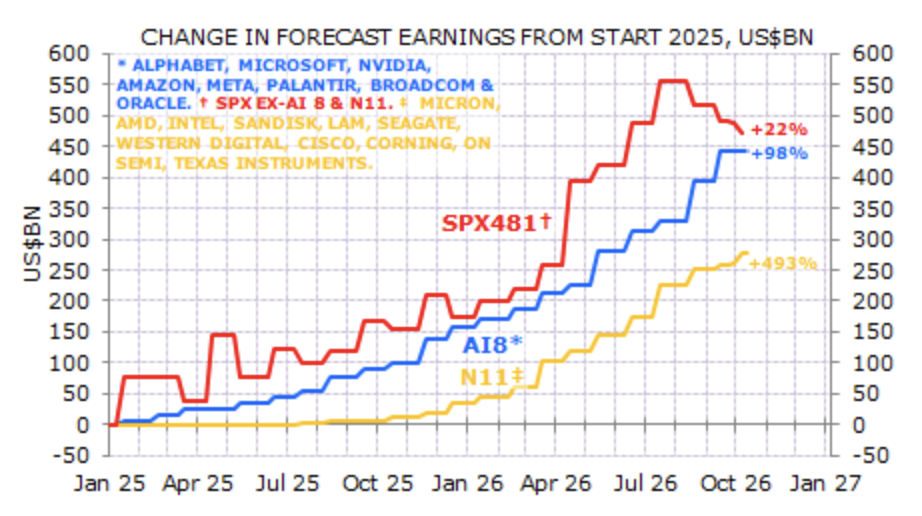
Gerard Minack argues that the September quarter reporting season will confirm the US is in the middle of an epic profit boom, offsetting valuation pressure from rising interest rates. Year-ahead forecast earnings have risen by USD1.2trn since early 2025, driven by the AI supply chain feasting on capex spending by AI providers, even whilst no one is making money from AI. Gerard expects earnings growth to continue offsetting multiple compression into 2027. Forecast earnings for the AI8 are up USD450bn, or 98%, while forecasts for 11 second-tier supply-chain stocks surged by USD$250bn, or almost 500%. The net effect is that AI leaders have outperformed whilst derating, leaving the Next 11 trading at a prospective PE below 14. If this is a bubble, it is an earnings bubble rather than a valuation bubble; the primary risk to medium-term US equity returns is not that valuation normalises, but that EPS growth does.
Notes from Brussels
Brussels faces an accelerating race against the clock ahead of the spring 2027 French presidential elections, compelling leaders to settle for stagnant compromises across critical policy fronts. Niall Ferguson expects European leaders to agree on the next budget, though resistance from the frugal six will prevent significant cuts to agricultural subsidies, leaving proposed competitiveness buckets squeezed. In trade, Berlin has turned hawkish as lost export markets drive German economic weakness, clearing the path for an Industrial Accelerator Act mandating Made in Europe quotas alongside a US Section 301 equivalent. Meanwhile, Belgium will uphold its veto against using Euroclear Russian frozen assets for Ukraine loans, forcing reliance on bilateral contributions as public support for financing weapons slips to 56%. Europe will still stop short of an escalating trade conflict, settling on minimum import prices for Chinese hybrid cars. These defensive trade instruments cannot counter the second China shock; they can only soften it.
A coming crisis? Bet on it
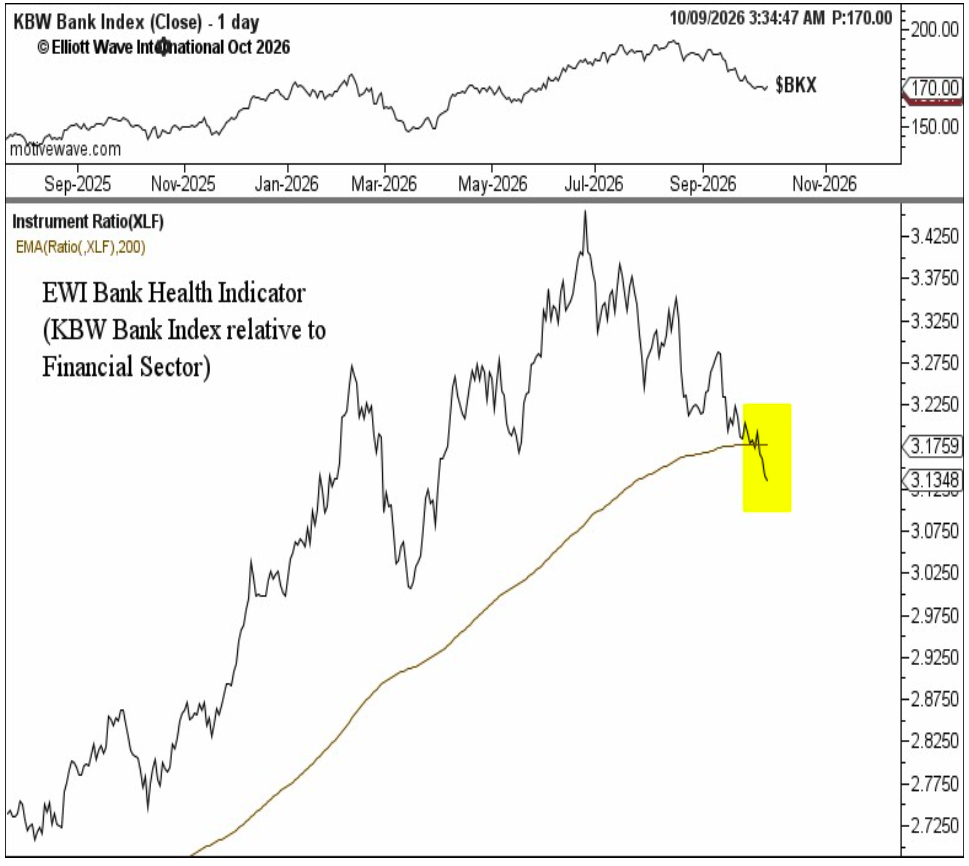
Surging bank lending to hedge funds has quietly revived acute systemic vulnerabilities across the financial sector, leaving prime brokers deeply exposed to a sudden unwind. Over the past decade, and particularly since 2020, bank lending to hedge funds has tripled while prime brokerage revenues have doubled. This aggressive balance sheet expansion has pushed leverage among the top 15 hedge funds above 12 times Gross Asset Value to Net Asset Value, a figure likely exceeding 20 times once derivative positions are factored into calculations. While post-crisis regulations were designed to de-risk commercial banking, prime brokerage arms have stepped in to supply the rocket fuel. Murray Gunn warns that this fragility is now threatening to breach the surface, with the relative strength of banks versus the wider financial sector rolling over against its 200-day moving average. Combined with deteriorating technical trends, the next crisis will almost certainly reverberate straight back into the banking system.
Canada: Distress deepens
Ben Rabidoux warns that although financial markets price in five Bank of Canada rate hikes over the next twelve months, such aggressive monetary tightening seems unlikely given extreme debt vulnerability. Canada remains near the top of the heap globally with total non-financial sector debt relative to GDP sitting 70 percentage points above the US and 80 above the G20 average. The household sector is extraordinarily exposed following an aggressive push into variable and short-term fixed rate lending, ensuring faster monetary policy transmission. Ben highlights that rising rates and escalating trade tensions have hammered consumer confidence, driving national home sales to 23-year lows while homeowner insolvencies hit decade highs. Simultaneously, a severe cyclical overbuild in purpose-built rentals will pressure residential rents well into 2028 just as distressed selling accelerates. In down cycles, your first loss is your best loss.
Will falling unemployment keep US inflation above target?
According to Felix Vezina-Poirier, a tighter labour market over the coming year could cause US inflation to stay elevated even if tariff and energy shocks dissipate. The US labour force has contracted over the past year, driven by the departure of unauthorised immigrants and a decline in the labour force participation rate. This has lowered the threshold for job growth to reduce the unemployment rate. Felix says that a sub-4% unemployment rate may prove to be more inflationary than in some periods in the past. In the late-1990s, productivity gains worked to prevent high inflation when the labour market was tight. AI has the potential to do the same today, but the impact of AI is not yet visible in the productivity data. In addition, inflation expectations are currently elevated. While the risk of a true wage-price spiral is overblown, investors cannot rule out a hawkish surprise from the Fed over the next 12 months.
Communications
Andrew Freedman moves RBLX from short to long, arguing the stock trades on the rate of change in bookings growth and that 3Q26 should mark the low point in the slowdown he had anticipated for this year. Bookings growth has fallen from 70% in 3Q25 to 8% in 2Q26, with 3Q26 guided to a 14-18% decline, but comparisons ease materially from here into 2027. Engagement is also improving, with mobile DAUs turning positive Y/Y in Sep and concurrent-user declines narrowing, while Steal an Egg may be the start of a new content cycle. RDC distribution changes should broaden discovery, although GTA VI creates a Q4 risk. With 2027 estimates reset, Andrew sees ~40% upside over the next 9-12 months.
European NBSK inventories plummet, tightening supply
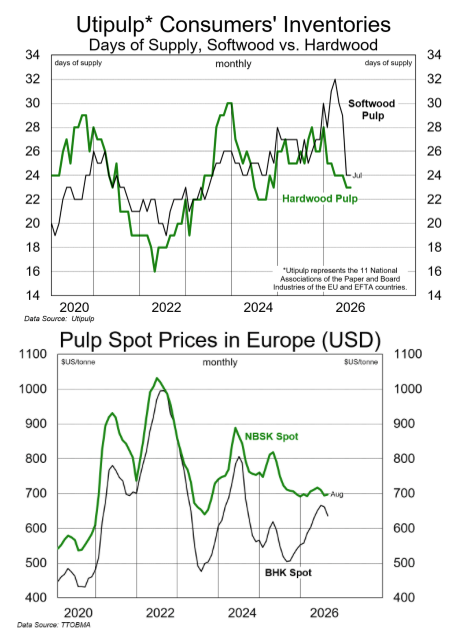
European consumer softwood pulp inventories plummeted from a peak of 32 days of supply in March to 24 days in June/July, undoing inventory accumulation since late 2024. The analyst emphasizes that while NBSK prices remain at unprofitable levels despite robust European downtime from producers like Metsä and UPM, the cushion of sky-high consumer inventories has clearly reversed. Tighter European NBSK supply should support improving prices over time, with consumer restocking expected to drive the next upcycle. Mill inventories remain elevated, but incremental volumes could shift to hardwood as producers substitute furnish. Tighter conditions would provide a tailwind for UPM’s Fibres North group and Mercer’s German mills. On trades, there is no significantly NBSK-leveraged investable equity in the coverage universe, but higher prices would aid Mercer’s bondholder discussions, benefit Domtar ahead of large maturities, and deliver knock-on gains to Suzano.
Taiwan: Making the best of the good times
Niall Fergusons’ team spent a week in Taiwan, meeting with a diverse group of senior contacts. They came away optimistic about 2027, anticipating booming growth, continued progress on societal resilience and deterrence against a cross-Strait invasion, and a relatively low-key presidential election in January 2028. Contrary to public reporting, relations with the United States are the best in decades. Knowledgeable officials are optimistic that an invasion is and will remain deterrable, particularly as Taiwan’s drone industry scales up. However, looking past next year, Taiwan faces major challenges. There is a structural energy shortage. The economic miracle is driven mainly by a single company: TSMC. Beijing’s grey-zone campaign is also accelerating. If President Lai Ching-te is re-elected, Niall’s current base case, Beijing has positioned itself to move swiftly toward a quarantine of Taiwan’s foreign trade. Investors should pay close attention not just to China’s grey-zone moves, but to changes in Washington’s public responses to them.
LatAm’s turn next?
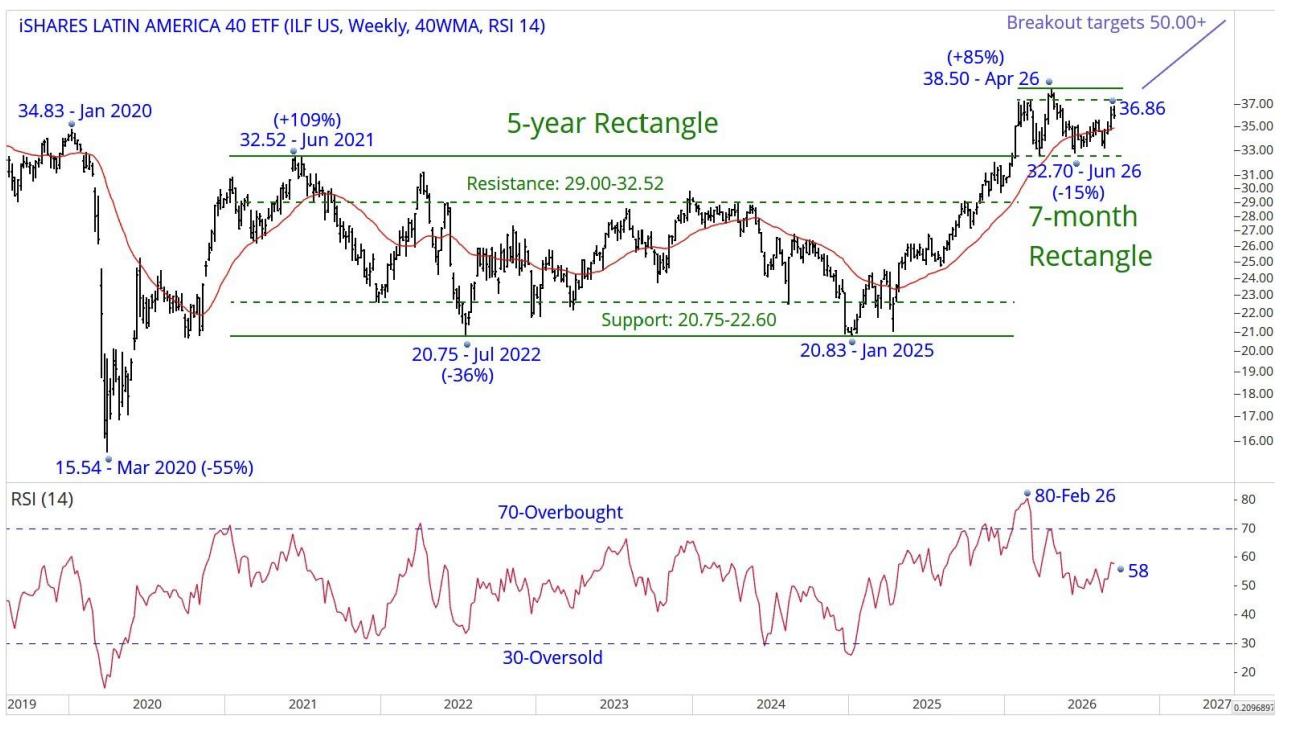
Chris Roberts points out how the iShares Latin America 40 ETF (ILF US, USD35.97) is breaking out after a nearly 18-year Down-Channel and a 75% drop from its 2008 peak. January’s channel breakout has held, with price finding solid support along the rising 20-month WMA and former downtrend line. The weekly chart confirms a breakout from a 5-year Rectangle targeting USD50.00+, backed by the 14-week RSI hitting Very Overbought 80, signalling a structural trend shift. A push above April’s USD38.50 high reinforces this bullish setup, whilst a weekly close above USD39.50 would complete a 7-month Rectangle targeting USD45.00+. With the index heavily depressed for nearly two decades, the USD50.00+ target looks achievable, paving the way for an eventual test of the USD60.00+ peak. The weekly chart breakout saw 14-week RSI reach Very Overbought 80, an important change in behaviour, which supports the idea of a change in trend.
Consumer Discretionary
Felix Wang sees an attractive pair trade around two converging risks for MELI: TikTok shifting more investment towards Brazil and SE’s Monee stepping up the fintech battle against Mercado Pago. TikTok’s Brazil push could pressure MELI through price, assortment and younger consumers, while Monee could challenge Mercado Pago just as MELI’s credit business faces potential NIMAL pressure and a less benign credit cycle. By contrast, if TikTok becomes more selective in Southeast Asia, Shopee could benefit from lower subsidy intensity and better margins. Felix is well below Street forecasts for MELI, he sees annual growth potentially halving next year, and estimates 40%+ upside from the pair trade.
Industrials
KAP remains something of an enigma: difficult to forecast and with new management challenged by old problems. FY26 HEPS rose 88% and EBITDA was up 13% on flat revenue, but much of the improvement came from Safripol, where Middle East disruption temporarily reduced import competition and tightened polymer supply, driving a 109% increase in H2 profit. Those benefits should extend into 1H27, but global oversupply clouds the medium-term outlook and the PET business remains loss-making. PG Bison is performing better as new capacity ramps faster than expected, while Unitrans remains a major challenge, requiring significant catch-up capex and potentially five years to fix. Chronux raises their FY27 HEPS by 11% but cuts FY28 by 7%. They remain cautious on KAP with the emphasis for the next three years on stabilising operations.
Consumer Discretionary
Iii’s channel work raises questions over whether Meesho’s improving reported unit economics are as durable as management suggests. Experienced e-commerce operators argue that logistics efficiency, rather than advertising, is the key determinant of marketplace profitability. While management reported another sequential decline in logistics cost per delivered order in 1Q27 despite higher fuel and wage costs, Iii’s channel work suggests defect rates remain above industry benchmarks, potentially offsetting those savings through higher return-handling and refund costs. With roughly two-thirds of GMV-contributing sellers already advertising, further ad growth increasingly depends on pricing and inventory mix, making Meesho Mall important to the next leg of monetisation. Iii sees logistics cost per delivered order as the key test: another decline would support management’s case, while a flat or rising print would strengthen the sceptical channel view.
India: Time to upgrade
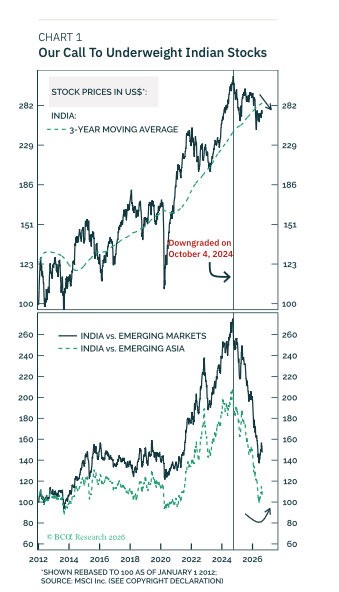
Brian Payne and Arthur Budaghyan argue that India has largely avoided the Hormuz shock, with fuel and fertiliser supplies intact and monsoon rains recovering. Consequently, they headline and core inflation to stay contained, asserting that the central bank’s next move will be a rate cut despite markets pricing in a 65-basis-point hike. Although absolute-return investors should not anticipate an outright equity rally, the analysts believe the bourse’s massive underperformance against emerging market peers is in a late stage. Dedicated EM portfolios should upgrade Indian equities to overweight and shift local bonds from neutral to overweight. In private markets, they advise leading with venture capital over private equity. Investors should now take profits on their short Indian stocks and long Chinese A-shares trade for a 44.5% gain, cut the short small-cap and long large-cap spread at a 16.8% loss, and buy unhedged 10-year domestic bonds.
Is a US debt crisis imminent?
Ed Yardeni points out that US federal spending continues to rise relentlessly. CBO projections show total outlays exceeding $11trn over the next 10 years, driven primarily by mandatory spending and rising interest costs. CBO projections also show annual budget deficits widening from $1.8trn to more than $3trn in 10-15 years. The US remains on an unsustainable fiscal path. However, Ed says it is not yet a crisis. Treasury yields remain in a range broadly consistent with a healthy economy, and Ed expects the 10-year yield to remain between 4.00% and 5.00%. He cites a couple of reasons that support his view: 1) US Treasury Secretary Scott Bessent has taken some actions recently to stop bond yields from rising, and can do more if necessary, and 2) Fed Chair Kevin Warsh is committed to restoring price stability. If inflation remains stubborn, the FOMC will probably raise the federal funds rate in September. That could ease pressure on long-term yields.
Nicaragua: Ortega’s regime is becoming more overtly dynastic
According to Daniel Landsberg-Rodriguez, President Ortega’s July declaration that competitive elections would end, followed by proposed constitutional changes, further entrenches Ortega-Murillo family control. The reform is expected to receive final ratification next year. Ortega is 80, while Rosario Murillo is already co-president and would automatically succeed him if he dies. The opposition has been largely dismantled and the armed forces remain loyal. For investors, policy arbitrariness remains the principal domestic risk. The government has confiscated more than 135 properties worth over $250 million from denationalised opposition figures, while a purge of thousands of lawyers has further weakened protections for private capital. Externally, US pressure is increasing with new tariffs. Separate Nicaragua-specific tariffs on non-CAFTA-origin goods rise to 10% in 2027 and 15% in 2028. The IMF forecasting 3.4% growth in 2026 despite tighter US immigration and trade policies and the risk of broader sanctions.
Everyday essentials, extraordinary pressure
Consumer Staples
Scott Mushkin argues the squeeze on food-at-home is intensifying, with GLP-1 adoption reducing industry volumes just as Amazon and Walmart accelerate their push into everyday consumables. AMZN's essentials business already exceeds $150bn, and he estimates FY26 unit growth of ~25% and revenue growth of ~20%; alongside WMT and Costco gains, this could leave the rest of the market shrinking ~2%. Aggressive pricing and faster delivery should also pressure competitors’ margins, reinforcing Scott’s Sell ratings on Kroger and Dollar General. Pepsico, Campbell's and Constellation (all not covered) are where he is most concerned, but he views the industry as generally uninvestable. Conversely, AMZN’s consumables momentum increases his confidence in his long-term North America retail forecasts and wider industry consolidation over the next couple of years.
Communications
The market is focusing too heavily on GOOGL’s ~$200bn capex bill and not enough on the long-term value of the infrastructure being built, according to Will Nutting. Google Cloud is already running at close to $100bn of annualised revenue, growing 82%, with a 35.6% operating margin and $514bn of contracted backlog. His analysis suggests Cloud could become a $600-700bn business by 2030 and $1.2-1.7trn business by 2035, supporting $400-700bn of operating profit, while the company as a whole could generate $600-900bn of annual earnings. Once the current construction phase slows, depreciation and maintenance capex should look very different from today’s growth capex, allowing it to throw off hundreds of billions in annual FCF. Will sees GOOGL evolving from a search company into a vertically integrated “intelligence utility”, with AI infrastructure ownership potentially becoming the next major investment trade.
Chinese-led AI deflation
Graham Turner argues that Chinese technology companies are leading the next cycle of deflation, implying interest rates will ultimately need to come down rather than rise. Energy prices spiked following Straits of Hormuz skirmishes, pushing the yield curve higher alongside strong US July services surveys. Markets remain anxious that higher energy costs and resilient data provide the Federal Reserve cover for a rate hike at the upcoming July FOMC meeting. However, Graham believes policymakers are missing the broader disinflationary impact of AI, highlighted by weak unit labour cost growth. US firms are increasingly turning to cheaper Chinese open-source AI models, some priced at one-twentieth of Western alternatives, to drive substantial cost savings. While the AI boom is causing short-term semiconductor bottlenecks, Graham contends that Chinese-induced AI deflation will force rate cuts, though a risk remains that the FOMC gets deflected by near-term energy shocks.
Japan: Sterilised intervention will not save the yen
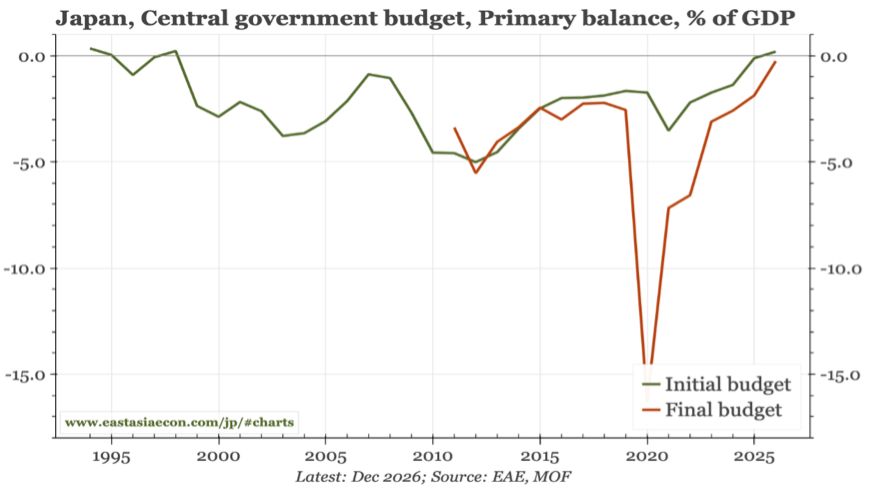
David Woo is sceptical that recent US-Japan FX intervention will yield durable yen appreciation, viewing the rally as an attractive opportunity to establish new yen-funded carry trades. Because the intervention was sterilised and left monetary conditions unchanged, it failed to activate the portfolio-balance channel or signal a monetary policy shift from the Bank of Japan. Export performance demonstrates that currency weakness stems from a structural loss of global competitiveness to South Korea, Taiwan, and China, rather than temporary mispricing. David argues that rising term premia, catalysed by Prime Minister Sanae Takaichi’s aggressive fiscal stimulus and 380 trillion yen investment plan, remain the primary driver of yen depreciation. Trapped by public debt exceeding 200% of GDP, Japan must maintain structurally low real interest rates. The intervention is not the beginning of a new bull market for the yen, but simply another opportunity to sell it until the next intervention becomes necessary.
Energy
Interim results demonstrate the earnings power of SBM’s Turnkey franchise when major project milestones and asset sales coincide, while the Lease and Operate fleet continues to provide a stable foundation. The substantial backlog increase and guidance upgrade confirm that the company is converting its strong market position into tangible financial outcomes. SBM has a very strong track record when it comes to on-time and on-budget delivery of the current construction portfolio, which should continue to support the conversion of the tender pipeline opportunities into additional order wins. With net debt reduced and cash-flow visibility extended far into the future, the balance sheet and capital-return framework look solid. Overall, the results reinforce confidence in SBM’s ability to generate attractive returns through the next phase of the deepwater cycle.
Technology
Future has seen its share price recover recently having been unfairly hit by the “AIpocalypse” sell-off. The company works with management teams to design and build advanced, practical IT systems and is seeing larger orders come through. Near-term earnings are being held back by a major loss-making order, evident in Q1 operating profit growth of just 3% Y/Y to ¥3.4bn and expected to keep H1 growth similarly muted at c.3% to ¥7.3bn. However, Asymmetric expects earnings growth to reaccelerate from Q3 and into FY3/28, with the shares trading on c.12x FY3/28E earnings. Future’s work sits in upstream, mission-critical areas such as architecture, testing, validation, integration, performance design and systems responsibility, making AI more likely to improve productivity than displace the business. Meanwhile, its next-generation core banking system, Future Bank, also appears close to broader take-off.
Economic strategy commits Japan to risky course of action
The Takaichi government has formally approved a new growth strategy and ‘Basic Policy on Economic and Fiscal Management and Reform’. These two documents translate Prime Minister Takaichi Sanae’s ambitions to use fiscal tools to build a strong Japan into guidelines for next year’s budget. Tobias Harris says that “growth through security, security through growth” could serve as a tagline for the Takaichi government’s strategic program. Takaichi believes that there are growth opportunities through investments in national security, economic security, cyber security, and energy security, but also that investments in growth industries – particularly artificial intelligence and robotics, information technology, and quantum computing, with an AI transformation (AX) as the single most important goal – will both ensure national prosperity but also safeguard Japan’s “autonomy and indispensability” in the global economy in the coming decades. However, Tobias notes that while the basic policy gestures towards market confidence, these documents show that rising interest rates have not deterred the government from raising outlays.
Macro View: The wind finally at my back
David Woo argued in the Unbound Global Macro Investor that the geopolitical risk premium remains too low. His short-term market bias is: higher oil - lower equities - neutral rates - neutral dollar.
(1) Higher oil: David says the market is under-pricing two risks: that the latest U.S. efforts to break Iran’s denial of Hormuz will ultimately require the deployment of ground troops; and that Iran will act on its threat to close the Red Sea.
(2) Lower equities: Higher oil is bearish for tech stocks. The release of Moonshot’s Kimi K3 model supports the hypothesis that LLMs are rapidly becoming commoditised.
(3) Neutral rates: Inflation breakevens are likely to play catch-up with oil price next week. However, a decline in expected investment returns of AI is bullish for bonds. The better-than-expected inflation data last week supports a 5s-30s steepener.
(4) Neutral dollar: If the AI bubble bursts, the real yield advantage of the dollar will begin to erode.
Healthcare
At 30x forward adjusted EPS, DXCM continues to raise multiple earnings-quality concerns, especially when compared to Insulet, which has cleaner accounting and trades on a lower P/E. Insulet’s rebates and sales incentives are 25 days of sales, while DXCM’s have exceeded 100 days in seven of the past eight quarters and continue to reach new highs. Inventory is also rising despite heavier discounting, with finished goods having tripled. Price discounts should reduce inventory value through a higher reserve, but reserve growth has stalled, supporting EPS. Warranty accruals also look low, while flat dollar R&D spend in Q1 added 3c to EPS as a percentage of sales. Other companies reporting next week where BTN has recently flagged earnings-quality risks include Belden, Church & Dwight and Eaton.
Micron specialty DRAM margins stay elevated
Technology
Specialty memory remains extremely tight, with fabs running close to full, gross margins at historical highs and the next meaningful capacity addition not arriving until 2027. JNK's research indicates specialty memory revenue rose close to 60% Q/Q and ~170% Y/Y last quarter, while Q2 price increases were larger than Q1. Pricing leverage sits with suppliers that still have legacy allocation through next year, including MU's remaining book. Customers are pushing suppliers into long term supply agreements, often with pricing left open, while end customers two and three steps down the chain are approaching component makers directly to secure supply. The key risk is that 2027 capacity additions ease the current squeeze, but JNK believes demand could still run ahead of supply, while a stacked memory product could offer a lower-cost bandwidth alternative to HBM for Broadcom (and Marvell) custom silicon.
Earnings season screens
Mill Street has developed an "Earnings Screen Score" ranking methodology that draws on selected inputs from their MAER (Monitor of Analysts’ Earnings Revisions) stock database to identify companies which have strong near-term fundamental momentum going into an earnings report. Mill Street’s research indicates that companies scoring highly in their ranking have a much higher chance of near-term improvements in analyst expectations than those that score poorly. Stocks most likely to produce positive near-term analyst estimate activity in the next couple of weeks include Franklin Resources, Humana, Seagate and Valero. Bottom ranked stocks include Boston Scientific, EchoStar, Intercontinental Exchange and S&P Global. Click here to access the full report.
Gold & Silver: Near-term price pullback likely
In this presentation, Jeffrey Christian of CPM Group gives a precious metals update focused on the gold price outlook, silver market slump, investor selling, political risks, platinum and palladium weakness, and the US dollar. He explains why gold continues to test the $4,000 to $4,100 area and why a move toward $3,800 remains possible over the next couple of months. Jeff also discusses silver’s test of the $60 level and why CPM Group would not be surprised to see silver move toward $55-$50 in the short term. He explains why some investors have been selling physical gold, silver coins, ETFs, and other positions, while longer term investors continue to hold precious metals as a hedge against economic, political, and financial risks. The presentation also covers China’s physical gold demand, India’s gold selling, political risks involving Ukraine, Russia, NATO, Israel, Turkey, and broader political instability, all of which remain supportive for gold and silver over time. Click here to watch.
Enterprise IT Channel Checks: AI demand meets pricing pressure
Technology
Channel conversations highlighted accelerating AI adoption, tightening cybersecurity spending priorities and growing pricing pressure across the infrastructure market. Partners pointed to rising enterprise demand for AI governance, next-generation SIEM platforms and sovereign cloud solutions, while networking, memory and security vendors continue to push through additional price increases. Sales Pulse also shares fresh partner commentary on key names including HPE, Zoom, RingCentral, Palo Alto, F5 and Nice, along with several emerging trends shaping the enterprise technology landscape heading into quarter-end.
Consumer Discretionary
BROS has assembled a C-suite with the functional depth required for its next phase of growth. CEO Christine Barone has built a leadership bench well matched to the current mandate, combining expertise in capital allocation, site development, retail technology, digital marketing and operational execution to support 185+ annual store openings, improve throughput and scale the brand nationally. The principal risk is cultural rather than operational, with a faster shift towards a more process-driven organisation potentially weakening the founder-led “Dutch Luv” culture that differentiates the brand. Nevertheless, Paragon believes this risk is manageable if management can preserve the customer-facing culture while building a more disciplined, scalable operating model capable of supporting stronger unit economics and a more durable growth algorithm. Their analysis includes diligence memos / interviews on Barone, CFO Guenser, CMO Davilla, CDO Cahoe, CT&IO Krishnababu and CSO Somers.
Bitcoin: The upcoming sixth cycle
Markus Thielen points out that there has been a recurring pattern to Bitcoin cycles: each cycle was defined by a distinct dominant narrative, which in turn demanded a different kind of promoter and attracted an entirely new class of believers. Bitcoin has now completed five bull markets and is navigating its fifth bear market. If a sixth cycle is coming, which Markus believes it is, what drives it, and who is the marginal buyer? He says that the sixth may look less like a reinvention and more like a continuation, driven by the same forces and the same buyers that defined the fifth. What gives him confidence in a sixth cycle is that the primary drivers of the fifth, money printing, dollar debasement, and the search for hard assets outside the traditional system, have not disappeared. If anything, they are compounding and accelerating. Markus believes that the next sovereign debt crisis, whenever it arrives, will not find Bitcoin without an audience.
South Africa: Structural reform faces capital shortfalls
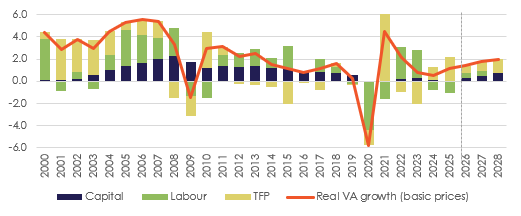
The Macro Advisors team outline how South Africa’s productivity problem has deepened alongside a long erosion in capital formation. While recent total factor productivity gains are welcome, they look more like windfall gains from a dire operating base than evidence of a sustained productivity cycle. Structural reform across logistics, electricity, and ports can lift productivity by restoring the operating base, but this constraint-relief channel is being deployed on a weak capital base. Net investment is just above depreciation, meaning the economy is barely replacing and repairing existing assets rather than expanding the productive frontier. The team struggle to pencil the required 4-5% real gross fixed capital formation growth into their forecasts over the next three years. Without stronger investment crowding into productivity-enhancing assets, potential growth remains stuck at a maximum 2% in the medium run, raising serious challenges for business positivity.
UK: Brexit, 10 years on
In an extensive report examining the paradox of Brexit a decade on, Niall Ferguson observes that leaving the European Union has fallen short of revitalising the economy or curbing immigration. Non-EU trade agreements fail to offset the single market exit, which permanently lowered trade volumes and left business investment significantly depressed. However, Niall believes that Britain's primary drags remain homegrown, driven by an inefficient NHS, rigid planning laws, and severe energy grid fragility exposed by recent shocks. While the likely next Prime Minister Andy Burnham targets incremental alignment on agri-trade and emissions, Brussels will demand politically costly concessions. Consequently, structural domestic blockages and demographic change will continue to impede fiscal consolidation. With public finances failing to recover from the pandemic, persistent energy-induced inflation risks and deep political uncertainty mean the structural rise in borrowing costs is unlikely to reverse, maintaining long-term upward pressure on 30Y Gilt yields.
The Great British Peso
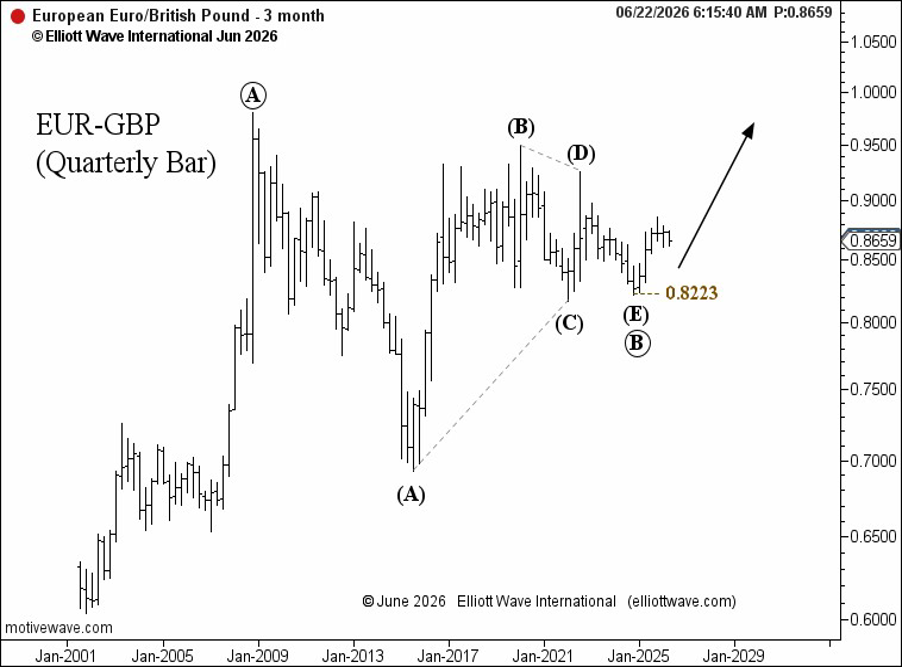
Now that U.K. Prime Minister Keir Starmer has said he will resign, it paves the way for, in all likelihood, Andy Burnham to become the next PM. Murray Gunn points out that in the nineteen years leading up to 2016, the U.K. had three PMs. In the ten years since 2016 there will now have been six PMs. What happened in 2016? Oh yes, that was when Britain became the only country in history to impose economic sanctions on itself by voting to leave the European Union, the planet’s largest economic trading bloc. Since then, social mood has continued to trend negatively, economic growth has been anaemic and the far-right has risen in the political zeitgeist. Sterling still looks like it is appreciating versus the US dollar, but the chart of EUR-GBP shows that it could be set for years of depreciation after completing a triangle from 2008 to 2024. Do not be surprised if developments on these islands become even more dramatic over the next decade.
Ripples of risk-off
Murray Gunn wrote about the dichotomy between the fortunes of Ripple, the cryptocurrency company, and XRP, its token. He pointed out the booming company that has been securing lucrative and high-profile contracts, yet the price of XRP has been declining. Another Bitcoin bust beckons, as the iconic cryptocurrency was declining in the next wave of its ongoing bear market since its peak last year. Bitcoin also sports at least one head and shoulders top pattern which could give it even more bearish implications. Murray pondered whether the crypto slump was a subtle sign that risk appetite was waning, and it might now be finally feeding through into the stock market with the S&P 500 down over 3% last week. Don’t be surprised to hear and read about people attempting to “buy the dip.” And when the stock market struggles to recover, as he suspects, expect increasing panic to ensue.
Japan: Yen under pressure, but data is encouraging
Graham Turner says that the prospect of a rate hike at the FOMC meeting in June casts a harsh spotlight on the Bank of Japan: the BoJ will meet earlier next week, and unless it agrees to tighten policy too, the yen is likely to plumb new lows against the US$. For the Bank of Japan, there is no obvious pressure to hike, as inflation has been well-behaved. The y/y for the Nationwide CPI eased to 1.38% in April. The CPI excluding food, alcohol & energy dipped to 1.06% y/y. Real wages are rising sharply, in part, because of the drop of core inflation as well as fuel subsidies. The labour market in Japan is tight. The unemployment rate fell to 2.5% in April. Total employment jumped to 68.76m, a new high, despite a shrinking population. These are encouraging trends that bode well for Japan’s response to an ageing population, particularly against the backdrop of high government debt.
US: Bond volatility matters most
Ahead of the next FOMC in mid-June, Michael Howell questions the importance of the rate-setting ritual. He argues that the bond market, not the US Fed, is the main force shaping the economy and equity markets. More specifically, what matters most is not bond yields but rather bond volatility. Investors should be watching the MOVE index and closely examine the US Treasury’s actions in the bond market, because they may now matter more than the policy rate itself. Michael argues that the Fed has been sidelined, losing much of its traditional influence over financial conditions. Still, it plays an important financial stability role in smoothing funding operations and specifically maintaining harmony in the crucial repo / collateral markets. Also, he notes that lower policy rates are not always stimulative. Because the private sector is a net creditor to the government, rate cuts can reduce interest income to bondholders and potentially dampen spending.
US: The populist backlash against AI
Matt Gertken and Marko Papic say that the populist backlash against AI could result in bipartisan regulation in 2027, but is especially likely to prompt tax hikes from 2029. Public criticism of the new technology is growing and politicians in the US and abroad are proposing measures such as AI regulation, taxation, redistribution, and restrictions on data centres. Job displacement is the core concern, with opposition to AI strongest in service-oriented economies where workers fear automation. Americans increasingly view AI as developing too quickly, oppose data-centre construction in their backyard, and are becoming less optimistic about the benefits of technology, particularly among younger generations. The investment risk is political, not technological: a recession, AI-driven mass layoffs, inflation, or a major AI-related accident could mobilise voters and lead to aggressive regulation or higher taxes on technology firms as early as next year – and especially after the 2028 election.
Eurozone growth risks mispriced amid hawkish consensus
The Variant Perception team examine the outlook for the Eurozone as inflation leading indicators and breadth remain elevated well above pre-Covid levels. Whilst rising service price surveys put pressure on the European Central Bank to remain hawkish to anchor inflation expectations, matching the market pricing of at least three interest rate hikes over the next year introduces substantial downside growth risks. According to the team, current market dynamics replicate the post-GFC period by overstating inflation fears and underestimating growth destruction. This structural misalignment occurs at a time when Eurozone macroeconomic breadth vs the rest of the G10 remains weak. With the trend component of the firm's tactical outlook model turning decisively negative, the underlying economic setup points toward a sharp growth capitulation rather than a sustained tightening cycle. The team express their bearish view on European growth by selling rallies in the euro.
Greek Equities: Adopting a more cautious stance
ResearchGreece revisits their stock picks and assesses the political outlook ahead of the next parliamentary elections. Macro conditions remain solid, with Q1 real GDP up 2.0% Y/Y, although inflation accelerated to 5.2% Y/Y in May (+0.0% M/M). With the Athens Index up +11% YTD, valuation multiples of non-banks in their universe have expanded to 13.2x P/E and 8.0x EV/EBITDA 2027, leaving more limited upside. Combined with polls pointing to a hung parliament, ResearchGreece is turning more cautious on Greek equities. Banks remain their preferred exposure (solid outlook - volume, rates, asset quality) as a leveraged Greek macro play. They prefer National Bank of Greece, Bank of Cyprus, Piraeus and Optima. Outside banks, they favour selective infrastructure, industrial and defensive names such as OTE, Titan, PPC and Piraeus Port over consumer stocks and cyclicals.
Hang Seng on the launchpad
Erik@YWR argues that the Hang Seng’s sluggish start to 2026 masks a much more attractive setup, with the index described as a “coiled spring” after moving sideways for 15 years in hard-currency terms. He sees 35,000 as achievable, supported by improving fundamentals: based on YWR’s approximation of 89 constituents, earnings growth is expected to accelerate from a 6% CAGR over 2015-2025 to 11% over the next 3 years. Key drivers include 17% EPS CAGRs at Tencent and Alibaba, 6% growth from the major Chinese banks, oil-price support for energy names, 26% growth from BYD and CATL, and a recovery in property stocks. With earnings revisions turning positive, Hong Kong property prices recovering (mainland China prices stabilising) and the index on <10x 2028 earnings, Erik sees meaningful upside.
Consumer Discretionary
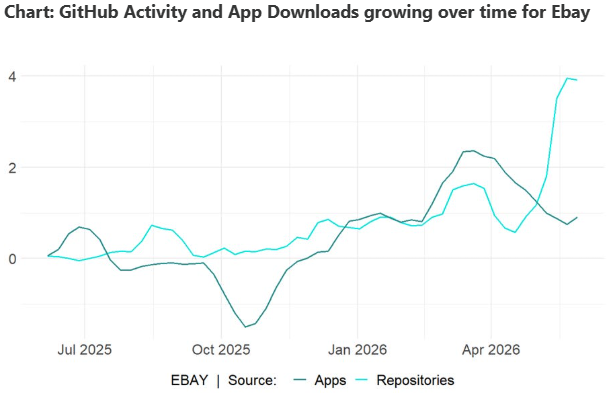
The company ranks in the top 20% of AnteData’s universe, reflecting a strong improvement in coding momentum during 2026. The signal is primarily being driven by rising App activity and exceptionally strong GitHub interest where developers are building pricing tools, arbitrage engines and inventory automations using EBAY as a pricing and transaction platform. AnteData sees the group’s focus on passion-driven goods, including auto parts, collectibles and luxury items, as increasingly important, with these categories now representing >30% of value traded. They believe EBAY can sustain c.8% annual revenue growth over the next 5 years, lifting sales from $11.5bn to $16bn and nearly doubling income to c.$4bn.
Copper’s record prices: What happens next?
In this presentation, Jeffrey Christian of CPM Group gives an update on gold, silver, platinum, and palladium prices before turning to copper. He explains why precious metals appear to be settling into a summer consolidation period, with gold trading near $4,500, silver holding within its recent range, and platinum and palladium also moving within broader trading bands. Jeff then turns the focus to copper, where CPM Group remains constructive on the long-term outlook but less aggressive than many other market forecasts. He discusses why copper demand tied to construction, electrification, vehicles, power grids, AI, and data centres needs to be analyzed with more nuance and less uncritical enthusiasm. While CPM expects the copper market to remain tight, with refined supply falling short of fabrication demand. Jeff also explains why some long-term copper price expectations may be too optimistic.
Click here to watch.
USDJPY: Stable but unsustainable
USDJPY seems stable for now, caught between the upward lift from the negative real interest rates in Japan, and the gravity of valuation and the MoF’s threats of interventions. Stephen Jen believes that the next big move in USDJPY is down. But elevated oil prices may delay the timing of this prospective correction. USDJPY remains elevated near 160. There are several powerful forces pushing USDJPY higher, even though the JPY is already grossly undervalued. Japan’s real interest rates remain very negative. The BOJ’s policy rate is minus-65 bps in real terms, and minus-300 bps relative to the Fed Funds Rate. Further, the negative terms-of-trade shock from higher oil prices is the second driver of USDJPY. In essence, the JPY is the mirror image of the USD, which has been propped up by capital inflows over the years, attracted by the higher carry and capital gains in US equities, pushing the USD deep into overvalued territory.
US: Warsh’s natural bias
In the last week markets have moved to peg the Fed for about 28bps of hikes in the next year, a substantial shift from the 1-2 cuts priced in late February. Warsh assumes the Chair with a challenge to his natural bias – higher productivity via AI implying stronger GDP growth potential (but less inflation and hence need to hike), weak jobs markets but immigration arguably keeping the U/E rate down (which should point to rate cuts), a tighter and smaller Fed balance sheet (that implies rate cuts to offset) and different measures of inflation (trimmed mean over core PCE which conveniently is lower and implies rate cuts). This set of biases imples that Warsh is more of a cutter than a hiker. While the markets peg the first Fed hike in March 2027, Craig Ferguson thinks that the Fed will get an inflation shock in the next 3-4 months that leads to them hiking in Q3.
US: …and the answer is margins
If you want to understand equity markets today, Paul Krake advises to start and end with margins. The blended Q1 2026 net profit margin for the S&P 500 came in at 14.7%, the highest figure since FactSet began tracking the metric in 2009, eclipsing the 13.2% record set just one quarter ago. The direction of travel is unambiguous. What is changing now, and what makes this margin story qualitatively different from the cycle-on-cycle expansions that preceded it, is who participates. The hyperscalers are not building this infrastructure for their own consumption. They are building the road, and the rest of the economy pays a toll to drive on it. The productivity gain accrues to the customer. The S&P at all-time highs is not a puzzle. The cleanest expression of this view in a single trade is long the equal-weight S&P 500 against the cap-weighted index. The next phase of this story is breadth. Equal-weight is how you own it.
The ECB’s coming hike
According to Mark Bathgate, the ECB is likely to hike at their next policy meeting on June 11th. Mark points out that President Lagarde has clearly stated, “memories of 2022 are very fresh” – hence he says that the ECB is going to prioritise its inflation stability mandate and tighten policy to deliver on that. He thinks they will hike 25bps, then suggest that more hikes are possible. The most likely scenario for further hikes after the initial one is an “end of war” outcome – where business/confidence rises, but inflation continues to rise due to the 12-18 months disruptions/inflation in energy-intensive products. The market has moved between pricing 2 and 3 rate hikes over recent weeks – this seems reasonable pricing. A cash rate around 2-2.5% and 100bps curve to the 10-year part of the curve is seen by the ECB as “back to normal”, and a sustainable place for monetary policy to be (also good for the health of the EU banking sector).