SK Hynix: The memory leopard will not change its spots
Technology
SK Hynix delivered an excellent Q3 and the near-term outlook remains exceptionally strong, with memory prices up 25%+ Q/Q and the company already sold out for 2027. DRAM demand next year is expected to grow faster than industry supply, while pricing should continue rising, setting up further strong revenue and profit growth; Richard Windsor suspects SK Hynix may even be lowballing its 2027 outlook. Where he disagrees is with the industry’s claim that memory cyclicality is over. Gross margins across memory are already around 86%, and while long-term agreements now cover 50% of SK Hynix’s 2027/28 production, Richard doubts they will prevent a price crash once supply eventually exceeds demand. AI-driven memory demand should keep that risk at bay for now, leaving the 12-month outlook excellent, but he sees 2028 as the point when the cycle could begin to turn.
China Advertising: AI widens the platform divide
Technology
86Research's latest channel checks sees them turn more cautious on China’s advertising outlook but more constructive on Tencent’s relative position. Ad growth fell short of expectations in Q3 and disappointing Double 11 demand points to further moderation, with 2027 likely to slow again as spending in AI products, smart devices and AIGC content normalises. At the same time, advertisers are shifting from headline GMV towards net transactions and measurable ROI, favouring platforms with stronger AI targeting, attribution and commerce integration. Tencent should benefit from deeper Alibaba integration, ADQ 3.0 and remaining Video Accounts traffic headroom, while Douyin remains strongest in end-to-end execution. Xiaohongshu and Bilibili also screen well, whereas Kuaishou, Baidu and Weibo face greater pressure. GEO adoption is accelerating, but near-term AI monetisation looks more likely to come through better ad efficiency than new chatbot advertising revenue.
Consumer Staples
BID remains an attractive way to play the structurally resilient shift towards eating out of home, with scaled distributors capturing more of the economics than restaurant operators themselves. Foodservice demand has compounded through the financial crisis, Covid, inflation, delivery apps and GLP-1 adoption, while barriers to entry in broadline distribution remain high because of route density, cold-chain infrastructure, purchasing scale and technology. BID combines that structural backdrop with record FY26 trading margins, light gearing, strong cash generation and a proven bolt-on acquisition model. Europe remains the main profit engine, while the UK offers the largest margin upside. Despite this, the company trades at just 16.5x FY26 P/E vs. materially higher US peer multiples.
Indonesia: Good companies at bargain prices
The substantial de-rating of some of Indonesia’s best businesses, alongside low inflation and a depressed real effective exchange rate, has created a rare opportunity to buy market leadership, strong management and growth at attractive valuations. David Scott’s top picks are Bank Central Asia, Cisarua Mountain Dairy, Multi Bintang Indonesia, Sumber Alfaria Trijaya and Kalbe Farma. BBCA combines strong organic growth in an underbanked economy with improving efficiency and now trades at just 10.7x P/E. CMRY offers strong dairy and packaged-food brands, direct distribution and 30%+ ROE, while MLBI combines the iconic Bintang franchise with pricing power and high cash generation. AMRT’s dense Alfamart network and procurement scale underpin further store and online growth, while KLBF offers diversified healthcare exposure, broad distribution and established local brands.
Technology
SITM is approaching an important competitive inflection as its MEMS timing products increasingly meet the low-jitter requirements of high-speed AI networking, while retaining advantages in stability, programmable frequency control and integration. Rosenblatt expects a clean beat-and-raise quarter, forecasting Sep/Dec revenue of $300m/$325m, while seeing substantial operating leverage as the business scales: every additional $50m of revenue adds ~$0.90-1.00 to FY28 EPS and each 100bps of operating-margin expansion adds ~$0.50. With consensus assuming only ~31% incremental EBIT margins, Rosenblatt sees room for further earnings upside. Yet the stock trades broadly in line with premium semiconductor peers despite stronger growth (forecasts sustainable 20-25% long-term revenue growth) and superior gross margins. TP $750 (55% upside).
Technology
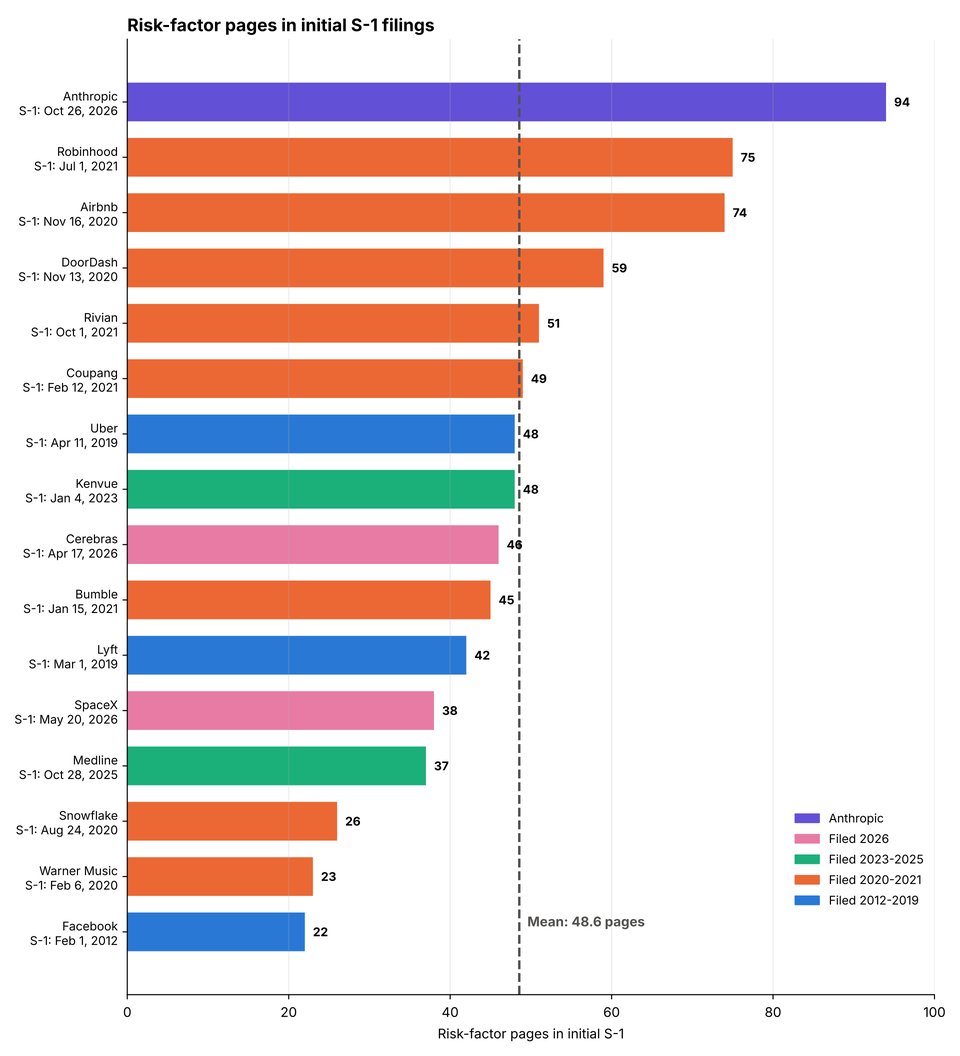
Anthropic’s S-1 contains one of the most extensive risk-factor sections footnoted has seen in a major US IPO. The company devotes 93 pages to risks, nearly twice the average for large US listings and well above recent IPOs such as Cerebras and SpaceX. The section has also grown materially from the 78 pages disclosed in Anthropic’s July filing. Several individual risks run for multiple pages, including constraints on compute availability and the possibility of models behaving in unintended, misaligned or autonomous ways. footnoted cautions that their comparison is not exhaustive across every S-1 filed since 2001 (when the SEC’s electronic repository of historical filings began), but among major IPOs over the past two decades, Anthropic stands out clearly for the scale of its risk disclosure.
Technology
ACIW is being valued like a growth software company just as its core banking franchise faces a revenue cliff. Roughly 70% of EBITDA comes from legacy on-premise bank software, where customers are resisting price increases, simplifying tech stacks and, in some cases, moving processing in-house or to competitors. The recent license-revenue surge looks more like a renewal-cycle pull-forward than a new growth algorithm: LTM license and services bookings are declining double digits, banking backlog is only growing low single digits excluding an anomalous quarter (2Q25), and maintenance revenue is flat despite the license spike. With the customer base already saturated, limited cross-sell and doubts around an accretive Biller sale, consensus growth looks hard to achieve. TP $26 (50% downside) applying ~10x multiple to FY28 EPS of ~$2.65 (vs. $4.28 consensus).
Industrials
The stock trades at ~18x earnings, ~20% above its long-term average, despite growing structural competition and signs that near-term sales are being pulled forward. Milwaukee Tool has taken share with a better product priced 20-30% lower, while Harbor Freight has doubled its store base, expanded overlap with SNA’s hand-tool range and undercut prices by as much as ~80%. Younger mechanics also appear less attached to the brand, while franchisee and route counts continue to decline. Recent growth has also been helped by SNA’s largest-ever power-tool price cut: franchisees loaded up after a 30% discount, only for the company to subsequently launch a cheaper line to compete with Milwaukee. Rising franchisee receivables add to channel-stuffing concerns. The short thesis sees Q3 as potentially the last good quarter for two or three quarters; assuming at least a 15% EPS miss, it implies ~25% downside from current levels.
Financials
FSZ shares have fallen ~30% since Fighting Financials initiated their short on 9th Sep, but they see further downside as attention turns to the sustainability of its dividend. Their original thesis was that FSZ is a sub-scale, relatively undifferentiated asset manager caught between specialist boutiques and scale leaders, with five years of net outflows, declining AUM margins and unusually high leverage. Despite respectable investment performance, AUM has remained broadly flat as outflows offset market gains, while dividends and buybacks have materially exceeded earnings. Fighting Financials now argues that, if recent trends persist, FSZ will have to cut its dividend. At a more sustainable 50% payout ratio on FY26 consensus earnings, the shares would yield just ~4.5%, offering little compensation for the risks.
Consumer Discretionary
The return-to-office tailwind for US office furniture is fading just as HNI takes on substantial execution and financing risk from the Steelcase acquisition. Organic growth remains weak at both businesses, with industry growth increasingly driven by price rather than volume, making bullish expectations for a sustained rebound look too optimistic. OWS also questions the $120m+ cost-synergy target, arguing it looks ambitious relative to the seemingly narrow opportunities for savings across procurement, manufacturing and logistics. Steelcase has historically operated at lower margins than HNI, creating a separate risk that the combined company’s profitability falls short of Street expectations. Hearth adds another headwind, with fireplace installations in new homes declining and remodelling activity subdued. OWS models FY27 EPS of $3.35 vs. $4.70 consensus.
Communications
Craig Huber sees OMC’s Q3 results as further evidence that AI is not disrupting the top line, with organic revenue growth accelerating to 7.2% - the best quarterly performance since 4Q22 and, excluding the post-Covid rebound, since 3Q11. Adjusted EPS rose 22% Y/Y to $2.73, while adjusted EBITA reached $1.13bn and margin expanded to 17.6%; on a pro forma basis, core margin improved 200bps as Interpublic synergies and stronger organic growth outweighed reinvestment in technology and agentic AI. Craig now forecasts 2026-28 organic growth of 5.8%/5.0%/4.5%, EBITDA of $4.58bn/$4.85bn/$5.33bn and core EBITDA margins of 18.1%/19.0%/20.0%, with adjusted EPS of $10.33/$11.80/$14.40. He sees attractive risk/reward with the shares trading at just 7.0x/5.7x 2027/28E adjusted EPS. 12-month TP $100 (25% upside).
Utilities
ResearchGreece sees Admie as unattractive despite strong Q2 results at IPTO, its 51%-owned grid operator. The concern is that IPTO’s business plan remains demanding: H1 capex is running below FY26 guidance, yet investment would need to rise sharply in 2027-29 to deliver the €6bn programme and expand the regulated asset base to €7bn by 2029 from €3.3bn in 2025. That execution burden should keep leverage elevated, with IPTO net debt/EBITDA expected to peak above 5x. At the same time, Admie’s dividend yield remains subpar and the valuation is not compelling, with IPTO trading around 10-11x EV/EBITDA across 2026-29 versus grid and transmission peers at roughly 8.2x 2029.
Technology
ASM’s results were well ahead of expectations, but the bigger surprise is the outlook: the upward revision to this year’s revenue forecast pales beside 2027, where ASM is projecting growth of at least 35%. Demand remains supported by AI-related investment and customer capacity ramps, with strong activity at 2nm and 3-5nm and the first meaningful contribution from 1.4nm. Its served available market at 1.4nm should increase by a solid double digit vs. 2nm, alongside higher market share. the IDEA! also expects substantial operating leverage next year, with gross margins benefiting from newer systems and opex lagging revenue growth, driving adjusted operating income up ~50% to just over €2.0bn. At ~15.5x EV/EBIT, they see the valuation as very modest, underpinning a highly attractive investment case.
European Industrials: The China risk investors are missing
Willis Welby sees a “second transformation” of Chinese manufacturing as an underappreciated threat to European industrials. China’s first advantage came from cheap labour after joining the WTO; the next could come from widespread deployment of AI and robotics, materially improving factory and supply-chain efficiency while retaining a lower-cost workforce. The risk extends beyond Chinese exports into Europe: more efficient domestic competitors could also displace European companies in China and take share from them elsewhere globally. Willis Welby therefore highlights European manufacturers with significant Asian exposure and relatively demanding valuations, including Sandvik, Alfa Laval, Atlas Copco, Epiroc, Hexagon, EMS-Chemie and DSM-Firmenich. All currently have positive earnings momentum, but their valuations leave them vulnerable if Chinese competitive pressure becomes a more prominent investor concern.
Financials
Lucror sees substantial risk that Intrum will need another debt restructuring when its 2028 maturities come due. Q3 results were dismal, with no sign of management's promised operational turnaround. Furthermore, guidance for servicing adjusted EBIT was revised downwards and they now anticipate a lower number than in FY25. Intrum also wrote down all the remaining goodwill for its German asset, which reflects poorly on management's judgment. Lucror maintains a Sell recommendation on the longer-dated second-lien notes and Hold on the rest of the capital structure.
Technology
Off Wall Street is removing ORCL from the Whiteboard following a 36% share price decline from USD225.30 to USD143.20 since being added on 9/2/25, compared to a 22% gain for the S&P 500 index and a 28% advance for the NASDAQ Composite index over the identical timeframe. The concerns previously highlighted regarding soaring capex, a prolonged period of negative free cash flow, and persistent uncertainty surrounding the conversion of remaining performance obligations (RPO) into realised revenue have now become well understood across the market. Further downside from current levels will largely depend on OpenAI's revenue growth trajectory, particularly given that OpenAI accounts for nearly half of ORCL's USD664bn RPO base, an operational dynamic that may take several quarters to fully play out.
Technology
Taiwan's ban on China-made glass fiber yarn keeps Taiwan laminate plants buying E-Glass locally through at least 2028, and JNK's research indicates Nan Ya Plastics Corp, the largest local supplier, holds the pricing power. The laminate makers behind high-end AI boards, including Elite Material Co Ltd, have asked for an exemption, but JNK sees one as unlikely while Nanya is still adding capacity. JNK estimates Taiwan's E-Glass shortfall could approach half of demand in 2027 as local glass makers shift lines to Low-Dk fiber. The main risk is AI server customers moving laminate volume offshore as the cost gap widens.
Consumer Discretionary
Arete Research initiates coverage of Garmin Ltd with a Buy rating, viewing its highly profitable Fitness and Outdoor smartwatches and tech ecosystem as undervalued. Garmin leads smartwatch innovation, while expanding into new form factors via the Cirqa screenless band and an anticipated Cirqa smart ring. Alternative data indicates the group will continue extracting maximum consumer surplus through a broadening premium SKU offering whilst holding entry-level model pricing steady to drive user acquisition. Long-term optionality centres on transforming into a holistic software platform, with subscription offering Connect+ forecast to exceed USD500m by FY33. On continued momentum across segments, FY28E sales and operating profit forecasts sit +2%/+12% ahead of consensus. Arete sets a USD335 YE27 target price (21% upside), derived from an equal-weight blend of 17x EV/FY28 Adj. EBITDA and a 10-year DCF. Rating: BUY.
Technology
Huber Research Partners downgrades Netflix Inc to Underweight from Overweight, arguing the stock is currently fairly valued as platform engagement stalls and top-line expansion slows. Craig Huber flags press reports that Netflix is preparing to reduce headcount by 5%, alongside viewing hours that rose just 2% to 97bn in 1H26 (down an estimated ~5% per subscriber). YouTube’s US TV and streaming market share reached 14.2% in July against Netflix’s 7.8% (down from 8.8% a year prior), domestic price increases will likely have to become less aggressive, and management’s openness to large M&A following an aborted pursuit of Warner Bros Discovery Inc signals pressure to defend scale. Craig highlights that engagement reporting will be reduced from twice yearly to annually from 1Q27. Huber establishes a 12-month price target of USD70 (down from USD85), based on 14.0x 2028E EBITDA of USD20.97bn or 16.3x EPS.
Consumer Discretionary
Alibaba Group Holding Ltd is pivoting from acquisition-led expansion to disposals and artificial intelligence, redirecting capital toward AI infrastructure and cloud whilst streamlining non-core assets. VRS highlights that external Cloud Intelligence revenue expanded 40% Y/Y in the March 2026 quarter, yet heavy investment is depressing near-term economics: FY26 adjusted EBITA dropped 56% to RMB76.4bn as free cash flow reversed to an outflow of RMB46.6bn following the group’s commitment to invest at least RMB380bn in AI and cloud infrastructure over three years. Meanwhile, domestic marketplaces have lost share to PDD Holdings Inc and Douyin, driving heavy quick-commerce spend. Valuation multiples have compressed markedly, with the shares trading at 14.87x P/E and 10.43x EV/EBITDA on 2025 figures against an asset base carrying negative net debt of USD10.06bn. VRS sets a weighted target price of USD150.56 (37.20% upside) by blending a two-stage DCF valuation of USD132.61 (60% weight; 20.84% upside) with a peer group valuation of USD177.49 (40% weight; 61.73% upside).
Consumer Discretionary
Management was clear that market conditions have deteriorated over the past 3 months, with higher interest rates, inflation, gas prices, and tougher housing affordability. Yet Lennar Corp persists with increasing incentives and sacrificing margins to maintain even-flow production. This strategy risks slow-motion financial “suicide”, as there is no natural bottom to margin degradation when chasing demand at affordability. This pressure stems from their land bank structure; unable to renegotiate take-down pace, Lennar must buy lots and burn inventory or incur higher option fees. FY26 EPS is forecast at USD4.80/share (down from USD5.47/share), with FY27 lowered to USD4.54/share (down from USD6.38/share) as margins compress under 7% interest rates. LEN trades at 16.3x FY26 P/E vs 16.1x for peers, and 1.04x adjusted tangible book value vs 1.35x for the group. Fair value estimate is USD68/share vs GAAP book value of USD91/share.
Healthcare
Stock ripping on the results but Hedgeye highlight management comments on sticky and escalating cost trends, sounds like the recent No Surprises Act will intensify conflict between payors and care providers (latter group is getting significant $ from arbitration awards in their favour). This is likely to be a driver of payors moving patients out of hospitals/Ambulatory care and into in-community settings (helpful for vendors skewed in that direction eg providing drugs with oral, subcutaneous rather than IV administration). Pressure on ACA increasing as UNH pulls out of big states like Georgia.
Industrials
Following analysis of its FY25 annual report, Ed Steele and Shailja Periwal trim their Sandvik AB score to 23/60 from 25/60, principally reflecting FY25's much reduced level of stripped-out restructuring expense. Ed and Shailja calculate that stripped-out costs represented 4% of PBT adj in FY25 (ex M&A-related items) down from 13% in FY24, whilst stripped-out restructuring costs fell to 2% from 11%. Offsetting, they flag compressed balance sheet bad debtor and inventory impairment provisions, with bad debtor provisioning falling to 3.1% of gross receivables, a 10-year low. The gap between provisions expensed above the line and used or released moderated to 3% of PBT adj. Governance concerns persist: only three of ten directors clearly meet independence requirements, non-audit fees to PwC remain above average at 15%, and whistleblower reports rose 19% to 518 cases with a higher substantiation rate.
It’s playing out as sustaining technology, not disruptive
NYSE parent Intercontinental Exchange Inc filed with OKX for a 24/7 venue trading digital versions of 60-plus stocks, NVIDIA Corp and Space Exploration Technologies Corp among them, and Securitize Inc launched digital shares of 12 US companies. While consensus views this as market structure disruption by blockchain upstarts, it is playing out as sustaining technology: ICE keeps the listing, Robinhood Markets Inc keeps the customer, and the SEC keeps the gate. Like ETFs, the economics belong to license and distribution owners rather than plumbing vendors. The same split shows in listed crypto names: HOOD delivers a 43.9% operating margin and 23.6% ROE, while Coinbase Global Inc sits at negative 13.9%. With record September trading reaching USD$15.6bn (+16.4% M/M), revenue lands on a regulated broker priced at 48x earnings. Exposure rests with after-hours venues, market makers and custodians reliant on a 4pm market close, not disrupted exchanges.
Consumer Discretionary
The impact of affordable Asian vehicles on the local market is being over-estimated, and used car fundamentals have not changed. The share price has suffered after its post-listing run, pulling back close to the listing price on concerns that Chinese cars have structurally disrupted the used car market and permanently impacted margins and volumes. New car disinflation and used car deflation have caused inventory write-downs and margin compression over the past 18 months, as buyers switched from used legacy brands to attractively priced new models in the R300-500k price band. Sourcing has been constrained as sellers hold onto depreciating vehicles, depressing supermarket parking bay utilisation. However, this is temporary; the market is in the final stages of adjusting, while a pricing data advantage and quick inventory turn should allow WeBuyCars Holdings Ltd to regain volumes and normal margins. Valuation is adjusted to R48.00 (from R52.00).
Japan: Breach wave to drive sustained growth
Consumer Discretionary
Initiate long positions across domestic consulting and security vendors as Japan experiences an unprecedented wave of large-scale personal data breaches, amplified by AI-driven attacks. While headlines sent small-cap security names to their daily limit-up on Oct 6th, the cleaner entry point may be consulting, which has only just begun to rebound from the AI-disruption sell-off and now gets a fresh demand driver as breach response, compliance remediation and board-level advisory work pile up. Regulatory pressure, rising litigation risk and boardroom fear should accelerate enterprise security spending, a structural tailwind for domestic security vendors. Industry precedent shows how fast a breach wave converts into compulsory spending, with forecasts converging on roughly 9-10% annual growth for Japan’s cybersecurity market from USD19.9bn in 2025 to USD46.0bn by 2034. Beneficiaries include Trend Micro Inc, Digital Arts Inc, Soliton Systems KK, and systems integrators NTT Inc, NEC Corp and Fujitsu Ltd, though rich multiples and competition from large global vendors remain active risks.
Technology
Global Mining Research upgrades First Quantum Minerals Ltd from sell to hold, arguing that severe peer underperformance leaves investment metrics more compelling, while headline confusion over Cobre Panama obscures what appears to be a preference for a new operating agreement. Although news agencies latched onto the Commission’s recommendation for an “orderly closure”, the report is clear that the state cannot afford to fund closure or international arbitration, with First Quantum retaining the right to recommence ICC proceedings (>USD27bn). GMR assumes no full restart and continues to ascribe a conservative USD2bn risked option value (a 1 in ~5 chance). A recommissioning phase treating 38Mt of stockpiles offers a potential window until ~2H 2027 to reach an agreement, while the environmental audit failed to identify any material non-compliance. On this basis, the shares trade at 1.1x spot P/NPV10, 9.2x 2027E EV/EBITDA and a 4.7% FCF yield, with net debt/EBITDA falling to ~1.4x by 2030E. David Radclyffe sets a 12-month target price of C$39.60 and rates the stock HOLD.
Greek Banks: Solid fundamentals, less valuation headroom
Financials
Ahead of Q3 reporting, ResearchGreece notes that Greek banks offer solid fundamentals driven by high-single-digit volume growth, rising fees and healthy asset quality. However, with the sector trading at 1.59x and 1.46x P/TBV for 2026 and 2027 while offering 5.5% to 6.7% distribution yields, there is less valuation headroom. The firm favours National Bank of Greece SA, Bank of Cyprus Holdings PLC, Piraeus Bank SA, and Optima Bank SA. NBG and BoC are preferred for their straightforward balance sheets, strong capital ratios, and high distribution yields. Optima leads across almost every profitability component with superior earnings growth, while Piraeus offers a compelling risk/reward profile. Sustaining business lending above €9bn a year could prove challenging despite European funding initiatives. NBG and BoC earn OWN IT ratings with TPs of €19.3 and €12.2, while Piraeus and Optima hold TPs of €11.1 and €14.6 respectively.
Buy Cipher Digital Inc into convertible-induced weakness, viewing its USD850m 0% convertible (upsized to USD1bn via a USD150m greenshoe) and offer to equitise part of its 2030 notes as a rational funding move. The financing meets an acute near-term cash need ahead of data hall completions in 4Q26 and 1Q27, unlocking September’s Barber Lake extension, where a second 10Y lease adds USD5.2bn in revenue. The original 10Y lease cost USD2.2bn to build against USD3.9bn in revenue. With additional costs of USD734-759m, partly from tenant change orders, and only 50% of the tenant’s USD375-400m overrun share recovered via rent, Cipher is investing a net ~USD550m more. Only USD832m of its USD4.6bn cash at 2Q26 was unrestricted. With credit markets difficult, the convertible with capped calls limits dilution to 5-6%, versus 10+% for straight equity, locking in an attractive return on capital.
Consumer Discretionary
Bennett Cheer sees Domino's Pizza Inc as an active short ahead of the 3Q print, citing diminishing returns from promotional discounting, deteriorating run rates, and the absence of a credible driver for a back-half inflection. September's pullback in national deals exposed severe promotional reliance; card transactions plunged 430bps QoQ and foot traffic decelerated 340bps to 1.0% YoY as order counts broke down. Domino's operates as a barbell on order count and ticket, but Bennett warns that trading order volume for ticket squeezes franchisee profitability, supply chain volumes, and unit economics, with international operations offering no offset. Management already trimmed US net new store targets to ~175, and adding units into slowing comps risks cannibalisation. With 3Q US same-store sales tracking at -0.2% versus consensus at 0.73%, the full-year low-single-digit guide appears untenable. He models 2027 EPS at USD19.99againsttheStreetatUSD20.82; a multiple derating from 14.5x to 13.0-13.5x PE indicates downside to USD260toUSD270. Rating: Best-idea short.
Technology
Sajal Dogra reviews Penguin Solutions Inc delivered a beat-and-raise quarter that pulled the bull case forward by a full year, guided by FY27 EPS of USD4.45 versus a prior bull-case FY28 EPS of USD4.54. The FY27 outlook assumes flat memory revenue, with sequential expansion driven entirely by Computing; segment revenue estimates rise to USD782m for Advanced Computing and USD1.40bn for Memory. Backward-looking Services softness is countered by 17 AI-infrastructure customer additions carrying three-to-five-year contracts. Management projects Advanced Computing and Memory growth of ~40% and ~50% in FY27, while non-hyperscale AI compute should near-double to ~USD600m alongside accelerating bookings. Heterogeneous NVIDIA Corp and Advanced Micro Devices Inc architectures reinforce the strategic positioning of vendor-agnostic ClusterWare. CXL memory penetration should exceed 10 50-60m quarterly run-rate ahead of inflection in 2H FY27 and >30% gross-margin potential. Sajal raises the price target to USD100 from USD80 on 20x FY28E EPS of USD$5.01; Reiterate Buy.
US Midcaps, two years on
Industrials
Kailash Capital Research argues that midcap allocations have shrunk to an unprecedented 19.4% of the Russell 1000, setting a fresh six-decade low beneath the dot.com trough. Although the relative trade lagged by 3.6% since year-end 2024 (Russell 1000 up 32.3% vs. 28.7% for midcaps), valuation spreads have stretched right back to dot.com peak extremes. The Russell 1000 trades at 3.3x sales (the 99.9th percentile historically) versus 1.7x for midcaps, leaving the relative price-to-sales multiple at 1.9x. Crucially, the largest 50 stocks trade at 6.0x sales, matching the dot.com record of 3.5x the midcap sales multiple. Sector concentration has also intensified, with IT expanding to 36% of the large-cap benchmark, whereas midcaps offer broader US economic exposure led by Industrials at 17%. Kailash Capital Research reiterates funding midcaps by trimming mega caps, ranking AES Corp (AES), Cheniere Energy Inc (LNG), Popular Inc (BPOP), Axis Capital Holdings Ltd (AXS), and Halliburton Co (HAL) at the top of their 25-stock screen.
Weston family strikes boot deal
Consumer Staples
Wittington Canada’s USD$8.9bn acquisition of Boots UK Ltd alongside Fairfax Financial Holdings Ltd reinforces Galen Weston’s preference to preserve capital-allocation flexibility rather than privatise George Weston Ltd (GWL) to eliminate its 132.3bn in equity. Financing appears manageable following the Weston family’s reported ~£4bn sale of Selfridges Group Ltd in 2022. Common control of Boots and Shoppers Drug Mart Corp creates operational benefits across beauty, proprietary brands, healthcare services, and digital loyalty, while Per Bank has shown an appetite to import global practices. These initiatives could support Shoppers’ performance and Loblaw Cos Ltd’s valuation over time. Given GWL’s 52.6% interest in Loblaw, intrinsic gains flow directly to NAV. The transaction leaves the USD$115 NAV and BUY rating unchanged, which assumes a persistent 12.5% holdco discount.
Technology
Meta Platforms Inc has launched its flagship closed models, Muse Wonder and Muse Wonder Full, retaking the high ground in AI benchmarks and addressing software generation to monetise compute against Anthropic PBC. Richard Windsor argues there is no moat in models; the ecosystem battle will instead be decided by ownership of the user touchpoint, where Meta holds an entrenched distribution advantage across its 3bn global users. Muse Wonder will power the core of Meta's consumer AI services, with the Muse agent already topping Apple Inc and Android download charts. Richard expects the maturing agent ecosystem to consolidate down to three or four dominant players to avoid commoditised returns, positioning Meta ahead of rivals like OpenAI Inc and Anthropic. The traction of Muse alongside enterprise compute monetisation underpins a valuation of at least USD$770 per share, where he maintains his position.
Is gold still behaving like a gold haven?
Milan Vaishnav explains that a safe haven is not an asset that rises whenever the news turns unsettling. Elevated geopolitical tensions and oil supply concerns have failed to buoy spot gold, which touched its lowest level since early August on September 28. Milan argues that the interest rate channel has proved decisive: the US Federal Reserve raised its target interest rate by a quarter of a percentage point in September, and higher Treasury yields impose a stiff opportunity cost on a metal paying no interest. Concurrently, persistent US dollar firmness has compounded headwinds, making gold more expensive for foreign buyers. A technical divergence between price and momentum would merely warn of easing selling pressure rather than trigger an outright reversal. Gold must stop forming lower lows, hold support, and break above its recent lower high to confirm buyers are regaining control.
Bitcoin to 140k minimum
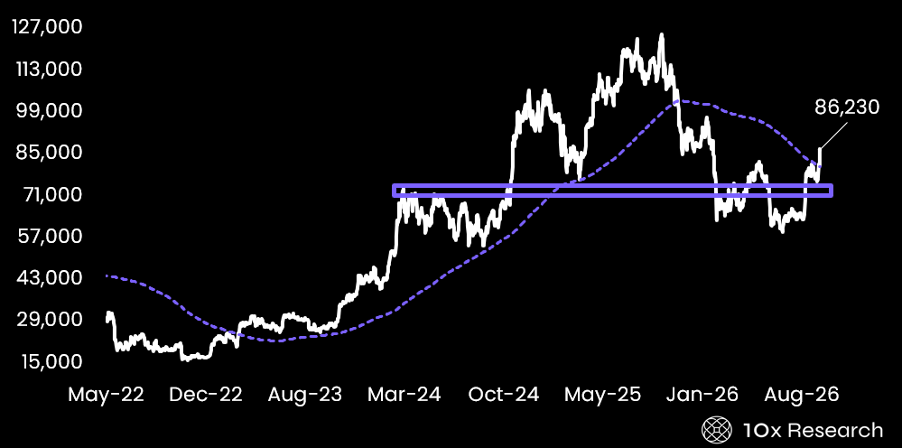
Markus Thielen points out that Bitcoin bottomed at US$63,000 in August, as he expected, during a quiet stretch when few people were paying attention. It has since climbed above 82,000. For now, the Fed is keeping money flowing, and that Markus says supports assets like Bitcoin. To judge how far this rally could go, he looks at the average price that investors (not miners) paid for their Bitcoin. That average is about 76,900 today, so the typical investor is sitting on a 12% gain. In past cycles, broad selling usually didn't start until investors were at least 85% in profit. That level is roughly 142,000 today. Markus therefore has a minimum target for this bull market of around 140,000 to 145,000. He doesn't expect to get there quickly, but the message is for people to stay invested and not let short-term news shake them out.
Will falling unemployment keep US inflation above target?
According to Felix Vezina-Poirier, a tighter labour market over the coming year could cause US inflation to stay elevated even if tariff and energy shocks dissipate. The US labour force has contracted over the past year, driven by the departure of unauthorised immigrants and a decline in the labour force participation rate. This has lowered the threshold for job growth to reduce the unemployment rate. Felix says that a sub-4% unemployment rate may prove to be more inflationary than in some periods in the past. In the late-1990s, productivity gains worked to prevent high inflation when the labour market was tight. AI has the potential to do the same today, but the impact of AI is not yet visible in the productivity data. In addition, inflation expectations are currently elevated. While the risk of a true wage-price spiral is overblown, investors cannot rule out a hawkish surprise from the Fed over the next 12 months.
Technology
BTN questions how much of MXL’s recent improvement in sales and adjusted earnings can be sustained, particularly at ~50x adjusted EPS. Sales allowances have fallen from ~100 days of sales to just 25, including substantial reversals of prior accruals, materially supporting both reported revenue and pretax income. At the same time, equity-based compensation exceeds adjusted EPS and cash flow, while increased stock compensation may have added as much as 6.4c to Q2 non-GAAP EPS. Fully depreciated equipment provides a further estimated 5.2c benefit, while BTN estimates the unusually low 3% non-GAAP tax rate added another 2.6c - enough that MXL would otherwise have missed consensus. Meanwhile, sharply higher inventory purchase commitments point to a working-capital rebuild that could put further pressure on cash flow.
Family transactions and bad revenue recognition
Hudson Labs uses proprietary AI-driven research and forensic risk screens to analyse public-company filings, transcripts and disclosures for accounting, governance and litigation red flags. Trimble stands out in their latest round-up after EY issued an adverse opinion over “the evaluation of performance obligations utilized in the accounting for revenue”; the company subsequently fired EY, replacing them with KPMG last year, while controls over revenue and related accounts were still not fully fixed as of August. The audit committee chair has also recently resigned and segment reporting has changed 3 times in 3 years. Tandem Diabetes was flagged separately for governance and operational issues, including a personal relationship between the CEO and CFO, a director’s family relationship with an employee, the abrupt dismissal of the COO, and rising receivables as a percentage of sales.
Communications
Andrew Freedman moves RBLX from short to long, arguing the stock trades on the rate of change in bookings growth and that 3Q26 should mark the low point in the slowdown he had anticipated for this year. Bookings growth has fallen from 70% in 3Q25 to 8% in 2Q26, with 3Q26 guided to a 14-18% decline, but comparisons ease materially from here into 2027. Engagement is also improving, with mobile DAUs turning positive Y/Y in Sep and concurrent-user declines narrowing, while Steal an Egg may be the start of a new content cycle. RDC distribution changes should broaden discovery, although GTA VI creates a Q4 risk. With 2027 estimates reset, Andrew sees ~40% upside over the next 9-12 months.
Materials
The share price has completely diverged from the underlying physical fundamentals, just as the petroleum-additives market is becoming increasingly oversupplied. Chinese competition is ramping, with producers moving from selling only components into full additive packages, while Afton Chemical’s own shipping data points to persistent weakness: volumes have fallen mid- to high-single digits for six consecutive quarters. Chinese exports have risen more than 20% annually in each of the past two years, with further capacity still being added. Iran-related surcharges are currently masking that deterioration by supporting pricing and profits, but some of those gains could reverse if customers push back on the higher prices or if the underlying surcharge-related costs fail to materialise, potentially forcing rebates. 2026 is likely to be peak earnings. TP $620 (30% downside).
Top 20 UK SMID stocks
Their Systematic Analysis Model (SAM) ranks 290 UK stocks by combining revisions momentum, shareholder value and valuation to identify the most attractive opportunities. Hikma Pharmaceuticals and SigmaRoc are the latest additions to their top 20 ideas. HIK screens as unusually cheap for its quality, ranking in the top quintile on capital-returns valuation and trading at just under 8.5x FY2 P/E. ROCE has been improving since 2022, revisions momentum has strengthened for 8 months and is back above median, while a new CFO and strategic reset provide meaningful recovery potential. SRC has seen ROCE grind higher with OPAT margins increasing materially following the successful integration of CRH assets. It is still very cheap with the market implying it can only do 6% ROCE with the FY2 forecast at 8%. Revisions Momentum is back above median and improved significantly over the past 3 months. There is also scope for further M&A. TPs are 1900p for HIK and 216p for SRC.
Materials
Just three months after GMR warned that NST looked vulnerable to a takeover, Gold Fields has made an unsolicited A$27/share bid at a 22% premium. They identified GFI as one of the more logical strategic buyers, and the combination scores highly on GMR’s M&A rationale framework given the asset overlap, potential synergies, combined production of 4-5Moz/year and greater Australian weighting for GFI. NST has rejected the proposal as opportunistic, but at just 0.58x spot P/NPV5 it remains one of the cheaper large-cap gold names despite producing more than 1.5Moz annually and owning high-quality assets. GMR now asks whether this is simply the opening salvo, while pressure will be on the new CEO to deliver KCGM and show value within the portfolio.
Industrials
The company is significantly undervalued relative to the growth potential of its Applied Electronics defence business, as warfare shifts towards drones, autonomous systems and the infrastructure needed to detect and defeat them. The Ukraine conflict has accelerated a structural change in sovereign defence planning, with governments increasingly focused on building missile and drone stockpiles, strengthening local supply chains and adding redundancy. Chronux believes this favours incumbent suppliers of NATO-approved fuzes, radar, communications and military-grade hardware, all areas where RLO is already active. Management guides to a threefold increase in Applied Electronics revenue by 2030, but that could prove conservative given a substantial order pipeline, high DD margins and relatively capital-light growth. Chronux increases their valuation to R105 (80% upside).
NSE IPO: It’s not running away
Financials
At its IPO price of ₹1,785, NSE was valued at ₹4.42tn (US$46bn), equivalent to 40.8x Sree Capital’s FY27E earnings estimate. Despite its dominant market position, selling pressure remains even after listing. Derivatives regulation, CAS, RBI funding restrictions, competition from BSE / MSE and the potential NCL structural issue remain key overhangs. Future share-price performance will depend heavily on how the regulatory landscape for derivatives evolves.
Communications
Although WorkBuddy is not yet an earnings asset, it is where evidence that Tencent’s AI can earn a return is most likely to emerge first. The enterprise AI-agent market is real, with a RMB257bn addressable opportunity and a low ROI hurdle: ~8 minutes of daily employee time saved pays for a seat, while ecosystem platforms can also pull through model, cloud and workflow revenue beyond seat fees. WorkBuddy leads on execution, but competition should intensify in Q4 as Alibaba, ByteDance and Baidu consolidate around single flagship agents, making workflow lock-in increasingly important. Longer term, 86Research expects an oligopoly led by Tencent and Alibaba, with ByteDance a strong third. Paid seats already earn ~35-40% gross margins, while free usage remains the key breakeven drag. More broadly, success would strengthen the investment case for Tencent’s wider Hunyuan, Cloud and WeCom ecosystem. TP HK$784 (80% upside).
Communications
SBG was a recurring topic across Astris’s recent Asia roadshow, highlighting how central the NAV debate has become for investors. Astris argues the group’s headline NAV substantially overstates what investors can realistically underwrite. Arm now represents ~64% of gross assets and has become both the biggest driver of NAV and a financing vehicle for further AI investments, while SVF2 / OpenAI accounts for another ~23% and carries a far less observable private-market valuation. Astris estimates realisable NAV at ~¥6,000/share, below the current share price, versus reported NAV of ¥12,686/share. This is the first of a three-part series: Part 2 examines SBG’s positioning for the AI cycle through three past big bets in Yahoo!, Alibaba and Arm, while Part 3 showcases Astris’s SBG model and swing-trade signal.
Materials
BASF’s reported €22.15 approach for EVK has been rejected as too low, but European Research believes €24-27 is achievable without stretching the valuation, with €25 their base case. At that level, BASF would pay 7.17x FY26E EBITDA, falling to 6.06x after €400m of estimated synergies, while RAG-Stiftung’s 43.8% stake would be worth €5.10bn. A partial RAG rollover into BASF could help bridge the gap while limiting the balance-sheet impact. They assign a 70% probability to a transaction, giving a probability-weighted value of €22.97, rounded to a €23 target price. That implies 15.8% upside from €19.84 vs. 8.9% downside to the €18.07 unaffected price.
Technology
Hamed Khorsand argues the proliferation of AI agents will sharply increase the need for guardrails, making development, testing and evaluation a more recurring source of revenue for INOD. The company is already generating revenue from AI-agent work, while Meta (INOD’s largest customer) is a key catalyst following the commercial launch of Muse. A second large customer and potential US federal-government work provide further diversification. Hamed expects revenue growth to exceed the company’s 40% target by Q4 and still forecasts ~37% growth in 2027. INOD is his Top Pick with a 12-month TP of $140 (110% upside).
Industrials
Investors are focusing too heavily on headline organic growth and not enough on the profitability and returns behind it. Reported underlying organic growth of c.3-4% has trailed peers, but Veritas estimates intentional post-acquisition shedding of lower-margin business has created a ~100bp volume headwind; adjusted for that, underlying volumes are only modestly negative and broadly in line with peers. That discipline has supported industry-leading ~33% margins, ~60bps of annual margin expansion since 2024 and attractive ~13% incremental ROIC. Veritas also sees Chiquita Canyon remediation costs declining and notes WCN remains ~6.5x cheaper than GFL on sustaining FCF. With the shares at their lowest premium to Waste Management / Republic Services in a decade, Veritas maintains a Buy rating and a valuation of US$198.