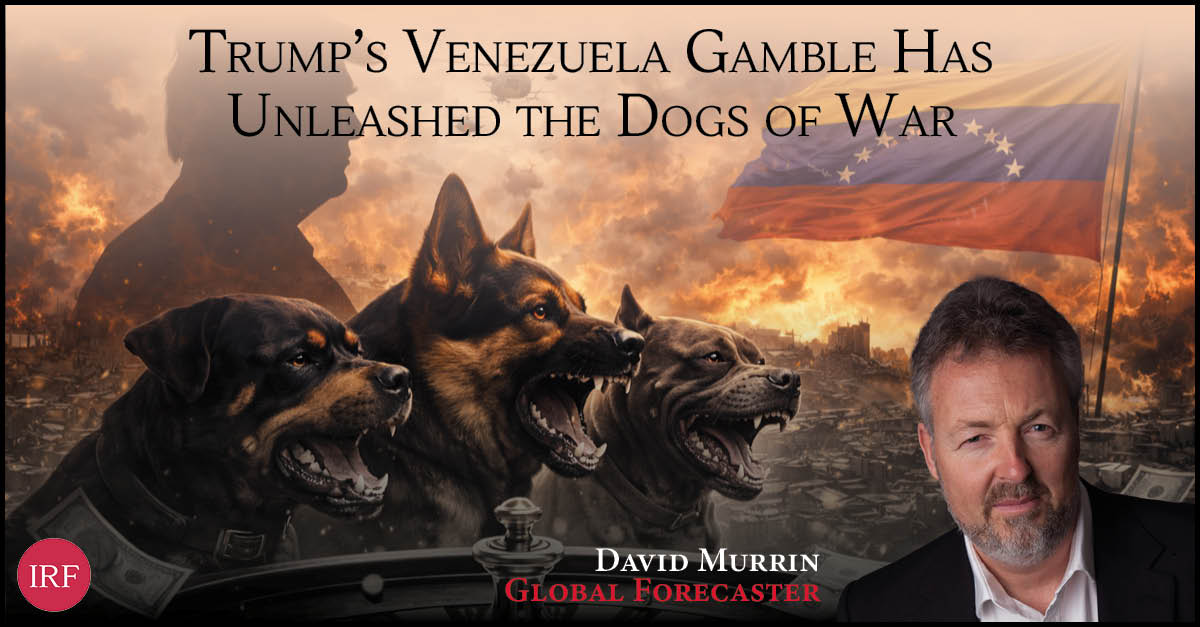
Trump’s Venezuela Gamble Has Unleashed the Dogs of War
Global Forecaster
Tue 13 Jan 2026 - 16:00 CET / 15:00 GMT / 10:00 EST
Summary
David Murrin frames the current moment as the breakdown of a “Westphalian” order and the late-stage collision of empire cycles: a declining US confronting a rising, war-prepared China. He argues China is using Russia and Iran as deliberate proxies, creating a widening, multi-theatre confrontation that is “proxy war at best, world war at worst.” In his view, the West is distracted and strategically incoherent—especially because Trump’s approach has weakened alliances and trust (including intelligence-sharing), exactly when allied industrial scale and coordination would be most needed. On China/Taiwan, Murrin thinks the military balance in the Pacific has shifted decisively, driven mainly by hypersonic anti-ship missiles that can deny US naval access far into the region. He dismisses the idea that China’s build-up is for deterrence, arguing its economy and force posture have been oriented toward offensive war since 2020. A blockade is possible, but he sees Beijing’s broader ambition as naval dominance: neutralise Japan/South Korea’s shipbuilding edge, consolidate control outward, then project power globally. He describes “strategic compression”: as the US, Japan, and Taiwan take steps to close the gap (defense budgets, base dispersal, missile defenses), China’s incentive rises to act before its advantage erodes. He also ties recent Venezuela and Iran pressure to an attempted oil squeeze on China in response to rare-earth leverage, warning of retaliation risks and “domino” dynamics reminiscent of 1914. Markets-wise, he urges extreme caution on China assets (likening the risk to Russian capital trapped after 2022). His core positioning: short government bonds (debt + rearmament issuance + undermeasured inflation), long commodities (including oil, industrial metals, and precious metals), skeptical on Bitcoin as a “liquidity spillover” entering a deeper bear phase, and wary of a US equity peak led by FAANG deterioration. He’s bearish on the USD longer-term after a sideways/corrective phase. He also forecasts prolonged Ukraine conflict, argues Western politics is destabilizing under information warfare, and sees Iran as a genuine revolution likely drawing some form of US interdiction—while noting the tightrope of avoiding backlash.
Topics
● The End of the Westphalian World
● The New NSS Strategy Unfolding Before Our Eyes
● Venezuela
● Iran
● Ukraine
● Taiwan and the western pacific
● Markets