Europe
Communications
New Street sees DIGIS as one of the most attractive high-growth names in European telecoms following its IPO. The company has a “right to win” in Spain, supported by cheap prices, its low cost to roll and a lean operating model that New Street believes makes it a formidable competitor. Importantly, they argue that the group's low prices are sustainable rather than a temporary customer-acquisition tactic, drawing parallels with Iliad’s disruptive model. They see ~40% upside to their target price vs. the IPO price, unusually attractive in a sector where New Street sees only c.10% average upside today.
Technology
AnteData’s alternative-data work points to growing implementation and adoption of SGE software. Measuring coding activity on various platforms, SGE ranks within the top 30% of the companies they track. App downloads, hiring of freelancers and search activity related to its software are all increasing. While SGE’s recent revenue growth already reflects steady adoption, with c.6% annual growth over the past five years and occasional double-digit periods, AnteData’s data support a more positive scenario in which growth stays near the top end of the recent range, around 10% annually. That would take revenue from c.£2.5bn to c.£4bn within five years. Given software operating leverage, costs could rise more slowly than revenue, potentially almost tripling net income to c.£1.1bn, leaving SGE valued at only c.7x year-five earnings.
Technology
The market is overvaluing a business-model transformation that remains hard to substantiate. The group's 2027 plan targets €2.2bn revenue and a 22% EBITDA margin, driven by €650m of recurring Value Added Services software revenue, but AlphaValue questions the IFRS substance of VAS, noting there is no segment cost allocation and that reconstructing gross profit implies a 100% VAS gross margin. The Walmart contract accounts for over 70% of 2025-26e revenue, but its economics are thin due to volume-linked price reductions, warrants treated as payment in kind and conditional pre-financing repayment, while advances also inflated OCF. AlphaValue estimates underlying cash generation over the WMT cycle at only c.€55m despite over $2.7bn billed. With WMT ending in late 2026, EMEA ex-France revenue declining at a -23% CAGR and 2026e cash burn above €220m, AlphaValue sees rising risk of a sharp 2027 revenue reset and de-rating. TP €71 (45% downside).
Utilities
MTLN’s Asset Rotation Plan and its impact on cash flow remains poorly understood by the market. Renewable-project SPV sales are treated as revenue-generating contracts rather than disposals, allowing MTLN to recognise “catch-up” revenue once a sale is signed, based on management’s estimate of project completion. Contract assets linked to the plan rose from €0.92bn to €1.41bn in 2025, increasing the risk of later write-downs if assumptions prove optimistic. Forensic Alpha also identifies asymmetric cash-flow treatment: development spending can be classified as capex when projects sit in PP&E, while subsequent sale proceeds may enter OCF after reclassification to inventory. Together with similar treatment of CO₂ allowances, they estimate c.€338m of benefit to reported OCF. MTLN is less cash generative than appreciated, leaving liquidity, leverage and refinancing more exposed if project sales slow.
North America
7 issues for US equity investors
1) The penalty for missing estimates remains severe, with low-valuation stocks that miss EPS facing the harshest market reaction on record. 2) Being underweight the Great 8 has helped performance this year, as breadth finally improved, but Trivariate worries that a big risk for some long-only investors is that they are positioned for the group to continue to lag. 3) Structurally higher gross margins (driven by Semiconductors) help explain why the market can sustain higher valuation multiples than in the past; a market de-rating would therefore likely require a meaningful margin rollover. 4) Financials earnings were solid, but positioning is elevated. 5) The US consumer looks more K-shaped by balance sheet than income statement. 6) The case for long low short interest names and shorting high short interest doesn’t look very compelling. 7) Trailing beta has never been a worse predictor of future beta.
Earnings season screens
Mill Street has developed an "Earnings Screen Score" ranking methodology that draws on selected inputs from their MAER (Monitor of Analysts’ Earnings Revisions) stock database to identify companies which have strong near-term fundamental momentum going into an earnings report. Mill Street’s research indicates that companies scoring highly in their ranking have a much higher chance of near-term improvements in analyst expectations than those that score poorly. Stocks most likely to produce positive near-term analyst estimate activity in the next couple of weeks include Franklin Resources, Humana, Seagate and Valero. Bottom ranked stocks include Boston Scientific, EchoStar, Intercontinental Exchange and S&P Global. Click here to access the full report.
The winner from refining scarcity
Energy
New Constructs’ latest long idea should benefit from widening crack spreads, long-term demand for gasoline, diesel and jet fuel, access to cheaper feedstocks, and an extended growth runway in renewable diesel and sustainable aviation fuel. While record refinery profits are unlikely to last forever, they argue strong profits can persist for much longer than the market implies, as global refined-product demand continues to rise and supply remains constrained by refinery closures, high utilisation, tight inventories and limited newbuild capacity. The company’s fundamentals are also strong: revenue and NOPAT have compounded at 6% and 13% since 2016, ROIC has improved from 8% to 21% and cumulative FCF of $33.9bn has supported shareholder returns. Despite this, valuation still implies a permanent profit decline.
Healthcare
At 30x forward adjusted EPS, DXCM continues to raise multiple earnings-quality concerns, especially when compared to Insulet, which has cleaner accounting and trades on a lower P/E. Insulet’s rebates and sales incentives are 25 days of sales, while DXCM’s have exceeded 100 days in seven of the past eight quarters and continue to reach new highs. Inventory is also rising despite heavier discounting, with finished goods having tripled. Price discounts should reduce inventory value through a higher reserve, but reserve growth has stalled, supporting EPS. Warranty accruals also look low, while flat dollar R&D spend in Q1 added 3c to EPS as a percentage of sales. Other companies reporting next week where BTN has recently flagged earnings-quality risks include Belden, Church & Dwight and Eaton.
Industrials
ALK reported operating results that might have been in line with the consensus forecast but they were nonetheless comparatively extremely poor. The 3.7% 2Q26 EBITDA margin was nowhere near the margin reported by Delta and United. The further deterioration in the cash operating margin indicates an inability to turn around Hawaiian’s operations. While not a complete surprise, the fact that a year and a half into the merger ALK has not achieved any operating progress whatsoever in this regard is worrisome. Reno Bianchi fears Hawaiian might drag ALK into financial despair. The airline has plenty of liquidity to confront the crisis but the harsh reality is that it is nowhere near as strong a credit as it used to be; it is now a very weak credit financially. Reno does not think its fixed income trading levels accurately reflect this reality.
Technology
OMNISIGHT deconstructs the engineered float mechanics and vendor-financing arbitrage behind NASDAQ's leading AI Cloud listing. While Wall Street consensus models BRUN as a high-growth AI infrastructure play with a massive contracted backlog, OMNISIGHT’s forensic audit reveals it to be a high-leverage hardware lessor. The company's celebrated 0% redemption rate was artificially created by locking up shares to compress the free float to a mere 1.07m shares - triggering an artificial spike that released millions of insider earnout shares. However, following a recent $45m warrant exercise, this micro-float vacuum is breaking. OMNISIGHT anticipates significant impending float expansion, exposing the stock to heavy dilution and substantial near-term seller pressure.
Micron specialty DRAM margins stay elevated
Technology
Specialty memory remains extremely tight, with fabs running close to full, gross margins at historical highs and the next meaningful capacity addition not arriving until 2027. JNK's research indicates specialty memory revenue rose close to 60% Q/Q and ~170% Y/Y last quarter, while Q2 price increases were larger than Q1. Pricing leverage sits with suppliers that still have legacy allocation through next year, including MU's remaining book. Customers are pushing suppliers into long term supply agreements, often with pricing left open, while end customers two and three steps down the chain are approaching component makers directly to secure supply. The key risk is that 2027 capacity additions ease the current squeeze, but JNK believes demand could still run ahead of supply, while a stacked memory product could offer a lower-cost bandwidth alternative to HBM for Broadcom (and Marvell) custom silicon.
Technology
QNT has set the industry benchmarks in quantum compute and yet trades at a substantial discount to its peers. With 50 logical qubits at a logical two-qubit gate error rate of roughly one in every 10,000 operations, Rosenblatt believes QNT’s Helios quantum computer is the most powerful production machine on earth. Senior management brings experience from Intel, Micron, Nike and Honeywell - whose 49% ownership stake brings blue-chip controls to the company. QNT’s product plans should keep them at the front of the quantum capability pack through commercial quantum advantage and the likely resulting significant inflection in financial results. The stock has also been added to the Rosenblatt Quantum Index (RQI). TP $155 (180% upside).
Technology
Bulls expect Gen 5 Vertical Power Delivery to help VICR regain share in GPU server boards and hyperscalers, while ITC-related royalty / module-purchase upside is seen as another positive driver. OWS believes both arguments are overstated. For a stock that has risen eightfold over the past nine months, the latest forward guidance and margin metrics were underwhelming. Q3 and Q4 revenue guidance was only in line with consensus because it included new licence revenue the Street had not assumed, implying weaker underlying product revenue. Product gross margin fell 170bps Q/Q despite 15% higher product revenue, which OWS attributes to low-margin CBRS revenue. Non-CBRS VPD targets were also pushed out a year to late 2027, leaving consensus estimates dependent on “heroic” CBRS growth. TP $38 (80% downside).
Utilities
The proposed Dominion Energy tie-up is less a sign of strength than evidence that NEE's premium growth engines at FPL and NEER are under increasing pressure. While Dominion would add regulated growth, Fernando Valle sees most of the EPS accretion coming from NEE using expensive equity to buy a lower-multiple utility, rather than superior underlying economics. Dominion's Virginia utility earns a lower allowed ROE than FPL and adds 10-12% less value per $1bn invested. At the same time, renewable and storage returns are thin, capex intensity is rising, regulatory scrutiny is tightening, and several onshore wind and solar projects are underwater ahead of a tax-credit cliff. Fernando thinks investors are underestimating the risk that NEE converges towards Dominion's valuation multiple, rather than the other way around. He also sees NEE's premium as increasingly dependent on financial engineering, including substantial off-balance-sheet debt, making the multiple harder to defend.
Japan
Industrials
Yuka Marosek highlights TES as a potential catch-up story after a post-results pullback. FY3/26 operating profit rose 78%, while management guides to a further 54% increase in FY3/27, supported by a record project backlog, nuclear-related work, data-centre-linked substation projects and decarbonisation upgrades at thermal plants. TES has significantly reduced its reliance on TEPCO from c.70% of revenue historically to c.30%, while management has also shifted from revenue growth to profitability, prioritising disciplined bidding, on-site staffing, cost synergies and avoidance of unprofitable projects. The company targets 7.7% operating margin and 8% ROE by FY3/28, while TEPCO’s stake reduction has improved liquidity and could support TOPIX inclusion. Nuclear policy delays remain the main external risk.
Technology
Future has seen its share price recover recently having been unfairly hit by the “AIpocalypse” sell-off. The company works with management teams to design and build advanced, practical IT systems and is seeing larger orders come through. Near-term earnings are being held back by a major loss-making order, evident in Q1 operating profit growth of just 3% Y/Y to ¥3.4bn and expected to keep H1 growth similarly muted at c.3% to ¥7.3bn. However, Asymmetric expects earnings growth to reaccelerate from Q3 and into FY3/28, with the shares trading on c.12x FY3/28E earnings. Future’s work sits in upstream, mission-critical areas such as architecture, testing, validation, integration, performance design and systems responsibility, making AI more likely to improve productivity than displace the business. Meanwhile, its next-generation core banking system, Future Bank, also appears close to broader take-off.
Developed Markets
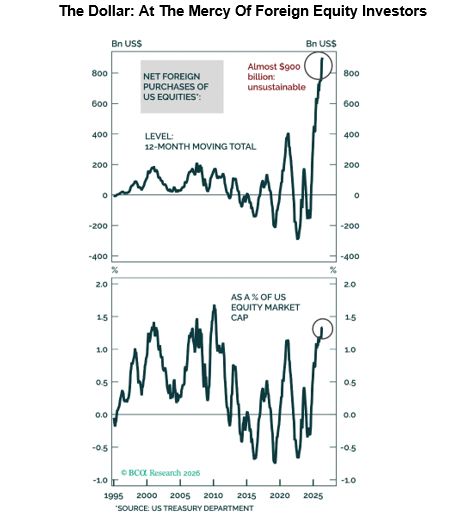
Get out of the dollar
Report by
BCA Research
BC
Paul Metcalfe points out that markets are recalibrating on multiple fronts: a dollar regime shift favouring surplus currencies over the greenback, and a bond market reasserting itself as the key threat to equity multiples, even as contained geopolitical risk keeps liquidity and risk appetite intact. Paul notes that strategists are rotating out of crowded trades, including US equities, Korean tech, and single-model AI bets, toward more selective plays like Chinese equities and Bitcoin miners as an AI-infrastructure proxy. Heavy IPO supply is the common thread of concern, though the burden of proof for a near-term bearish case remains high.
Trump orders new 50% tariffs on some Canadian goods
US President Donald Trump has ordered new 50% tariffs on a range of Canadian goods, claiming "discriminatory treatment" by Ottawa against US alcohol, automobile and dairy products. The tariffs will take effect in 30 days and cover a range of items including wine, hockey sticks and cement, according to a White House fact sheet. There are no carve-outs for exporters shipping under the US-Mexico-Canada Agreement (USMCA), a notable tightening given that about 81% of Canadian goods qualified as USMCA-compliant in May. The tariffs invoke Section 338 of the 1930 Tariff Act, a provision that has never been used for this purpose.
US economy powers on as FIFA spending & IRS tax rebates fade
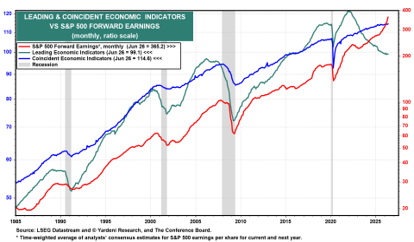
The World Cup is over and an important economic tailwind is beginning to fade. The stimulus from tax refunds is also fading. The total amount refunded to households rose 18.1% y/y to $324.8 billion, putting nearly $50 billion of additional cash into consumers' pockets. With both tailwinds now fading, the economic data are reflecting the slowdown. Ed Yardeni is not concerned. Seven years into his Roaring 2020s scenario, the underlying pulse of the US economy and American consumer remains strong. Redbook same-store retail sales growth cooled to 8.0% y/y in the week ending July 17, but sales growth remains robust by historical standards. The Index of Coincident Economic Indicators (CEI) rose 0.2% to a record high in June. Ed favours S&P 500 forward earnings per share as an economic indicator (see chart). It rose to a record high in June and in recent months, it has been signalling stronger economic growth than the CEI.
Stock-bond correlation biased upwards: Gold remains diversifier
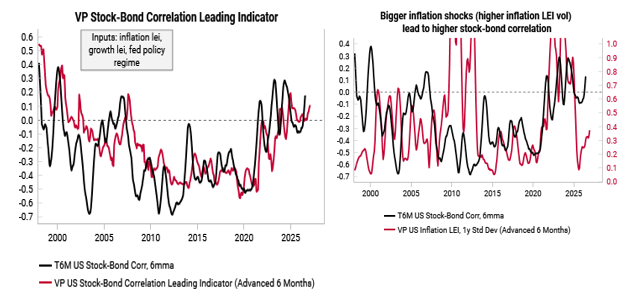
According to Tian Yang and Tony Huo, the recent volatility in inflation leading economic indicators (LEIs) is poised to push up stock-bond correlations, continuing a macro environment where bonds are less effective as equity diversifiers. They say gold's meme-like price collapse this year is an opportunity to add gold exposure for multi-asset portfolios. Their leading indicator for stock-bond correlations is ticking higher again, signalling positive expected correlations ahead. This has been driven by rising volatility of their inflation LEI. Tian and Tony note that more frequent inflation shocks tend to restrict central bank policy flexibility, resulting in slower policy responses to negative shocks and driving up stock-bond correlations.
Are policymakers deliberately suppressing oil prices and bond yields?
Michael Howell argues that two of the most important prices in the world economy—the oil price and the long-term US interest rate—appear increasingly misaligned with underlying economic fundamentals. He points out that long-term bond yields look too low relative to nominal GDP, while risk-adjusted Treasury yields are lagging the pace suggested by US money growth and survey data. He also observes that oil looks cheap relative to gold, with the gold-to-oil ratio remaining far above its long-run average. Michael points out that policymakers have strong incentives to keep both prices suppressed. Lower oil prices support consumption and corporate margins, while lower long-term bond yields ease financing pressure and support asset prices. However, he says that this strategy carries a significant cost, because it is self-defeating: suppression can create a negative feedback loop in which stronger nominal growth lifts energy demand and pushes renewed upward pressure onto bond yields. This forces policy makers to double-down and creates an investment risk of an abrupt readjustment.
Macro View: The wind finally at my back
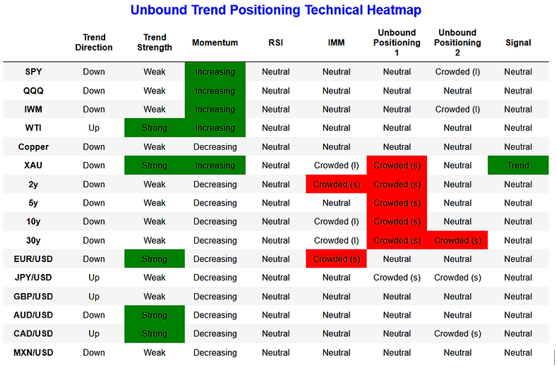
David Woo argued in the Unbound Global Macro Investor that the geopolitical risk premium remains too low. His short-term market bias is: higher oil - lower equities - neutral rates - neutral dollar.
(1) Higher oil: David says the market is under-pricing two risks: that the latest U.S. efforts to break Iran’s denial of Hormuz will ultimately require the deployment of ground troops; and that Iran will act on its threat to close the Red Sea.
(2) Lower equities: Higher oil is bearish for tech stocks. The release of Moonshot’s Kimi K3 model supports the hypothesis that LLMs are rapidly becoming commoditised.
(3) Neutral rates: Inflation breakevens are likely to play catch-up with oil price next week. However, a decline in expected investment returns of AI is bullish for bonds. The better-than-expected inflation data last week supports a 5s-30s steepener.
(4) Neutral dollar: If the AI bubble bursts, the real yield advantage of the dollar will begin to erode.
Germany: Locked into a weak uncompetitive economy?
Andrew Hunt says that ongoing large capital inflows into the German debt markets are obscuring the seemingly poor position of the underlying domestic economy. Without these “mega flows”, he believes that yields would be higher and equity prices materially lower. Germany is locked into a fixed exchange rate regime with a weak uncompetitive economy but the currency cannot adjust because of the “externality effect” caused by incoming capital and the rules of the Eurosystem. What economic growth there is in Germany seems to be at the behest of the public sector, but even the EUR180 billion deficit looks to have reached something of a plateau. Andrew concludes that it is difficult to be optimistic for German private sector growth trends at the current time.
Is Europe facing a repeat of the 2021 energy crisis?
Wolfgang Munchau notes that Europe has already been through one major gas crisis, starting off around the summer of 2021. It began with higher market prices and unusually low storage volumes through the later part of that year. Wolfgang says that it’s very unlikely that the current Hormuz crisis turns out to produce anything so severe. But there are some signs of problems brewing that look eerily similar to what we saw at the beginning of 2021, as futures prices for energy are on an upward march. The problem is not only now, however. It is what happens if this continues until the winter and interacts with another echo of 2021: lower storage volumes. That will be an issue if we’re in a position where we have to make up the difference with flexible or spot LNG cargoes, and the Hormuz situation is still not back up to normal.
Economic strategy commits Japan to risky course of action
The Takaichi government has formally approved a new growth strategy and ‘Basic Policy on Economic and Fiscal Management and Reform’. These two documents translate Prime Minister Takaichi Sanae’s ambitions to use fiscal tools to build a strong Japan into guidelines for next year’s budget. Tobias Harris says that “growth through security, security through growth” could serve as a tagline for the Takaichi government’s strategic program. Takaichi believes that there are growth opportunities through investments in national security, economic security, cyber security, and energy security, but also that investments in growth industries – particularly artificial intelligence and robotics, information technology, and quantum computing, with an AI transformation (AX) as the single most important goal – will both ensure national prosperity but also safeguard Japan’s “autonomy and indispensability” in the global economy in the coming decades. However, Tobias notes that while the basic policy gestures towards market confidence, these documents show that rising interest rates have not deterred the government from raising outlays.
Emerging Markets
The savings glut and the A share market
China has an unprecedented household savings glut with more than a trillion dollars' worth of extra liquidity flooding into the financial system every year. Jonathan Anderson notes that, so far, this money has "nowhere to go" and has depressed interest rates and yields to rock-bottom levels. Moreover, he points out that the authorities have been unsuccessful both in trying to revive the property market and in pushing a bona-fide consumption boom. The main "viable" channel left is the local A share market. The growth environment is weak and corporate earnings are flat - but then the domestic equity index has never been particularly correlated with growth in China, in part because of the overwhelming role of liquidity in pushing valuations around. With the combination of record-high excess liquidity and still-moderate multiples in the market today, this is a meaningful driver of potential further gains ... and a big reason why Jonathan continues to hold the A share index in his own portfolio.
Chile: Expect an extended period of unchanged monetary policy
Since Pacifico’s last report, markets have remained relatively calm and have largely absorbed the renewed tensions between the United States and Iran. As a result, nominal interest rates have recorded only modest increases, while inflation linked rates have remained broadly stable, with the exception of the shorter end of the curve. In that segment, markets have started to price in a higher probability of a renewed oil price shock, which could put upward pressure on short-term inflation expectations. At the same time, Igal Magendzo’s base-case scenario of an extended period of unchanged monetary policy has continued to strengthen. Markets have even begun to reintroduce some probability of a rate hike, now pricing close to a 50% chance by the second quarter of 2027. Igal continues to believe that the inflation priced by the market for the second half of 2026 remains somewhat elevated, and he maintains positions designed to benefit from this divergence relative to his own forecasts.
Venezuela: The debt restructuring clock restarts
Plans for rapid U.S.-backed debt restructuring appear to have survived the earthquakes. Jose Ignacio Hernandez maps out how the shock reshapes the economic outlook, and whether a 2026 deal remains viable. At a 13 July meeting of the National Economic Council convened to coordinate the post-earthquake recovery, the government announced that it was revising its macroeconomic framework and Debt Sustainability Analysis (DSA). The statement, delivered less than three weeks after the 24 June earthquakes, confirms that debt restructuring remains on the government’s agenda and is increasingly being presented as a means of creating fiscal space for reconstruction. Jose expects revisions to the government’s economic assumptions to reshape the DSA through three principal channels: timing, fiscal capacity, and the growth outlook. Jose identifies those factors that will likely reveal whether or not the missed June deadline marks the beginning of a more protracted process.
Nicaragua: Ortega announces end to elections
On 19 July President Daniel Ortega announced that Nicaragua will never again hold elections that could allow the opposition to “grab the government, grab the power”. In power since 2007, Ortega’s comments appear to put paid to elections scheduled for November 2027. Local activists, such as Salvador Marenco of local rights group Colectivo de Derechos Humanos Nicaragua Nunca Más (CDHNN+), point out that free elections have effectively not taken place in Nicaragua since 2011, with Ortega having since dismantled democratic institutions – a process which has gathered pace since April 2018, when the government began a brutal crackdown on dissent. Ortega’s announcement also comes despite a constitutional reform package that took effect last year, which further concentrated power in his hands along with those of his wife, Rosario Murillo. Ortega’s latest announcement looks set to further entrench Nicaragua’s pariah status, and could result in further international sanctions.
Bangladesh: BSEC to facilitate direct listings for MNCs
Bangladesh’s economy slowed sharply in the third quarter of FY26, with GDP growth decelerating to 2.22% during the January–March period from 4.53% a year earlier. The slowdown was primarily driven by a 0.28% contraction in industrial production, reversing 3.33% growth recorded in the corresponding quarter of FY25, alongside weaker growth in the agriculture and services sectors. Meanwhile, the Bangladesh Securities and Exchange Commission (BSEC) announced plans to facilitate direct listings for established multinational companies (MNCs) and large domestic corporations, aiming to broaden market depth and accelerate the listing process for fundamentally strong companies.
Commodities
Russia & Ukraine: War continues to damage oil and grain exports
Nancy O’Flynn points out that Russia and Ukraine continue strikes on each other's grain and energy infrastructure. Oil loading at the Caspian Pipeline Consortium’s (CPC) terminal on Russia’s Black Sea coast remains suspended after a Ukrainian drone strikes. CPC said that operations at mooring 1 and mooring 3 were suspended. Ukraine said it struck Gazprom Neft’s Yanos refinery site (capacity 300k bpd). In July, Moscow increased targeting of cargo ships and Ukraine’s main grain shipping terminals of Chornomorsk, Odesa and Pivdennyi. Ukraine has lost roughly a third of its Black Sea grain export capacity due to the intensified strikes, according to the Ukrainian Agrarian Council. On July 11 and 12, Russia struck the port of Izmail on the Danube River. Ukraine said it had attacked 183 Russia-linked bulk cargo ships and tankers in the Sea of Azov and the Black Sea as of July 20. Ukraine also struck two key Russian Azov ports in July.
Aluminium: No ordinary Section 232
President Trump has signed a proclamation aimed at strengthening the domestic aluminium industry by encouraging companies to invest in new and expanded smelting facilities in the United States while adjusting aluminium imports on national security grounds. Issued under Section 232 of the Trade Expansion Act of 1962, the proclamation directs the US Secretary of Commerce to create an incentive program for companies that invest in building, expanding, or refurbishing primary aluminium smelters. While the headline features Donald Trump and Section 232 tariffs, James Burdass says that the policy mechanism represents a notable evolution in US trade and industrial strategy. The key development is the creation of a conditional, heavily discounted tariff tier. Aluminium producers that commit to the substantial capital expenditure required to build or modernise a US primary smelter will qualify for a 50% reduction in their import tariff rate. The inclusion of retroactive clawback provisions—revoking these benefits should companies fail to deliver their investment commitments—also introduces an enforcement mechanism that was absent from previous policy.
Resilient lumber markets
North American lumber markets have shown impressive resilience over the past couple of months, and stud prices have gone on a tear. We are into peak fire season and, sadly, there is an uptick in fire activity in both Canada and the US. Structural panel markets remain bifurcated; OSB markets have been ho-hum, while plywood markets remain a bright spot. The US remains the dominant producer and exporter of kraft linerboard despite multiple shuts of export-oriented mills last year. Exports appear to have found a new baseline level. In BC, excess chips and an oversupply of pulpwood are creating new challenges for industry. There is a lot of talk about the K-shaped economy, but the box industry itself is bifurcating given some recent changes. The North American boxboard industry has suffered from weak demand and pricing, with the pricing differential between SBS and CRB compressing to unheard of levels. That is slowly changing.
Bitcoin: Trend model turns bullish
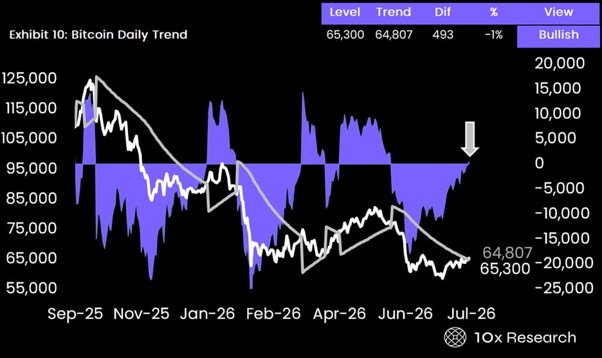
Markus Thielen points out that his Bitcoin trend model has turned bullish. He says that over medium time frames, trend following tends to work well, especially for higher-volatility assets like Bitcoin. And when a trend breaks, it provides a non-judgmental, rules-based level to cut positions. That's precisely why he built the dashboard for his Trading Signals subscribers. Given that his medium-term indicators (weekly data, 1-3 month view) also show Bitcoin as deeply oversold, with those reversal indicators now turning, he takes this bullish trend change seriously. The key level is $70,000, where Bitcoin would also break above its 21-week moving average, a simple but effective bull-vs-bear market indicator that also flagged the bear market coming in October 2025. In addition, his 4-week breakout model confirms this: Bitcoin has made a new 4-week high. Depending on which systematic strategy traders and funds follow, this is another signal that could prompt long positioning and further push prices higher.