Europe
Accounting Flags at Nexans, Nokia, Reckitt and Shaftesbury
Nexans has seen a sharp increase in leverage linked to the purchase of shares in consolidated companies, while its c.$200m factoring programme remains substantial and is acting to improve the optics of the balance sheet. A new flag is also recorded for DSI. Nokia’s risk rating increases due to a continued divergence between statutory and adjusted earnings, with restructuring charges highlighted as heavily recurring and growing. Expansion of inventory and receivables acted to drag on cash conversion in H1. At Reckitt, a new flag is highlighted for DSO. This comes on top of existing flags from the FY25 annual report related to "Ageing of Receivables" and "Receivable Loss Allowance". Shaftesbury is flagged for a sharp increase in rent receivable, from £13.3m to £24.8m over 6 months, possibly an indicator of tenants under stress. This is in addition to lease incentives and deferred fees sitting in “Trade and Other Receivables” of around £54.6m.
Energy
Interim results demonstrate the earnings power of SBM’s Turnkey franchise when major project milestones and asset sales coincide, while the Lease and Operate fleet continues to provide a stable foundation. The substantial backlog increase and guidance upgrade confirm that the company is converting its strong market position into tangible financial outcomes. SBM has a very strong track record when it comes to on-time and on-budget delivery of the current construction portfolio, which should continue to support the conversion of the tender pipeline opportunities into additional order wins. With net debt reduced and cash-flow visibility extended far into the future, the balance sheet and capital-return framework look solid. Overall, the results reinforce confidence in SBM’s ability to generate attractive returns through the next phase of the deepwater cycle.
Financials
Strong Q2 results beat consensus, with FY26 guidance raised. Management raised net income guidance to >€210m (from >€195m) and RoTE to c.25% (from c.24%). The higher net income guidance reflects expectations for additional loan expansion (+20%) and base rates (+25bps), with the average Euribor rate budgeted at 2.25%. ResearchGreece raises their TP to €14.6 (35% upside), on 10% CoE and 3% tg. They align their loan and deposit forecasts with management's guidance, lifting their 2026-28 net income estimates by c.10%. They now forecast 2026 net profit of €221m, above guidance, reflecting 8-10bps higher Euribor assumptions. Their 2026-28 RoTE estimates rise to c.26% (+30-125bps).
Healthcare
AlphaValue argues Q2 results put to rest the execution risk that emerged after the Q1 miss, while the new German reimbursement framework reduces uncertainty around Helios. The key message is not simply the earnings beat, but the quality of the step-up. Kabi’s higher-growth businesses are now translating into structurally higher profitability, with Growth Vectors helping the division enter its 17-19% margin corridor as Biopharma scales and the biosimilar pipeline broadens. This reinforces AlphaValue’s confidence in the 2030 ambition to double Biopharma sales at c.20% margin. At Helios, German volumes have stabilised and the reimbursement framework supports the margin trajectory from 2027. With Kabi margins improving, Helios visibility strengthened and deleveraging improving financial flexibility, AlphaValue maintains their Buy recommendation. TP €62.7 (30% upside).
Technology
The Chair, a Divisional President and the Chief Technology Officer buy a combined €1.4m of shares at c.€8.45. Smart Insider has had a positive rank on the stock since 30th Jan 26, initially triggered by buying from Chair Timo Ihamuotila at €5.37 per share. He subsequently added again in Apr at €9.10 and has now bought once more after the shares retreated from a recent high of €15. The latest cluster is also notable because Pallavi Mahajan, Chief Technology Officer, and Patrik Hammaren, Divisional President, are making their first purchases, despite neither being new to the company. Smart Insider renews its +1 rank (highest rating).
North America
The Ocean Wall BNP Molecular War basket
Great-power competition has shifted below the threshold of conventional warfare and towards control of the systems underpinning modern economies: semiconductors, critical minerals, enrichment capacity, biological feedstocks and energy infrastructure. Ocean Wall’s BNP Molecular War basket is designed as a conviction map of these chokepoints, comprising 33 liquid stocks across 8 sectors: nuclear energy and fuel, enrichment and isotopes, rare earths and strategic metals, lithium and battery materials, energy-security feedstocks, geothermal, industrial infrastructure, semiconductors and agritech. Each name is selected for pricing power, scarcity or irreplaceable strategic positioning. The basket has returned 16% YTD, outperforming the Nasdaq, S&P 500 and Mag 7, with 60% of constituents up strongly and standout performances from TWST (+218%), NEO (+112%) and OUST (+97%). For five years, US exceptionalism and the Mag 7 dominated everything. The rotation is now visibly underway.
Consumer Idea Forum
MYST’s latest buyside event showcased companies launching new initiatives/products, business inflections/turnarounds and companies with higher-end offerings. Also notable were numerous potential consolidation/M&A candidates. The most compelling ideas included:
DoorDash (DASH) - DashPass “loyalty moat” driving durable share gains + several “call options”. TP $275 (30% upside).
Warby Parker (WRBY) - Eyewear rebounding from cyclical trough + game changing AI glasses launch. TP $60 (130% upside).
D’Alba Global (483650 KS) - Ulta + Costco distribution wins signal K-beauty share gain acceleration. TP ₩415K (70% upside).
Vita Coco (COCO) - Rising competition threatens coconut water fad. TP $42 (35% downside).
Hermes (RMS FP) - Perma-short forced to confront prolonged deceleration or painful supply cuts. TP €1,250 (20% downside).
Consumer Discretionary
Q2 results showed better-than-expected earnings and the company’s highest gross margin in 6 years, despite FX headwinds. Management also raised the low end of full-year guidance across all metrics, suggesting recent sales momentum should continue in H2 despite concerns over weaker industry unit volumes. Design wins from the past 2-3 years are beginning to support production, while GTX’s operating discipline is translating into stronger FCF, which should fund further buybacks and support shareholder value. Hamed Khorsand also sees growing optionality in industrial products, with several new wins reaching production in 2027. He thinks GTX’s approach to industrial compression could eventually lead to the company being considered as an industrial equipment maker than an automobile parts supplier. TP $42 (35% upside).
Energy
Erik@YWR believes the market is overlooking the significance of EXE’s $1.25bn Twin Eagle acquisition, which makes the company North America’s largest natural gas marketer as well as its largest producer. He argues this matters because US natural gas is moving from a supply story to a demand story, with LNG growth, AI/data-centre power demand and reshoring potentially adding 30bcf/day of demand to a c.100bcf/day market. Twin Eagle also gives EXE the trading, storage and logistics capability to monetise gas-price volatility rather than just trying to smooth it out. Erik sees CEO Mike Wichterich pursuing a “hedgehog” strategy: not trying to "vertically integrate" and build a data centre, which some gas producers are trying to do, but by becoming the best and most profitable US natural gas company.
Industrials
While bulls appear to be extrapolating POWL's recent record financial performance far into the future, OWS’s analysis suggests the group has been overearning. They see growing evidence that margins have peaked (their primary short thesis), even if orders remain robust. Near term capacity constraints mean revenue growth is likely to remain mired in the mid-to-high single digits in the quarters ahead. With gross margins expected to be flat (and possibly down as new incremental capacity additions ramp) and R&D trending higher, EPS growth should be underwhelming (mid-to-high single digits) in FY26 and FY27, especially relative to other large electrical equipment peers. At 40X consensus FY26 EPS, POWL remains highly vulnerable to multiple compression. TP $55 (75% downside).
Industrials
The company continues to command a growth multiple despite producing little underlying growth. Q2 revenue rose just 1.5% Y/Y and still missed consensus, while several accounting tailwinds appear to be supporting reported results. The key concern is contract assets: revenue recognised before it has been billed. These rose by $202m Y/Y, compared with only $25m of revenue growth, and BTN estimates this lower-quality revenue source explains nearly all of XYL’s 12c adjusted EPS beat. Without the contract-asset tailwind, the revenue miss would have been far larger. Contract liabilities also continue to fall both in absolute dollars and as a percentage of sales, raising additional questions about the sustainability of reported revenue growth.
Materials
Frank Mitsch remains constructive on LYB, framing it as one of the clearest economic beneficiaries of the Middle East conflict. The stock is only 6% above where it traded when the Iran war began, despite 2026 and 2027 consensus EBITDA estimates rising 84% and 32%, respectively. Frank shares CEO Peter Vanacker’s view that the Iranian conflict is likely to roil petrochemical markets for “quarters not months”, even if normalisation is unlikely to be linear. For Q3, he expects EBITDA to almost double Y/Y led by the O&Ps. Valuation also looks undemanding at c.5.4x his new 2026 EBITDA estimate with a 4.5% dividend yield. Leverage has dropped sharply to 2.6x and the Cash Improvement Plan continues to progress, with a surprising announcement that it will be making a 30% reduction in its entire management structure.
Technology
JNK argues ADI’s acquisition of Empower and the broader move towards in-package voltage regulators are important, but unlikely to displace board-level power delivery for some time. The issue is scale: today’s rack-class AI accelerators draw so much power that multiple in-package regulators would need to be combined to support a single high-power socket. That keeps the practical solution at the board level for now, where VICR’s vertical power delivery approach remains well positioned through the current design cycle. The risk is that in-package power delivery becomes viable for high-power AI accelerators faster than expected, pulling share from board-level suppliers sooner. JNK sees that risk as limited for now, with customer activity still at the collaboration and development stage rather than committed accelerator sockets, and Broadcom indicating in-package alternatives remain more than a year or two away.
Technology
Sidoti upgrades the stock to Buy after stronger-than-expected 3Q results and another guidance increase. Management now expects FY26 revenue growth well above 20% (vs. previous target of >12%), with strong growth across all end markets and guidance still not dependent on any meaningful return of the commercial aerospace primers that PLXS supports indirectly. Margin expansion should continue into Q4, aided by higher revenue, the ramping of new facilities in Thailand and Malaysia as capacity utilisation improves, and automation and efficiencies. Sidoti also expects FY27 revenue growth to exceed the higher end of management’s 9-12% goal. They raise their FY26/FY27 EPS estimates to $7.13/$9.03 from $6.66/$8.59 and introduce FY28 EPS of $10.25.
Technology
The post-results sell-off reflects an expectations miss vs. Seagate’s exceptional print rather than any deterioration in fundamentals. WDC’s June-quarter exabyte shortfall was modest and largely tied to the move towards 40TB ePMR, while STX is benefiting from a richer HAMR mix and higher guided margins. Rosenblatt accepts the margin gap could widen before it narrows but still sees WDC exiting FY28 near 64% gross margin. Importantly, Nearline price/TB growth accelerated to 17% Y/Y and management effectively endorsed sustained high-teens pricing growth through FY27. Product transitions across 40TB ePMR, ultraSMR and 44TB HAMR remain the key catalyst, expected to reaccelerate exabyte growth towards the high-20% range in 2H27. TP $800, while Rosenblatt sees $375-400 as a “back-up-the-truck” level.
Utilities
BEP’s Q2 results superficially support management’s message that cash flow can compound at 10%+, but the composition of growth is a concern. Gains on asset sales now represent c.66% of trailing 12-month FFO, the highest reliance Veritas has observed. Excluding those gains, underlying performance continues to deteriorate, with lower margins, weak generation and declining asset-level cash flow. Management describes asset-sale gains as recurring, but Veritas disagrees, arguing they depend on transaction volumes, buyer appetite, interest rates and market liquidity. They are lower quality than the contracted, inflation-indexed cash flows investors were told would drive growth. More concerning, capital recycling has recently extended into hydro assets at meaningful scale, despite BEP historically presenting hydro as a core competitive advantage. Veritas maintains a Sell rating and intrinsic value estimate of US$20.00 (40% downside).
Japan
Materials
Yuka Marosek sees DIC as an attractive opportunity after strong Q1 results challenged the market’s view of the company as a structurally declining printing-ink and pigment business. DIC is targeting record operating profit in FY26, above the prior FY17 peak, despite concerns over petrochemical-linked raw material costs. Yuka argues the mix is healthier than DIC’s legacy reputation suggests: packaging inks now account for nearly two-thirds of Packaging & Graphic sales, while the group is shifting towards higher-value “Chemtronics” electronic materials, including semiconductor epoxy resins, smartphone industrial tapes and specialty materials. Restructuring of pigments and legacy ink operations is also progressing, aided by activist investor Oasis Management’s 11.6% stake. With DIC still trading below book value, further margin expansion, earnings stability and capital-structure improvements from cross-shareholding and non-core asset sales should drive a re-rating.
Technology
"The ASML of optical" - this is not an over-earning bottleneck commodity story: JEOL has +40% long-term operating margins and a deep R&D moat. The hidden upside is on the optical side, where JEOL has a front-end tool used in expanding indium phosphide ultra-high-power lasers. With Lumentum and Coherent ramping optical capex to expand capacity by an estimated 5x over 5 years, JEOL is positioned as a picks-and-shovels beneficiary of that cycle. The stock trades on 16x 2027 Street EPS, with consensus forecasting only 10% revenue growth and little optical contribution. Rising Intel and Samsung foundry activity should also broaden demand beyond TSMC, while Chinese AI accelerator design starts adds another source of demand. TP ¥16,500 (90% upside).
Technology
Sony has entered a period of exceptional content launches, while its semis position remains under-appreciated given its 60%+ share of smartphone image sensors, growing auto exposure and pending TSMC JV to support future Physical AI demand. Electronics is also being reshaped, with loss-making TVs and Home Audio moving into a TCL JV and Sony proposing to buy higher margin lensmaker Tamron. Arete also thinks the threat from AI music and content is overstated, given Sony’s catalogue IP and potential for AI to reduce production costs. Simply put, Sony looks deeply undervalued, especially with a weak yen and 55% of sales in the US and Europe, supported by a ¥250bn buyback plan likely to be expanded and ample headroom for further shareholder returns or acquisitions. Arete raises their FY26E EBIT forecast to ¥100bn above guidance. TP ¥5,320 (45% upside).
Developed Markets
Tech bubble implosion triggers shift to defensives
Michael Belkin is closing all short positions and initiating selective new buys across gold and silver equities as valuations reach major support zones. With silver down -51% from its January 29, 2026 peak, Michael views any further near-term weakness in precious metals as a buying opportunity. Meanwhile, the artificial intelligence bubble implosion is accelerating, causing corporate managers to mitigate damage as technology shares tumble. Big veteran institutional investors are orchestrating a major rotation into defensive sectors, mirroring the post-2000 tech bust where defensive sectors rallied while technology collapsed. Energy remains a core model long recommendation; Donald Trump’s tweets spoofing crude oil futures have bashed energy prices down, creating a buying opportunity. Michael recommends shorting tech and communication services while rotating longs into energy, health care, financials, staples, REITs, utilities, and gold and silver equities, alongside long XMAG/short MAGS and long IWD/short IWF ETF spreads.
The AI efficiency trade: Look beyond LLMs
The Sustainable Market Strategies team predicts that specialised energy management companies, industrial automation leaders, and enterprise AI software firms are best positioned to capture durable revenue as AI optimises power usage across grids and heavy industry. They contend that the energy leverage from narrow, purpose-built AI models is orders of magnitude better than the energy paradox narrative surrounding large language models, and investors who conflate the two are misreading the opportunity. Grid and industrial process optimisation present clear mechanisms to extract value: grid tools yield 30-50% fault outage reductions and $10 billion in annual US virtual power plant savings, while edge-deployed industrial models cut plant energy bills by 5-15% with a 50:1 to 500:1 leverage ratio on consumed power. Large-cap infrastructure names provide defensible entries via hardware and integration moats, including Schneider Electric SE, GE Vernova Inc and Eaton Corp PLC.
Europe: Flat growth despite data beating expectations
BCA’s European growth diffusion index, covering 123 components, points to flat growth ahead. The issues stem from energy volatility and supply chain uncertainty weighing on the outlook, with natural gas prices also posing a near-term risk. The European economy is also more sensitive to credit growth given banks’ enhanced role, and both lending standards and credit demand point to a gradual slowdown to stagnation ahead. Sluggish credit dynamics reinforce the need for Germany to deploy its fiscal capabilities to support growth. So far, Europe has borne the costs but not yet received the benefits of looser fiscal spending. Financial conditions are easier than at the peak of Iran tensions, but they have recently stopped easing; European data surprises will revert over the coming weeks. In the near term, this leaves European assets vulnerable relative to their US counterparts. European weakness also creates a tactical opportunity to go long EUR versus USD rates.
The Fed can create volatility, but should it?
Paul Krake contends that Kevin Warsh is right to elevate the bond market's role in monetary policy, yet warns that removing forward guidance restores suppressed volatility. Paul believes interest rates carry less economic impact than Kevin thinks: fixed-rate mortgages shield homeowners, cash-rich hyperscalers borrow regardless of coupon costs, and supply-side inflation sits beyond the funds rate. Facing the press conference problem, Paul outlines three choices for Chairman Warsh: continue holding press conferences while markets mine every answer, restrict them to policy change meetings, or eliminate them entirely in favour of written statements. With US inflation above target for five years, 30-year yields at 2007 highs, and record debt issuance, an American Liz Truss moment cannot be ruled out. When volatility inevitably produces a casualty, Warsh will face a choice: let markets impose discipline or intervene. The Fed can create volatility, but can it tolerate the consequences?
US: Kevin Warsh, lonesome dove
Brian McCarthy argues that Chairman Kevin Warsh is not leading a hawkish charge, but fighting a rearguard action against an FOMC committee ganging up to force a rate hike. While voting members express growing concern over the AI capex boom overheating demand, Brian points out that Warsh openly disputes these characterisations, refusing to view the AI supply shock as inherently inflationary. Warsh tells us he views this as a good family fight, arguing that high prices stem from productive corporate investment rather than share buybacks. Brian expects benign inflation readings and the Chairman's reluctance to forestall a July move, though markets will likely interpret the meeting as a hawkish hold. Furthermore, Brian argues that expectations for a September rate hike will linger unless hyperscaler earnings at month-end reveal a clear slowdown in AI capex growth - any hint of a slowdown would be bullish for rates.
Warsh invites the bond vigilantes
Manoj Pradhan points out that the 1:3 Z6Z7 steepener performed exceptionally well through the Federal Reserve, though Manoj did not anticipate Kevin Warsh would roll out the red carpet for bond vigilantes in his second meeting. Manoj argues that Warsh may get bailed out in the near term by President Trump’s desperation to find a truce ahead of midterms. However, if any truce holds and macro fundamentals once again start driving yields, he expects 100 basis points of hikes to eventually get priced into Z7 and Z8 because a massive procyclical fiscal impulse from the OBBBA will force the Fed to act if the economy overheats. Core inflation currently remains free of pass-through and there are no signs of overheating, but he believes growth remains very strong. Manoj advises that the 1:3 Z6Z7 steepener needs to be rebalanced to reflect President Trump’s truce announcement in conjunction with either 10-year or 30-year exposure.
Australia: Breaking out down under
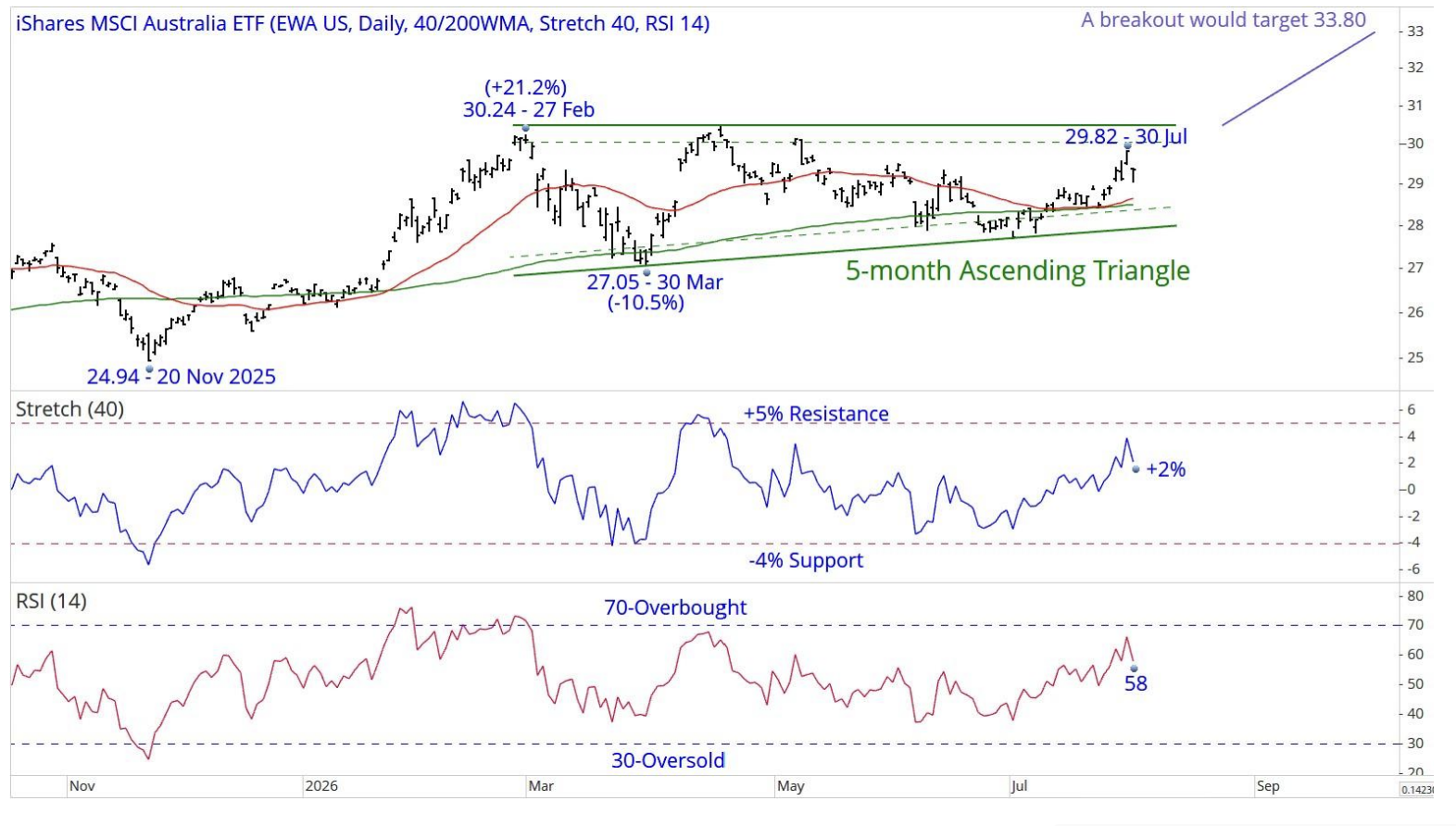
The iShares MSCI Australia ETF (EWA US, USD29.34) broke out from a 55-month Range/Rectangle in Jan this year. The Iran bombings saw a more than 10% sell-off, but Chris Roberts comments that the decline ended in the old resistance zone at USD25.50-27.43, and the ETF recovered to set new uptrend highs. The ETF has formed a potential 5-month ascending triangle, a breakout from which would target USD33.80 but more importantly it would confirm the breakout from the 55-month Rectangle which targets USD39.00+. Chris will look to go 75% long on a weekly close above USD31.00. The stop will be a daily close below USD27.40.
Japan: Buying time
Tobias Harris outlines how joint US-Japan foreign exchange intervention on July 31st provided temporary relief for Prime Minister Takaichi Sanae, but failed to address fundamental Japanese fiscal strain. The bilateral action, involving Japanese sales of up to JPY 11tn in dollar holdings alongside US euro sales to buy yen, aimed to curb disorderly currency movements and mitigate spillovers into US bond markets. However, Tobias emphasises that this devil's bargain cannot substitute for structural reform. With Japanese government bond yields hitting multi-decade highs amidst ambitious state-financed industrial policies and proposed consumption tax cuts, foreign pressure is mounting. US Treasury Secretary Scott Bessent is pushing Tokyo towards Bank of Japan rate hikes, portfolio adjustments by pension funds, or fiscal retrenchment. Tobias expects the ultimate bill to arrive via higher domestic interest rates, a forced fiscal u-turn, or faster rate normalisation at upcoming policy meetings.
Japan: Sterilised intervention will not save the yen
David Woo is sceptical that recent US-Japan FX intervention will yield durable yen appreciation, viewing the rally as an attractive opportunity to establish new yen-funded carry trades. Because the intervention was sterilised and left monetary conditions unchanged, it failed to activate the portfolio-balance channel or signal a monetary policy shift from the Bank of Japan. Export performance demonstrates that currency weakness stems from a structural loss of global competitiveness to South Korea, Taiwan, and China, rather than temporary mispricing. David argues that rising term premia, catalysed by Prime Minister Sanae Takaichi’s aggressive fiscal stimulus and 380 trillion yen investment plan, remain the primary driver of yen depreciation. Trapped by public debt exceeding 200% of GDP, Japan must maintain structurally low real interest rates. The intervention is not the beginning of a new bull market for the yen, but simply another opportunity to sell it until the next intervention becomes necessary.
Emerging Markets
EM active funds capitalise on AI concentration
Active GEM funds rebounded strongly in the second quarter of 2026, delivering average year-to-date returns of 24.64% to almost match the iShares MSCI Emerging Markets ETF benchmark. However, this was far from a broad-based rally. South Korean and Taiwanese technology alone contributed 25.8% of first-half returns, with just five stocks accounting for 22% of gains, led by SK Hynix, Samsung Electronics, and TSMC. Main detractors stemmed from China and India, where Tencent, Alibaba, and HDFC Bank generated severe drag. Unlike global peers, active managers managed the technology sector well: strong stock selection within technology more than offset an allocation drag from maintaining an underweight stance. Emerging Markets remains one of the few major asset classes where active management competes over the long term.
Should investors care about LatAm’s populist new wave?
Personalist political vehicles built around anti-incumbent outsiders have become the dominant route to power across Latin America, projects Mariano Machado. While these right-wing conservative figures project personal strength and win over foreign bondholders, the parties, institutions, and fiscal positions beneath them remain exceedingly weak. Leaders increasingly bypass congress to rule by executive decree. Looking ahead to Brazil’s October election, every precondition is in place for another populist outcome, with Flávio Bolsonaro level-pegging against Lula da Silva. However, Mariano warns that Flávio’s underlying policy agenda beyond protecting family priorities remains shrouded in total uncertainty. This political decay matters little to short-term speculative capital chasing Latin America’s high yields and attractive FX carry trades in Colombia, Brazil, and Mexico, but declining sovereign ESG scores signal mounting long-term risk. For sovereign bond investors, keeping an active eye on domestic political as well as macro and external factors will thus remain critical to a competitive portfolio over all but the shortest durations.
Chinese-led AI deflation
Graham Turner argues that Chinese technology companies are leading the next cycle of deflation, implying interest rates will ultimately need to come down rather than rise. Energy prices spiked following Straits of Hormuz skirmishes, pushing the yield curve higher alongside strong US July services surveys. Markets remain anxious that higher energy costs and resilient data provide the Federal Reserve cover for a rate hike at the upcoming July FOMC meeting. However, Graham believes policymakers are missing the broader disinflationary impact of AI, highlighted by weak unit labour cost growth. US firms are increasingly turning to cheaper Chinese open-source AI models, some priced at one-twentieth of Western alternatives, to drive substantial cost savings. While the AI boom is causing short-term semiconductor bottlenecks, Graham contends that Chinese-induced AI deflation will force rate cuts, though a risk remains that the FOMC gets deflected by near-term energy shocks.
China turns Japanese
Gerard Minack sees China as sharing all the hallmarks of Japan’s lost decades, marked by slowing growth, low inflation, falling rates, rising leverage, and poor equity returns. The key macro problem is a surfeit of saving relative to investment, occurring at a high investment share of GDP that creates excess capacity. GDP growth is increasingly reliant on external demand. High household saving, driven by demographics, the absence of a solid social safety net, and rising inequality, matches debt-funded investment. High investment spending has led to diminishing returns on capital and damped inflation, pushing listed sector return on assets below EM and DM peers. Aggregate profits have risen, but EPS growth badly lags earnings growth. China is delivering lost-decade-Japan-like investment returns: debt does well while equities stagnate. Relative to the rest of the world, Chinese Treasuries have been world-beaters while equities have been terrible. There’s no obvious reason for this to change any time soon without a change in the macro model.
A Colombian paper tiger?
Abelardo de la Espriella looks like a necessary improvement on what is arguably one of the worst Colombian presidencies to date. However, Niall Ferguson points out that El Tigre’s influence will be limited on arrival, and the Colombian Senate has inflicted an early defeat on him. Fiscal adjustment will require hard congressional battles to adjust constitutionally protected spending, and we expect the new administration to focus on smaller wins and international collaboration, mostly with Washington. The recent experience of Chile suggests that security policy will define how far the new government remains popular and effective. Niall expects de la Espriella’s inauguration to be positive for Colombian risk assets in the short term, but the new president’s agenda is more vulnerable than markets currently believe. It is too early to tell whether El Tigre will live up to his nickname or prove to be a paper tiger.
Mongolia: Soaring eagles, soaring exports
The macroeconomic environment in Mongolia is charging forward once again on the back of rising export revenue and improved current account. As a result, the tugrik is fairly stable, sovereign dollar spreads are tight, and with ongoing investment in export capacity and growing underlying export volumes, Jonathan Anderson continues to expect further macro gains ahead. Jonathan points out the obvious main source of downside risk: China - Mongolia's sole export market - as the ongoing construction and property shakeout raises the potential for macro volatility. On balance, however, he believes that property woes will have only limited impact on mainland demand for Mongolian coal and copper, as in the past couple of years. Jonathan remains invested in Mongolian equities and dollar credit on the back of medium-term structural growth prospects.
Taiwan: Firm inflation pressure
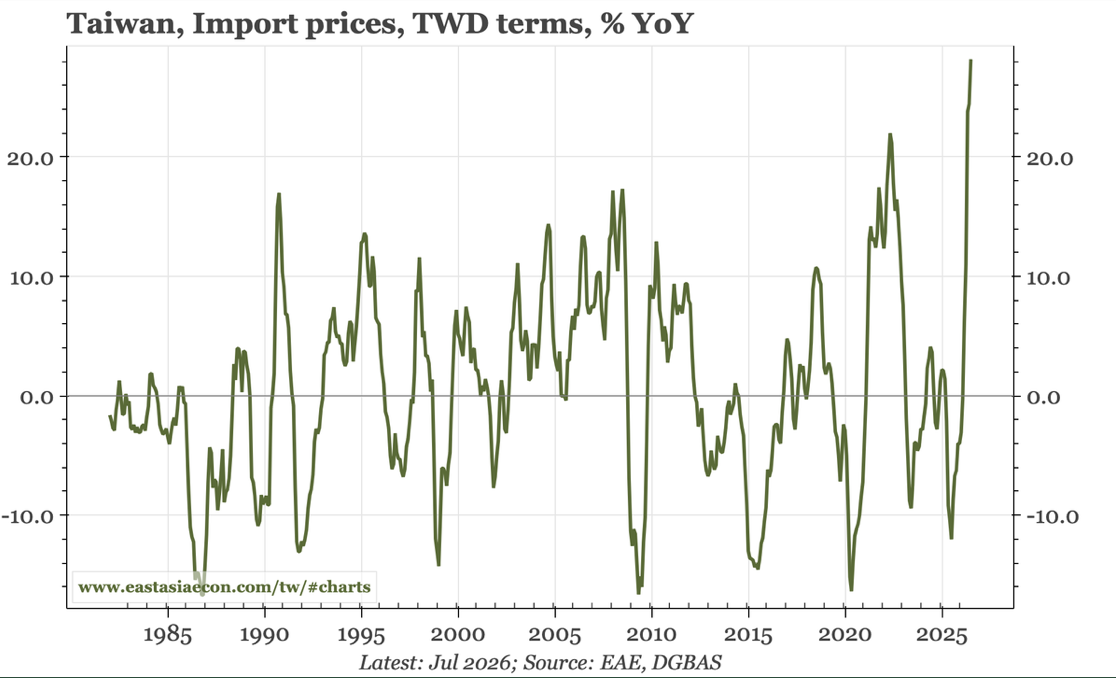
Although headline and core YoY inflation ticked down in July, Paul Cavey thinks overall inflation pressure in Taiwan remains firm. CPI excluding broad energy edged up to over 2% YoY, and despite price pressures easing elsewhere from the Iran War, the MoM annualised rate did not fall below 2%, which he feels is significant given core was closer to 1% last year. Pipeline pressures stay strong, with import price inflation accelerating to 25% YoY and PPI reaching 17%, the highest since the early 1980s. Paul suspects memory chip imports from Korea for AI accelerators are causing cost-push inflation, raising computer prices by 8.2% YoY. While export prices rose even faster to edge up terms of trade, Paul notes that private services inflation remains over 2.5% YoY.
Venezuela: Debt restructuring clock restarts
Jose Ignacio Hernandez expects revisions to the Debt Sustainability Analysis to reshape Venezuelan debt restructuring through timing, fiscal capacity, and the growth outlook. Jose points out that incorporating the 24 June earthquake doublet is analytically sound, as relying on a pre-earthquake baseline invites immediate challenges. Centerview must now estimate the consequences amid severe data gaps, with recovery costs potentially reaching $37 billion. Oil production largely spared the industry, favouring optimistic growth scenarios, while a 2026 restructuring would likely be limited to roughly $101 billion in international bonds. Jose assigns a 45% probability to a macro framework delivery within four weeks, a 55% probability to significant US involvement, and a 55% chance of OFAC authorizing negotiations. Despite political obstacles to an expedited bond restructuring, the process is moving - eppur si muove!
Commodities
The bankability blind spot in critical minerals
In their latest Situation Brief, OMNISIGHT exposes a critical 'Bankability Blind Spot' in Western critical mineral strategies. The analysis argues that Western financial de-risking frameworks, such as DoD price floors and massive IRA/CRMA subsidies, fundamentally conflate financial bankability with strategic deliverability. While billions are poured into domestic recycling and processing, these efforts ignore the commercial reality of technological sovereignty. Following China's export controls on secondary resource recycling technology, Western startups like Ascend Elements have faced insurmountable IP friction, ultimately leading to bankruptcy despite securing over $1 billion in capital. Surviving projects are increasingly forced into joint ventures with Chinese giants like Huayou Cobalt and GEM. Consequently, Western taxpayers are inadvertently paying an 'Allied Industrial Tax,' where domestic subsidies ultimately fund and entrench Chinese technological hegemony in the midstream processing sector.
Limited impact of US tariffs on wood producers
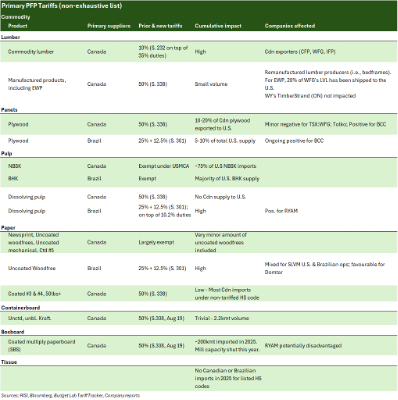
The series of new US tariff announcements include 50% tariffs on ~5% imports from Canada, a 25% tariff on Brazilian imports and 10–12.5% tariffs on virtually all trading partners. The new tariff suites apply to more categories, with the latest possible impact on Canadian exports appearing to be in paperboard and plywood. Although plywood will see some direct impacts (table), public companies in Canada have little exposure. US plywood producers should benefit from lower Brazilian uncoated woodfree imports, although the team expect incremental impact on the names in their coverage universe. Given the inflationary impact on freight/personal transportation from the Iran war, persistently high rates, and escalating domestic energy costs, the team are cautious on the housing market outlook and underlying consumer demand. They see limited benefit to US producers from these latest tariff machinations, with some producers benefiting from one category but hurt by another (e.g., Sylvamo Corp, Rayonier Advanced Materials Inc).
Indian silver market faces prolonged tightness
Indian silver market premiums will not normalise in the coming months, warn Metals Focus analysts, who highlight that prolonged supply tightness will continue to grip the domestic market. Mandatory import licence requirements from the Directorate General of Foreign Trade have severely choked inflows, driving domestic premiums to nearly 10%, the highest level since the October silver squeeze. The team expect total Indian silver demand to fall by 13% y/y to 5,874t in 2026 due to historically elevated prices, yet the country will still require 2,000-3,000t of imports in the second half. A key risk stems from a deficient Indian monsoon, with rainfall 16% lower than normal and Kharif crop sowing down 4.7% y/y, which the team predicts will weigh heavily on rural incomes and jewellery consumption. Even with recent trader approvals, import allocations will fall short of peak festive demand, leaving open the distinct possibility of sharp premium spikes due to severe supply arrival time lags.
The outlook for gold & silver
In his latest video, Jeffrey Christian provides a precious metals update covering the gold price outlook, silver market analysis, COMEX deliveries, precious-metals fraud, storage programs, and the importance of independent audits. Jeff expects gold to trade broadly between approximately $3,800 and $4,150–$4,200 during August and discusses the technical levels affecting the precious metal as well as the upcoming Jackson Hole conference. Meanwhile, silver continues to test the $60 area, and Jeff would not be surprised to see another temporary move below $56 during August. The outlook becomes more constructive during the final four months of the year. Political, economic, inflation, and currency concerns could support stronger investment demand for gold and silver, but Jeff remains less optimistic about platinum and palladium. Topics also include fraud, the interest stock bubble and mortgage crisis, AI, crypto, private equity and private debt.
Click here to watch.
Copper: Price – Supply link is broken
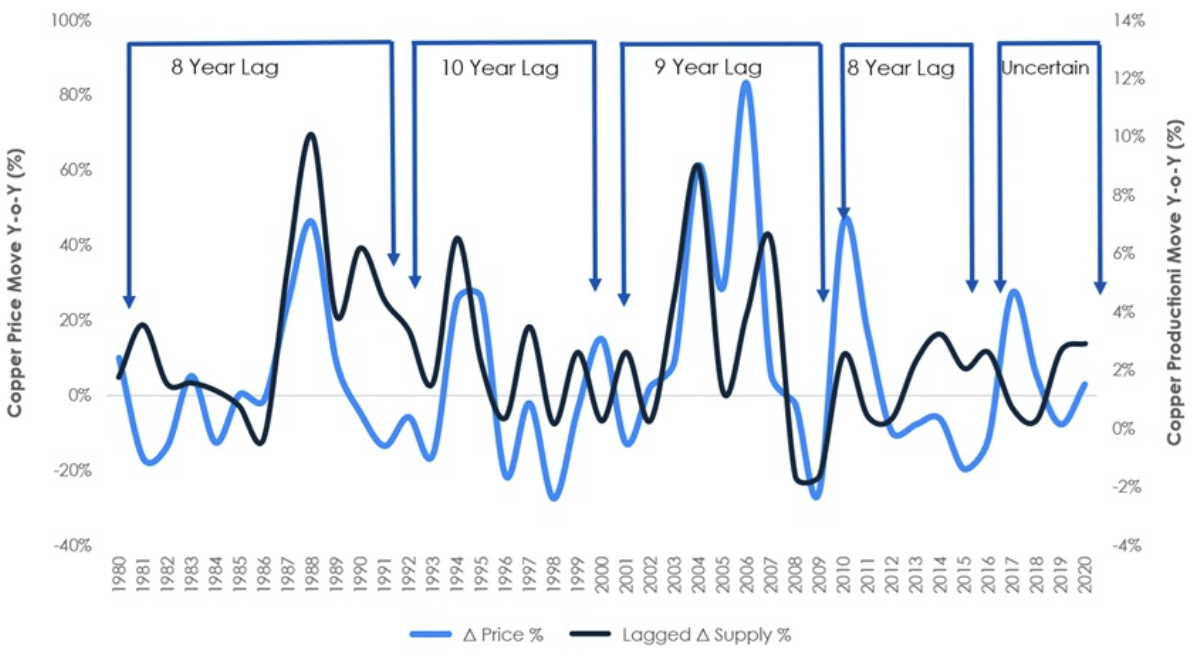
David Radclyffe warns that the long-standing link between copper prices and lagged mine supply has broken, as greenfield project timelines stretch far beyond traditional lead times. Short-term production responses remain tightly constrained, as mines run near capacity and can only target richer ore or expand mill operations. Historically, David’s analysis shows global copper supply responded to price moves with an eight to ten-year lag. However, Anglo American data reveals project completion timelines from initial discovery have surged from seven years in the 1990s to 18 years today, with permitting and environmental studies inflating from four to 13 years. Extended scopes, including required desalination plants, pipelines, and tailing dams, further delay construction. David believes project timelines will keep lengthening across most host nations. With new mines taking 20 years to build, copper supply simply cannot respond to ten-year-old price signals.