Europe
Europe’s rally is just getting started
European companies have shattered already-high expectations this earnings season, with the STOXX 600 on track to grow earnings over 22% (+11% excluding energy), the fastest pace since 2Q22. Sales growth has accelerated to 10% Y/Y, while guidance upgrades are outpacing downgrades by the widest margin since at least early 2024. Management commentary has also become more confident, with companies raising capex and defending margins alongside healthy demand. This challenges the view that Europe remains a structurally inferior market, noting that the STOXX 600 has significantly outperformed the S&P 500 since 2025 and that Europe’s largest sectors have limited exposure to low-cost Chinese imports. Autos remain the weak spot, but AIR sees scope for deep-value laggards to benefit if investors start to price Europe as an AI beneficiary rather than an AI developer. Their preferred H2 investment ideas are available on request.
Consumer Discretionary
Candle Lake’s SEK695 mandatory offer sits below EVO's market price and has no minimum acceptance threshold, so tender participation should be limited. Candle Lake already controls 31.56% of the votes, partly because EVO's substantial share buybacks have reduced the denominator. Further repurchases could increase Kenneth Dart’s ownership without requiring additional purchases. The situation also has fundamental support: EVO trades at 8.7x NTM EBITDA and 11.4x earnings despite a 66% EBITDA margin, c.30% ROIC and more than €1bn of annual FCF. European Research therefore views EVO as a fundamental long with control optionality rather than a conventional merger-arbitrage trade.
Industrials
Q2 results show fleet stabilisation is on track, with leasing and service margins reaching their highest level since AYV was created in 2023 and opex tracking ahead of guidance. Management highlighted lower financing costs and better service profitability, and sustaining a 600bps margin on earning assets could add ~10% to consensus net income estimates. AYV also announced a €700m capital distribution. The main weakness was an €8m used-car sales loss as EV residual values fell, although this was modest vs. Arval’s much larger miss and supports the view that AYV has been more conservative on residual values. Longer term, meaningful cost savings, share gains and capital returns underpin a €21 target (80% upside).
Industrials
AlphaValue raises their FY26 estimates on better H2 visibility, stronger automation penetration and an improving margin mix. The order backlog is up 23% Y/Y, while a greater contribution from smaller, higher-margin orders should offset the heavier weighting of lower-margin key-account projects seen in H1. FY27 sales and EBIT estimates rise 3%, with FY28 forecasts increased 5%. AlphaValue expects continued growth in warehouse automation to increasingly offset weakness in ITS, supported by long-term structural drivers including labour shortages, the continued expansion of e-commerce and the growing importance of reverse logistics. While competition from Asia, particularly Chinese players, remains a drag, AlphaValue believes the expanding secondary market for lithium-ion battery-powered trucks should remain supportive and become increasingly relevant over the coming years. TP €35 (45% upside).
North America
TMT Idea Forum
While AI was a dominant theme at MYST’s latest buyside event, several participants deliberately avoided it, migrating towards media-related names, out-of-favour international companies and recent IPOs. The most interesting ideas included:
Disney (DIS) - stale narrative masks broad fundamental improvements + IP moat. TP $150 (40% upside).
Flex (FLEX) - CPI spin-off to unlock hidden hyperscaler growth. TP $250 (125% upside).
Motorola Solutions (MSI) - sleepy Street models ignoring transformational counter-drone acquisitions. TP $700 (45% upside).
SharonAI (SHAZ) - sweetheart Nvidia deal fuels unrecognised EBITDA upside + ASX listing catalyst. TP $200 (245% upside).
Spotify - significant margin upside from restructured label deals, new product features + ads. TP $1,206 (125% upside).
Communications
The market is focusing too heavily on GOOGL’s ~$200bn capex bill and not enough on the long-term value of the infrastructure being built, according to Will Nutting. Google Cloud is already running at close to $100bn of annualised revenue, growing 82%, with a 35.6% operating margin and $514bn of contracted backlog. His analysis suggests Cloud could become a $600-700bn business by 2030 and $1.2-1.7trn business by 2035, supporting $400-700bn of operating profit, while the company as a whole could generate $600-900bn of annual earnings. Once the current construction phase slows, depreciation and maintenance capex should look very different from today’s growth capex, allowing it to throw off hundreds of billions in annual FCF. Will sees GOOGL evolving from a search company into a vertically integrated “intelligence utility”, with AI infrastructure ownership potentially becoming the next major investment trade.
Communications
MDC Financial Research's Event-Driven Legal℠ service is monitoring the State Attorneys General Social Media Addiction Trial against Meta Platforms, Inc. (Case #22-03047), where a Jury Trial commenced with Opening Statements on August 18th, 2026, in California. The litigation centres on allegations by 29 State Attorneys General that Meta's social media platforms were designed to be addictive and causes harm to adolescents (among other claims). The Trial is ongoing and is expected to continue through early October 2026. MDC attended Opening Statements and they currently plan to attend at least a portion of this ongoing Trial. Institutional investors can contact MDC for timely insights, court coverage and risk assessment on this and other event-driven equity opportunities.
Consumer Discretionary
Hollister enters back-to-school with strong momentum, heavy social-media visibility and several fast-selling categories. Abercrombie has been weaker, with stale assortments weighing on the brand, but The Retail Tracker sees signs of improvement following merchandise changes and new design leadership; YPB looks very good as well. One notable watchpoint is Hollister inventory: stores were unusually empty in July, prompting questions over potential delivery issues, although The Retail Tracker says this may simply reflect summer product selling through faster than expected. Tougher second-half comparisons remain a headwind, particularly for Hollister, but the combination of sustained momentum there and improving product at Abercrombie leaves ANF well positioned for the remainder of the year.
Everyday essentials, extraordinary pressure
Consumer Staples
Scott Mushkin argues the squeeze on food-at-home is intensifying, with GLP-1 adoption reducing industry volumes just as Amazon and Walmart accelerate their push into everyday consumables. AMZN's essentials business already exceeds $150bn, and he estimates FY26 unit growth of ~25% and revenue growth of ~20%; alongside WMT and Costco gains, this could leave the rest of the market shrinking ~2%. Aggressive pricing and faster delivery should also pressure competitors’ margins, reinforcing Scott’s Sell ratings on Kroger and Dollar General. Pepsico, Campbell's and Constellation (all not covered) are where he is most concerned, but he views the industry as generally uninvestable. Conversely, AMZN’s consumables momentum increases his confidence in his long-term North America retail forecasts and wider industry consolidation over the next couple of years.
Healthcare
BMY’s ZENBEXUS approval shifts the debate from whether the IMiD franchise can retain relevance to whether the market is underpricing a credible rebuild opportunity. The approved relapse indication creates a commercial floor, but the equity question is now earlier-line use, duration of treatment and whether ZENBEXUS can shift from a capped RRMM asset into a broader Revlimid-successor thesis. Foveal thinks the setup is less about label optics and more about whether the maintenance opportunity can justify a materially larger peak-sales construct than consensus currently reflects.
Industrials
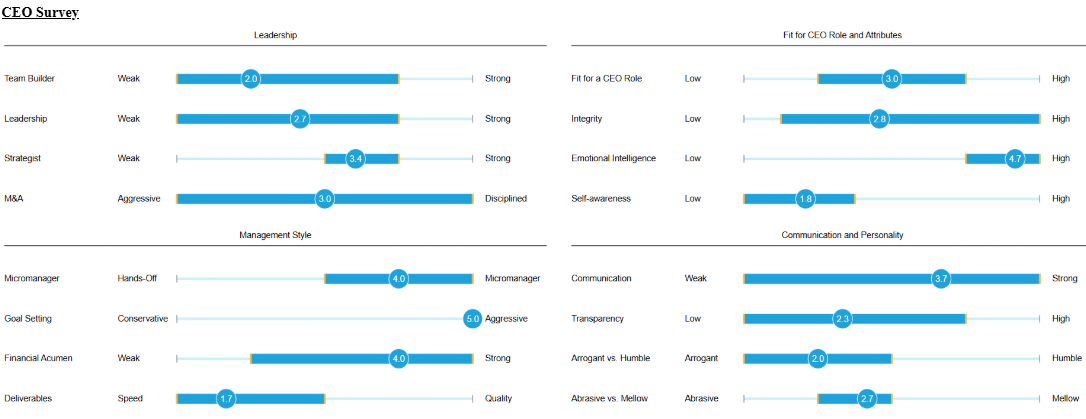
Paragon interviewed six former senior executives at BE who worked with Sridhar for 50+ years combined. Sources provided negative feedback, with his founder-driven intensity also seen as his central weakness. He sets frequently unrealistic goals, can micromanage and override functional experts, struggles with talent selection and delegation, and has produced significant executive turnover, with multiple sources describing weak accountability, inconsistent strategic discipline, limited self-awareness, and serious concerns around transparency and integrity. The group’s success reflects Sridhar’s technological conviction, fundraising ability and persistence, but his dependence on a small group of capable executives and directors to provide operating discipline leaves the organisation vulnerable to overcommitment, leadership churn and execution problems when his ambition runs ahead of the company’s capabilities.
Materials
GMR sees HBM as one of the strongest ways to play US copper growth, with Arizona emerging as the core of its long-term optionality. Copper World is approaching a sanction decision in late 2026, while the recently acquired Cactus project adds a second large-scale development opportunity and potential synergies. GMR estimates HBM could account for 30-35% of new US copper production by 2035, while projects across its broader portfolio are expected to increase total copper production by ~140kt over the period. The balance sheet has strengthened, 2027 production guidance implies ~30% Y/Y growth at the midpoint, and HBM trades at ~0.9x spot P/NPV10, a discount to Canadian peers. In a market short of copper equities, HBM offers growth optionality at a reasonable price and GMR would be surprised if peers have not noticed.
Technology
Hamed Khorsand thinks the sell-off in ATEN reflects investors focusing too heavily on Microsoft customer concentration and missing the upside from a deepening relationship. MSFT accounted for 38% of Q2 revenue, but Hamed argues the new agreement should reduce purchase lumpiness and could drive another step-up in quarterly sales, similar to the increase seen after MSFT expanded its use of ATEN products in 2025. He expects revenue growth to exceed ATEN’s historical targets, particularly in 2027, while a recovery in Japanese and European service-provider spending should broaden the revenue base. The group’s ability to generate FCF further enhances value creation as it puts excess capital towards share repurchases. TP $45 target (80% upside).
Technology
Corto argues TENB's sharp rerating is getting ahead of the fundamentals. Shares are up 50% YTD and 120% since early April as investors have become more comfortable that generative and agentic AI will not displace the company, a view reinforced by management’s Hexa AI strategy and partnerships with Anthropic and OpenAI. Corto is less convinced, arguing agentic AI could still reshape vulnerability management and that TENB has yet to show a corresponding growth inflection. Most key revenue indicators including organic growth, H2 guidance, new customer revenue, enterprise additions, NDE, deferred revenue and RPO continue to point to deceleration. With the shares now pricing in a growth rebound, Corto expects softer H2 trends, estimate risk and multiple compression, leaving significant downside from current levels.
Gig economy sector update (UBER, LYFT, DASH, CART) with Gridwise CEO Ryan Green
Technology
Peter Daniel hosted Gridwise CEO & Founder Ryan Green to discuss the scale and evolution of the US gig economy. Gridwise analyses more than 700m trips from 1.5m workers across platforms including Uber, Lyft, DoorDash and Instacart, providing insight into driver supply, pricing, pay and unit economics. The US is the most mature gig market, with independent workers contributing $1.3trn annually. Around 73-76m Americans, or 36% of the workforce, participate in freelance or gig work, with that share projected to exceed 50% by 2027. Rideshare and delivery alone account for more than 8m drivers, while the market is highly saturated with low median net margins. Gig work remains largely supplemental: only 21% rely on it as their primary income source. A recording of the call is available on request.
Asia
Consumer Discretionary
HTHT’s Q2 beat-and-raise showed earnings can compound without waiting for a broad China lodging recovery. Domestic RevPAR remains soft, but network expansion, faster fee-based growth, an increasingly asset-light mix and tight cost control drove ~3ppts of Y/Y margin expansion, prompting 86Research to increase their FY27 revenue and EBITDA estimates. HWC’s expansion remains firmly on track, supported by healthy signings and an improving pipeline, while newer formats such as Hanting 4.0 are delivering stronger economics. Internationally, Europe remained resilient and HWI EBITDA rebounded sharply despite Middle East disruption and Asia mix pressure. 86Research sees margin expansion as structural, with earnings quality improving faster than RevPAR normalises. At ~8x FY27E EV/EBITDA, they see further rerating potential. TP $65/ADS (40% upside).
Banks: China too cheap to ignore, avoid India
Financials
David Scott sees global banks as still offering substantial value, with China the standout deep-value opportunity. Chinese banks trade at distressed-looking valuations despite resilient loan growth, profitability and well-covered dividends; David argues they are “too cheap to ignore”, with buybacks also looking increasingly likely given the large discounts to book value. China Merchants Bank is his preferred name given superior fundamentals and a valuation now around peer levels. By contrast, he expects Indian banks such as HDFC and Kotak to continue underperforming as intense competition for deposits, staff and lending compresses margins and efficiency. He remains positive on Banorte (a cheap play on Mexico’s growth) and Lion Finance (which is up another 155% since he last recommended it), while highlighting Commercial International Bank as a new Egyptian idea.
Technology
Aequitas takes a cautious view on Longsys’ planned ~$500m H-share listing. The memory-products supplier has benefited from the sharp rebound in memory pricing, with FY25 revenue up 31% and PAT margin recovering to 6.1%, while 1H26 revenue more than doubled and PAT surged. However, Aequitas questions the sustainability of this earnings strength: Longsys remains a small global player with just 1.2% market share, relies heavily on a concentrated supplier base and is effectively a price taker, with gross margin only 18% in FY25. Operating cash flow has remained negative and net debt reached ~$1.2bn, although the IPO could nearly halve this. Aequitas also notes that margins may come under renewed pressure as lower-cost inventory is exhausted and replacement wafers are purchased at higher prices.
Developed Markets
AI: Circular financing
Paul Krake doesn’t see the unprecedented surge in circular GPU financing as fundamentally a leverage problem, but a question of long-term corporate demand and collateral resilience. While critics condemn Nvidia’s vendor financing as a late-cycle trick, history demonstrates that vendor credit allowed the building of rail, automotive, and aviation empires whenever secondary markets remained deep. However, GPU structures face acute risks: rapid annual silicon product cycles threaten Itel Corp-style obsolescence, custom chips lack resale markets, and customer funnels remain heavily concentrated compared to aviation leasing. Paul remarks that financial engineering is not the fault line, noting early constructive signals as Anthropic’s revenue run-rate expanded rapidly. When evaluating the sustainability of these massive structures, investors should look past the circular paper and interrogate corporate adoption directly: ask bears when they last spoke to a corporate about long-term AI strategy, because that is where the true risk lies.
The transition hiding in plain sight
According to Dimitri Zenghelis, it has become fashionable to be pessimistic about humanity's ability to reduce emissions and wean itself off fossil fuels. The headlines seem clear: Trump in the White House; emissions continuing to climb; climate policy weakening; and the fossil fuel industry talking up new reserves. But headlines are not the same as underlying trends. The science of climate change has not altered; nor, more importantly, has the extraordinary pace of technological change. Nor is this simply a climate story. Two enduring wars involving major fossil-fuel producers have reinforced the value of secure domestic energy. Energy independence, climate action, and economic efficiency increasingly point in the same direction. None of this means that the transition will be smooth, nor that fossil fuels are about to disappear. But the transition is no longer being driven only by political targets and policy. It is increasingly propelled by technology, cost, energy security, and industrial competition.
UK gilts: An unexploded bomb supported by carry
Andrew Hunt warns that the Gilt market resembles an unexploded bomb for investors, supported by a sizeable BoE-sponsored carry trade. The domestic case against Gilts is straightforward: large budget deficits exceeding household savings, persistent current account deficits, sticky inflation, and ongoing quantitative tightening. Domestic institutions absorb minimal supply, leaving demand dependent on foreign capital and hedge funds leveraging the massive BoE repo facility to ride the curve. Andrew expects net government debt sales already running at circa £200 billion annually (6.5% of GDP), which will likely rise further under Mr Burnham’s spending ambitions. While carry trades can sustain the unsustainable longer than common sense dictates, their unwinding causes immense capital destruction. If Burnham provides a shock, the resulting sell-off in Gilts and sterling will likely prove far worse than many expect. Gilts should be handled with extreme caution; if the fuse arms, one needs to leave the area rapidly.
UK: Manchester’s true underperformance
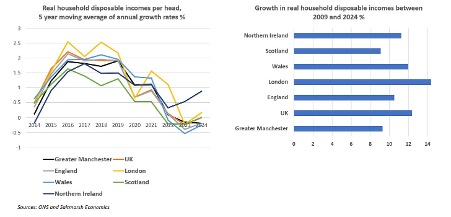
Commonplace talk of a near renaissance in the Greater Manchester economy is directly challenged by newly published ONS disposable income estimates. While regional labour productivity trends show strong output growth, this output measure conceals a far less flattering reality. Between 2009 and 2024, real household disposable incomes per head in Greater Manchester grew by only 9.3%, lagging the UK's 12.4% and London's 14.4%. In 2024, growth managed just 2.4% versus 3.2% nationally. Internal divergence is severe: gross disposable income per head ranges from under £19,000 in Oldham (15th poorest UK local authority) to nearly £30,000 in Trafford, with Manchester itself below £20,000 against a £26,500 national average. Against reports of Andy Burnham and John Healey moving Treasury functions to Manchester, output per head diverges sharply from income per head, flying counter to the narrative of a completely transformed regional economy.
France: On an unsustainable debt path
When economic growth falls below the real interest rate, public debt enters an unsustainable trajectory. With French growth at 0.8%, 10-year OAT yields between 3.8% and 4%, and inflation around 1.8% to 2.4%, France’s debt-to-GDP ratio sits at 115–116%. Wolfgang Münchau points out that this is wholly unsustainable unless a primary surplus is achieved. There is no surplus in sight. Sébastien Lecornu is unlikely to even reduce the deficit to 5% of GDP ahead of critical elections. Without savings measures, state expenditures are expected to surge by €60bn, driven by an €11bn increase in debt servicing and €12bn in pensions. Unsuccessful savings efforts previously brought down Michel Barnier and François Bayrou; Lecornu has already suspended pension reform. With no parliamentary majority, budget talks will trigger more concessions and tax increases. Expect another season of silly entitlement debates when courageous politicians are needed to sell a blood, sweat and tears narrative.
Favouring Norway over Sweden
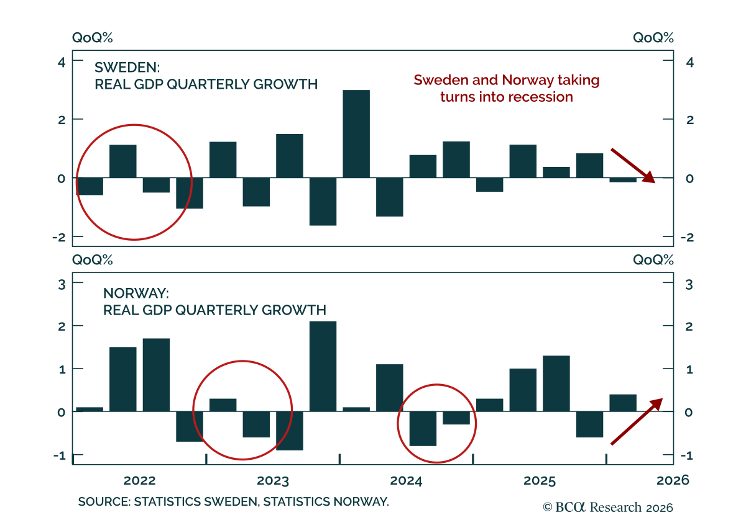
BCA Research see the Iranian war and resulting energy shock reversing Nordic fortunes, favouring Norway over Sweden as Sweden's recovery stalls while Norway reaps an energy windfall. Their strategists note that Sweden's exposure to a weakening global industrial cycle leaves it vulnerable, with AI-related investment too small to cushion the slowdown whilst inflation cools rapidly to 0.7% CPIF. Conversely, higher energy prices are lifting Norwegian exports and prolonging the energy investment cycle, with sticky wages and services inflation keeping Norges Bank cautious and rate cuts a distant prospect. To express this divergence, they recommend buying 3-month STIBOR futures to fade roughly 80 bps of Riksbank tightening priced through H1 2027, alongside downgrading Norwegian government bonds to neutral. They also initiate a 12-month long NOK/SEK position and prefer Norwegian equities over Swedish shares as an energy hedge against a fading global capex cycle.
US rates: Has anything really changed?
Markets have gone too far in assuming no further Federal Reserve hikes, contends Jonathan Turek, warning that extrapolating recent softer spot data into the balance of risks is premature. The US economy remains biased towards hikes against a resilient backdrop where the unemployment rate is 4.1%, three-month average non-farm payrolls are adding 20k jobs, energy is above $80, and core PCE sits at 3.3%. Crucially, the $1T annual impulse from AI capex continues to push the cost of capital curve steeper, as bond supply from hyperscalers prevents forward rate cuts. With the FOMC seeking an excuse to hike, terminal pricing of just 35bps at the peak of the curve is far too low, underpricing the risk that the economy accelerates rather than slows in the second half. To capture both Fed terminal repricing and duration-led term premia, Jonathan is re-establishing a short in US rates and added a short in SFRH8 at 96.00.
US: The bond mystery
David Woo examines why long-term borrowing costs are climbing despite weakening payrolls, falling inflation, and deteriorating macro surprises. David argues that while the Fed controls short rates, long-term real yields are driven by a shifting saving-investment balance. The US structural budget deficit will surpass $2 trillion this year following the Supreme Court tariff ruling, even as China continues dumping Treasuries and Japanese capital threatens to repatriate. Concurrently, AI capex accounts for only 15% of private nonresidential investment, leading David to conclude the boom is too small to fully explain elevated yields. Instead, investors simply prefer equities, though non-AI earnings were flattered by $160 billion of one-off tariff refunds that will fade. With hyperscalers motivated by fear and token prices plunging, David warns investors to go very slow on bonds. He likes owning 5y Treasuries to hedge his long oil position, looking to re-establish short SOXX when technicals improve.
Emerging Markets
Downgrading EM
Ed Yardeni is downgrading emerging markets to market weight as four distinct macro headwinds converge, even as he maintains the broader Go Global thesis remains intact. Oil prices have climbed back above $80 a barrel with the Strait of Hormuz contested, whilst sticky inflation and a solid labour market prompt financial markets to price in an additional FOMC rate hike this year. This policy outlook is boosting the dollar and tightening global conditions, alongside visible AI fatigue across North Asian equity indices. Nevertheless, Ed stresses this tactical pullback does not reverse the multi-year case for international equities: overseas valuations remain cheaper than in the US, and the structural rotation away from decades of US stock market leadership is unbroken. With US and ex-US proxies PBUS and ACWX locked together near record highs, the long-run international trade survives, even as EMXC absorbs acute near-term pressure.
Argentina: Fading political momentum
Attention is shifting toward the 2027 presidential elections as President Javier Milei polls below 40%, leaving his re-election far from secured while an active opposition stirs market anxiety. Marcos Buscaglia expects the government and BCRA to expand local liquidity and allow interest rates to decline, because consumption financing relies on pesos rather than recent USD-denominated loan relaxations. He forecasts inflation to fall back below 2.0% month-on-month in August, with the central bank likely maintaining benchmark rates around 20% to spur credit growth. Although authorities have treated 1,500 as a line in the sand, they do not expect the central bank to hold this FX level for long if it prioritises low rates. In market terms, Marcos expects short-dated rates to drop, the peso to weaken slowly, and any repricing of hard-currency bonds to wait as sovereign credit spreads remain elevated.
China’s cycle concerns v the CNY
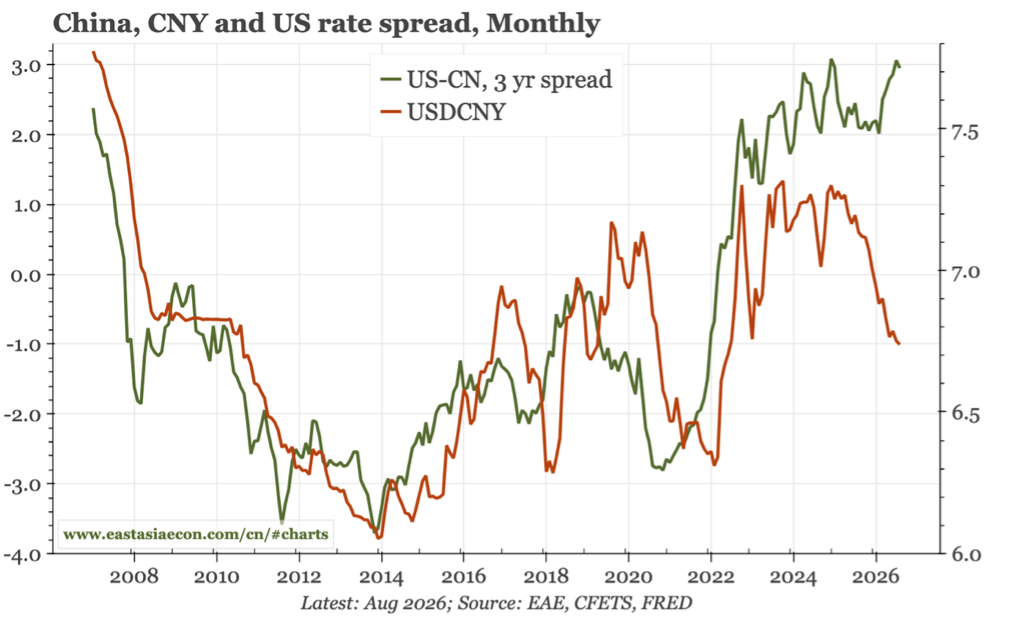
Paul Cavey warns that domestic monetary stabilisation rests on fragile foundations, as China's property market fails to find a firm floor and the decline in starts re-accelerates. With consumption weak, the risk of the PBC restarting monetary easing is rising, directly challenging market confidence in sustained CNY appreciation. Paul is sceptical of a dramatic policy pivot whilst industrial production growth near 5% keeps the annual GDP target in sight. However, as onshore yields drop, renewed easing would create serious headwinds for the currency. Beijing prefers mild appreciation and capital inflows to support monetary reflation, but cannot maintain stability if forced to loosen. While the Politburo gave no sign of fiscal relief for households or property inventories, policy shifts have become non-linear. For Paul, the market's confidence that CNY appreciation continues is entirely at odds with the worsening problems in China's cycle.
China: A balance sheet recession road map
Harry Colvin argues that contrary to optimistic calls for a housing turnaround, evidence increasingly points to an ongoing Chinese balance sheet recession that probably has many more years to run. Property valuations remain expensive, unsold inventory sits near multi-year highs, and credit intensity remains dysfunctional: for every extra dollar of GDP growth, total private sector credit grows by circa RMB 5.5. Persistently elevated credit intensity across 14 quarters signals deep distress, with companies rolling unpaid interest into loan principals while households deleverage and curb spending. Total corporate leverage has jumped 20 percentage points of GDP in four years, driving high-yield spreads wider. Chris notes Beijing is replicating Japan’s historical playbook, offsetting private retrenchment with massive fiscal deficits that push public debt towards 130% of GDP, transferring strain onto the sovereign. Trend growth will stay low, while high credit intensity remains the definitive symptom of an economy stressed and struggling to grow.
China: A grim picture
China's economic slowdown deepened in July as domestic demand sank to post-pandemic lows. While export values surged 23.9% on price-driven high-tech categories like semiconductors, underlying volumes tell a different story. Crucially, earlier bright spots are fading fast: services consumption slowed to a two-year low of 3.3%, retail sales grew just 0.6%, and cost-push inflation from the Iran war is ebbing, dragging month-on-month CPI back into deflation. Meanwhile, fixed asset investment contracted 12.9% and new real estate investment collapsed 27.4%, accelerating a property decline with no end in sight. With bank loans contracting and local governments constrained by hidden debt, analysts argue that incremental monetary tweaks and accelerated fiscal deployment look increasingly inadequate. Whether Beijing reaches for forceful, demand-focused stimulus or leans entirely on high-tech manufacturing remains the defining question for the second half of 2026.
China & Hong Kong: The long road back
Active EM managers are not exiting China but selectively rotating into market dislocation, explains Steven Holden. While China and HK average weight remains depressed at 20.14%, active positioning is turning as the benchmark underweight hits its narrowest level in almost a decade. Steven highlights that managers are actively buying into weakness: net estimated flows turned positive at $6.7bn over the seven months to July, led by value managers whose average overweight swung from a trough near -12% to +3.50%. Funds are actively trimming post-reopening consumer winners including Trip.com, Xiaomi, and Meituan to fund a technology self-sufficiency trade. Allocations are aggressively building across AI infrastructure and semiconductor equipment names such as NAURA Technology, Zhongji Innolight, and CATL, which absorbed $1.7bn in inflows. With China carrying roughly the same active weight as Taiwan or South Korea despite a vastly larger market, the current order of play looks temporary, not sustainable.
Nicaragua: Ortega’s regime is becoming more overtly dynastic
According to Daniel Landsberg-Rodriguez, President Ortega’s July declaration that competitive elections would end, followed by proposed constitutional changes, further entrenches Ortega-Murillo family control. The reform is expected to receive final ratification next year. Ortega is 80, while Rosario Murillo is already co-president and would automatically succeed him if he dies. The opposition has been largely dismantled and the armed forces remain loyal. For investors, policy arbitrariness remains the principal domestic risk. The government has confiscated more than 135 properties worth over $250 million from denationalised opposition figures, while a purge of thousands of lawyers has further weakened protections for private capital. Externally, US pressure is increasing with new tariffs. Separate Nicaragua-specific tariffs on non-CAFTA-origin goods rise to 10% in 2027 and 15% in 2028. The IMF forecasting 3.4% growth in 2026 despite tighter US immigration and trade policies and the risk of broader sanctions.
Nigeria: Hanging on and watching oil
Nigerian markets have performed well since March on the back of higher oil prices, with a strong NGN exchange rate yielding high carry gains, solid dollar yields and a further equity rally. Macro trends are more mixed in the first half, however. Export data have yet to show much impact from the oil price spike, the budget position has been weakening and external surpluses are fading at the margin as well. On the positive front, the authorities have kept rates high and lending policy tight, supporting the value of the currency. Jonathan Anderson is looking for signs of improvement in the coming quarters. With oil prices still above US$80/barrel he expects further support on the external and budgetary front and is maintaining his Nigerian portfolio positions for now.
Commodities
The commodities secular bull market resumes
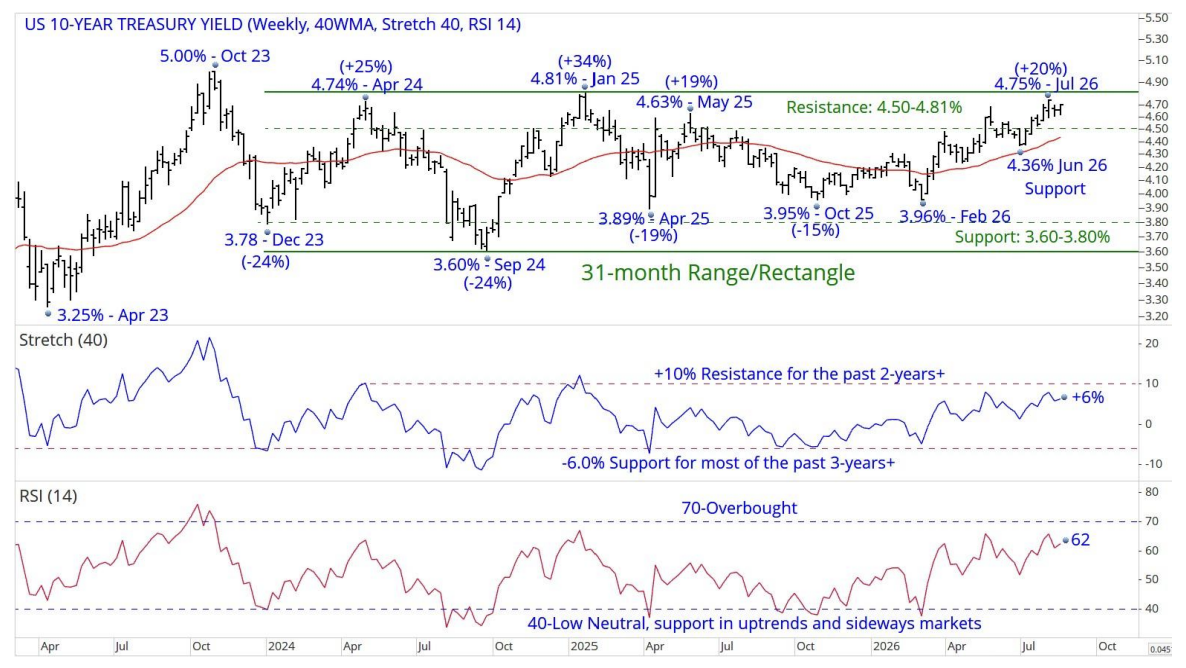
Chris Roberts believes that the broad commodity secular bull market is resuming after the iPath Bloomberg Commodity Index near 17% correction in May/June found support around the rising 40-week WMA (see chart), with the 14-week RSI bottoming at Neutral 46. DJP US broke out of a three-year base in late 2025, and this second advancing phase targets an advance to either 80.00 or 140.00. A break above the May peak of 51.73 should signal an acceleration, making 80.00 too low a target. While precious metals take a break, Chris likes Spot Copper at USD6.59 as it breaks clear of a 19-year ceiling at USD4.00-5.00 with a minimum target of USD8.00-9.00, adding to long exposure this week. Chris also sees Crude Oil setting new all-time highs above USD240.00+, and is holding a small, actively traded long in Spot Brent. He sees grains in late base development, and is holding long positions in Soybeans and Sugar while monitoring Corn and Wheat.
Crude prices could slingshot higher
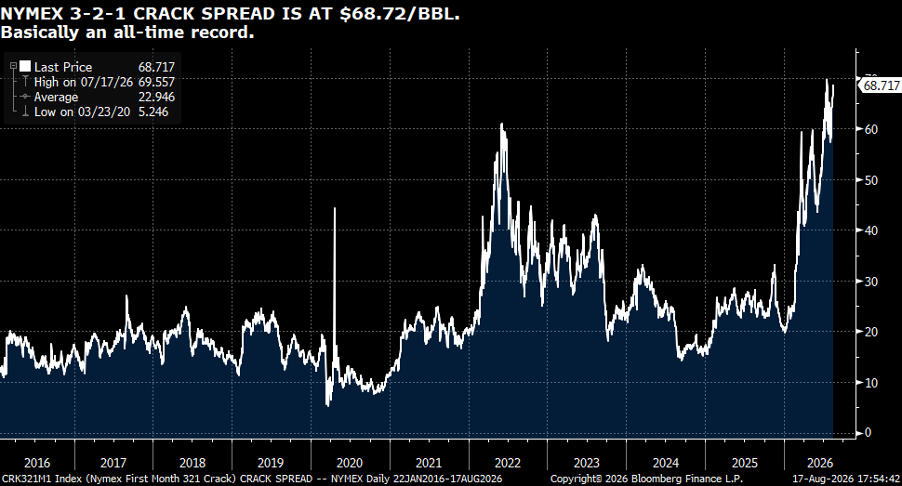
The Nymex 3-2-1 crack spread is back up to $68.72 – about a dollar below its all-time high. Michael Churchill says it’s telling you crude oil prices aren’t low because of weak demand for end products and that there is a huge arbitrage opportunity for crude refiners that is waiting to be pounced on. To get the crack spreads back to its normal $25/bbl, crude would need to be $129/bbl. Michael asks: “Just how much extra oil is the world going to need to rebuild all these reserves?” His rough calculations suggest that if we’ve suffered 165 days of oil production running 8mm barrels/day below normal: that’s 1.32bn barrels ‘missing’. Normal daily demand is 103mm barrels. If we assume 3 million bbls/day would need to go into overall stock rebuilds, then you have 3mm bbl/day of excess demand for 440 days. Politically, there’s no obvious resolution to the Iran situation on the horizon – so the accumulated oil “deficit” keeps growing every day. Michael sees a risk that crude prices could slingshot far higher as countries rebuild reserves just as refiners seek to arb out crack spreads.
Bitcoin: Why $63,000 is the line between bottom and breakdown
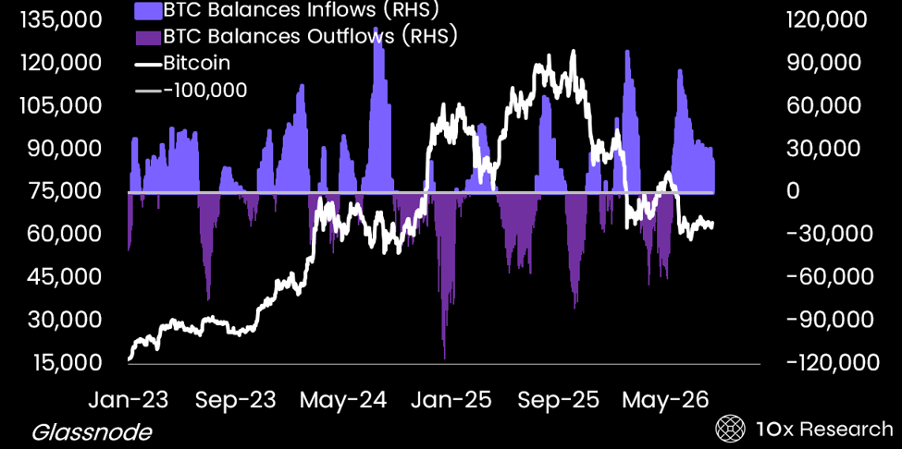
Markus Thielen says the $63,000 level is pivotal for Bitcoin, not just from his monthly regime and cycle analysis, but also because it marks the peak distribution zone where the largest share of Bitcoin last changed hands. Many traders could fall back into losses if Bitcoin drops below that number; conversely, a rally from here would let that same cohort turn profitable again, and growing confidence from rising profits tends to bring more leverage. Short-term traders, who tend to drive most of the leverage in this market, become profitable again above $68,871. A move above that level could trigger something more than just a technical bounce: a fundamental, reflexive shift, where sentiment turns, and exchange balances start dwindling as holders move coins back into cold storage. However, a drop below the recent low of $58,000 would likely trigger a liquidity search. As long as Bitcoin holds above $62,000 (Markus’s stop), the bullish narrative might prevail. But it's a binary outcome, and BTC call options could help manage downside risk while preserving upside exposure.