Europe
Financials
Lucror sees substantial risk that Intrum will need another debt restructuring when its 2028 maturities come due. Q3 results were dismal, with no sign of management's promised operational turnaround. Furthermore, guidance for servicing adjusted EBIT was revised downwards and they now anticipate a lower number than in FY25. Intrum also wrote down all the remaining goodwill for its German asset, which reflects poorly on management's judgment. Lucror maintains a Sell recommendation on the longer-dated second-lien notes and Hold on the rest of the capital structure.
European Industrials: The China risk investors are missing
Industrials
Willis Welby sees a “second transformation” of Chinese manufacturing as an underappreciated threat to European industrials. China’s first advantage came from cheap labour after joining the WTO; the next could come from widespread deployment of AI and robotics, materially improving factory and supply-chain efficiency while retaining a lower-cost workforce. The risk extends beyond Chinese exports into Europe: more efficient domestic competitors could also displace European companies in China and take share from them elsewhere globally. Willis Welby therefore highlights European manufacturers with significant Asian exposure and relatively demanding valuations, including Sandvik, Alfa Laval, Atlas Copco, Epiroc, Hexagon, EMS-Chemie and DSM-Firmenich. All currently have positive earnings momentum, but their valuations leave them vulnerable if Chinese competitive pressure becomes a more prominent investor concern.
Technology
ASM’s results were well ahead of expectations, but the bigger surprise is the outlook: the upward revision to this year’s revenue forecast pales beside 2027, where ASM is projecting growth of at least 35%. Demand remains supported by AI-related investment and customer capacity ramps, with strong activity at 2nm and 3-5nm and the first meaningful contribution from 1.4nm. Its served available market at 1.4nm should increase by a solid double digit vs. 2nm, alongside higher market share. the IDEA! also expects substantial operating leverage next year, with gross margins benefiting from newer systems and opex lagging revenue growth, driving adjusted operating income up ~50% to just over €2.0bn. At ~15.5x EV/EBIT, they see the valuation as very modest, underpinning a highly attractive investment case.
Technology
The company delivered a solid Q3, with strong operating leverage and cost efficiencies driving an upgrade to FY26 earnings guidance. Underlying demand remains healthy, supported by encouraging ARR growth, new customer wins and a robust pipeline. However, the subscription and SaaS revenue shortfall highlights ongoing execution risks around large deal closures. Achieving FY growth guidance will depend on a strong Q4 and timely revenue conversion. AI-driven efficiencies offer further upside to margins, while implementation automation could support demand over the medium term. The shares are trading at estimated EV/sales multiples of 4.4x for 2026 and 4.0 for 2027, and estimated EV/adjusted EBIT multiples of 12.1x for 2026 and 11.2x for 2027.
Utilities
ResearchGreece sees Admie as unattractive despite strong Q2 results at IPTO, its 51%-owned grid operator. The concern is that IPTO’s business plan remains demanding: H1 capex is running below FY26 guidance, yet investment would need to rise sharply in 2027-29 to deliver the €6bn programme and expand the regulated asset base to €7bn by 2029 from €3.3bn in 2025. That execution burden should keep leverage elevated, with IPTO net debt/EBITDA expected to peak above 5x. At the same time, Admie’s dividend yield remains subpar and the valuation is not compelling, with IPTO trading around 10-11x EV/EBITDA across 2026-29 versus grid and transmission peers at roughly 8.2x 2029.
North America
Communications
Craig Huber sees OMC’s Q3 results as further evidence that AI is not disrupting the top line, with organic revenue growth accelerating to 7.2% - the best quarterly performance since 4Q22 and, excluding the post-Covid rebound, since 3Q11. Adjusted EPS rose 22% Y/Y to $2.73, while adjusted EBITA reached $1.13bn and margin expanded to 17.6%; on a pro forma basis, core margin improved 200bps as Interpublic synergies and stronger organic growth outweighed reinvestment in technology and agentic AI. Craig now forecasts 2026-28 organic growth of 5.8%/5.0%/4.5%, EBITDA of $4.58bn/$4.85bn/$5.33bn and core EBITDA margins of 18.1%/19.0%/20.0%, with adjusted EPS of $10.33/$11.80/$14.40. He sees attractive risk/reward with the shares trading at just 7.0x/5.7x 2027/28E adjusted EPS. 12-month TP $100 (25% upside).
Consumer Discretionary
The return-to-office tailwind for US office furniture is fading just as HNI takes on substantial execution and financing risk from the Steelcase acquisition. Organic growth remains weak at both businesses, with industry growth increasingly driven by price rather than volume, making bullish expectations for a sustained rebound look too optimistic. OWS also questions the $120m+ cost-synergy target, arguing it looks ambitious relative to the seemingly narrow opportunities for savings across procurement, manufacturing and logistics. Steelcase has historically operated at lower margins than HNI, creating a separate risk that the combined company’s profitability falls short of Street expectations. Hearth adds another headwind, with fireplace installations in new homes declining and remodelling activity subdued. OWS models FY27 EPS of $3.35 vs. $4.70 consensus.
Financials
FSZ shares have fallen ~30% since Fighting Financials initiated their short on 9th Sep, but they see further downside as attention turns to the sustainability of its dividend. Their original thesis was that FSZ is a sub-scale, relatively undifferentiated asset manager caught between specialist boutiques and scale leaders, with five years of net outflows, declining AUM margins and unusually high leverage. Despite respectable investment performance, AUM has remained broadly flat as outflows offset market gains, while dividends and buybacks have materially exceeded earnings. Fighting Financials now argues that, if recent trends persist, FSZ will have to cut its dividend. At a more sustainable 50% payout ratio on FY26 consensus earnings, the shares would yield just ~4.5%, offering little compensation for the risks.
AI Drug Discovery: Mapping the value chain
Healthcare
Hudson Labs has mapped the emerging AI drug-discovery ecosystem, providing investors with a structured view of where AI is actually being deployed across pharmaceutical R&D. Their work covers 353 companies (158 public and 195 private) spanning discovery CROs, lab tools, clinical-stage developers and large pharma, with each company classified by its position in the value chain, primary modality and the importance of AI to its business. Hudson has also compiled 705 sourced statements from earnings calls and filings on AI’s current and expected impact on R&D, giving investors a way to distinguish genuine adoption from broader AI narratives. The dashboard was developed alongside Citrini Research’s recent work with Anthropic on AI-enabled drug discovery and is now live on Hudson’s platform.
Industrials
The stock trades at ~18x earnings, ~20% above its long-term average, despite growing structural competition and signs that near-term sales are being pulled forward. Milwaukee Tool has taken share with a better product priced 20-30% lower, while Harbor Freight has doubled its store base, expanded overlap with SNA’s hand-tool range and undercut prices by as much as ~80%. Younger mechanics also appear less attached to the brand, while franchisee and route counts continue to decline. Recent growth has also been helped by SNA’s largest-ever power-tool price cut: franchisees loaded up after a 30% discount, only for the company to subsequently launch a cheaper line to compete with Milwaukee. Rising franchisee receivables add to channel-stuffing concerns. The short thesis sees Q3 as potentially the last good quarter for two or three quarters; assuming at least a 15% EPS miss, it implies ~25% downside from current levels.
Materials
After estimate cuts in recent months, Frank Mitsch sees a meaningful change in direction at Dow. Successful price increases at the end of Sep, improving margin expectations and self-help measures helped support Q4 EBITDA guidance of $1.5bn, ~9% above consensus. He also sees signs that Chinese customers are beginning to return after a period of inventory drawdown, with spot PE pricing up sharply, while feedstock dynamics and the US natural-gas versus oil advantage provide further support. Despite this improving backdrop, Dow’s share price is back near pre-Iran-war levels even though 2026 and 2027 consensus earnings are materially higher than they were then. Frank argues that a stronger balance sheet and rising near-term profitability deserve more than the ~5.5x EBITDA multiple currently implied, with a ~4.6% dividend yield providing additional support.
DevOps: AI agents create winners and losers
Technology
Q3 channel checks suggest AI agents are beginning to reshape the economics of DevOps, with partners increasingly favouring vendors exposed to software usage, deployments and workflow activity rather than traditional developer-seat growth. JFrog looks well positioned as more AI-generated code increases demand for artifact management, software distribution and security, with partners saying business is tracking ahead of expectations. GitHub also remains strong, benefiting from Microsoft’s enterprise footprint, Copilot adoption and incremental consumption through GitHub Actions and Azure. Atlassian is seeing encouraging Rovo adoption as customers look to coordinate workflows across Jira, Confluence and multiple development environments. GitLab faces the most uncertainty: partners see softer business trends, pressure on seat growth and near-term disruption from the shift to Flex and more consumption-based pricing.
Technology
ACIW is being valued like a growth software company just as its core banking franchise faces a revenue cliff. Roughly 70% of EBITDA comes from legacy on-premise bank software, where customers are resisting price increases, simplifying tech stacks and, in some cases, moving processing in-house or to competitors. The recent license-revenue surge looks more like a renewal-cycle pull-forward than a new growth algorithm: LTM license and services bookings are declining double digits, banking backlog is only growing low single digits excluding an anomalous quarter (2Q25), and maintenance revenue is flat despite the license spike. With the customer base already saturated, limited cross-sell and doubts around an accretive Biller sale, consensus growth looks hard to achieve. TP $26 (50% downside) applying ~10x multiple to FY28 EPS of ~$2.65 (vs. $4.28 consensus).
Technology
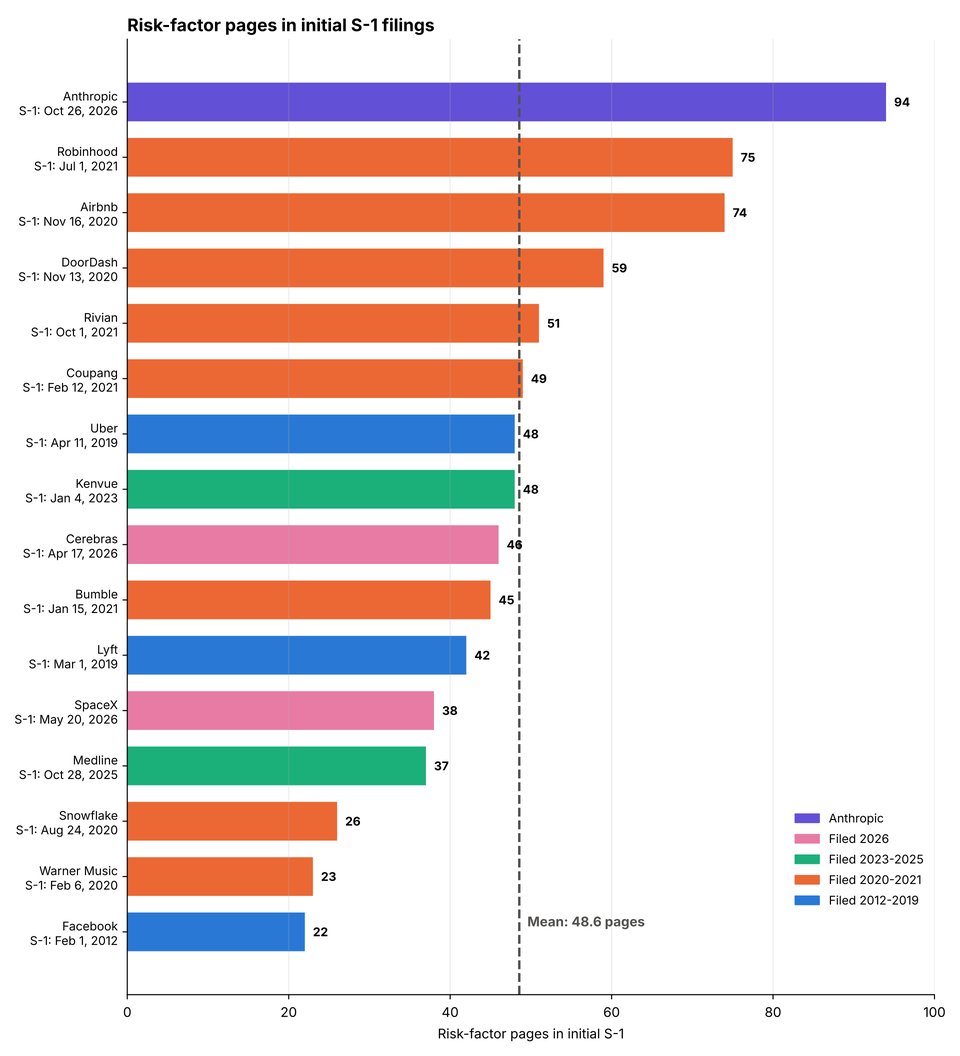
Anthropic’s S-1 contains one of the most extensive risk-factor sections footnoted has seen in a major US IPO. The company devotes 93 pages to risks, nearly twice the average for large US listings and well above recent IPOs such as Cerebras and SpaceX. The section has also grown materially from the 78 pages disclosed in Anthropic’s July filing. Several individual risks run for multiple pages, including constraints on compute availability and the possibility of models behaving in unintended, misaligned or autonomous ways. footnoted cautions that their comparison is not exhaustive across every S-1 filed since 2001 (when the SEC’s electronic repository of historical filings began), but among major IPOs over the past two decades, Anthropic stands out clearly for the scale of its risk disclosure.
Technology
SITM is approaching an important competitive inflection as its MEMS timing products increasingly meet the low-jitter requirements of high-speed AI networking, while retaining advantages in stability, programmable frequency control and integration. Rosenblatt expects a clean beat-and-raise quarter, forecasting Sep/Dec revenue of $300m/$325m, while seeing substantial operating leverage as the business scales: every additional $50m of revenue adds ~$0.90-1.00 to FY28 EPS and each 100bps of operating-margin expansion adds ~$0.50. With consensus assuming only ~31% incremental EBIT margins, Rosenblatt sees room for further earnings upside. Yet the stock trades broadly in line with premium semiconductor peers despite stronger growth (forecasts sustainable 20-25% long-term revenue growth) and superior gross margins. TP $750 (50% upside).
Asia
Indonesia: Good companies at bargain prices
The substantial de-rating of some of Indonesia’s best businesses, alongside low inflation and a depressed real effective exchange rate, has created a rare opportunity to buy market leadership, strong management and growth at attractive valuations. David Scott’s top picks are Bank Central Asia, Cisarua Mountain Dairy, Multi Bintang Indonesia, Sumber Alfaria Trijaya and Kalbe Farma. BBCA combines strong organic growth in an underbanked economy with improving efficiency and now trades at just 10.7x P/E. CMRY offers strong dairy and packaged-food brands, direct distribution and 30%+ ROE, while MLBI combines the iconic Bintang franchise with pricing power and high cash generation. AMRT’s dense Alfamart network and procurement scale underpin further store and online growth, while KLBF offers diversified healthcare exposure, broad distribution and established local brands.
EM Telcos: A rare buying opportunity
Communications
Higher inflation driven by the war in Iran has turned what were macro tailwinds for EM telcos into headwinds. But most of what the market is worrying about is noise, the fundamentals have never been stronger and history says not to wait for the macro to turn: after Ukraine, the sector bottomed a year before bond yields peaked. Sentiment is at a low and the market is about to be reminded of how good the fundamentals are via Q3 results. New Street believes this is the best buying opportunity investors are likely to see in EM Telcos for some time.
China Advertising: AI widens the platform divide
Technology
86Research's latest channel checks sees them turn more cautious on China’s advertising outlook but more constructive on Tencent’s relative position. Ad growth fell short of expectations in Q3 and disappointing Double 11 demand points to further moderation, with 2027 likely to slow again as spending in AI products, smart devices and AIGC content normalises. At the same time, advertisers are shifting from headline GMV towards net transactions and measurable ROI, favouring platforms with stronger AI targeting, attribution and commerce integration. Tencent should benefit from deeper Alibaba integration, ADQ 3.0 and remaining Video Accounts traffic headroom, while Douyin remains strongest in end-to-end execution. Xiaohongshu and Bilibili also screen well, whereas Kuaishou, Baidu and Weibo face greater pressure. GEO adoption is accelerating, but near-term AI monetisation looks more likely to come through better ad efficiency than new chatbot advertising revenue.
SK Hynix: The memory leopard will not change its spots
Technology
SK Hynix delivered an excellent Q3 and the near-term outlook remains exceptionally strong, with memory prices up 25%+ Q/Q and the company already sold out for 2027. DRAM demand next year is expected to grow faster than industry supply, while pricing should continue rising, setting up further strong revenue and profit growth; Richard Windsor suspects SK Hynix may even be lowballing its 2027 outlook. Where he disagrees is with the industry’s claim that memory cyclicality is over. Gross margins across memory are already around 86%, and while long-term agreements now cover 50% of SK Hynix’s 2027/28 production, Richard doubts they will prevent a price crash once supply eventually exceeds demand. AI-driven memory demand should keep that risk at bay for now, leaving the 12-month outlook excellent, but he sees 2028 as the point when the cycle could begin to turn.
Developed Markets
An AI credit crunch?
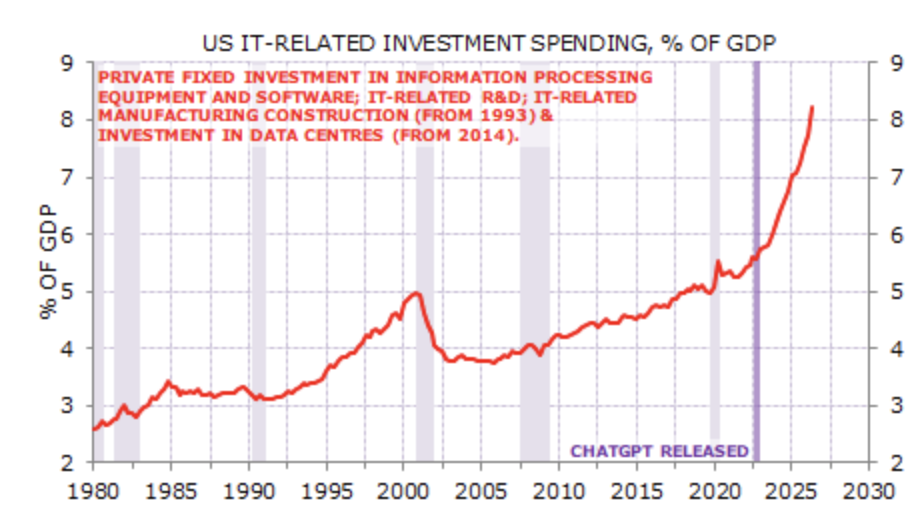
Investors worry whether sufficient capital exists to fund ambitious AI infrastructure, but Ed Yardeni comments that market-driven tightening remains healthy for the boom, resulting in more efficient capital allocation and reducing over-investment risks. Meta’s negative free cash flow of USD$2.1bn and raised 2026 capex guidance of USD$135bn to USD$145bn triggered fears that hyperscalers are racing to secure financing before competitors absorb available funds. Broadcom CEO Hock Tan warned that capital could become the biggest constraint on AI development, while BlackRock CEO Larry Fink called competition for financing the fiercest of his career. Markets rotated accordingly, sending SOXX down 6.8% and the 10-year Treasury yield below 5.00%. Nevertheless, Ed remarks that key players will retain financing access; the five major hyperscalers alone will spend nearly USD$780bn in 2026, with outlays exceeding USD$1trn annually through 2030, supported by formidable cash flows, balance sheets and market access.
Updating the AI investment bear case
Gerard Minack argues that the investment bear case for AI is simple: profits from selling AI services will generate a poor return on invested capital. History shows that big investment booms end in a bust, while companies that grow their assets quickly almost always underperform. Hyperscalers face sell-side forecasts of USD$2.2trn in capex over the next two years. Assuming a 10% depreciation rate, annual profit must rise by USD$352bn to achieve a 10% return on invested capital, or by USD$529bn to match their current 20% ROIC. In short, profits need to double just to deliver a dilutive 10% ROIC. Meanwhile, Chinese competitors offer reasonable products at cut-throat prices as users migrate to open-weight models. Gerard notes that confidence in disappointing fundamental returns is growing, but timing a peak is not. Perhaps AI ends with a whimper rather than a bang, as in relative terms AI stocks have gone nowhere for a year.
The biggest consensus trade
David Woo warns that the balance of risks points to further downside for the AI trade, and thus for US rates and likely also for the USD. Systematic, fundamental, and multi-strategy hedge funds have built an identical, crowded long Nasdaq against short S&P 500 position that backfired sharply, resulting in their worst day since the COVID shock. Last week’s price action reinforces his conviction that hyperscalers can no longer take investors’ willingness to finance rising AI-related capex for granted, with credit default swaps on CoreWeave and Alphabet hitting new highs while Anthropic faces squeezed profit margins. David continues to target the July low on the Nasdaq 100, realising only last week to what extent he sits on the opposite side of the hedge fund community. He remains long oil and short AI, holding his December WTI call spread up to the 105 strike.
Increasing reliance on the collateral multiplier
Michael Howell says global liquidity continues to slip, with the latest flash estimates putting it at USD$196.1tr, down from the recent peak of USD$196.6tr. He notes that the Shadow Monetary Base has contracted to a 17-month low of USD$106.9tr, USD$5.4tr below its late-February peak, as growth rates point to a persistent loss of momentum. As a result, the collateral multiplier has reached a record high of 1.84, which Michael says underscores an increasingly fragile liquidity environment that relies heavily on leverage, while collateral haircuts have yet to adjust to bond volatility. In his view, downward pressures are building through US dollar strength, weaker collateral values, flat Fed liquidity and quantitative tightening at the ECB, Bank of England and Bank of Japan. As nominal liquidity falls, he adds, institutional investors are rotating away from global risk assets, cutting exposure across major markets and emerging Asian equities while selectively adding to Latin America.
Expansion, no recession
Global trade growth rates provide a reliable proxy for cyclical momentum, and AAS Economics argues that monetary fundamentals continue to support world trade expansion across major economies with no recessionary clouds on the horizon. Fluctuations in money supply drive import cycles, yet national trends are diverging sharply. Annual US import growth reached 22.2%, but monetary momentum points towards slowing economic growth from the first quarter of 2027. Eurozone imports face flat growth after running at 9.2%, while Chinese imports, currently up 31%, risk a near-term pullback as their leading money supply index flattens. Conversely, Japan stands out as annual import growth hits 18.9%; despite Bank of Japan tightening, its steep monetary profile should sustain momentum into 2027 following a temporary pause. Across the World 4 grouping, current over-extended acceleration suggests a short-term reversionary pause before broader expansion resumes through late 2027.
UK budget sparring
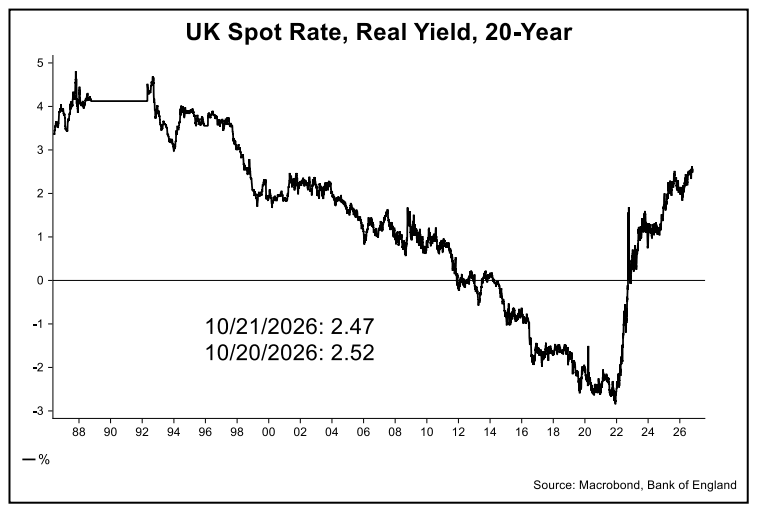
Shadow boxing ahead of next Wednesday's House of Commons budget statement has commenced, with prime minister Andy Burnham pointing to the September 2022 gilt crisis whilst sovereign borrowing costs jump. Graham Turner observes that the UK 20-year index-linked yield touched 2.63% on 7 October, climbing 134 bps since July 2024, far outpacing a 103 bps rise in comparable US Treasuries. Welfare spending remains critical to how far real yields climb: whilst long-term sick figures dropped to 2.74m, benefit growth continues to outstrip total tax receipts. Graham warns that with headline inflation accelerating towards 5.0% by early 2027 and net government debt touching a record 90.7% of GDP, the gap between revenues and outlays risks reversing, causing PSNB-ex to widen sharply. Although technology hiring helped 3m/3m GDP growth reach 0.7%, higher national insurance contributions and minimum wages are disproportionately hammering small-business vacancies.
UK: Carry cushion masks structural cracks
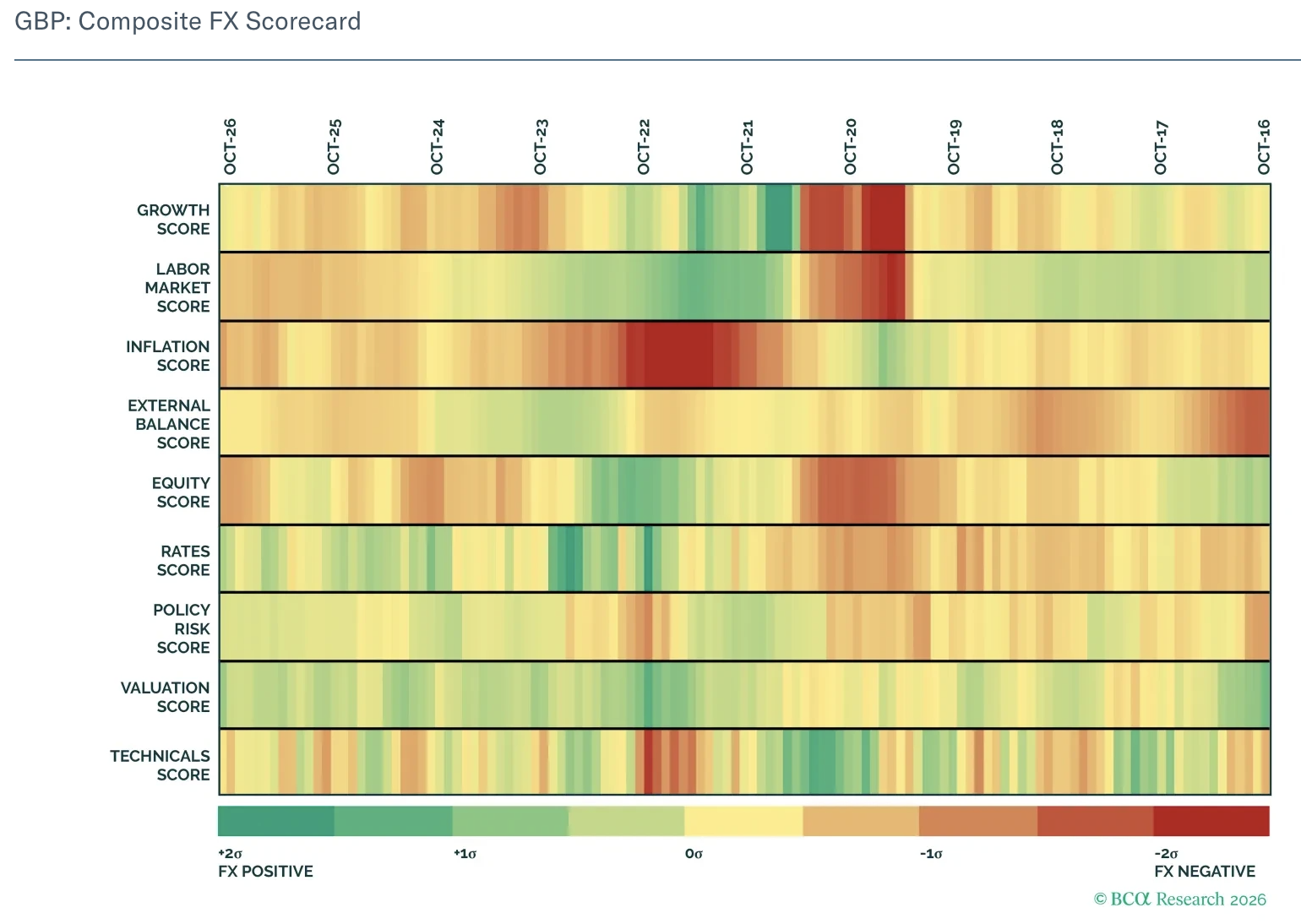
Elevated UK rates remain supportive of the pound in the near term, bolstered by an attractive yield advantage over G10 peers and market credence in a more hawkish BoE stance. Over a 12-month horizon, however, aggressive market pricing of nearly four rate hikes is more likely to become a headwind, as policymakers are unlikely to deliver given already restrictive rates and lingering downside risks to growth. Slack continues accumulating in the labour market, consumer spending remains soft, and economic expansion tracks below potential. Longer term, sterling is trapped without a clear catalyst: the currency appears expensive on a trade-weighted basis, competitiveness is eroding amid lagging productivity, and the UK maintains the weakest basic balance among major economies. This leaves the pound reliant on volatile portfolio inflows and acutely exposed during external shocks, ensuring that fiscal drag and elevated political uncertainty will prevent durable recovery.
France: Le Pen’s risky election strategy
Wolfgang Münchau points out that Marine Le Pen has been a presidential candidate in four elections. In all polls she is leading by a wide margin. Her campaign has switched from attacking opponents, except President Macron (who cannot stand again), to a message of unity. She hopes to enlarge her voter base towards the centre. In Orléans she promised a peaceful France, one of national unity and a pluralist government. She left it to Jordan Bardella, her designated prime minister, to react to the violent street protests. The Rassemblement National is a party of order and authority. However, Wolfgang notes that Le Pen's strategy carries risks that prompts him to be cautious about the outcome of the French presidential elections. One such risk is the political effect of a financial crisis ahead of the elections. She still lacks a convincing economic strategy - as she is betting the house on focusing more on blame-games than concrete solutions to problems.
France: The bullish case for French debt
Marchel Alexandrovich argues that France’s fundamentals remain far stronger than those of peripheral sovereigns prior to the GFC, dismissing debt restructuring or redenomination as non-credible risks. While repricing in yields puts French debt interest payments on course to reach €130bn by 2030, rising from 2.4% of GDP to 3.8% alongside a 5% budget deficit, Marchel expects pragmatism to trump populism regardless of presidential election results. Crucially, French debt retains an unlimited buyer of last resort in the ECB, which commands far more firepower than markets and can deploy PEPP reinvestments, structural LTROs, or the Transmission Protection Instrument to counter unwarranted volatility. Furthermore, domestic banks and insurance companies possess massive headroom to absorb local supply, echoing the broader European banking system absorbing nearly €40bn in September sovereign debt. As a speculative punt, one can bet on further spread widening.
US: Democrats to sweep congress
Forecasts position Democrats as 90% or greater favourites to flip the House, with the median projection indicating a majority between 20 and 25 seats. Outside spending confirms this expanding battlefield, pushing into double-digit Republican districts across Minnesota, Nebraska, and Virginia while conservative groups shift to defence. In the Senate, Democrats maintain odds between 65% and 75% to take control, an outcome requiring a net four-seat gain from 35 contests. North Carolina is practically assured at a 95.7% flip probability, while Maine at 71.2% and Texas at 70.8% show Democratic nominees leading. A surging Black southern electorate has placed South Carolina and Mississippi into play, contrasting with low single-digit baseline odds. Retaining the lower chamber demands a historic, correlated polling error running below 10% probability, leaving Republicans relying almost entirely on survey error as their primary out on Election Night.
Emerging Markets
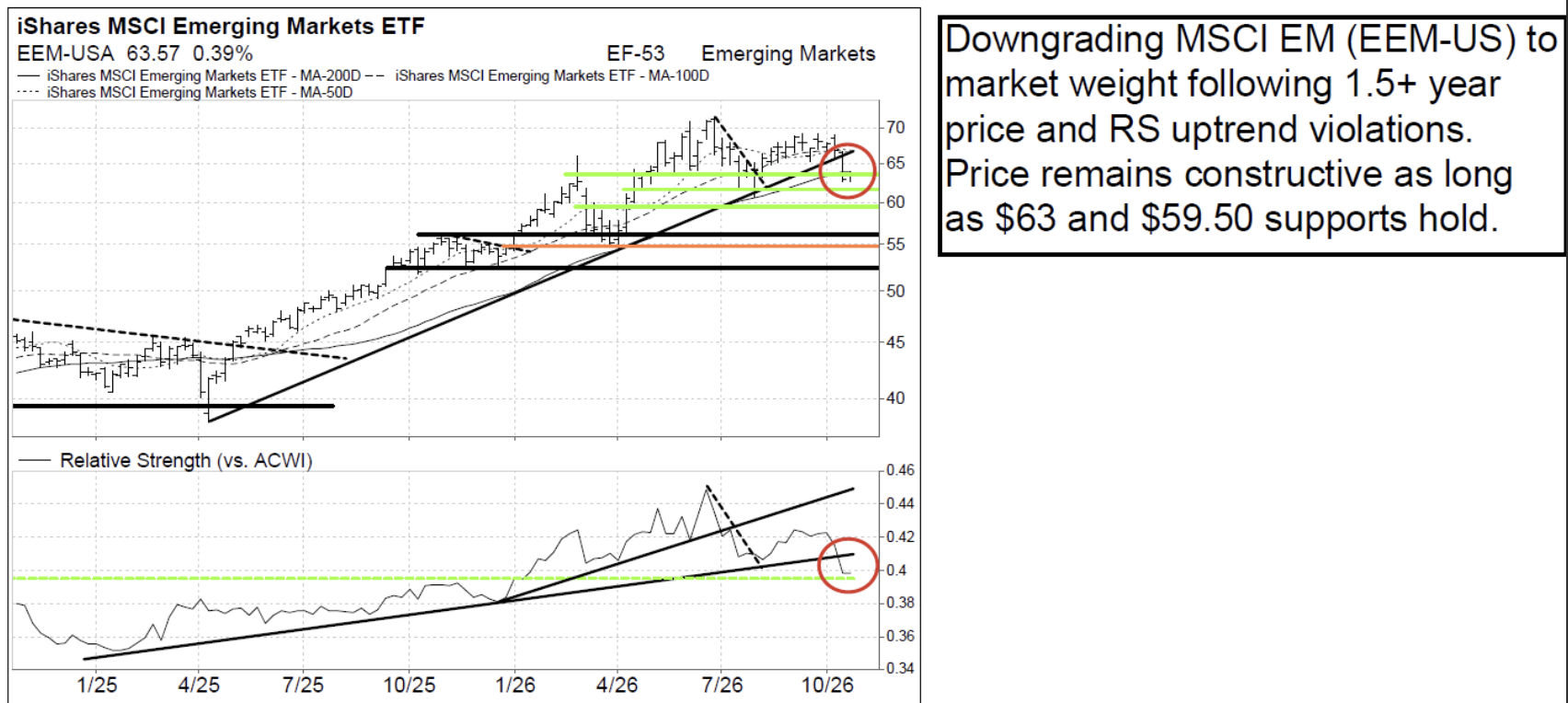
Downgrading EM
After being overweight since mid-January 2026, Ross LaDuke is downgrading emerging markets (MSCI EM vs. MSCI ACWI) to market weight (as of our October 19, 2026 ETF Pathfinder). He is also downgrading EM relative to EAFE to market weight, after being overweight since August 4th, 2025. The 1.5+ year price uptrend on MSCI EM (EEM-US) is being violated, and the 1.5+ year RS uptrends on the EM vs. ACWI and EM vs. EAFE ratios are being violated as well. From a price perspective Ross is no longer near-term bullish on EEM-US following its break below $63.00, though he remains intermediate-term bullish as long as EEM-US holds above $59.50. As discussed since early-July, his primary focus continues to be on non-A.I. areas. In the Emerging Markets preferred countries include Mexico, Colombia, Poland, Romania and Greece. Favorite EM sectors continue to be MSCI EM Energy and Financials, though Health Care, Utilities and Consumer Staples are also attractive.
Brazil: Darkest before the dawn
Brazilian risk assets face extreme pressure following the surprise fourth election of President Luiz Inácio Lula da Silva, yet Niall Ferguson views the violent selloff as an overcorrection from an unwinding crowded trade. Although the local yield curve closed 255bps higher, the BRL depreciated 8%, and the Ibovespa dropped 14%, Niall sees no structural risks to Brazil's financial system. While the market prices in 200bps of rate hikes next year to 15.75%, he finds rates expectations out of line with the activity outlook. Grounded in the conviction that Lula is obsessed with his legacy and will do whatever it takes to protect it, including fiscal reform, the administration is expected to appoint ministers who support fiscal adjustment. Greenmantle is re-entering its long-duration trade via the long end of the nominal yield curve and maintaining its BRL exposure.
Chile: A hawkish feint
Revisiting the “Maradonian strategy” that Igal Magendo has discussed in previous reports, the communiqué amounts to a hawkish feint: it adopts a tougher tone in response to higher inflation risks without necessarily signalling imminent policy action. Indeed, the October communiqué conveys a shift in the balance of risks surrounding the policy rate. Following the previous meeting, the Board had communicated a relatively balanced assessment of weak domestic activity and upside pressures stemming from oil prices, with a slightly dovish tone. Inflation concerns now take centre stage. Weak economic activity persists but has become secondary to inflation dynamics. Nevertheless, the communiqué does not alter Igal’s baseline scenario of an unchanged policy rate. At the margin, the probability of a hike has increased relative to that of a cut, but the bar for policy action remains high in both directions.
China: All you need is a global yuan?
The RMB internationalisation drumbeat is getting louder and Zhu Min argues that China and the rest of the world both need RMB internationalisation. Zhu calls on China to expand RMB pricing and settlement in commodity imports and trade with Global South partners, promote RMB payments and financing within China-led supply chains, and deepen onshore and offshore RMB bond and derivatives markets. Noticeably, he calls only to further improve the capital management framework, with no mention of convertibility. Zhu has been explicit on this point before, calling it a mistake to believe the currency cannot internationalise without a fully open capital account. That stance aligns with Beijing's preference for expanding the currency's global footprint without relinquishing control over capital flows; however, leverage does not necessarily translate into sustained foreign demand for Chinese assets whilst capital controls constrain entry and exit.
Indonesia: A value trap
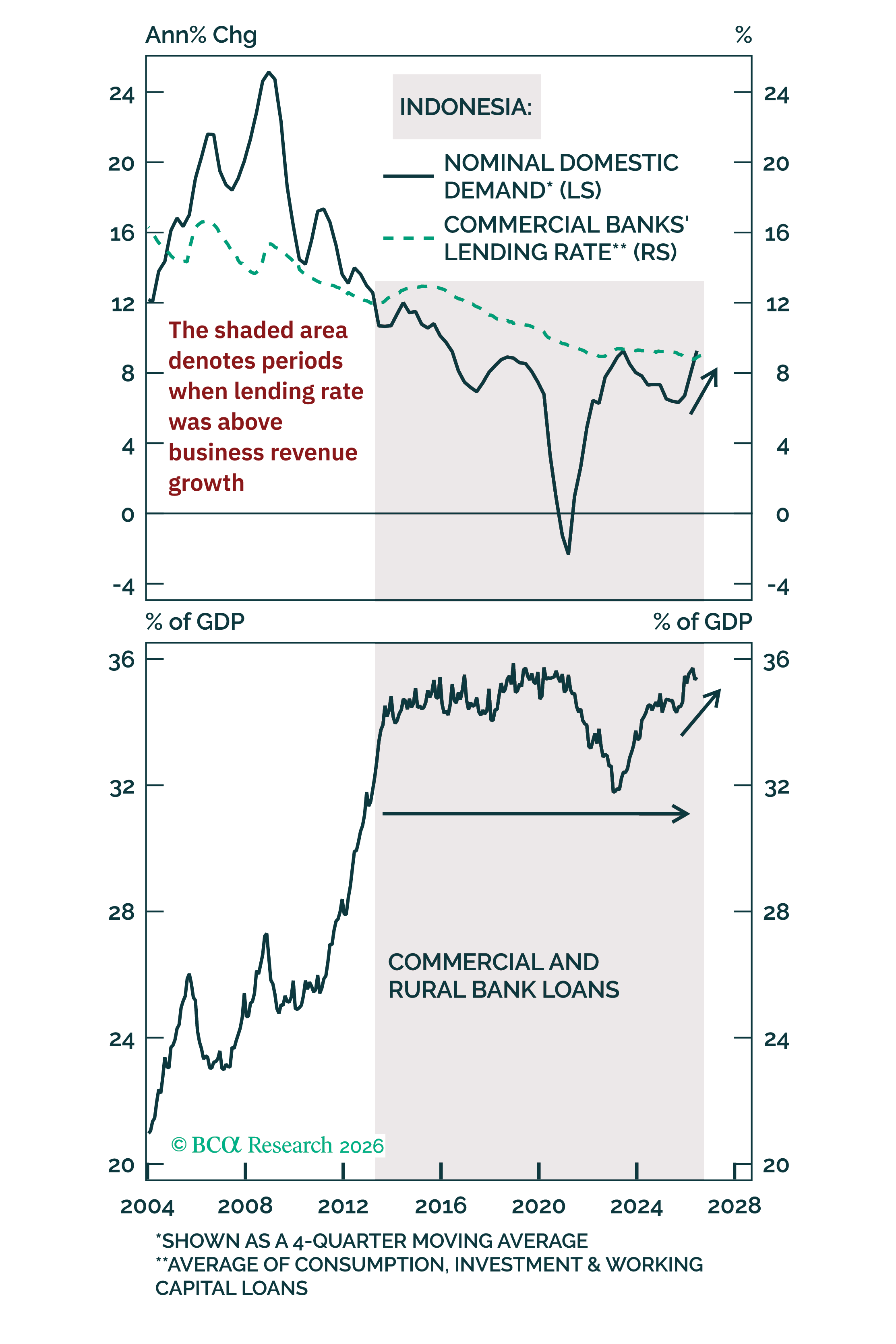
President Prabowo’s state-directed economic push will deliver higher inflation rather than real expansion, cementing the view that domestic financial markets remain an outright value trap. Unorthodox fiscal spending and off-budget credit programmes through state-owned enterprises will accelerate nominal domestic demand past borrowing costs without expanding productive potential. Inadequate infrastructure and lagging manufacturing capacity will redirect this state-led investment surge into imports, widening the external funding gap to 2% of GDP, or USD$43bn, whilst Bank Indonesia falls behind the inflation curve through tacit liquidity easing. With real interest rates falling, shrinking corporate margins, and looming credit losses, capital flight will accelerate. Stay underweight equities, local bonds, and sovereign credit relative to EM benchmarks. Maintain outright shorts in local currency bonds alongside short positions in the rupiah against a basket of the yen and euro.
South Africa debt: More room on the way down
South Africa’s medium-term budget policy statement redrew the fiscal path, with an updated debt sustainability analysis showing gross debt falling faster to 64.1% of GDP by 2040/41, down from 74.6% in 2025/26. Peter Montalto argues that structural revenue strength, rather than temporary windfall gains, fundamentally lifts the primary surplus trajectory. Although GDP rebasing expanded the economy 5% overnight and improved optics, no debt was repaid and interest continues absorbing roughly 21c of every rand of revenue. Over the long run, the primary surplus required to stabilise debt falls towards 1% through the 2030s and 0.7% by 2050, creating room to loosen fiscal policy marginally after dealing with state-owned enterprise risks. National Treasury is deploying cash buffers alongside a new ZAR50bn bond buyback programme, repurchasing ZAR42bn of R2030 bonds below par to reduce the 2029/30 redemption wall from ZAR300bn to ZAR260bn.
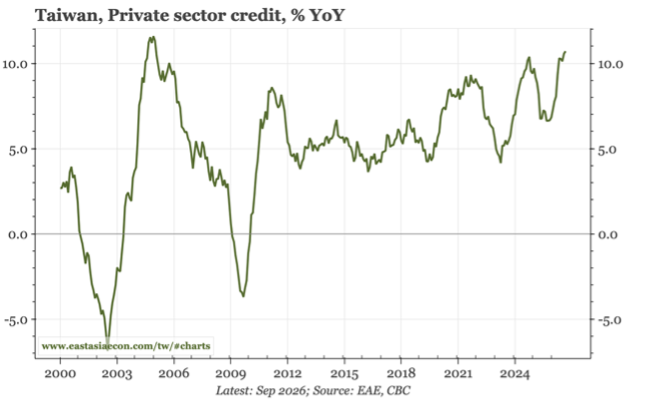
Taiwan: Strong monetary data, but no trigger for higher interest rates
Paul Cavey says the money and credit data for September, like other indicators for Taiwan, are quite strong, but not high enough on their own to think that they suddenly break the central bank’s apparently strong desire not to change policy. M2 growth ticked up in September to 7.2% YoY, from 6.8% in August. That keeps growth above the CBC's "policy guideline" range of 2.5-6.5%. Apart from the central bank’s seeming desire to not have to tighten, the direct implications of these data for monetary policy are dampened by three factors: strong growth in the economy; private sector credit growth dipping in September; and growth in consumer loans, other than mortgages, slowing sharply in September. So, while the monetary data are firm, they are unlikely to be enough for the CBC suddenly to become hawkish. That, in turn, will limit the reaction in rates, and means global sentiment towards AI will remain the only real factor in Taiwan markets.
Commodities
AI-linked platinum demand grows despite price volatility
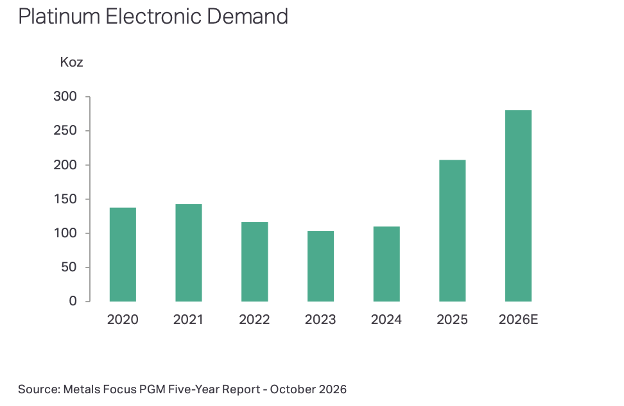
The platinum market has experienced substantial volatility in 2026, with prices swinging between USD$2,992 and USD$1,535 before settling near USD$1,650. While elevated prices and vehicle electrification create structural pressure on jewellery and automotive consumption, Metals Focus projects industrial demand to rise 8.0% y/y in 2026. This expansion signals a gradual transition in the platinum demand narrative, shifting from the exhaust aftertreatment automotive cycle towards a high-end manufacturing and computing infrastructure cycle. Surging AI demand has created an acute shortage of high-capacity enterprise HDDs, where platinum sputtering targets are used in thermally assisted magnetic recording. In optical communications, platinum crucibles remain critical consumables in crystal-pulling for co-packaged optics and high-speed optical modules, whilst platinum-rhodium bushings ensure dimensional stability for high-layer-count PCB fibreglass. Whether this investment translates into sustained consumption will depend on new capacity additions and replacement cycles.
Bitcoin trend model has turned bearish
Markus Thielen observes that Bitcoin has (briefly) slipped below $80,000, but the price move is only part of the story. Over the past week, something has shifted across almost every corner of the market he tracks. In the options market, large traders made a decisive move on one day and have been repositioning ever since; the strikes and expiries they chose say a lot about what they expect next. Markus says his Bitcoin trend model has turned bearish. Fewer people are trading, money is leaving stablecoins, and investors are selling their biggest winners and moving into safer coins. Options traders are buying protection against further declines over the next one to two months, but they are not panicking. He sees this as a pause in a bigger bull market, not the end of it. Markus says that the best move now is to take profits, hold more stablecoins, and wait for the next buy signal rather than bet on a crash.
What next for the gold:silver ratio?
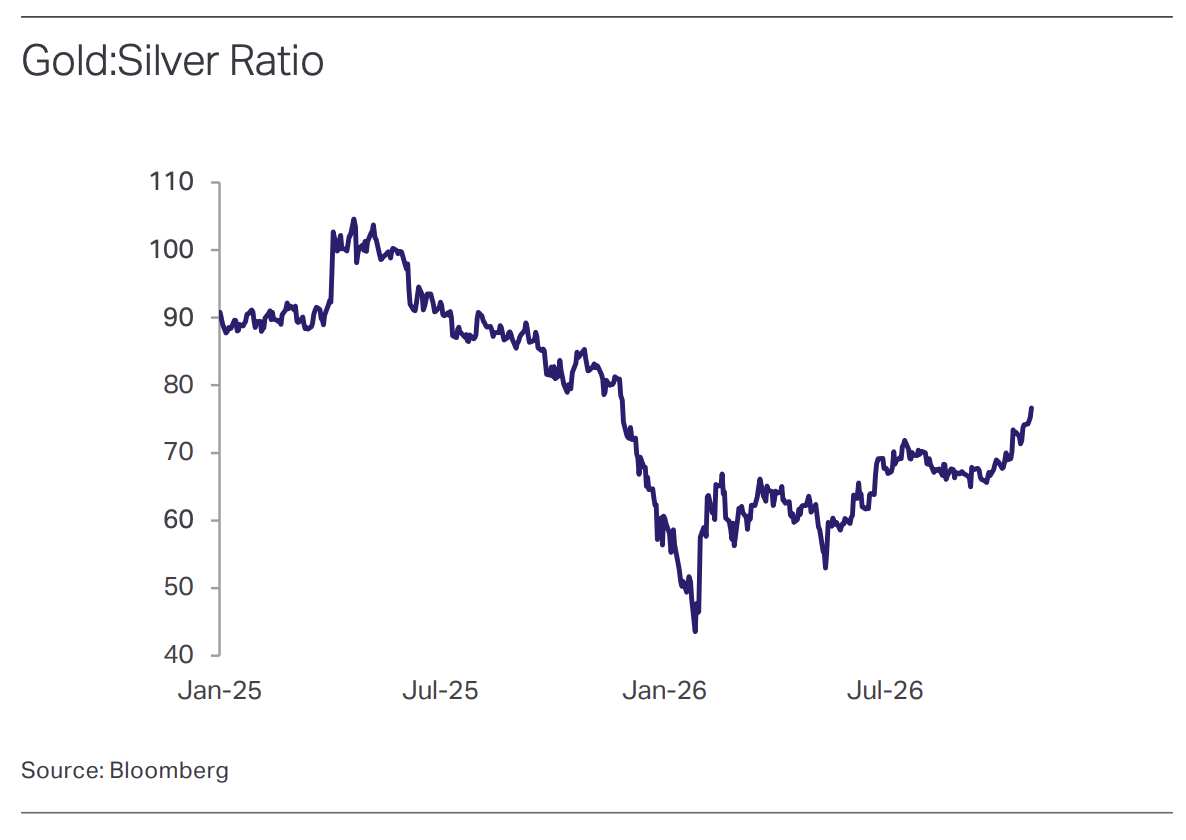
Silver continues to underperform gold as easing physical tightness and hawkish monetary headwinds remove the earlier squeeze dynamics. Metals Focus analysts project that the gold:silver ratio, now above 76 after holding between 60 and 70 from June to September, faces further upward pressure over the next twelve months. While gold found firm support around USD$4,000 through official sector and long-term safe-haven buying, silver slid to successive year-to-date lows in the low USD$50s. London vault inventories rebounded to a nearly four-year high of 932Moz, with free-float stocks almost doubling to 267Moz alongside 60Moz of net ETP liquidations. With coin sales plunging by over 80% q/q in Q2 and photovoltaic thrifting eroding industrial fabrication, the silver market deficit will narrow this year ahead of a projected surplus next year. Precious metals face sustained near-term pressure, though silver could outperform once markets scale back aggressive 2027 monetary tightening expectations.
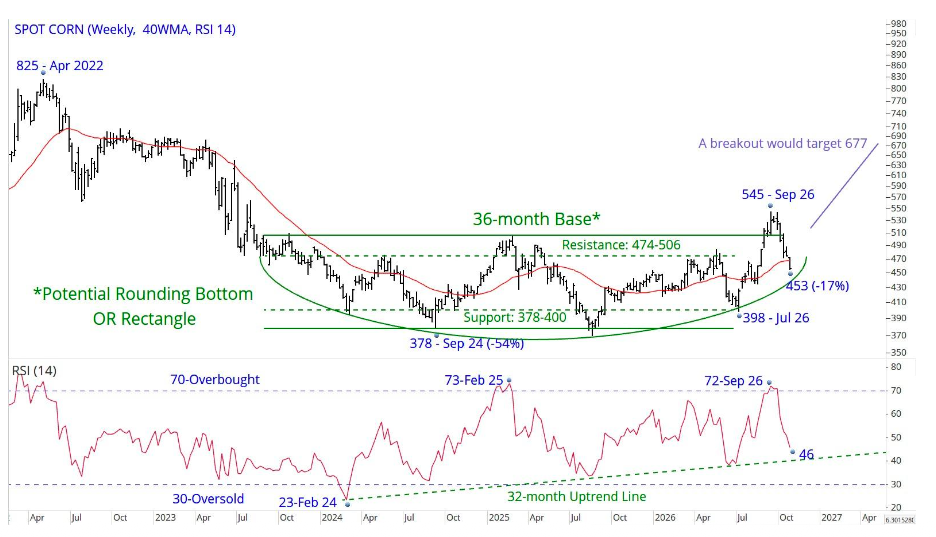
Corny trends
Chris Roberts believes another cyclical advance is underway in spot corn towards the USD$7.00-8.50 resistance zone, following a period in which the market based and tested the broad USD$3.00-4.00 support area between February 2024 and September 2025. Two major ranges have dominated the past fifty years of trading, with the current USD$3.00-8.50 corridor holding firm since 2007. Although the weekly chart showed a failed breakout from a three-year rounding bottom formation after prices reached USD$5.45 in September, the downside appears limited near pattern support, despite a 17% drop to recent lows of USD$4.53. A renewed, sustained breakout targets USD$6.77 and opens a path towards testing the 19-year ceiling at USD$7.00-8.50, before secular commodity strength could potentially unlock USD$14.00-17.00 targets. Chris remains on the sidelines for now, but will consider buying a new daily chart uptrend.