Europe
Greece: From bailout to breakout
If AIR had to pick one European country for growth prospects through 2030, it would be Greece. The Iran war is redrawing South-Eastern Europe’s economic map, with Greece increasingly central to the region. Cyprus is emerging as a financial hub as the UAE–India–Cyprus corridor develops, while Bulgaria’s entry into the Eurozone is creating opportunities for Greek companies already established there, including Eurobank, PPC and Jumbo. Domestically, GDP is on track for ~3% growth in 2026 and nine Greek companies entered the STOXX Europe 600 last September. Strong banking institutions, competitive labour costs, substantial refining capacity and export links into the Balkans, Turkey, India and the Near East add to the case, while a 3.6% primary budget surplus and major projects such as Elliniko and the Athens airport expansion provide further support.
Energy
VPK delivered another strong quarter and raised FY26 guidance, with proportional EBITDA now expected at €1.20-1.22bn and operating FCF at ~€840m. the IDEA! sees the quality of delivery as particularly strong: 9M EBITDA rose 5% on an adjusted basis, cash conversion improved to ~74%, and Q3 operating FCF hit a record €227m. Visibility into 2027 is also improving as contracted growth projects come online, including the fourth LNG tank at Gate (Netherlands) and REEF Phase 1 (Canada). At the same time, leverage remains within target and cash generation is supporting both investment and shareholder returns, including a multi-year buyback and semi-annual dividends. With a ~12% proportional FCF yield, the IDEA! sees the investment case as increasingly well supported.
Healthcare
There are grounds for renewed optimism under CEO Luke Miels, with the group finally having a clearer strategy for replacing the looming HIV patent cliff. Oncology is central to the turnaround, with Blenrep, Ojjaara, Jemperli and recently acquired assets such as Jideytro and neladalkib giving GSK a much stronger cancer pipeline. Improving R&D execution and recent acquisitions make the £40bn 2031 sales target look increasingly credible, while GSK trades at only ~11x 2026E P/E vs. ~18x for Big Pharma peers. AlphaValue also sees M&A optionality: an AstraZeneca takeover of GSK could be a win-win, while acquiring Genmab could deepen oncology exposure and ease patent-cliff concerns, although GMAB’s >150% five-month rally and ~42x P/E make patience advisable. More broadly, AlphaValue sees echoes of AZN in 2012/13: a patent cliff, a cancer-led turnaround and a valuation still reflecting market scepticism.
Industrials
Following analysis of the company’s FY25 registration document, Iron Blue increases their SGO score to 28/60 (top quartile and fertile grounds for shorting). This principally reflects: 1) FY25’s P&L benefit from compression in the expense for inventory and bad debtor impairment provisions, which could provide a tough comp effect in FY26. 2) FY25 saw deterioration in SGO’s health & safety performance and an increase in SpeakUp whistleblower alerts. 3) SGO seems to have reduced disclosure of its goodwill impairment test calculation assumptions. Iron Blue continues to flag sustained stripped out costs.
Technology
CAP delivered better-than-expected Q3 growth, outperforming most large IT services peers and prompting management to raise FY26 revenue guidance while maintaining margin and FCF targets. Growth was led by Strategy & Transformation and Intelligent Business Operations, with improving momentum in France and continued strength in the UK and North America. GR20 sees accelerating enterprise-wide AI adoption as a major structural tailwind and believes CAP has the right strategy to capture the opportunity, much as it did during earlier digital transformation and cloud adoption cycles following the GFC and Covid crisis. Alongside Accenture, TCS, Cognizant and Infosys, they see CAP as one of the best-positioned global IT services players for enterprise AI. Despite a 25% share-price rise over 6 months, the shares trade at 8.3x/7.6x 2026/27E EV/adjusted EBIT.
North America
Stock Picking: #1 ranking for 65 consecutive months
New Constructs has extended their run to 65 straight months with at least one category ranked #1 on SumZero. They currently rank first in Consumer Discretionary, second in Industrials and Energy, and hold top 10 positions in Large Caps, Value, Long, Healthcare and Micro Caps. They attribute this track record to their proprietary Robo-Analyst AI, which analyses financial-statement footnotes and MD&A disclosures to calculate Core Earnings, which they argue is a superior measure of earnings. The performance evidence also extends beyond the rankings: since Jan 2021, New Constructs’ Focus List Long portfolio has outperformed the S&P 500 by 12%, while their Short portfolio has outperformed shorting the index by 57%. Bloomberg indices built around New Constructs’ research have also beaten the S&P 500 over the past five years, including the Core Earnings Leaders Index by 37%.
Consumer Discretionary
The company has turned the corner under CEO Mary Ellen Coyne, with cleaner assortments, more colour and print, improved denim and a more modern look helping drive better store traffic and sales after a weak Q1. The key is that the changes appear to be broadening the customer base without alienating the core shopper: younger customers are being retained at higher levels, spending more per visit and returning more frequently. Marketing remains underdeveloped, creating further upside if improved product is matched with stronger customer acquisition, while the store base is already relatively lean at 255 locations. The shares are up 66% YTD following the Q2 improvement, but The Retail Tracker believes successful execution could support further upside.
Healthcare
BMY’s patent-cliff concerns are masking an improving growth portfolio and a tangible AI opportunity. Newer drugs already contribute more than half of group revenue, while legacy products are proving more resilient than feared: Eliquis sales rose 22% in Q2 and BMY raised its 2026 growth outlook to 20-25%. At the same time, the company is deploying AI through its “Predict First” approach to identify viable drug candidates earlier, improve clinical-trial design and reduce development costs. Management believes AI could cut average trial timelines by as much as three years and toxicology study times by ~25%. KCR finds it remarkable that a life sciences company deploying concrete revenue-generating and cost-saving AI use-cases is trading at 10x earnings with nearly a 7% FCF Yield.
Healthcare
New CEO Julie Sawyer Montgomery is a strong fit to raise core growth and integrate DHR’s acquisitions. She inherits a company with improving underlying growth but continued pressure to accelerate performance and integrate the debt-financed Masimo acquisition. Paragon’s analysis includes interviews with former senior executives who worked with Montgomery for more than 30 years combined. Sources provided positive feedback. She is an intelligent, data-driven commercial leader with strong command of the Danaher Business System, a sharp customer focus, and a personable, low-ego style that builds followership. She sets demanding targets, develops talent, and holds managers accountable, though she can be directive and intimidating and has been slower to replace weak leaders as her responsibilities expanded.
Healthcare
INTerpath-001 at ESMO delivered statistically positive Phase III efficacy for V940 plus pembrolizumab, but Foveal’s detailed clinical review identifies several unresolved questions that could materially influence interpretation of the results and the programme's regulatory and commercial outlook. They believe the central debate extends beyond statistical significance to the robustness of the efficacy profile, confidence in sustained benefit, risk-benefit differentiation and the implications for eventual market adoption. These uncertainties matter for assessing V940's probability of regulatory success and the sales opportunity currently embedded in expectations.
LTL: Structural downgrade, not cyclical recovery
Industrials
Jay Van Sciver argues the industry’s long-running share-gain model is breaking down as excess capacity and tougher competition begin to pressure pricing. For years, premium valuations were supported by share gains from higher-cost unionised competitors and a pricing umbrella created by marginal capacity. With much of that capacity now removed and the share-gain opportunity largely exhausted, the competitive backdrop is becoming less favourable. The industry remains fragmented, price-transparent and relatively low growth, while carriers still have substantial excess capacity. Jay says recent volume growth is increasingly coming at the expense of operators trying to hold price, suggesting pricing discipline may be starting to break. If that continues, the pressure should shift from volumes to margins, challenging the premium valuations still attached to leading LTL names such as Old Dominion Freight Line, Saia and XPO.
Materials
BTN sees a growing disconnect between ECL’s premium valuation and the quality of its recent growth. Acquisitions added 5.9ppts to Q3 sales growth, while receivables continued to outpace revenue and DSOs rose 3.2 days from 4Q25, suggesting the underlying business may be relying increasingly on more favourable payment terms or customers buying ahead of price increases. Despite that support, ECL still missed Q3 revenue expectations by $5m and beat EPS by only 1 cent. BTN notes that the Y/Y reduction in bad debt expense alone was worth more than the EPS beat, while relatively modest sales pull-forward could also have bridged the gap. At ~39x forward adjusted EPS it leaves little room for disappointment.
AI panic debate
Technology
Richard Windsor believes the AI sell-off has gone too far because very little has changed fundamentally: demand remains strong, while the main new risk is a more hostile US political backdrop that could slow data-centre permitting. More delays and objections may stretch build-out timelines, but Richard sees this as a manageable problem and one that keeps AI compute scarce for longer. He still sees two bubbles: spot pricing for AI compute and the valuations of Anthropic and potentially OpenAI. With no clear defensible winner among AI models, the picks and shovels remain the lowest-risk part of the industry. The bigger risk is a liquidity crunch that restricts startup funding and materially slows AI usage. For now, Nvidia, memory, Qualcomm and GlobalFoundries are “on sale”, while Arm and Nebius also warrant a closer look.
Apple’s growing risk factors
Technology
There has been a notable expansion in AAPL’s 2026 risk disclosures, with the 10-K risk section around 2.5 pages longer than last year and AI emerging as a major new theme. The phrase “artificial intelligence” appears 55 times vs. 6 in 2025, while AAPL added a new ~600-word risk factor covering AI-related legal and regulatory uncertainty. Other sections were also expanded to flag constrained compute capacity, AI-enabled phishing and deepfakes, cybersecurity vulnerabilities and risks from third-party developers moving away from the App Store. Legal and regulatory disclosures also grew materially, alongside new tariff language. footnoted argues that AAPL rarely changes its SEC wording without reason, making the breadth of these additions particularly noteworthy.
Technology
UI delivered its first-ever $1bn+ revenue quarter, while gross margin reached 47.3%, its highest since FY21. Growth was led by enterprise technology, up 44.5% Y/Y, as new Wi-Fi 7 products and enterprise switches helped UI take share without the subscription requirements of many peers. Purchase obligations rose again to ~$1.8bn from $1.5bn in June, which Hamed Khorsand sees as a sign of continued demand strength rather than channel build, with inventory remaining relatively stable. He raises his FY27/FY28 revenue forecasts to just under $4.2bn/$4.6bn and EPS to $21.61/$23.73. Despite double-digit organic growth, ~38% operating margins and being debt free, UI trades at <28x FY27E EPS. 12-month TP $980 (45% upside).
Developed Markets
The AI story is weakening
Credit markets are increasingly signalling financial stress as CCC-rated high yield bonds sell off. AI infrastructure capex is projected to exceed US$1trn in 2027, whilst credit financing more than doubles from US$280bn in 2026 to US$594bn in 2027. Credit markets feel uncomfortable financing almost US$600bn of AI capex in 2027, emerging as a new restraint on AI. Konstantin Fominykh comments on the circular financing that is amplifying vulnerabilities across equity valuations, debt obligations and hyperscaler commitments, with Amazon, Oracle and Alphabet now spending more on capex than they generate from operations. Meanwhile, China AI companies are already in a bear market, and renewed US inflation keeps borrowing costs elevated alongside softening labour conditions. Konstantin holds a sell on the CCC-rated High Yield Corporate Bond ETF, Alphabet and Nvidia. Stay 40% in cash, allocating the rest across energy, materials, healthcare, Brazil, Australia, India and China as defensive and pro-inflationary sectors lead rotation.
AI must die
Brian McCarthy argues that persistent US inflation is driven by excessive aggregate demand rather than supply shocks, with nominal final sales running at a blistering 8.3% seasonally adjusted annual rate over Q2 and Q3. The root catalyst is the AI capex boom, which also fuels consumption through stock market wealth effects. Although Federal Reserve officials prefer blaming supply disruptions, Brian warns the central bank faces a classic late-cycle dilemma where aggregate spending will not slow unless monetary policy actively forces capitulation. While tightening financial conditions already bite into capital raising across the ecosystem, the boom is unlikely to collapse after a single rate increase. Instead, an injection of US$100bn via Anthropic’s initial public offering could temporarily stabilise conditions, prompting a December rate hike. Ultimately, more than US$1.2trn in 2027 hyperscaler capex cannot be permitted if the Fed is to retain institutional credibility.
Owning the market, missing the flood
Large asset owners are structurally underexposed to climate adaptation, leaving portfolios vulnerable as systemic physical shocks transmit through food prices and broader inflation, causing equities and bonds to fall together. Examining Norges Bank Investment Management as a benchmark-hugging universal owner reveals the structural blind spot: despite managing NOK 22,700bn across 7,077 companies, NBIM holds merely 1.3% of its fund in adaptation names, an incidental exposure skewed 40% into four industrial giants. Private adaptation finance languishes at roughly 0.5% of total climate finance because resilience pays in avoided losses rather than direct cash flows. Crucially, an adaptation sleeve will not provide direct shelter from an extreme-weather financial storm, carrying a downside beta above 1 with no significant loading on commodities or duration. Instead, institutional allocators should measure look-through exposure and fund a phased, driver-balanced adaptation sleeve within their risk budgets alongside separate physical protection.
Nudging back into oversold fundamentals
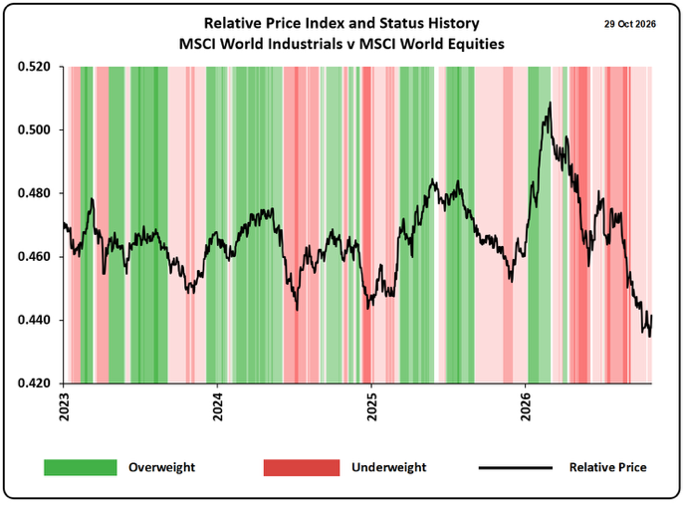
World Industrials have underperformed significantly since earlier this year, but now look much cheaper, are oversold, and have started to turn up. Relative price index deviations versus trend recently reached minus 2.5 standard deviations, leaving the sector more oversold on a relative basis than in 2008. Over the past 25 years, World Industrials have only been more oversold during the Covid 2020 turmoil. This persistent underperformance has rebuilt relative Value Yield back to high, attractive levels within its historical range. Although one would normally disregard short-term movements, this early sign of life carries genuine relevance following such an extreme washout. Tread carefully because it might just be noise, yet potentially this is a classic turning point. The quantitative model is at the early stage of nudging back into Industrials, a re-allocation set to continue so long as the recovery builds momentum. Abandon the trade if it proves a false dawn.
ESG: The fight against cultural Marxism
Stephen Soukup warns that Wall Street has engineered an inverted arrangement where financial elites direct political discourse, posing an existential threat to capital markets. Having captured mainstream religion, education, news media, and entertainment, the political Left targeted business as the last holdout institution, using ESG and stakeholderism to finish the job and take ideological control. Stephen explains that the transformation of Wall Street was the product of a long, careful march through institutions, convincing titans of capitalism that cultural surrender was their only morally legitimate path. While early proxy battles sought to push companies back to neutral, this pernicious dimension entrenched itself across banking channels. Recent regulatory findings confirm lenders actively restricted credit to oil and gas exploration, coal mining, firearms, and digital assets, weaponising advocacy blacklists to debank traditional organisations under the guise of reputational risk. The spear has been blunted, but not broken, and the work started in that room is far from finished.
UK: 99 problems but breakup ain’t one!
Talk of British civil war is vastly overdone, and the UK is unlikely to break into three different countries over the coming decade. In a lengthy report, Matt Gertken argues that while the country struggles to meet its basic geopolitical imperatives, the geopolitical floor will hold firm, creating a durable basis for economic and social stabilisation. The burden of proof lies on those forecasting extensive breakdown: murder rates sit at their lowest levels since 1977, real median household disposable income continues to expand across lower income brackets, and the nationalist legislative vote remains capped below 40%. Prime Minister Andy Burnham commands 404 seats in the House of Commons with no election due until August 2029, securing ample political leeway to enact painful fiscal consolidation. Matt notes that secession remains economically irrational for Edinburgh, with 60% of Scottish exports tethered to the UK, while rejoining the EU remains a viable path to preserve the union. Bet on the union holding intact.
Germany and Taiwan: A tale of two countries
Wolfgang Münchau notes that Jensen Huang observed on a recent visit to Germany that whomever he met only wanted to talk about AI regulation; the delusion that Germany would be an early industrial beneficiary of AI has widely disappeared, aided by Berlin supporting EU anti-AI rules. Taiwan sits on the opposite end of the scale, reporting third-quarter GDP growth of 14.4% year-on-year, the highest recorded increase in 48 years and the first clear example of an extreme AI macro effect. Extrapolating current trends would see Taiwan catch up with Germany in 2039. European sceptics view AI as an unpleasant intrusion bound to vanish, treating Alphabet share price drops as the beginning of the end. Yet while the tech revolution may devour some of its children, Wolfgang argues it will mostly devour European Luddite tech. This is not tulips, internet cafés, or subprime mortgages.
US: The Fed needs to tighten more than markets expect
Gerard Minack argues that short rate markets are underestimating the tightening required to slow US growth and return inflation to target. There is minimal evidence that US monetary policy is restrictive outside housing, which sits in the doldrums largely from mortgage lock-in effects rather than policy tightening. Real spending across households, corporates, and government rose 5% in the September quarter, whilst tech spending spills overseas: an eventual AI capex bust will hit exporter economies like Korea rather than domestic output. History shows monetary policy is rarely tight until the funds rate approaches nominal GDP growth, which currently runs near 6%, leaving policy roughly 2% too loose. Bond markets bought Treasuries after September assuming one final hike, but Gerard views this cyclical pricing as misplaced. With the central bank facing considerably more work, the recent rally across Treasuries is cyclical folly: prepare for another leg up in long rates.
Japan: BoJ shifts to overshoot defence
Niall Ferguson expects the Bank of Japan to deliver a 25bps hike in December with an 80% probability, followed by another move as early as March, where he is more hawkish than consensus. The Policy Board voted 8-1 to hold the uncollateralised overnight call rate at 1.25%, with Takata Hajime dissenting in favour of an immediate hike to 1.50%. Niall highlights that for a central bank that spent 13 years trying to generate inflation, guarding against an overshoot represents a regime change rather than business as usual. Governor Ueda Kazuo struck a moderately hawkish tone, noting underlying inflation is generally consistent with the 2% price stability target whilst policy rates remain below neutral. Political resistance is no longer a meaningful constraint as appointees endorsed the assessment. Overnight swaps price around 0.8 hikes by December, 1.0 by January, and 2.7 by September 2027.
Emerging Markets
China’s AI stock rout threatens Xi
William Pesek warns that if China’s AI trade has burst, President Xi Jinping’s ambition of creating a “Wall Street East” could burst with it. Deploying the “national team” of state-backed funds to prop up equities highlights growing fragility, as the tech-heavy STAR50 has plunged 40% in under four months, erasing at least USD$480bn in market value. Goldman Sachs estimates 42% of China’s market capitalisation is AI-related, spanning more than 3,000 firms valued at USD$10trn, yet heavyweights are sliding: CATL is down 35% year to date, Unitree has halved since its August flotation, and optical component maker Suzhou TFC Communication has dropped 26%. Pesek cautions that repeated busts risk thwarting Xi’s push to steer household savings away from a troubled property sector accounting for roughly 70% of family wealth. If domestic savers view Shanghai as a casino with odds set by the Politburo, creating a Chinese Wall Street will remain just a dream.
China: Right seed, wrong soil?
Policy banks are increasingly steering seed capital into factories rather than traditional infrastructure, muddying the stimulus impact as cash-strapped local governments struggle to get projects off the ground. Dinny McMahon and Joe Peissel explain that policy lenders deployed RMB 800bn in seed funds across September and October, yet rather than supporting shovel-ready civil works, capital is being channelled directly into industrial and private-backed ventures. Almost 50% of Export-Import Bank of China's allocation funded industrial schemes, alongside 49% of China Development Bank's RMB 365bn deployment targeting AI, semiconductors, and low-carbon tech. Dinny notes this pivot signals a structural shortage of infrastructure projects meeting Beijing's stricter fiscal sustainability standards. While this shift undermines infrastructure investment, whether it boosts manufacturing fixed-asset investment hinges entirely on capital displacement. If cheap official financing merely substitutes existing private outlays, the stimulatory effect will prove negligible; true traction requires clear acceleration in targeted sectors to confirm crowding in.
China’s Bond Market: The slow growing panda
Warut Promboon argues that scale does not decide the case for Panda bonds, as issuer quality and cost do. While Dim Sum bonds remain roughly 3.8 times larger at c.CNY1.9tn, Panda outstanding hit CNY506bn by end-July, driven by a surge to CNY195.7bn across 111 tranches that reached c.98% of the 2024 annual record. Warut expects 2026 to close as a record issuance year, with maturities peaking over CNY151bn to sustain high refinancing supply. Foreign issuers supplied 50% of 2026 Panda issuance, up from 27% in 2023, led by sovereign debuts from Slovenia, Pakistan, and Kazakhstan alongside bank supply from BNP Paribas and Deutsche Bank. Meanwhile, Southbound Bond Connect holdings surged 85% YoY to CNY1tn, making Dim Sum a mainland-funded market with an offshore label. With eleven rule changes favouring supply, process costs issuers more than rules do.
India: Bright prospects, challenges remain
India faces an increasingly unfavourable growth and inflation tradeoff as price pressures mount, warns Jeffrey Young. While economic activity continues to best expectations despite the Iran-related energy shock, domestic spare capacity remains limited. Headline and core CPI quickened to 5.54% and 4.60% respectively, accompanied by sharp upward momentum in the India inflation factor, where the six-month surge of 1.81 stands among the largest across coverage. A yawning divergence between resilient expenditure and depressed household sentiment mirrors global trends. In response, the Reserve Bank of India enacted an earlier-than-anticipated 25bp rate hike alongside currency liquidity interventions to stem INR depreciation. Across model allocations, Jeffrey swings UK short-term rates from pay to receive, holds the highest fixed income exposure in over two years, and remains long USD against GBP, CHF, EUR, SEK, AUD and NZD, while shorting CAD, JPY and NOK.
Korea: Strong but still unbalanced
Earnings releases and September macro data show the cycle has strong momentum, yet growth remains dominated by semis and dependent on global demand. Paul Cavey remarks that tech firms remain bullish about the outlook for the semi cycle, with TSMC, SK Hynix, and Samsung pointing to further revenue expansion and rising average selling prices next year. Assuming global tech appetite holds firm, 2027 should deliver another strong year for Korean nominal growth. However, domestic broadening remains uneven. The official measure of economy-wide capex ticked up, but labour market tightness is lagging; regular wage growth sits near 2% YoY, leaving gains concentrated in electronics bonuses. With tech employing only a low single-digit percentage of workers, fiscal policy must carry the burden of distribution. Paul expects this expenditure surge to be fully affordable, supported by corporate tax receipts nearly doubling YoY as semiconductor earnings surge.
Chile: Three inflation scenarios
Personal vehicle fuels, accounting for 3.9% of the CPI basket (gasoline 3.4%; diesel 0.5%), represent the main source of uncertainty surrounding the inflation outlook, making a high-conviction view on their future trajectory difficult. Pacifico Research’s projections incorporate three distinct paths for fuel prices: a baseline assuming a gradual reversal in international prices and the exchange rate, a no-reversal scenario holding prices near recent highs, and an immediate-reversal track pricing a rapid drop to 2025 levels over two weeks. Similar probabilities are assigned to the baseline and no-reversal outcomes, whilst immediate reversal receives a considerably lower probability, establishing a clear downside bias relative to the trajectory implied by market prices. Differences relative to the FWD CLP/UF curve remain limited initially but widen significantly from March, reaching -514 pesos in June 2027 under baseline assumptions, whilst December 2027 inflation-linked contracts align more closely with no reversal.
Commodities
LATAM copper supply growth lacking
David Radclyffe highlights surprisingly low copper supply growth across Latin America, projecting a regional CAGR of just 1.3% for 2025-2030E and 2.6% for 2030-2035E. Although the territory represents the single largest producer of mined copper at over 40% of global supply, blessed by favourable geology in the subduction of the Nazca plate, government policies over the last decade have failed to incentivise reinvestment. In 2025 Chile ranked first globally, followed by Peru in third, Mexico ninth, and Brazil fourteenth, yet regional output remains problematic. David points to key hurdles across the jurisdiction: Argentine reforms face testing in a 2027 election, permitting delays hit Collahuasi, operating challenges plague Codelco, and delivery issues drag on Antofagasta. Equities appear oversold on 2027 surplus concerns and shifting sentiment regarding data centre demand. Preferred equity exposures include Lundin Mining, Hudbay Minerals, KGHM and Glencore among diversified miners.
Using satellite data to track steel output
Navigate Commodities delivers an independent, real-time assessment of US raw steel production and capacity utilisation, monitoring heat activity across all blast furnaces and electric arc furnaces nationwide via daily thermal satellite imagery. Designed specifically for recyclers, mills, traders, and consumers within the steel and recycled ferrous scrap sectors, the dataset converts thermal signatures directly into volumetric output in metric tonnes and regional capacity utilisation rates (%). Coverage spans total national operations as well as regional breakdowns across the Midwest, Northeast, South, West, and Great Lakes. Built entirely upon asset-level physical evidence, the framework rejects voluntary surveys and corporate reporting lags. Multi-year backtesting shows that the thermal satellite data holds up directly alongside official worldsteel figures, capturing identical trajectories across shifting market environments. The service offers market participants an unvarnished view of operational run-rates, plant by plant: built from daily physical evidence at the asset level.
Indian silver market faces chronic regulatory friction
The Indian silver market faces a challenging year as prices crashed over 50% from their peak, keeping buyers on the sidelines with investment demand particularly subdued. Regulatory disruption compounded market distress after silver moved from the free to restricted import category, capping inward shipments under Directorate General of Foreign Trade licences. Higher landed costs followed a tariff hike from 6% to 15%, while initial quota scarcity drove local premiums to 10%. Although authorities allocated import quotas exceeding 10,000t for six months and removed the certificate of origin mandate under this route, shipments require routing via the India International Bullion Exchange, banks, or nominated agencies. Metals Focus expects more than 10,000t of this quota to remain underutilised as jewellery demand slows. With prices 40% higher year on year, full-year imports could fall 30% below 2025 volumes.
Crypto: Defending pivots as altcoin momentum unwinds
Bitcoin has broken below its USD80,000 trend model as crypto asset market structure exhibits clear signs of exhaustion, leaving upside strictly capped below USD82,000. While retreating US 10-year Treasury yields offer temporary macro breathing room, internal market mechanics signal an outright risk-off regime rather than healthy sector rotation. The altcoin season index has rolled over to 49.3% as median correlations reconverge to the downside, with 47 of 55 monitored tokens negative. The 21-week EMA at USD76,853 serves as the non-negotiable risk invalidation level demarcating bull and bear regimes; although intra-week volatility marked a consolidation low of USD76,190, failing to defend this dynamic threshold on a weekly close dictates de-grossing for medium- and long-term books. Portfolio managers should treat relief rallies toward USD81,800 to USD82,000 as liquidity events to derisk, eliminate weak-beta DeFi allocations and preserve paired spread structures through long BTC versus short ETH.