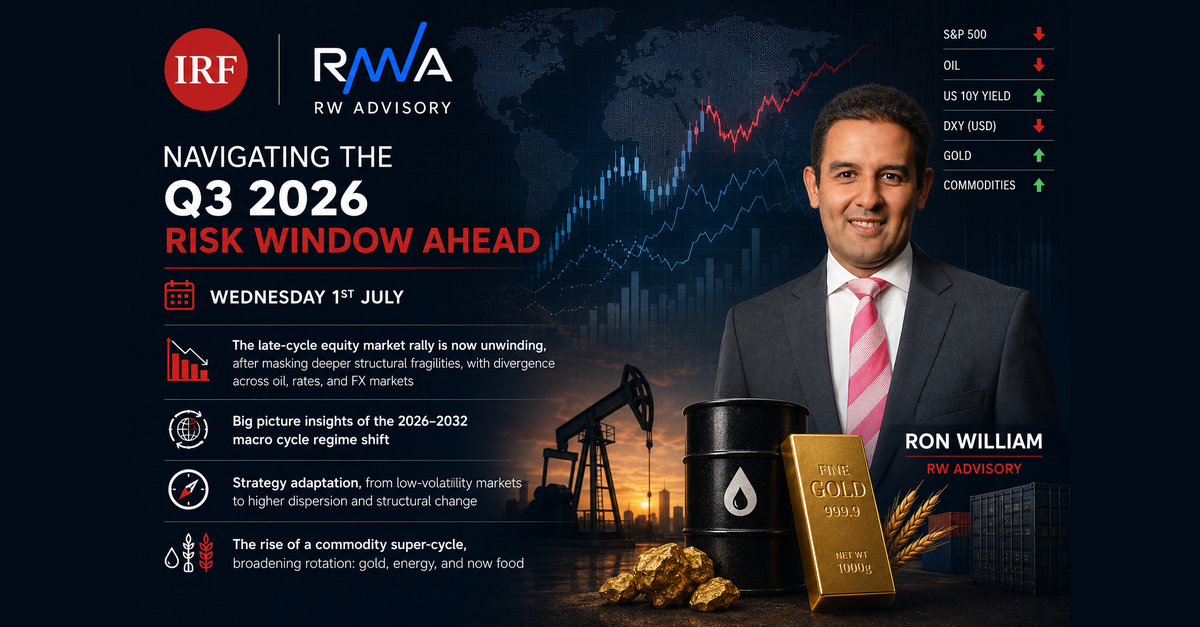
Navigating the Q3 Risk Window Ahead
RW Advisory
Wed 08 Jul 2026 - 15:00
Summary
Ron William argued that markets have been “shaken, not yet stirred,” meaning recent geopolitical shocks have increased volatility without yet triggering a full structural bear market. His central thesis is that markets are entering a period of regime change driven by the convergence of several long-term economic, financial and geopolitical cycles, with volatility expected to increase through the second half of 2026 and into 2027. William expects a renewed bout of market turbulence during Q3 2026, identifying July–August and again from November as key inflection points. He believes the strong post-oil-shock equity rally has become overextended, particularly in US and Asian markets, with the S&P 500 approaching an important technical risk level. Rather than forecasting an immediate bear market, he anticipates rolling corrections and tactical trading opportunities. A major focus was his long-term cycle framework, which combines business, investment, inflation and generational cycles. William argues that the rare alignment of these cycles between 2026 and 2032 historically corresponds with periods of financial instability, geopolitical tension and structural economic transformation, comparable to previous major historical resets. From an investment perspective, he remains constructive on commodities, particularly energy and precious metals. He believes the commodity supercycle remains intact, with energy markets likely to experience renewed volatility and higher prices following recent corrections. Gold continues to be recommended as a strategic portfolio diversifier despite near-term weakness, while agricultural commodities may benefit from rising inflationary pressures. On currencies, William expects the US dollar to remain dominant in the near term but gradually weaken over the longer run as a more multipolar global financial system emerges. Overall, he advocates active portfolio management, tactical risk controls and diversified exposure to real assets to navigate what he sees as an extended period of structural change, heightened volatility and shifting global leadership
Topics
Navigating the Q3 2026 risk window across key macro markets
Big picture insights of the 2026–2032 macro cycle regime shift
Strategy adaptation, from low-volatility markets to higher dispersion and structural change
The rise of a commodity super-cycle, broadening rotation: gold, energy, and now food
Live market review & questions