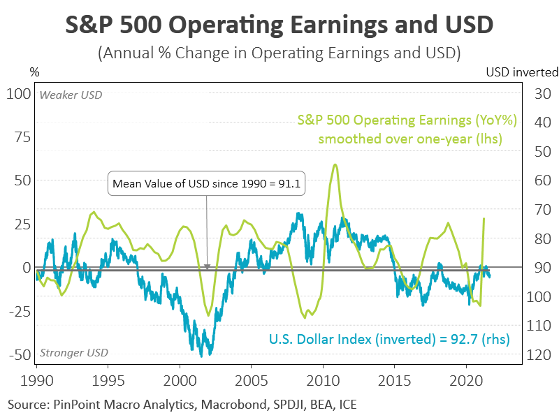
Chart of the fortnight: USD to rise, S&P500 earnings to fall
The depreciation of USD played a helpful part in lifting S&P500 operating earnings to their highest annual growth in a decade in H1/2021. Looking forward, the USD is close to its four-decade average and will modestly appreciate as the Fed commences tapering. Richard Grace believes the positive impact the USD played on S&P500 earnings won’t be sustained, and we will see a lower average rate of growth in S&P500 earnings throughout 2021.
Is a collapse in the US economy imminent?
Jeff Christian discusses the state of the US economy - he addresses the real concerns we face and contrasts economic realities with the constant warnings of imminent economic collapse. Watch here.
US: Beware the Fiscal Cliffers!
Report by
MRB Partners
MR
Concerns that the US is approaching a fiscal cliff are misplaced. Fiscal policy won’t be a drag in 2022 and will in fact still be providing stimulus to the economy. It’s crucial to note that government transfers to the private sector are not directly counted in GDP, but rather only when the funds are actually spent. The huge pool of household savings sitting in cash will be spent over time as consumers feel more confident and spur greater investment and consumption with a long lag.
US: Don’t be fooled by Powell’s platitudes
Report by
Macro Intelligence 2 Partners
Powell’s Friday speech was greeted with predictable jubilation in risk markets, but Julian Brigden claims that equities have overlooked the fact that the balance sheet is also a significant and much more imminent threat to lofty valuations than interest rates. If anything, signalling further hike delays increases the odds of the Fed needing to taper PDQ to arrest economic trends. There’s also the fact that, as credible as Chair Powell is, the Fed is trying to run it hot, and his job is to play it down regardless of the economic reality.
The 3 R’s: Recovery, Relocation and Resilience
Report by
Llewellyn Consulting
LL
In the face of rapidly changing supply and demand, structural policies are more crucial now than ever before. In Preston Llewellyn’s latest report, he ranks countries’ supply-side policies. Key takeaways include Denmark coming on top with Finland and Sweden in the top ten; Japan being the one economy that is consistently in the top 10; and, surprisingly, the UK coming in second place, largely due to its strong showing in product market regulation.
Uncertainties about the formation of the next German government
Report by
Forefront Advisers
FO
The upcoming coalition government talks will prove more complex than ever with a deal possibly taking months to secure. In an unprecedented situation, we will see all of the real kingmakers – the parties needed for all plausible coalitions – hold talks with all potential partners, but internal struggles pose a looming threat to some deals being made.
Is the Bank of Japan being overwhelmed?
Only six months ago it appeared that the BoJ was set to allow yields to rise in the economy. However, yields have recently declined despite a sharp slowdown in the Bank’s purchases of bonds. It seems that the BoJ may be struggling to hold yields up, even as monetary growth decelerates. Andrew Hunt believes the excessive levels of global liquidity / weakness in the economy – and perhaps that in the PRC – is beginning to overwhelm even the BoJ’s ability to influence domestic markets.